
ASEAN
Southeast Asia’s 2026 Economic Outlook: 8 Key Opportunities (and Risks) Reshaping the Region

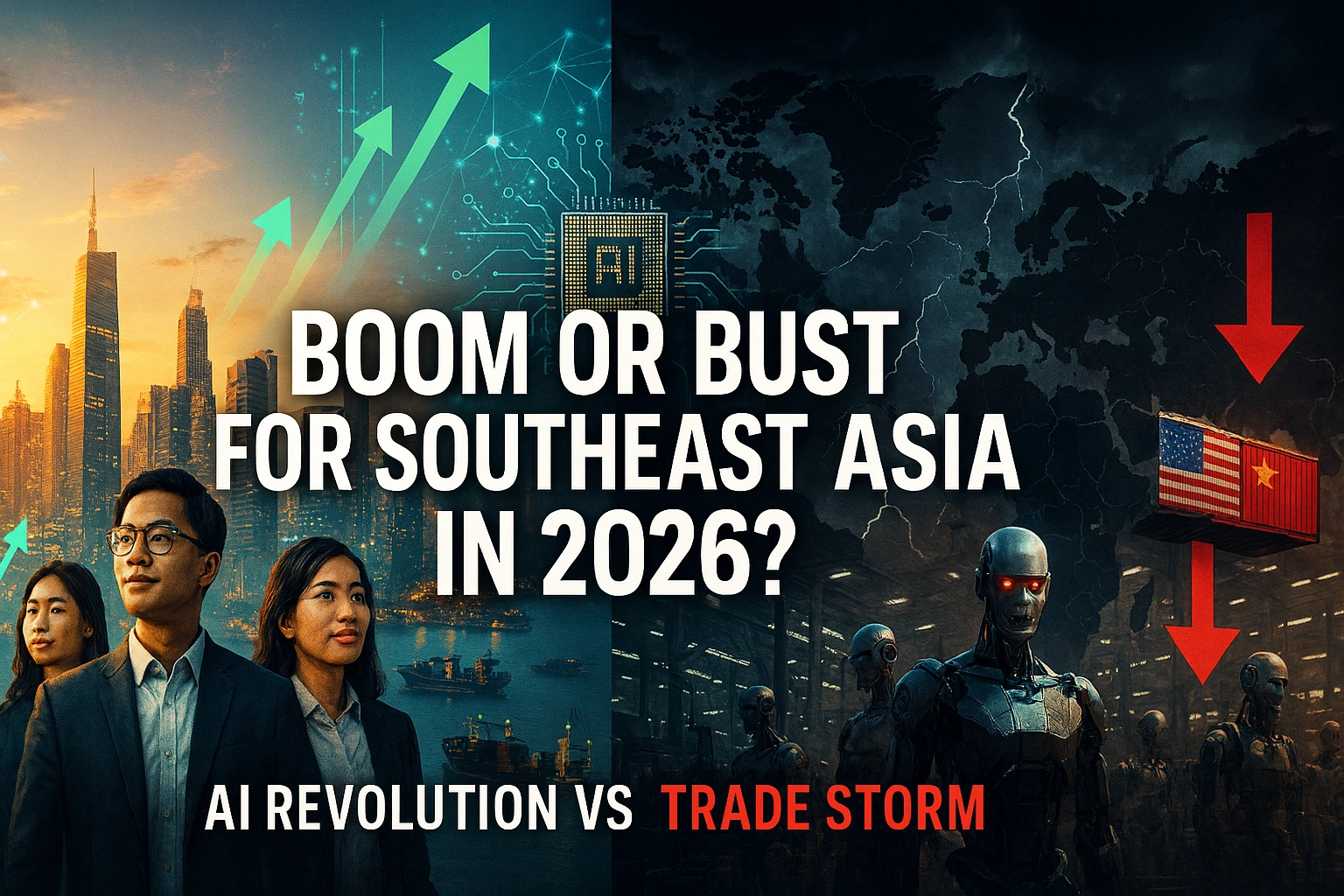
In the plush conference rooms of Davos this January, a question hung in the air above every discussion of Southeast Asia: Is ASEAN moving fast enough? The region stands at a crossroads where artificial intelligence promises productivity gains, yet threatens job displacement; where trade tensions create diversification opportunities, yet expose supply chain vulnerabilities; where digital transformation could unlock trillions in value, yet widens inequality if poorly managed.
At the World Economic Forum panel moderated by The Straits Times, Thailand’s Deputy Prime Minister Ekniti Nitithanprapas sketched three “mega shifts” dominating the global conversation: geopolitics, AI transformation, and climate change. Indonesia’s Digital Affairs Minister Meutya Viada Hafid pushed back on the speed question itself, noting that for a nation of 280 million people across 17,000 islands, pace cannot be separated from inclusivity. Meanwhile, Asian Development Bank President Masato Kanda acknowledged that while AI offers significant productivity gains, it carries social risks if not managed carefully.
The tension is palpable. Southeast Asia’s 670 million people and $3.8 trillion economy represent one of the world’s most dynamic growth stories, yet the region faces unprecedented challenges. On one hand, companies like Indonesia’s Kopi Kenangan—which grew from a single Jakarta storefront in 2017 to over 1,200 locations and unicorn status—demonstrate the entrepreneurial dynamism coursing through ASEAN markets. The coffee chain’s CEO Edward Tirtanata epitomizes a generation of founders leveraging mobile-first commerce and localized AI-powered operations to scale rapidly across borders.
On the other, the numbers tell a more nuanced story. The Asian Development Bank’s December 2025 outlook projects Southeast Asia’s GDP growth at 4.5% in 2025 and 4.4% in 2026—revised upward from earlier forecasts, but down from the 4.7% originally anticipated for both years. The IMF’s January 2026 World Economic Outlook maintains global growth at 3.3% for 2026, while the World Bank’s latest projections for East Asia and the Pacific region show growth slowing to 4.4% in 2026 and 4.3% in 2027.
Behind these aggregate figures lies extraordinary heterogeneity. Vietnam’s growth is expected at 6.0% in 2026, driven by robust exports and technology-led manufacturing. Indonesia anticipates 5.1% growth, supported by domestic consumption and strategic positioning in AI-era mineral supply chains. Singapore, having grown 5.7% year-on-year in Q4 2025, faces moderation but remains Southeast Asia’s AI investment hub. Meanwhile, the Philippines confronts infrastructure bottlenecks, and Malaysia navigates semiconductor sector opportunities alongside automotive tariff pressures.
The region’s diversity—once seen as a weakness—is increasingly viewed as a strategic asset. At Davos, panelists emphasized ASEAN’s neutrality and growing resilience as advantages in a fragmenting global order. As Jaime Ho, editor of The Straits Times, noted, middle powers benefit from alliances with like-minded nations rather than becoming client states of superpowers. Singapore, Ho observed, has “possibly been the best at this”—maintaining deep economic ties with China while serving as America’s closest military ally in the region.

Yet moving forward requires Southeast Asia to confront eight critical dynamics that will determine whether 2026 marks an inflection point toward shared prosperity or deepening fragmentation. These opportunities and risks—from AI-driven productivity to geopolitical escalation—demand policy agility, private sector adaptability, and regional coordination at a scale the bloc has rarely achieved. The stakes could not be higher: get it right, and ASEAN could capture a disproportionate share of 21st-century growth; get it wrong, and the region risks falling behind in the very technologies and trade relationships that will define competitiveness for decades.
1. How AI Can Supercharge Southeast Asia’s Productivity in 2026
The productivity multiplier that could redefine regional competitiveness
Artificial intelligence is no longer a distant promise for Southeast Asia—it’s actively reshaping how businesses operate, governments deliver services, and consumers interact with the digital economy. In 2026, AI adoption is accelerating at unprecedented speed, with ASEAN+ enterprises planning to increase AI spending by 15% on average, covering generative AI, agentic AI, cloud-based services, and on-premises infrastructure.
The opportunity is staggering. Singapore alone is investing S$270 million (approximately $200 million) in next-generation supercomputing infrastructure, with the National Supercomputing Centre’s ASPIRE 2A+ system harnessing NVIDIA H100 GPUs to deliver 20 PetaFLOPS of compute power. The city-state’s AI market is projected to grow from $1.05 billion in 2024 to $4.64 billion by 2030—a 28.10% compound annual growth rate. For generative AI specifically, growth is even more dramatic: from $0.52 billion to $5.09 billion, representing a stunning 46.26% CAGR.
This investment is translating into tangible gains. Financial institutions are leading the charge: OCBC Bank now makes 6 million AI-powered decisions daily, targeting 10 million by 2025, while deploying OCBC GPT to all 30,000 employees globally. In manufacturing, Vietnam’s electronics sector is using AI to optimize quality control and supply chain logistics, contributing to the country’s emergence as a critical node in semiconductor production. Malaysia’s electrical and electronics sector—accounting for roughly 40% of total exports—is integrating AI across design, testing, and production processes.
The regional AI ecosystem is maturing rapidly. Singapore is developing SEA-LION (Southeast Asian Languages in One Network), an open-source large language model trained on 11 regional languages including Malay, Thai, Vietnamese, and Indonesian. By 2026, SEA-LION is expanding to 30-50 billion parameters with text-to-image and text-to-speech capabilities, specifically designed to handle the low-resource languages and context-switching essential in Southeast Asia’s multilingual societies. This contrasts sharply with English-centric models that often fail to capture regional nuance.
The business case is compelling. According to Salesforce’s 2026 predictions, 94% of customers who observe an AI agent in a chat window engage with them, while monthly interactions between employees and AI agents grew by 65% in the first half of 2025. The Philippines is positioning itself to evolve from a service-oriented economy into a knowledge-driven innovation hub through AI-enhanced productivity. Indonesia’s Kopi Kenangan attributes its rapid expansion—opening one store per day—partly to AI-driven demand forecasting, inventory optimization, and mobile-first ordering systems where 70% of transactions flow through AI-enhanced apps.
Infrastructure is scaling to match ambition. The J.P. Morgan Private Bank 2026 Asia Outlook notes that Asia-Pacific is on track to become the world’s largest data center market before 2030, with Singapore maintaining the lowest vacancy rate in the region at just 1.4% while deploying an additional 80MW capacity between 2026 and 2028. Malaysia and Thailand are rapidly expanding data center infrastructure to support AI workloads, with Google signing solar power purchase agreements in Malaysia specifically to supply regional data center operations.
The productivity gains extend beyond high-tech sectors. In agriculture, Thai farmers are using AI-powered analytics to optimize crop yields and predict pest outbreaks. Vietnamese logistics companies employ machine learning to reduce delivery times and fuel costs. Indonesian fintech platforms leverage AI for credit scoring in populations traditionally underserved by banks, expanding financial inclusion while managing risk.
Yet the opportunity demands coordinated action. The January 2026 Hanoi Digital Declaration, adopted at the 6th ASEAN Digital Ministers’ Meeting, commits member states to “accelerate Digital Economy Integration through development of interoperable Digital Public infrastructure” and “leveraging AI and digital analytics to anticipate emerging skill needs.” Japan has joined this effort, pledging cooperation on AI model co-development and comprehensive AI governance frameworks tailored to regional priorities.
The evidence is clear: AI represents Southeast Asia’s most significant productivity opportunity in a generation. Countries that successfully deploy AI across sectors—from manufacturing to services to agriculture—while simultaneously developing local talent and infrastructure will capture disproportionate economic gains in 2026 and beyond.
2. Job Displacement Risks in Manufacturing: The Dark Side of Automation
When efficiency gains create human costs
While AI promises productivity gains, it simultaneously threatens to displace millions of workers across Southeast Asia’s manufacturing heartland. The World Economic Forum projects that almost 40% of existing skillsets will be transformed or made obsolete by 2030—a transition compressed into just four years that could leave swaths of workers behind.
The risk is particularly acute in labor-intensive manufacturing sectors that have defined ASEAN’s export success. Vietnam’s textiles and garments industry, employing millions, faces automation pressures as global brands demand faster turnaround times at lower costs. Cambodia’s 800,000 garment workers—the backbone of the nation’s economy—confront similar threats. In Thailand, factory closures are already emerging: over 2,000 facilities shut down in 2025, partly due to floods of cheap Chinese imports but also reflecting automation trends that reduce labor needs.
The numbers are sobering. According to World Bank analysis, while most jobs exposed to AI are complementary rather than substitutable (only 7% face direct displacement risk), the concentrated impact on specific sectors and demographics creates severe adjustment challenges. Workers in repetitive assembly, quality control inspection, and basic data entry face the highest displacement probability. These tend to be lower-skilled, lower-wage positions disproportionately held by women and rural migrants—populations with fewer resources to retrain or relocate.
Indonesia illustrates the complexity. As the country positions itself as a critical supplier of nickel for AI-era batteries and semiconductors, traditional mining employment patterns are shifting. Automated extraction and processing require fewer workers with different skillsets, potentially displacing communities that have depended on resource extraction for generations. President Prabowo Subianto’s ambitious 8% annual growth target relies heavily on industrial expansion, yet achieving this through automation could create a political backlash if job creation lags.
The Philippines faces a distinct challenge. Long positioned as the world’s call center capital, employing over 1.3 million in business process outsourcing, the nation now confronts AI-powered chatbots and natural language processing systems that can handle routine customer service inquiries more efficiently than human agents. While higher-value analytical and creative roles remain secure, entry-level positions—traditionally a pathway to middle-class stability for college graduates—are eroding.
Malaysia’s experience offers both warning and hope. The country’s manufacturing sector has been investing in automation for years, particularly in electronics. Initially, this displaced workers, but over time, the transition created demand for technicians, engineers, and specialists who maintain and program automated systems. The key difference: significant investment in technical education and retraining programs. Workers who could transition to higher-skilled roles found opportunities; those who couldn’t faced prolonged unemployment or precarious informal work.
Singapore’s approach provides a potential model. The government’s SkillsFuture initiative provides subsidies and programs for continuous reskilling, while the TIP Alliance has secured 800+ tech job commitments for polytechnic graduates. Companies like AWS commit to training 5,000 individuals annually through 2026, while Microsoft’s Asia AI Odyssey targets 30,000 developers across ASEAN. Remarkably, 81% of Singapore businesses plan to increase AI training investment in the next 6-12 months.
Yet Singapore’s per capita resources and small population make its programs difficult to replicate at Indonesia’s or Vietnam’s scale. The challenge intensifies in countries with large rural populations, limited social safety nets, and education systems ill-equipped to deliver rapid reskilling. The risk is not merely economic but political: displaced workers fuel populist movements, protectionist policies, and social unrest that could derail the very reforms needed to sustain competitiveness.
The ADB’s December 2025 outlook explicitly warns that “AI offered significant productivity gains but also carried social risks if not managed carefully.” Indonesia’s Digital Affairs Minister Hafid emphasized at Davos that inclusion cannot be separated from speed—a recognition that leaving populations behind creates instability that ultimately slows development.
The path forward requires unprecedented coordination between governments, businesses, and educational institutions. Countries must simultaneously embrace automation to remain competitive while investing massively in retraining programs, strengthening social safety nets, and creating new employment pathways. Those that succeed will harness AI’s productivity gains without fracturing their societies. Those that fail risk social instability that could undermine decades of development progress.
3. Trade Diversion from US-China Tensions: ASEAN’s Unexpected Windfall
How geopolitical rivalry is reshaping supply chains in Southeast Asia’s favor
The US-China trade war, far from ending, has intensified into a defining feature of the global economic landscape—and Southeast Asia is emerging as the primary beneficiary. What began as tariff skirmishes has evolved into fundamental supply chain reconfiguration, with ASEAN positioned at the center of a massive reallocation of manufacturing capacity and foreign direct investment.
The numbers tell the story. According to Al Jazeera’s analysis of census data, Vietnam’s US trade deficit for goods rose more than $20 billion—from $123.4 billion in 2024 to $145.7 billion in 2025—despite facing a 20% reciprocal tariff. This isn’t simply Chinese goods being rerouted through Vietnam (though that occurs); rather, there’s been “a more fundamental reconfiguration of supply chains,” with ASEAN importing more machinery and intermediate goods from China for production of electronics and consumer goods ultimately destined for US markets.
The tariff architecture creates clear winners and losers within ASEAN. The Lowy Institute’s detailed analysis reveals that while headline reciprocal tariff rates appear devastating—Cambodia, Malaysia, the Philippines, Thailand, and Indonesia all face 19% tariffs, Vietnam 20%—effective tariff rates tell a different story. Malaysia faces only an 11% effective rate (compared to 0.6% in 2024) because approximately half its exports are electronics products currently exempt from reciprocal tariffs. Singapore, the Philippines, Thailand, and Vietnam enjoy similar advantages.
The strategic implication is profound: major ASEAN economies have seen their tariff advantage over China in the US market increase significantly. While China faces combined tariffs exceeding 60% on many products, ASEAN nations maintain market access at substantially lower rates. This differential is driving unprecedented investment flows.
HSBC believes that after years of subdued foreign direct investment, US-China trade tensions have been “a game-changer for the whole ASEAN region.” The ASEAN-6 (Indonesia, Malaysia, the Philippines, Singapore, Thailand, and Vietnam) now captures 14.5% of global FDI—with 65% flowing to Singapore, which serves as both manufacturing hub and regional headquarters location. The city-state’s 10% baseline tariff (lower than most Asian peers) combined with its sophisticated financial services and logistics infrastructure makes it a magnet for companies diversifying from China.
Vietnam has emerged as the clearest beneficiary. The country increasingly functions as a “connector economy,” facilitating trade flows between the US and China. As corporations diversify production away from China, Vietnam absorbs manufacturing activity tied to US end-demand while continuing to source intermediate inputs from China. Samsung, Nike, Intel, and dozens of other multinationals have expanded Vietnamese operations, creating a sophisticated electronics and consumer goods manufacturing ecosystem. The country’s 6.7% growth projection for 2025 and 6.0% for 2026 reflects this momentum.
Indonesia plays a more upstream but increasingly critical role. As the world’s largest nickel producer (59% of global production), Indonesia is positioning itself at the heart of the AI-era battery and semiconductor supply chains. The country’s 79% commodity export composition increasingly aligns with digital economy needs, transforming it from a raw materials supplier to a strategic contributor to the global AI ecosystem. President Prabowo’s administration is leveraging this advantage, with the IMF raising Indonesia’s 2026 growth forecast to 5.1%.
Malaysia’s semiconductor sector offers another compelling case. With electronics and electrical components accounting for 40% of exports (semiconductors comprising 65% of that), Malaysia has captured significant investment from firms diversifying from concentration risks in Taiwan and China. The country’s mature industrial base, skilled workforce, and strategic location make it an attractive alternative. The Star reports that Singapore’s HSBC economist Yun Liu sees diversification as key to the city-state’s manufacturing outperformance, with transport engineering growing at double-digit pace.
The regional coordination response is noteworthy. Rather than compete destructively, ASEAN is moving toward collective engagement. The bloc’s 10 April 2025 joint statement rejected retaliation against US tariffs, opting instead for dialogue. The May 2025 conclusion of ASEAN Trade in Goods Agreement negotiations aims to achieve free flow of goods among member states, creating greater economies of scale. Meanwhile, the ASEAN-China Free Trade Area 3.0 negotiations concluded in May 2025, with China positioning itself as a reliable economic partner in contrast to US volatility.
The European Union has responded by concluding new free trade deals with Indonesia, Mexico, and Mercosur, while exploring enhanced cooperation with Malaysia, the Philippines, and Thailand. The Comprehensive and Progressive Agreement for Trans-Pacific Partnership (CPTPP) already includes Singapore, Malaysia, Vietnam, and Brunei, with Indonesia and the Philippines having applied for membership. This web of agreements provides ASEAN with diversified market access that reduces dependence on any single partner.
Yet the opportunity demands careful navigation. Glen Hilton of DP World observes that companies are adopting “China Plus Many”—spreading operations across multiple countries to reduce risks and enhance agility. ASEAN must ensure that this diversification benefits the region as a whole rather than creating zero-sum competition among member states. The key is regional integration that turns ASEAN’s 670 million people into a unified market attractive to global capital.
Trade diversion from US-China tensions represents perhaps the most significant near-term opportunity for ASEAN. Countries that successfully attract investment, build sophisticated manufacturing ecosystems, and integrate into global value chains will capture decades of prosperity. The window is open in 2026—but it may not remain open indefinitely.
4. Supply Chain Vulnerabilities: The Hidden Risks of Rapid Diversification
Why becoming the alternative to China exposes ASEAN to new fragilities
The very trade diversion that represents opportunity also creates profound vulnerabilities. As Southeast Asia absorbs manufacturing capacity fleeing China and US tariff pressures, the region is discovering that supply chain diversification is neither simple nor without cost. The risks emerging in 2026 threaten to undermine the gains from increased investment and trade.
The Chinese dependency paradox is stark. Even as manufacturing shifts to ASEAN, these new production hubs remain heavily reliant on Chinese inputs and capital goods. J.P. Morgan’s analysis is unequivocal: “Even as some manufacturing shifts to ASEAN and India, these new hubs remain heavily reliant on Chinese inputs and capital goods, reinforcing China’s central role in global trade.” Southeast Asian economies are benefiting from supply chain diversification, but their rising exports are matched by sizable trade deficits with China.
Vietnam exemplifies this dependency. While the country has become a major electronics exporter to the US, it imports vast quantities of components, machinery, and intermediate goods from China. When Chinese supply chains experience disruption—whether from COVID-style lockdowns, power shortages, or policy shifts—Vietnamese manufacturers feel immediate impact. The relationship is symbiotic but asymmetric: Vietnam needs Chinese inputs more urgently than China needs Vietnamese assembly capacity.
The “dumping” crisis reveals another vulnerability. As US tariffs shut Chinese goods out of American markets, these products must find alternative destinations. Southeast Asia, with its relatively open markets and proximity to China, becomes a natural outlet. Thailand’s experience is instructive: the country saw over 2,000 factory closures in 2025 partly due to a flood of cheap Chinese steel and other goods that undercut local producers. Asia Society analysis warns that Chinese industrial overcapacity—especially in sectors like steel, chemicals, and solar panels—threatens to devastate Southeast Asian manufacturers who cannot compete on price.
ASEAN governments are responding with anti-dumping measures. Vietnam and Indonesia have imposed tariffs on specific Chinese goods; Thailand recently announced monitoring mechanisms for cheap imports. But enforcement is challenging, and domestic constituencies differ on the appropriate response. Consumers benefit from lower prices, while manufacturers demand protection. Export-oriented firms fear Chinese retaliation against their products. This creates political complexity that delays effective action.
Infrastructure constraints compound the challenge. The Asian Development Bank estimates that Southeast Asia’s power generation and transmission infrastructure needs $764 billion in investment to support planned economic expansion and renewable energy integration. Current grid systems, developed for centralized fossil fuel generation, struggle to accommodate variable renewable energy at scale. Vietnam’s power grid is already under strain from rapid solar and wind deployment, with the government estimating $18 billion needed by 2030 just to upgrade transmission equipment—yet funding committed so far covers only a fraction.
This infrastructure deficit directly impacts manufacturing competitiveness. Companies relocating from China seek reliable, affordable power; if ASEAN cannot deliver, they’ll look elsewhere. Data centers supporting AI workloads require massive, consistent electricity supply. Thailand’s regulators approved a 2GW Direct Power Purchase Agreement pilot for data centers launching in January 2026, but matching infrastructure to demand remains an ongoing struggle across the region.
Geopolitical risk layering creates additional uncertainty. The US has explicitly targeted “transshipment” from third countries, threatening 40% levies on products produced in Vietnam with significant Chinese content. Sidley Austin’s legal analysis notes that deals with both Vietnam and Indonesia include commitments to strengthen rules of origin to ensure third countries (particularly China) don’t gain from bilateral agreements. This creates compliance burdens and uncertainty for manufacturers trying to navigate complex regulations.
The US-China technology competition adds another layer. As Washington pressures allies to restrict Chinese access to advanced semiconductors, AI chips, and critical technologies, ASEAN countries face difficult choices. Singapore’s inclusion in the Pax Silica agreement—the US’s AI “inner circle”—reflects its strategic positioning but also creates expectations of alignment that may conflict with economic relationships with China. Malaysia, Thailand, and Vietnam must balance security partnerships with economic pragmatism.
Regional coordination remains underdeveloped. While ASEAN has concluded negotiations on trade agreements and digital frameworks, implementation lags. The Digital Economy Framework Agreement (DEFA), if fully implemented by 2026, could expand the region’s digital economy toward $2 trillion by 2030. Yet the agreement requires harmonizing regulations, establishing interoperable systems, and coordinating policies across ten diverse nations—a herculean task. Malaysia’s share of intra-ASEAN consumer exports has dropped sharply, illustrating how countries often pursue national interests over regional integration.
The COVID-19 pandemic revealed how quickly global supply chains can fragment when crisis strikes. ASEAN’s integration into these chains without adequate buffers, redundancy, or regional self-sufficiency creates vulnerability to future shocks. Whether the next disruption comes from pandemic, climate disaster, military conflict, or financial crisis, Southeast Asia’s exposure is significant.
The paradox of 2026 is that ASEAN’s greatest opportunity—becoming the alternative to China-centric supply chains—simultaneously exposes the region to dependencies, dumping, infrastructure constraints, and geopolitical pressures that could undermine the very competitiveness the region seeks to build. Navigating this requires not just attracting investment but developing resilience through infrastructure investment, regional coordination, and careful balancing of great power relationships.
5. Digital Economy Boom: ASEAN’s $2 Trillion Opportunity
How mobile-first innovation and fintech are transforming everyday life
While headlines focus on manufacturing and trade, Southeast Asia’s most transformative economic story in 2026 may be the explosive growth of its digital economy—an ecosystem encompassing e-commerce, fintech, online media, digital services, and increasingly, the platforms that underpin daily life for hundreds of millions of people.
The Digital Economy Framework Agreement (DEFA), which ASEAN leaders are poised to sign in 2026, could expand the region’s digital economy toward $2 trillion by 2030 according to ASEAN Secretariat projections. Indonesia’s Minister Hafid described DEFA as “not only a trade agreement among ASEAN countries, but an operating system” that allows technologies from different countries to work together. This represents ASEAN’s attempt to operationalize strategic autonomy in the digital domain—a recognition that regional cooperation on data flows, cybersecurity, digital identity, and cross-border payments is essential to capture the full value of digitalization.
The mobile-first revolution is already well advanced. ASEAN famously leapfrogged the PC era to become mobile-first, with smartphone penetration exceeding 70% among the region’s over 213 million people aged 14 to 34. More than 90% of Southeast Asian shoppers use AI-powered recommendations when buying online. This digital-native population creates massive opportunities for platforms that can deliver seamless, localized services.
Indonesia’s QRIS (QR Code Indonesian Standard) payment system exemplifies this potential. The system has expanded digital payments nationwide and is now interoperable with systems in Thailand, Malaysia, and other countries, allowing cross-border transactions using local payment apps. This kind of infrastructure—developed regionally rather than imported from Silicon Valley or Shenzhen—gives ASEAN control over critical digital plumbing while ensuring that value created stays within the region.
Fintech is democratizing financial services. Traditional banking has left hundreds of millions of Southeast Asians underserved or excluded entirely. Digital lenders, mobile wallets, and app-based banks are filling this gap. Companies like Grab, Gojek, and Sea Group have evolved from ride-hailing and e-commerce into financial services powerhouses, offering loans, insurance, and investment products to populations that have never held traditional bank accounts.
The implications extend beyond convenience. Small businesses that once struggled to access credit can now get microloans approved in minutes based on AI-powered analysis of transaction data. Rural farmers can receive payments instantly rather than traveling to distant bank branches. Migrant workers send remittances home at a fraction of traditional costs. This financial inclusion drives economic growth while reducing inequality.
Singapore’s leadership in fintech regulation creates spillover benefits for the region. The Monetary Authority of Singapore’s Veritas Framework promotes responsible AI use following FEAT principles (Fairness, Ethics, Accountability, and Transparency). The PathFin.ai initiative launched in July 2025 supports collaborative AI knowledge sharing among financial institutions. MAS’s S$100 million FSTI 3.0 enhancement specifically targets quantum and AI technologies. This regulatory clarity attracts investment while setting standards that other ASEAN nations can adapt.
E-commerce continues explosive growth. The region’s e-commerce market, already one of the world’s fastest-growing, is expanding as infrastructure improves and trust in online transactions deepens. Lazada, Shopee, Tokopedia, and other platforms have transformed retail, especially during COVID-19 when physical commerce contracted. The shift is structural, not cyclical: consumers who experienced the convenience and variety of online shopping aren’t returning entirely to traditional retail.
This growth creates opportunities throughout the value chain. Logistics companies invest in last-mile delivery infrastructure. Small merchants gain access to national and regional markets. Content creators monetize followers through live-streaming commerce. The multiplier effects ripple through the economy.
The creator economy and digital services represent another frontier. Southeast Asia’s young, creative population is producing content, building brands, and monetizing attention across social media platforms. Indonesian, Thai, and Filipino influencers command millions of followers. Vietnam’s tech-savvy developers are building apps and games for regional and global markets. The Philippines’ call center expertise is evolving into higher-value virtual assistance, graphic design, and digital marketing services delivered remotely to clients worldwide.
Salesforce predicts that 2026 will see breakthroughs in localized AI, with more large language model options tailored to Southeast Asia’s unique linguistic and cultural contexts. This enables businesses to build customer service bots, content generation tools, and analytics platforms that actually understand regional languages and cultural nuances—a massive improvement over English-centric models that frequently miss context.
The business models emerging from ASEAN are distinctly regional. Unlike Silicon Valley’s “move fast and break things” ethos or China’s surveillance-capitalist model, Southeast Asian digital platforms emphasize practicality, affordability, and local customization. Kopi Kenangan’s hyperlocal approach means lattes taste different in Singapore than Indonesia, calibrated to local preferences through data analysis. Grab and Gojek bundle services—ride-hailing, delivery, payments, insurance—in ways that reflect the daily rhythms of Southeast Asian life.
The January 2026 Hanoi Digital Declaration commits ASEAN to “promoting paperless and seamless digital trade” and “strengthening a safe, secure, and trusted cyberspace.” The agreement recognizes that the digital economy’s full potential requires coordinated action on standards, interoperability, and security—not just individual national efforts.
Yet realizing the $2 trillion vision demands addressing persistent challenges: uneven internet connectivity, digital literacy gaps, cybersecurity threats, data governance disputes, and the risk that regulatory fragmentation creates barriers rather than opportunities. Malaysia’s leadership as 2025 ASEAN chair emphasized the need for bold economic integration beyond “business-as-usual.” The digital economy’s trajectory in 2026 will test whether ASEAN can deliver.
The opportunity is clear: ASEAN’s digital economy could become the region’s most important competitive advantage, creating inclusive growth that reaches beyond traditional manufacturing hubs into every corner of Southeast Asia. Success requires infrastructure investment, regulatory harmonization, and a commitment to ensuring that digital transformation benefits the many, not just the few.
6. Geopolitical Escalation Risks: When Great Power Competition Turns Hot
The scenarios that could derail Southeast Asia’s growth story
Beneath 2026’s economic opportunities lurks a darker possibility: that geopolitical tensions escalate from economic competition to military confrontation or political instability that fundamentally disrupts ASEAN’s development trajectory. While most forecasts assume continued stability, the risks are significant and growing.
The South China Sea remains a flashpoint. Despite periodic diplomatic efforts to establish a Code of Conduct, territorial disputes among China, Vietnam, the Philippines, Malaysia, and Brunei persist. China’s island-building and militarization continue; the Philippines under President Marcos has strengthened defense ties with the United States; Vietnam maintains wary independence while modernizing its military. A miscalculation—a collision at sea, an overzealous commander, domestic political pressure demanding strong response—could spark confrontation that cascades beyond control.
The economic implications would be severe. The South China Sea hosts some of the world’s busiest shipping lanes; roughly one-third of global maritime trade transits the area. Disruption would immediately affect supply chains, insurance costs, and energy flows. Countries dependent on seaborne trade—essentially all of ASEAN—would face economic shock regardless of whether they’re directly involved in conflict. Financial markets would recoil, capital would flee to safety, and development projects would stall as uncertainty freezes decision-making.
Taiwan represents the ultimate geopolitical wild card. While forecasting scenarios is beyond this analysis’s scope, escalation around Taiwan would impact ASEAN more severely than any other region except Northeast Asia. As Fortune notes, Taiwan produces the majority of the world’s advanced semiconductors; any conflict would immediately halt production and potentially destroy fabrication facilities that cannot be quickly replaced. ASEAN economies heavily dependent on semiconductor imports—Malaysia, Singapore, Thailand, Vietnam—would face supply shortages that halt downstream manufacturing.
Moreover, conflict would force ASEAN nations into impossible choices about alignment. Singapore’s inclusion in Pax Silica signals US partnership; would this require participation in sanctions or enforcement actions? Would China demand that ASEAN remain neutral or face economic consequences? Can the bloc maintain cohesion if members face contradictory pressures from great powers? The strategic ambiguity that has served ASEAN well in peacetime becomes liability when great powers demand clarity.
Domestic political instability within ASEAN adds another layer of risk. Myanmar’s ongoing civil conflict shows no signs of resolution; the country’s 2025 growth forecast was cut sharply to -3.0% following the March earthquake that deepened existing instability. While Myanmar is relatively small economically, its strategic location bordering China, India, Bangladesh, Thailand, and Laos means prolonged chaos creates spillover effects: refugee flows, smuggling routes, and opportunities for extremist groups.
The Philippines faces its own challenges, with weak public infrastructure investment hampering growth and political investigations disrupting governance. Indonesia’s ambitious development plans under President Prabowo require political stability and policy continuity; if these falter, the nation’s 280 million people and strategic location become sources of regional instability rather than growth. Thailand’s history of military coups and political polarization remains a concern despite current stability.
The climate-security nexus intensifies risks. Southeast Asia is among the world’s most vulnerable regions to climate change: rising seas threaten coastal populations and infrastructure; changing rainfall patterns affect agriculture; extreme weather events increase in frequency and severity. These environmental stresses create resource competition (especially over water), force migration, and strain government capacity to respond.
The Lowy Institute warns that geopolitical tensions and the persistence or escalation of conflicts pose significant risks to the regional outlook. The ADB’s December 2025 forecast explicitly states that “geopolitical pressures and weakness in the People’s Republic of China’s property market could also weigh on the region’s growth outlook.”
The Ukraine precedent looms large. Russia’s invasion demonstrated how quickly geopolitical assumptions can shatter, with cascading effects on energy markets, food security, and defense spending worldwide. If great power conflict emerges in Asia, the economic and humanitarian consequences would dwarf Ukraine given the region’s larger populations, deeper economic integration, and critical role in global supply chains.
Business Today’s coverage of Davos 2026 captured the prevailing sentiment: “Nobody really wants to be a client state either of the United States or of China.” Yet this desire for autonomy becomes difficult to maintain when great powers demand alignment. ASEAN’s diversity and neutrality—advantages in peacetime—become sources of tension when members face contradictory pressure.
The probability of major conflict remains low; most analysts expect continued competition below the threshold of armed confrontation. But low probability does not mean no probability, and the consequences of escalation would be catastrophic for Southeast Asia’s development prospects. The region’s economic planning for 2026 assumes geopolitical stability—an assumption that, if wrong, would invalidate growth forecasts and investment strategies overnight.
Risk mitigation requires diversification of economic partnerships, strengthening of regional cooperation mechanisms, and investment in conflict prevention diplomacy. ASEAN’s centrality—the principle that the bloc should remain the primary forum for regional security dialogue—serves this purpose. Maintaining open channels with all great powers, avoiding permanent alignments, and building resilience through economic diversification reduces exposure to any single relationship’s breakdown.
Yet ultimately, much lies beyond ASEAN’s control. Decisions made in Washington, Beijing, Tokyo, Delhi, and other capitals will shape Southeast Asia’s security environment. The region’s best hope is that great powers recognize their shared interest in ASEAN’s stability and prosperity—and that this recognition proves sufficient to prevent escalation that would harm all parties.
7. Green Transition Opportunities: Southeast Asia’s Energy Revolution
How renewable energy and climate action could become competitive advantages
While the global conversation around climate change often focuses on costs and constraints, Southeast Asia’s green transition in 2026 presents genuine economic opportunities—if governments and businesses approach decarbonization strategically rather than viewing it merely as compliance burden.
The investment opportunity is immense. The International Energy Agency estimates that ASEAN needs approximately $21 billion annually in grid investment from 2026 to 2030. Total power generation and transmission infrastructure requirements could reach $764 billion according to ASEAN Centre for Energy assessments. Rather than viewing these figures as daunting, forward-looking governments see them as capital inflows—investment that creates jobs, builds modern infrastructure, and positions countries for long-term competitiveness.
Several ASEAN economies are already moving aggressively. Vietnam’s solar generating capacity exploded from 4 megawatts in 2015 to 16 gigawatts a decade later, with plans to reach 73.4 gigawatts by 2030 and up to 295 gigawatts by 2050. The country’s Direct Power Purchase Agreement mechanism, allowing large companies like LEGO and Samsung to buy electricity directly from renewable producers, could potentially double Vietnam’s renewable energy share from 19% to 42%. This isn’t just environmental policy—it’s industrial strategy to attract manufacturers who face pressure from customers and investors to decarbonize operations.
Malaysia’s Sarawak state offers a compelling case study. The Bintulu Industrial Cluster is advancing hydrogen production, carbon capture, and renewable energy projects, supported by the state-level Post COVID-19 Development Strategy 2030 and Sarawak Energy Transition Policy. A forthcoming state-level carbon levy under the Sarawak Carbon Roadmap provides revenue while creating incentives for clean investment. World Economic Forum analysis notes that consistent policy signals are attracting investment, positioning Bintulu as one of Malaysia’s emerging low-carbon industrial hubs.
Thailand’s Saraburi Sandbox, located in a province producing nearly 80% of the country’s cement, uses blended finance from international partners to support projects in low-carbon cement, alternative fuels, biomass, and solar. This targeted financial support, backed by clear national climate goals, is helping boost industrial decarbonization plans. The approach recognizes that cement and steel—massive emitters—can become cleaner through technology and finance rather than abandoning these essential industries.
The green transition creates distinct competitive advantages. As the European Union’s Carbon Border Adjustment Mechanism (CBAM) takes effect in 2026, companies exporting to Europe face carbon pricing on embedded emissions. ASEAN manufacturers who decarbonize early avoid these costs while gaining preferential access to customers demanding sustainable supply chains. This is particularly relevant for steel, cement, aluminum, and chemicals—sectors where Southeast Asia has significant capacity.
Indonesia exemplifies both opportunity and challenge. As the world’s largest coal exporter and Southeast Asia’s biggest carbon emitter, the country is critical to the regional energy transition. The Just Energy Transition Partnership (JETP) signed in 2022 pledged $20 billion to accelerate Indonesia’s renewable deployment and coal phase-down. However, ABC News reports that Indonesia’s updated climate pledge dropped the promise to phase out coal by 2040, and the government now considers reopening doors for new coal plant construction.
This reflects a broader ASEAN tension: economic development demands reliable, affordable energy; coal delivers both. A recent ISEAS-Yusof Ishak Institute survey found growing public preference for delaying coal phase-out until 2030 or even 2040, as concerns over power supplies and costs counter climate worries. President Prabowo’s brother and Indonesia’s special climate envoy stated: “What is important is that our government is firm in its stance that there will be no phase-out of fossil fuels.”
Yet the clean energy business case is strengthening. Solar and wind costs have plummeted, making renewables cost-competitive with new fossil fuel plants in many contexts. Energy storage technology is improving rapidly, addressing intermittency concerns. Moreover, ASEAN’s renewable resource endowment is substantial: Laos has massive hydropower potential; Indonesia possesses up to 2,900GW of solar PV capacity; Vietnam and the Philippines have excellent wind resources; geothermal potential exists across volcanic island chains.
The challenge is mobilizing capital and building infrastructure. Vietnam’s power grid is under strain from rapid solar deployment, requiring approximately $18 billion by 2030 for transmission upgrades—yet funding committed covers only a fraction. Singapore is exploring regional renewable imports through the ASEAN Power Grid, recognizing its own generation constraints. The World Economic Forum notes that accelerating Southeast Asia’s energy transition requires tighter alignment across policy, industry, and finance.
Industrial decarbonization presents specific opportunities. Indonesia’s dominance in nickel production (59% globally) positions the country at the center of battery supply chains for electric vehicles and energy storage. RMI’s analysis emphasizes that Indonesia’s nickel and aluminum processing, increasingly powered by coal, poses a challenge but also opportunity: shifting to renewable energy for processing creates competitive advantage as customers demand “green” metals produced with clean power.
The Philippines is exploring offshore wind opportunities identified in RMI reports as high potential for accelerating renewable deployment. Thailand and Malaysia are attracting data center investments specifically by offering renewable power supply agreements—Google’s solar PPA with Shizen Energy for Malaysian operations illustrates how clean energy access attracts high-value digital infrastructure.
Singapore’s approach to nuclear energy research through the Singapore Nuclear Research and Safety Institute, mentioned in Heng Swee Keat’s December 2025 remarks, signals that ASEAN is exploring all options to meet surging electricity demand while maintaining decarbonization commitments. As AI and data centers drive energy consumption sharply higher, nuclear could provide baseload clean power that complements variable renewables.
The green transition in 2026 represents a fork in the road for Southeast Asia. Countries that successfully attract clean energy investment, build modern grid infrastructure, and position themselves as sustainable manufacturing hubs will gain lasting competitive advantages. Those that cling to coal may face higher capital costs, market access barriers, and stranded assets as the global economy decarbonizes. The opportunity is significant—but the window to capitalize on it is narrowing.
8. Policy Agility: The Decisive Factor That Will Determine Winners and Losers
Why institutional capacity and adaptive governance matter more than resources
After examining seven major opportunities and risks, a pattern emerges: the countries that will thrive in 2026 and beyond aren’t necessarily those with the most resources, largest populations, or best starting positions. Rather, success will favor nations with institutional capacity to adapt quickly, implement policies effectively, and coordinate across sectors—what might be called “policy agility.”
Singapore exemplifies this advantage. With no natural resources, a tiny land area, and only 5.9 million people, the city-state consistently punches above its weight. Its inclusion in Pax Silica as the only Southeast Asian signatory reflects not just technical capabilities but “strong governance, regulatory credibility, capital markets, logistics, and advanced data center and connectivity infrastructure,” according to NUS Professor Ruben Durante.
Singapore’s AI investments—S$270 million for supercomputing, S$100 million for quantum and AI finance, S$70 million for the SEA-LION language model—demonstrate rapid resource mobilization toward strategic priorities. The government’s ability to identify emerging technologies, consult stakeholders, allocate funding, and execute implementation with minimal bureaucratic friction gives Singapore speed that larger, more complex nations struggle to match. The 81% of Singapore businesses planning to increase AI training investment in the next 6-12 months reflects public-private alignment difficult to replicate elsewhere.
Vietnam offers a different model of agility. The country’s GDP growth—projected at 6.7% in 2025 before moderating to 6.0% in 2026—reflects policy flexibility that has attracted massive foreign investment. Vietnam’s Direct Power Purchase Agreement mechanism, allowing companies to procure renewable energy directly, solved a specific business need while advancing clean energy goals. The country’s rapid solar deployment, while straining grid infrastructure, demonstrated willingness to move quickly and adjust as challenges emerged.
Vietnam’s success in navigating US-China tensions illustrates sophisticated diplomacy. The country increased US trade significantly despite 20% tariffs, expanded economic ties with China, joined multiple regional trade agreements, and maintained strategic relationships with Japan, South Korea, and the EU. This requires bureaucratic capacity to negotiate complex agreements while managing domestic political economy of winners and losers from trade liberalization.
Malaysia’s trajectory shows policy consistency pays dividends. The country’s long-term commitment to electronics manufacturing—maintaining and upgrading capabilities over decades—positioned it to benefit from semiconductor supply chain diversification. Malaysia’s Post COVID-19 Development Strategy 2030 and Sarawak Energy Transition Policy provide predictable frameworks that attract patient capital willing to invest for long-term returns. The government’s ability to approve specific mechanisms like Direct Power Purchase Agreements for data centers demonstrates nimble problem-solving within stable policy direction.
Indonesia presents the challenge of scale. With 280 million people across 17,000 islands, the coordination required for policy implementation dwarfs Singapore’s or Vietnam’s challenges. Yet President Prabowo’s administration is attempting ambitious reforms: joining CPTPP, restructuring state-owned enterprises through the new Danantara holding company, and targeting 8% annual growth. The IMF’s upgraded 2026 forecast to 5.1% reflects confidence that policies are gaining traction, though implementation risks remain high.
The Philippines illustrates how policy paralysis undermines opportunity. Despite favorable demographics and strategic location, the country’s 2026 growth outlook has been downgraded, largely due to weak public infrastructure investment and investigations of publicly-funded projects. When governments cannot execute infrastructure programs, cannot maintain policy consistency, or cannot coordinate across agencies, the best resources and opportunities yield disappointing results.
Thailand’s experience with political instability—multiple coups and frequent government changes—demonstrates how policy uncertainty deters long-term investment regardless of other advantages. Even as the country develops promising initiatives like the Saraburi Sandbox and renewable energy agreements, investors worry about political risk that could reverse priorities or create regulatory chaos.
Regional coordination represents ASEAN’s greatest governance challenge. The Digital Economy Framework Agreement, ASEAN Trade in Goods Agreement, and various connectivity initiatives require harmonizing policies across ten diverse nations with different political systems, economic structures, and development levels. Malaysia’s warning against “business-as-usual” acknowledges that incremental progress is insufficient for the challenges ahead. Yet moving from consensus-driven slow progress to more decisive action requires institutional innovation that ASEAN has historically resisted.
The January 2026 Hanoi Digital Declaration and related initiatives signal awareness that regional coordination must accelerate. Japan’s partnership with ASEAN on AI model development and governance frameworks, formalized at the 6th ASEAN Digital Ministers’ Meeting, provides external support for regional capacity-building. Yet ultimately, ASEAN member states must develop stronger mechanisms for implementation and enforcement of agreed frameworks.
The IMF’s January 2026 World Economic Outlook emphasizes that “private sector adaptability” alongside technology investment and policy support enables economies to offset trade policy shifts and maintain growth. This adaptability—at firm, sector, and national levels—depends on institutional quality. Countries with capable bureaucracies, transparent regulations, effective legal systems, and corruption controls create environments where businesses can adapt quickly to changing conditions.
The ADB’s December 2025 outlook recommends that ASEAN enhance national resilience through “domestic market development, foreign exchange and debt risk management, and regional integration.” These are fundamentally governance challenges, not resource constraints. Cambodia and Laos, despite limited resources, can still develop policy frameworks that attract appropriate investment for their development stages. Larger economies like Indonesia and Thailand have resources but must deploy them effectively.
Skills development—emphasized by Indonesia’s Digital Affairs Minister at Davos—requires sustained policy commitment. AWS’s pledge to train 5,000 individuals annually, Microsoft’s 30,000 developer target across ASEAN, and Singapore’s SkillsFuture programs demonstrate what’s possible. But these initiatives demand government-private sector partnership, curriculum development, quality assurance, and adaptation as technology evolves. Countries that execute well on human capital development will reap decades of advantage.
As 2026 unfolds, the differential performance across ASEAN will increasingly reflect governance quality rather than just resource endowments or geography. Countries that can identify priorities, mobilize resources, implement policies effectively, and adapt to emerging challenges will thrive. Those that cannot—regardless of their potential—will fall behind. The decisive factor is neither AI nor trade relationships nor natural resources, but the institutional capacity to leverage these opportunities while managing risks.
Conclusion: Seizing the Moment Requires Urgency, Unity, and Adaptability
Southeast Asia stands at an inflection point. The region’s 2026 economic outlook features growth forecasts of 4.4% to 4.5%—respectable but not spectacular—masking extraordinary turbulence beneath the surface. AI promises transformation but threatens disruption. Trade tensions create opportunities for diversification but expose vulnerabilities to supply chain shocks. Digital economy expansion could unlock trillions in value but requires infrastructure and governance that remain underdeveloped. The green transition presents competitive advantages but demands investment at a scale that challenges political will.
The World Economic Forum panel’s central question—”Is ASEAN moving fast enough?”—captures the urgency. The honest answer, as Indonesia’s Minister Hafid acknowledged, depends on how speed is defined. If speed means matching the raw pace of technology deployment in the US or China’s state-directed investment, ASEAN will always lag. But if speed means inclusive development that brings 670 million diverse people along, balances growth with stability, and maintains strategic autonomy in a fragmenting world, then ASEAN’s measured approach may prove wisest.
Yet measured should not mean complacent. The risks outlined in this analysis—job displacement, supply chain vulnerabilities, geopolitical escalation—are real and growing. The opportunities—AI productivity gains, trade diversion, digital economy growth, green transition advantages—have windows that may close if action comes too slowly. What’s required is selective urgency: rapid movement on high-priority initiatives while maintaining deliberate planning for complex, long-term challenges.
For policymakers, the action agenda is clear:
- Accelerate AI governance frameworks while investing in skills development at scale. The technology moves too fast to wait for perfect regulation, but moving without guardrails risks social disruption.
- Strengthen social safety nets before automation displaces workers, not after. Reactive programs cost more and provide less security than proactive investment in retraining and support.
- Deepen regional economic integration beyond rhetoric. The Digital Economy Framework Agreement, trade goods agreements, and energy connectivity initiatives require resources and political capital to implement effectively.
- Diversify economic partnerships while managing great power relationships carefully. ASEAN’s strategic value lies in neutrality and centrality—squandering this through premature alignment serves no member’s interests.
- Mobilize green transition capital through innovative financing mechanisms. Whether blended finance, carbon markets, or international partnerships, the $764 billion needed won’t materialize without creative approaches.
For businesses, the imperatives include:
- Invest in AI capabilities while preparing workforces for transition. Companies that view AI purely as cost-cutting automation will create backlash; those that use it to augment human capabilities while retraining workers will build sustainable advantage.
- Build supply chain resilience through diversification and redundancy. Over-optimization for efficiency created brittleness exposed by COVID-19 and trade tensions; 2026 demands balancing efficiency with resilience.
- Embrace sustainability as competitive strategy, not compliance burden. Early movers will capture customer preference, regulatory advantages, and lower capital costs as ESG factors increasingly drive investment.
- Engage with regional initiatives like DEFA and ASEAN Power Grid. These frameworks create opportunities for companies willing to shape their development rather than merely respond.
The path forward demands realism about constraints alongside optimism about possibilities. Singapore Prime Minister Lawrence Wong’s assessment that “the era of rules-based globalization and free trade is over” reflects clear-eyed recognition that the post-World War II international order is fragmenting. Yet as The Straits Times Editor Jaime Ho noted at Davos, middle powers benefit from alliances with like-minded nations. ASEAN’s strength lies in collective action and strategic flexibility.
The region’s diversity—ten countries with different political systems, development levels, and strategic priorities—complicates coordination but also provides resilience. Vietnam’s manufacturing strength complements Singapore’s financial services. Indonesia’s commodities balance Malaysia’s electronics. Thailand’s agriculture aligns with Philippines’ services. This complementarity, if properly harnessed through integration, creates an economic ecosystem more robust than any single member could build alone.
As 2026 unfolds, Southeast Asia faces choices that will echo for decades. Will ASEAN embrace AI transformation while managing social disruption? Will the region capitalize on trade diversion while building genuine capabilities? Will digital economy growth remain concentrated in urban centers or extend to rural populations? Will green transition commitments translate to action or fade amid development pressures? Will policy agility improve or stagnate?
The answers lie not in forecasts but in decisions made this year by governments, businesses, and civil society across the region. The opportunities are real; the risks are significant; the outcomes remain unwritten. What’s certain is that ASEAN’s 2026 economic performance will depend less on external circumstances than on the region’s ability to move with urgency, maintain unity amid diversity, and adapt to a world changing faster than comfortable but perhaps not faster than necessary.
Southeast Asia’s moment is now. The question is whether the region will seize it.


Asia
Central Banks Need ‘Heightened Vigilance’ as Middle East Conflict Rewrites the Inflation Playbook
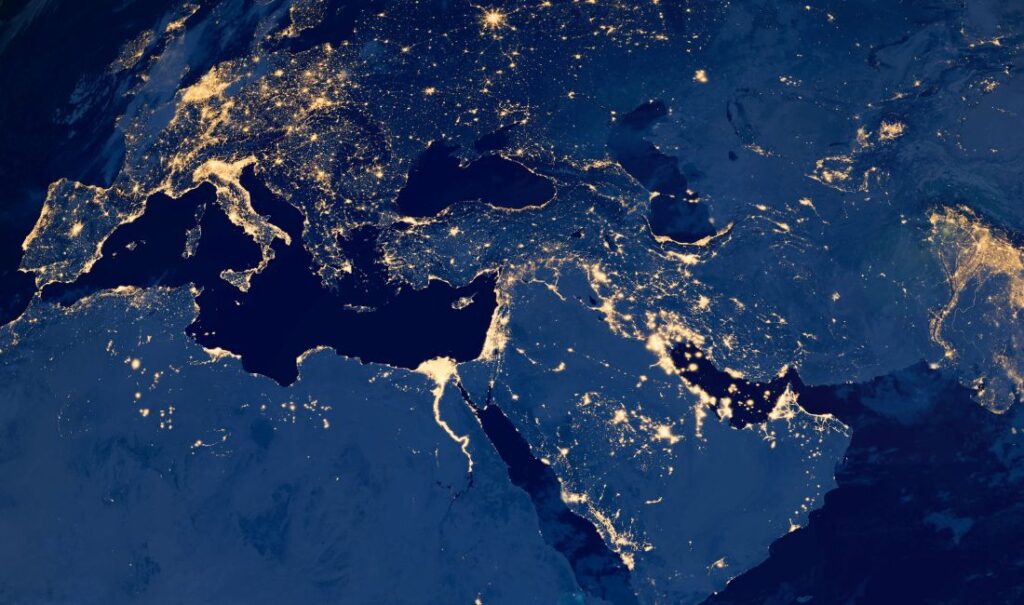
At the Conrad Singapore Orchard hotel on Friday morning, the warning from the Monetary Authority of Singapore landed with unusual bluntness. Central banks, said MAS chief economist Edward Robinson, must maintain “heightened vigilance” as the Middle East conflict feeds a new wave of financial and inflation risks into the global economy. For policymakers who spent the past two years cautiously steering inflation back toward target, the message was unmistakable: the old assumptions no longer hold.
Oil markets have become the transmission mechanism of geopolitical shock. Shipping lanes are under pressure, insurance costs are rising, and the threat of prolonged energy disruption now hangs over economies already carrying heavy debt loads and fragile growth expectations. What once looked like a manageable disinflation cycle is turning into something more complicated, and potentially more dangerous.
The fear in central banking circles isn’t simply higher energy prices. It’s what follows after them.
A New Inflation Shock Is Rippling Through the Global Economy
Edward Robinson’s remarks came during the 13th Asian Monetary Policy Forum in Singapore, where officials gathered amid escalating concern over the economic fallout from the Middle East conflict. Robinson warned that the world faces a “persistent supply shock” with consequences extending well beyond oil markets. Small open economies, he argued, remain especially vulnerable because energy costs pass rapidly into wages, transport prices, and broader consumer inflation.
The timing matters.
Just months ago, many central banks expected 2026 to be the year inflation pressures finally eased enough to justify a sustained rate-cutting cycle. Instead, the geopolitical landscape has reversed the momentum. According to a recent European Commission growth forecast reported by Reuters, eurozone inflation projections have already climbed from 1.9% to 3%, while growth expectations were downgraded sharply to 0.9%.
That combination, slower growth alongside resurgent inflation, revives memories of the stagflation era that haunted policymakers during the 1970s oil crises.
The difference today is structural fragility. Governments are carrying far larger debt burdens. Corporate refinancing costs remain elevated. And global supply chains, despite years of diversification efforts after the pandemic, still depend heavily on shipping corridors linked to the Gulf.
The Strait of Hormuz alone handles roughly one-fifth of global oil shipments. Even limited disruption there creates outsized effects across freight, manufacturing, aviation, agriculture, and sovereign bond markets.
Kristalina Georgieva, managing director of the IMF, warned in April that “all roads” from the conflict point toward higher inflation and slower growth. In remarks reported by Reuters, she said the IMF’s earlier baseline scenario was already becoming obsolete as oil prices stayed elevated above $100 per barrel.
For central banks, this creates a policy trap.
Raise rates too aggressively, and already weak economies risk recession. Cut rates too early, and inflation expectations may become unanchored again.
Neither outcome is attractive.
Why Central Banks Are Reassessing Interest Rate Risks
The phrase “central banks heightened vigilance” is rapidly becoming more than rhetorical caution. It reflects a growing recognition that policymakers may have underestimated how quickly geopolitical shocks can re-enter inflation dynamics.
The Bank of Japan offers a telling example. Reuters recently reported that hawkish voices inside the BOJ are pushing for earlier rate hikes as Middle East-driven energy shocks complicate Japan’s inflation outlook.
That would have seemed improbable a year ago in a country that spent decades battling deflation.
The broader issue is persistence. Central bankers can usually tolerate temporary commodity spikes. What worries them now is second-round inflation: rising wages, embedded pricing expectations, and prolonged cost transmission through the real economy.
What does “heightened vigilance” mean for central banks?
“Heightened vigilance” means central banks are monitoring whether temporary energy shocks evolve into sustained inflation and financial instability. Policymakers are watching wage growth, bond market volatility, credit conditions, and inflation expectations to determine whether geopolitical disruptions require tighter monetary policy or delayed interest-rate cuts.
That shift explains why policymakers increasingly talk about “financial stability” alongside inflation control.
In April, the Financial Stability Board warned G20 finance ministers that several vulnerabilities could collide simultaneously. FSB Chair Andrew Bailey pointed specifically to leveraged non-bank financial institutions, stretched asset valuations, and disorderly bond-market conditions as areas vulnerable to geopolitical stress.
The concern isn’t theoretical.
Government bond markets have already shown signs of strain in several advanced economies. Higher oil prices raise inflation expectations, which then push yields upward. Rising yields increase government borrowing costs precisely when fiscal deficits remain elevated after years of pandemic spending and industrial subsidies.
Singapore’s warning therefore resonates far beyond Asia.
The MAS itself operates differently from most central banks, using exchange-rate policy rather than conventional interest-rate targeting. Yet Robinson’s remarks carried unusual global relevance because Singapore sits at the crossroads of trade, shipping, and commodity flows. Few economies feel supply-chain distortions faster.
That sensitivity often turns Singapore into an early-warning system for broader economic shifts.
Still, not every economist believes a repeat of 2022-style inflation is inevitable. Some argue that weak global demand, aging demographics, and slowing Chinese growth will ultimately cap price pressures. Others point out that renewable energy investment and diversified gas infrastructure have improved resilience since Russia’s invasion of Ukraine.
The picture is more complicated than a simple oil shock narrative.
But markets are clearly reassessing risk.
The Global Economic Fallout Could Extend Far Beyond Energy Markets
The most immediate consequence of the Middle East conflict remains visible in commodity pricing. Yet second-order effects are spreading into areas many investors barely considered six months ago.
Food inflation is one example.
This week, the UN Food and Agriculture Organization warned that prolonged disruption around the Strait of Hormuz could trigger a “systemic agrifood shock” within six to 12 months. Fertilizer, shipping, fuel, and grain transport costs are all vulnerable to sustained disruption.
For emerging economies, that matters enormously.
Countries already battling currency weakness and elevated import costs may face another cycle of food-price instability similar to the pressures seen after Russia’s invasion of Ukraine in 2022. In lower-income economies, food inflation quickly becomes political inflation.
Businesses are also recalculating assumptions that once looked stable. Airlines are rerouting flights. Shipping insurers are raising premiums. Manufacturers dependent on petrochemicals face renewed margin pressure. Energy-intensive industries in Europe and Asia remain particularly exposed.
Then there’s the corporate debt problem.
During the low-rate era of the 2010s and pandemic years, companies accumulated large amounts of cheap borrowing. Many expected refinancing conditions to ease during 2026 as inflation cooled and rate cuts accelerated. If geopolitical shocks keep inflation elevated, those assumptions collapse.
That would tighten financial conditions even without additional central-bank hikes.
The spillover into equity markets could become significant. Technology stocks, especially companies trading at elevated valuations tied to artificial intelligence optimism, are sensitive to rising yields. The Financial Stability Board explicitly warned about “stretched” valuations in sectors vulnerable to abrupt repricing.
What follows, however, may prove even more consequential for governments.
Fiscal policy is losing room for manoeuvre.
High debt servicing costs, rising defence expenditures, and weaker growth leave many advanced economies exposed to political backlash if living costs rise again. In Britain, Germany, and France, policymakers already face public fatigue after several years of inflation-driven pressure on household budgets.
Central banks know this history well. Once inflation expectations shift psychologically, regaining credibility becomes expensive.
That explains the increasingly hawkish tone emerging from institutions that only recently sounded cautiously optimistic.
Not Everyone Believes Another Inflation Spiral Is Coming
There is, however, a serious counterargument.
Several economists argue that markets may be overestimating the inflationary power of the current conflict. Unlike the 1970s, advanced economies are less energy-intensive, more service-oriented, and far more diversified in energy sourcing. Strategic petroleum reserves remain substantial. Renewable energy capacity has expanded rapidly across Europe and parts of Asia.
Some analysts also note that China’s structural slowdown acts as a disinflationary anchor on the global economy. Weak property markets, subdued consumer demand, and excess industrial capacity in China continue to suppress export prices globally.
That dynamic could offset some upward pressure from energy markets.
Others believe central banks themselves have become institutionally more credible since the inflation crises of past decades. Inflation expectations, while rising modestly, remain relatively anchored compared with historical episodes of entrenched stagflation.
Even the IMF, despite its warnings, still projects global growth above 3% under baseline assumptions.
There is also skepticism about whether oil prices can remain elevated for a prolonged period without triggering demand destruction. Consumers facing higher fuel costs often cut discretionary spending quickly, slowing broader economic activity and eventually reducing commodity demand itself.
In that interpretation, the current shock may prove sharp but temporary.
Yet policymakers appear unwilling to rely on optimism alone.
The repeated emphasis on vigilance suggests central banks increasingly see geopolitical fragmentation as a structural feature of the global economy rather than a passing disruption. Supply chains are becoming politicised. Trade corridors face rising security risks. Defence spending is climbing across multiple regions simultaneously.
That changes the inflation equation.
The Return of Geopolitics to Monetary Policy
For much of the past three decades, central banking operated within a relatively predictable framework. Globalisation kept goods cheap. Energy markets remained broadly stable. Inflation shocks, when they appeared, were often short-lived.
That era is fading.
Edward Robinson’s warning in Singapore captured something larger than a regional policy concern. Central banks are confronting a world where geopolitics increasingly shapes monetary outcomes. Oil flows, shipping routes, sanctions, defence alignments, and strategic rivalries now feed directly into inflation models once dominated by labour markets and consumer demand.
The danger isn’t simply another spike in prices.
It’s the gradual erosion of the assumptions that made low inflation seem structurally permanent.
Markets can absorb isolated shocks. What they struggle with is chronic uncertainty. When businesses delay investment, consumers pull back spending, and governments face rising financing costs simultaneously, monetary policy loses much of its precision.
That’s why central banks are talking less about confidence and more about vigilance.
Because the global economy may be entering a phase where geopolitical instability is no longer the exception.
It’s the baseline.

Oil shock Southeast Asia | Strait of Hormuz disruption | Stagflation risk Philippines Thailand | Fuel subsidy bills Asia 2026
Picture a Monday morning in Bangkok’s Chatuchak district. Nattapong, a 34-year-old motorcycle-taxi driver who normally hauls commuters through gridlocked sois for roughly 400 baht a day, is staring at a petrol pump display that has climbed the equivalent of 18% in eight days. He hasn’t raised his fares yet — the app won’t let him — but his margins have almost evaporated. “Before, I could fill up and still send money home,” he says quietly. “Now I’m not sure.”
Multiply Nattapong’s dilemma across 700 million people, eleven countries, and a dozen interconnected supply chains, and you begin to understand what the Strait of Hormuz crisis of March 2026 is doing to South-east Asia. On the morning of Monday, March 9, 2026, Brent crude futures spiked as high as $119.50 a barrel — a session high that will be branded into the memory of every finance minister from Manila to Jakarta — before settling around $110.56, still up nearly 40% in a single month. WTI posted its largest weekly gain in the entire history of the futures contract, a staggering 35.6%, a record stretching back to 1983.
The trigger: joint US-Israeli strikes on Iran beginning February 28, which escalated into a full war and brought Strait of Hormuz shipping to a near-total halt. The choke point — that narrow 33-kilometre-wide passage between Oman and Iran — carries roughly 20 million barrels of oil per day, about one-fifth of global supply. When Iran’s Revolutionary Guard declared the waterway effectively closed and warned vessels they would be targeted, the arithmetic was brutal and immediate. Iraq and Kuwait began cutting output after running out of storage. Qatar’s energy minister told the Financial Times that crude could reach $150 per barrel if tankers remain unable to transit the strait in coming weeks. At Kpler, lead crude analyst Homayoun Falakshahi was blunter: “If between now and end of March you don’t have an amelioration of traffic around the strait, we could go to $150 a barrel,” he told CNN.
For South-east Asia — a region that imports the overwhelming majority of its oil and whose economies run on cheap fuel the way a clock runs on a mainspring — this is not merely a commodity story. It is a cost-of-living crisis, a monetary policy dilemma, and a fiscal time bomb, all detonating simultaneously.
Oil Shock Southeast Asia: Why the Region Is Uniquely Exposed
The geography alone is damning. Japan and the Philippines source roughly 90% of their crude from the Persian Gulf; China and India import 38% and 46% of their oil from the region, respectively. South-east Asia as a whole, with the sole exception of Malaysia, runs a persistent deficit in oil and gas trade. When the Strait of Hormuz tightens, the region doesn’t just pay more — it scrambles for supply.
MUFG Research calculates that every US$10 per barrel increase in oil prices worsens the current account position of Asian economies by 0.2–0.9% of GDP, with Thailand, Singapore, Taiwan, India, and the Philippines taking the largest hits. From a starting price of roughly $60 per barrel in January 2026 to a current print north of $110, that’s a $50-per-barrel shock — implying current account deterioration of potentially 1–4.5% of GDP for the region’s most vulnerable economies. Run that number through to your household electricity bill, your bag of jasmine rice, your morning commute, and the pain becomes visceral.
Nomura’s research team, in a note that has become one of the most-cited documents in Asian trading rooms this week, identified Thailand, India, South Korea, and the Philippines as the most vulnerable economies in Asia. The bank’s reasoning is unforgiving: Thailand carries the largest net oil import bill in Asia at 4.7% of GDP, meaning every 10% oil price change worsens its current account by 0.5 percentage points. The Philippines runs a current account deficit that, at oil above $90 per barrel on a sustained basis, is likely to breach 4.5% of GDP. “In Asia, Thailand, India, Korea, and the Philippines are the most vulnerable to higher oil prices, due to their high import dependence,” Nomura wrote, “while Malaysia would be a relative beneficiary as an energy exporter.”
Country by Country: Winners, Losers, and the Ones Caught in the Middle
The Philippines: Worst in Class, No Cushion
If there is one country in the region for which this crisis reads like a worst-case scenario, it is the Philippines. Manila has nearly 90% of its oil imports sourced from the Middle East and, crucially, operates a largely market-driven fuel pricing mechanism with minimal subsidies. There is no state buffer absorbing the shock before it hits the pump. Retailers in Manila imposed over ₱1-per-liter increases for the tenth consecutive week as of early March, covering diesel, kerosene, and gasoline. The Philippine peso slid back through the ₱58-per-dollar mark on March 9, adding a currency depreciation multiplier to an already brutal import bill.
ING Group estimates the Philippines could see inflation rise by up to 0.4 percentage points for every 10% increase in oil prices. At Nomura, the estimate is 0.5pp per 10% rise — the highest pass-through in the region. Oil at $110 represents roughly an 80% increase over January’s $60 baseline, an inflationary impulse that Capital Economics pegs could push headline CPI well above the Bangko Sentral ng Pilipinas’s 2–4% target. Manila has already announced plans to build a diesel stockpile as an emergency buffer — an admission that supply anxiety, not just price, has entered the conversation.
Thailand: The Biggest Structural Loser
Thailand’s problem isn’t just the size of its oil import bill — it’s the timing. The country is already wrestling with below-potential growth, persistent deflationary pressures in some sectors, and a tourism sector still finding its post-COVID footing. MUFG Research flags Thailand as one of the economies most sensitive to oil price increases from an inflation perspective, with CPI rising up to 0.8 percentage points per US$10/bbl increase — the highest reading in their Asian sensitivity matrix.
The government responded swiftly, announcing a suspension of petroleum exports to protect domestic stocks, an extraordinary measure that signals just how seriously Bangkok is treating supply security. The Thai baht, already vulnerable, has come under selling pressure alongside the Philippine peso, Korean won, and Indian rupee. For Thai factory workers supplying export goods to Western markets, higher transport and energy costs arrive precisely when global demand is wobbling under the weight of US tariffs. It is, as the textbook definition goes, a stagflationary shock — cost pressures rising while growth falters.
Indonesia: The Fiscal Tightrope
Indonesia occupies a peculiar position. It is technically a net importer of petroleum products — paradoxical for a country that was once an OPEC member — but it deploys a system of fuel subsidies (via state-owned Pertamina) that partially shields consumers from global price moves. The catch, of course, is that the shield is funded by the national treasury.
Indonesia’s government budget was built around an Indonesian Crude Price (ICP) assumption of $70 per barrel for 2026. With Brent at $110, that assumption looks almost quaint. Government simulations, according to Indonesia’s fiscal authority, show the state budget deficit could widen to 3.6% of GDP if crude averages $92 per barrel over the year — already above the 3% legal ceiling. At $110 sustained, the numbers are worse. Officials have acknowledged that raising domestic fuel prices — essentially passing the shock to consumers — could become a last resort. Nomura estimates a 10% oil price rise could worsen Indonesia’s fiscal balance by 0.2 percentage points via higher subsidy spending, breaching the 3% deficit ceiling at sufficiently elevated prices. President Prabowo Subianto, who swept to power partly on a cost-of-living platform, faces a politically combustible choice between fiscal discipline and popular anger at the pump.
Malaysia: The Region’s Unlikely Winner
Not everyone in South-east Asia is suffering equally. Malaysia, a net oil and gas exporter and home to Petronas — one of Asia’s most profitable energy companies — finds itself on the rare right side of an oil shock. MUFG Research identifies Malaysia as the only net oil and gas exporter in the region, likely to see a small benefit to its trade balance from higher prices. The ringgit, which has been strengthening as a commodity-linked currency, provides a further buffer.
The complexity lies in Malaysia’s domestic subsidy architecture. Kuala Lumpur has been in the process of a painstaking, politically fraught RON95 fuel subsidy reform — targeting the top income tiers first — which was already reshaping the fiscal landscape before the current crisis. Higher global prices actually make the reform argument easier: the subsidy bill would explode if oil stays elevated, giving Prime Minister Anwar Ibrahim political cover to accelerate rationalization. For Malaysia’s treasury, $110 oil is a revenue windfall and a subsidy headache simultaneously.
Singapore: The Price-Setter That Cannot Escape
Singapore imports everything, including every drop of fuel, but its role as a regional refining and trading hub makes it a price-setter rather than merely a price-taker. The city-state’s commuters are already feeling it: transport costs have risen sharply, and the government’s careful cost-of-living management is under renewed pressure. MUFG’s analysis ranks Singapore among the economies with the highest current account sensitivity to oil price increases, even though its GDP per capita provides a far larger fiscal cushion than its regional neighbours.
Stagflation Risk: The Word Nobody Wanted to Hear
The word “stagflation” is being whispered — and in some trading rooms, shouted — across Asia this week. Nomura’s note explicitly warns of a “stagflationary shock”: the simultaneous combination of rising inflation (from fuel and food cost pass-through) and slowing growth (from weakening consumer purchasing power and export competitiveness). It is the worst of both monetary worlds, leaving central banks without a clean tool. Cut rates to support growth, and you risk stoking inflation. Hold rates to fight inflation, and you choke a slowing economy.
ING Group notes the impact is far from uniform, with several economies partially shielded by subsidies or regulated pricing — but for the Philippines, the stronger inflation hit from market-driven fuel prices creates direct pressure on the BSP to hold rates. Capital Economics, while not abandoning its rate-cut forecasts for the Philippines and Thailand, has flagged that central banks may pause if oil hits and holds above $100 — as it already has. The ripple effects move quickly: higher fuel costs push up food prices (fertilisers, transport, cold chains), which push up core inflation, which pushes up wage demands, which erode manufacturer competitiveness. The chain is well-known. The speed this time is not.
Travel and Tourism: The Invisible Casualty
The oil shock has an airborne dimension that tends to get buried beneath the more immediate news of pump prices and fiscal deficits. Jet fuel — which tracks closely with crude — has surged in lockstep with Brent. Airlines operating regional routes out of Singapore’s Changi, Bangkok’s Suvarnabhumi, and Manila’s NAIA are facing fuel costs that represent 25–35% of operating expenses at normal prices. At current Brent levels, that share rises materially. The consequences are already filtering through: several Gulf carriers have partially resumed flights from Dubai International Airport after earlier disruptions, but route uncertainty and insurance premiums for Gulf overflight remain elevated.
For South-east Asia’s tourism recovery — Bali, Chiang Mai, Phuket, and Palawan were all expecting strong 2026 visitor numbers after several lean post-pandemic years — the arithmetic is uncomfortable. Higher jet fuel costs translate, with a lag of weeks rather than months, into higher airfares. Budget carriers such as AirAsia and Cebu Pacific, which built their business models around cheap fuel enabling cheap tickets, have the least pricing power and the thinnest margins. The traveller contemplating a Bangkok city break or a Bali retreat in Q2 2026 may find the price tag has quietly risen 10–20% since they first searched. That is not a crisis. But it is a headwind — and a reminder that in a globalised economy, no leisure industry is fully insulated from a Persian Gulf conflict.
Could Oil Really Hit $150? The Scenarios
The $150 question is no longer a fringe analyst talking point. Qatar’s energy minister said it publicly. Kpler’s lead crude analyst said it on record. Goldman Sachs wrote to clients that prices are likely to exceed $100 next week if no resolution emerges — a forecast already overtaken by events.
Three scenarios shape the trajectory:
Scenario 1 — Rapid de-escalation (30 days). The US brokers a ceasefire, Hormuz reopens to traffic with naval escorts, and oil retraces toward $80–85. This is the “fast war, fast recovery” template. The damage to South-east Asia is real but contained — a quarter or two of elevated inflation, some current account deterioration, minor growth drag.
Scenario 2 — Prolonged blockade (60–90 days). Tanker insurance remains unavailable or prohibitively expensive, shipping companies stay out, and the physical supply disruption persists. JPMorgan’s Natasha Kaneva has modelled production cuts approaching 6 million barrels per day under this scenario. Brent in the $120–130 range becomes the base case. For South-east Asia, this means inflation breaching targets in the Philippines and Thailand, subsidy bills in Indonesia threatening fiscal rules, and a genuine monetary policy bind across the region.
Scenario 3 — Escalation with infrastructure damage. Further strikes on Gulf energy facilities — as already seen against Iranian oil infrastructure and Qatari and Saudi installations — reduce physical capacity for months, not weeks. $150 becomes plausible. The 1970s-style shock, feared but never fully materialised in the 2022 Ukraine episode, arrives in earnest. South-east Asian growth forecasts get ripped up. The IMF’s 2026 regional outlook, cautiously optimistic as recently as January, would require emergency revision.
The G7 finance ministers were meeting Monday to discuss coordinated strategic reserve releases; the Trump administration announced a $20 billion tanker insurance programme, though shipping companies remain hesitant to transit the region. These measures can dampen prices at the margin. They cannot substitute for an open strait.
Policy Responses and the Green Energy Accelerant
Governments across the region are not waiting passively. Thailand’s petroleum export suspension, Manila’s emergency diesel stockpiling, Indonesia’s scenario planning for domestic fuel price adjustments — these are the short-term reflexes of policymakers who have been through oil shocks before and know that the first 72 hours matter.
The more interesting question is whether this crisis, like previous energy shocks, accelerates structural energy transition. Malaysia’s Petronas has been expanding LNG capacity and renewable partnerships. Indonesia’s vast geothermal resources — the world’s second-largest — have long been under-utilised relative to their potential. The Philippines, which currently imports nearly all its energy, has been pushing solar and wind development under the Clean Energy Act framework. The calculus that kept governments cautious about rapid transition — cheap imported fossil fuels were easy and politically manageable — has just shifted violently.
As ING’s analysis notes, energy makes up a large share of consumer inflation baskets across emerging Asia, meaning the political pain of oil shocks is both immediate and democratically legible. Leaders who endure it once tend to invest in insulation against the next one. The 1973 oil shock gave Japan its world-class energy efficiency. The 2022 Ukraine crisis gave Europe its renewable acceleration. Whether 2026’s Hormuz crisis becomes South-east Asia’s inflection point toward genuine energy security remains the region’s most consequential open question.
The Bottom Line
Brent at $110 and rising is not a number — it is a sentence, handed down to 700 million people who had little say in the conflict that produced it. For the Philippines, it means inflation at the upper edge of tolerance and monetary policy frozen in place when the economy needs easing. For Thailand, it is a stagflationary pressure on a growth story that was already fragile. For Indonesia, it is a fiscal arithmetic problem that risks breaching the legal deficit ceiling. For Malaysia, it is a windfall tempered by subsidy obligations and political exposure. For Singapore, it is a cost-management challenge that tests the city-state’s well-earned reputation for economic resilience.
The $150 scenario is not inevitable. But it is no longer implausible. And in a region that runs on imported energy, the difference between $110 and $150 is not merely financial. It is the cost of a week’s groceries for a Manila family. It is whether a Thai factory orders its next shift. It is whether Nattapong, Bangkok’s motorcycle-taxi driver, can still afford to fill his tank and send money home.
That is the oil shock South-east Asia is living through, right now, in real time.

Singapore stands at an inflection point. For decades, the city-state has built its prosperity on precision, predictability, and prudent risk management—the very qualities that transformed a resource-poor island into one of the world’s wealthiest nations. But on January 29, 2026, Deputy Prime Minister Gan Kim Yong delivered a message that would have seemed heretical a generation ago: Singapore must learn to embrace failure.
The Singapore Economic Strategy Review 2026 mid-term update, unveiled after months of consultation with businesses and workers, marks a striking departure from the nation’s traditional playbook. At its core lies a fundamental recognition that in an era of geopolitical fragmentation, artificial intelligence disruption, and climate imperatives, playing it safe is the riskiest strategy of all. The question now is whether a society built on stability can genuinely cultivate the “spirit of risk-taking” its leaders insist is essential for survival.
A Changed World Demands Changed Thinking
“Today’s crisis is very different,” DPM Gan told reporters at the briefing. “It is going to be a different world that we are going to emerge from. We are never going to go back to where we were.” His words carried unusual weight, spoken by a minister who has spent decades navigating Singapore through economic turbulence—from the Asian financial crisis to the global pandemic.
The seven recommendations emerging from the five Economic Strategy Review committees read less like incremental policy adjustments and more like a cultural manifesto. Developed through over 60 engagements with stakeholders, they acknowledge uncomfortable truths: achieving economic growth will be challenging, and growth can no longer be assumed to generate jobs. The twin objectives—sustaining growth at the higher end of 2-3% annually over the next decade while creating good jobs for Singaporeans—require a fundamentally different approach.
What makes this Singapore ESR risk-taking agenda particularly striking is not just what it proposes, but what it admits. Singapore must move beyond simply attracting multinational corporations and instead nurture enterprises that “dream big and take risks.” The phrase appears repeatedly in committee documents—a deliberate rhetorical choice in a nation where failure has historically carried deep stigma. As Acting Minister Jeffrey Siow emphasized during the briefing, the global economy is being reshaped by forces Singapore cannot control: major power rivalry, security concerns supplanting free trade, and technological advancement that renders traditional comparative advantages obsolete within years rather than decades.
The Seven Pillars of Singapore’s Economic Reinvention
What Are the 7 ESR Recommendations?
The ESR recommendations Singapore announced on January 29 form an interconnected strategy to position the nation for a more volatile future:
1. Establish Global Leadership in Key Growth Sectors
Singapore aims to transform its manufacturing prowess in semiconductors, healthcare, specialty chemicals, and aerospace through aggressive investment in AI, automation, and emissions-reducing technologies. But ambition extends beyond making existing industries more efficient—the goal is “best-in-class and sustainable operations” that serve as global benchmarks. The recommendation includes directing national-level R&D resources toward securing leadership positions rather than merely participating in high-value industries.
2. Pursue Emerging Opportunities to Create New Economic Engines
This represents perhaps the boldest cultural shift. The ESR committees are urging Singapore to place bets on frontier technologies—quantum computing, decarbonization technologies, space exploration—where outcomes remain deeply uncertain. Committee member Lim Hock Heng, former vice-president of British pharmaceutical giant GSK, captured the ambition: “Singapore can be more than just a regional hub. We have the chance to become the global benchmark for advanced manufacturing and modern services, a place where the future of the industry takes shape.”
3. Position Singapore as an AI Leader with an AI-Empowered Economy
Building on the National AI Strategies launched in recent years, this recommendation pushes for Singapore to become “a location of choice for companies and talent to come together to develop, test, deploy, and scale innovative and impactful AI solutions.” Crucially, it emphasizes AI adoption across the entire economy to drive productivity, not just in elite tech sectors. This Singapore AI leader strategy recognizes that AI will reshape every industry—and nations that hesitate will be left behind.
4. Strengthen Connectivity and Support Firms to Internationalize
Rather than relying solely on its position as a regional hub, Singapore must actively help local firms expand abroad. The recommendation calls for enhanced transport links, deeper trade networks, and support for Singaporean companies pursuing international ventures—a recognition that in an age of protectionism, market access cannot be taken for granted.
5. Broaden the Range of Good Jobs
This tackles a more sensitive issue: the concentration of high-quality employment in a narrow band of sectors. The review proposes expanding opportunities in skilled trades, care services, and emerging fields created by AI and frontier technologies. It’s an acknowledgment that Singapore innovation growth 2026 must translate into broad-based prosperity, not just elite prosperity.
6. Make Lifelong Learning Practical
Workers will need to become more agile, acquiring new skills throughout their careers through flexible pathways that blend training and work. The proposal includes developing a national AI workforce strategy to build literacy and fluency across the workforce—not just among data scientists and engineers.
7. Enable Businesses to Navigate Transitions
Companies will receive support to assess their health, plan pivots, and reposition themselves for new opportunities. In a restructuring economy, this amounts to acknowledging that not all businesses will survive—and providing mechanisms to help those that can adapt do so successfully.
The Cultural Chasm: Can Singapore Truly Embrace Failure?
Here’s where theory meets the hard ground of cultural reality. Singapore’s success has been built on the opposite of the risk-embracing, failure-tolerant culture now being advocated. Students face intense pressure to excel in standardized exams. Civil servants advance through proven competence rather than bold experimentation. The bankruptcy laws, though reformed, still carry social stigma. Even the vaunted startup ecosystem tends to favor proven business models over moonshots.
The Singapore economy embrace failure message will require more than policy changes—it demands a generational shift in mindset. When ESR committees urge the government to “go beyond attracting multinational corporations and nurture a new generation of enterprises and start-ups that dream big and take risks,” they’re essentially asking Singapore to become something it has never been: comfortable with ambitious failure.
Consider the contrast with other innovation economies. Israel’s “Startup Nation” culture actively celebrates pivots and failures as learning experiences. Silicon Valley treats bankruptcy as a badge of honor, evidence that you swung for the fences. China’s tech giants grew by launching dozens of products simultaneously, killing the failures quickly. Singapore’s approach has historically been more like Japan’s: careful, consensus-driven, risk-averse.
Yet there are reasons for optimism. Singapore has demonstrated remarkable adaptability before—pivoting from entrepôt trade to manufacturing to financial services to tech hub within two generations. The government’s willingness to convene this review and publicly acknowledge the need for risk-taking is itself significant. As DPM Gan noted, the recommendations and measures being considered “have to be quite different from what we were doing before” precisely because the environment has fundamentally changed.
The AI Gambit: Singapore’s Biggest Bet Yet
If there’s one area where the Singapore economic update risk appetite is most evident, it’s artificial intelligence. The ESR committees are proposing that Singapore position itself as a global AI leader—not just in deployment, but in development and governance.
This is audacious. Singapore lacks the vast data lakes of China, the venture capital ecosystem of the United States, or the deep bench of AI researchers in London or Toronto. What it can offer is something potentially more valuable: a trusted regulatory environment where AI can be tested, deployed, and scaled with both innovation and accountability.
The proposal to create “a location of choice” for AI companies recognizes that geography matters less than governance in the AI era. If Singapore can establish itself as the jurisdiction where controversial applications get fair, intelligent oversight—where privacy, safety, and innovation are balanced—it could capture an outsized share of AI value creation. The Republic has form here: it did something similar with biotech in the 2000s, building Biopolis and attracting pharmaceutical giants through intelligent regulation and infrastructure investment.
But the AI strategy goes beyond attraction. The push for economy-wide AI adoption—helping SMEs integrate AI into operations, building AI literacy across the workforce—addresses a hard truth: the countries that thrive won’t be those with the most AI researchers, but those where AI amplifies human productivity most broadly.
The Global Context: Singapore’s Gamble in Historical Perspective
Singapore’s pivot toward risk-taking arrives at a peculiar moment in global economic history. The post-Cold War consensus that favored open trade, mobile capital, and integrated supply chains—the very system Singapore mastered—is fracturing. Countries are “reconfiguring trade networks and supply chains in the name of resilience and security”, Prime Minister Lawrence Wong warned in December. These aren’t temporary disruptions but “permanent features of a fragmented world.”
The irony is rich: just as protectionism makes Singapore’s traditional strengths less valuable, the ESR is urging the nation to double down on openness and risk-taking. It’s a calculated gamble that in a balkanized world economy, there will be even more value in being the trusted intermediary, the neutral ground where Chinese and American companies can still do business, the place willing to try things others won’t.
History suggests this could work. Small, trade-dependent nations have often thrived during periods of great power competition by becoming indispensable to all sides. The Netherlands did it during the religious wars of the 16th century. Switzerland managed it through two world wars. Singapore itself prospered during the Cold War by maintaining relationships with both camps.
But there’s a crucial difference: those historical examples involved managing existing strengths, not cultivating new ones. Singapore is attempting something harder—transforming its risk culture while maintaining the stability and trust that made it successful in the first place. It’s trying to become both the safe harbor and the daring adventurer simultaneously.
The Uncomfortable Questions
The ESR mid-term update raises questions that deserve frank examination. First, can a government engineer a culture of risk-taking, or is such a culture necessarily organic? Singapore’s top-down approach has worked brilliantly for infrastructure, education, and industrial policy. But risk-taking and innovation may be different beasts—less amenable to five-year plans and committee recommendations.
Second, is Singapore being realistic about the trade-offs? A genuine failure-tolerant culture means accepting that some high-profile bets will fail spectacularly and publicly. It means entrepreneurs will squander government grants. It means brilliant researchers will pursue dead ends. Singapore’s electorate, accustomed to efficiency and accountability, may find this difficult to stomach.
Third, can Singapore compete with economies that have natural advantages in risk-taking cultures? The United States produces more failed startups than successful ones—but it also produces Google, Amazon, and Tesla. China’s tech giants emerged from chaotic, under-regulated environments where failure was ubiquitous and cheap. Singapore cannot replicate either model even if it wanted to.
Perhaps the answer lies not in becoming Silicon Valley or Shenzhen, but in creating a distinctly Singaporean model: calculated risk-taking, not reckless gambling. Failure tolerance within guardrails. Innovation with governance. The ESR’s emphasis on supporting “high-potential, fast-growing start-ups” to scale globally suggests this middle path—identifying promising ventures early and backing them intelligently rather than throwing money at everything.
What Success Looks Like—And What It Costs
If the ESR succeeds, Singapore in 2035 will look different from Singapore in 2025. The economy will be more diversified, with clusters of globally competitive companies in quantum computing, space technology, and climate tech alongside the traditional strengths in finance and manufacturing. Workers will move fluidly between roles and sectors, armed with AI skills and comfortable with career pivots. The startup ecosystem will have produced a handful of global champions—companies valued in the tens of billions that choose to keep their headquarters in Singapore even as they expand worldwide.
The Singapore innovation growth 2026 trajectory will have created not just GDP expansion but meaningful social mobility. The “good jobs” the ESR promises will span a wider range of sectors and skill levels. Care workers and skilled tradespeople will earn professional wages. AI will have automated drudgery without devastating employment, because the workforce adapted fast enough.
But this optimistic scenario requires Singapore to overcome its hardest challenge: accepting that some bets won’t pay off. The quantum computing company that burns through billions before pivoting. The space venture that launches satellites into the wrong orbit. The AI startup whose promising technology fails to find product-market fit. These aren’t policy failures to be avoided—they’re the inevitable price of ambition.
As the government prepares its formal response to the ESR recommendations at Budget 2026 in February, the crucial test will be whether it’s willing to embrace this reality. Will ministers defend failed ventures as necessary learning experiences, or will they retreat to safe, incremental bets at the first sign of trouble?
The Verdict: A Necessary Gamble
The Singapore Economic Strategy Review 2026 represents either a courageous reimagining of what Singapore can become or a risky departure from proven success formulas—possibly both. What’s certain is that standing still isn’t an option. In DPM Gan’s phrasing, doing “more of the same” in a fundamentally changed world guarantees decline.
The review’s power lies not in any single recommendation but in its cumulative message: Singapore must transform its relationship with uncertainty. That means celebrating ambitious failure as much as steady success, supporting companies that dream big over those that play it safe, and accepting that 2-3% GDP growth in a volatile world represents triumph, not mediocrity.
Whether Singapore’s leaders and citizens are truly ready for this psychological shift remains the great unanswered question. The next decade will reveal whether a nation built on calculated prudence can learn to dance with risk—or whether the call to “embrace failure” will itself become a failure to embrace.
For now, Singapore is placing its bet. The world will be watching to see if a 728-square-kilometer city-state can write a new playbook for economic success in the 21st century—one where taking the leap matters more than landing perfectly every time.

Business Insurance for Digital Exports: Protecting Your Company in the AI Era

Real Estate Crash Predictions 2026: Data-Backed Regional Guide

What is a “Lead-Left” Bank? Unpacking Morgan Stanley’s Role in Anthropic’s Mega-IPO

Is SPY Overvalued in September 2026? Fed Rate Hike Odds & Intrinsic Value

Pakistan’s KSE-100 Nears Record Territory Even as the Trade Gap Persists

US Consumer Sentiment Sinks as Retail Sales Drop

Barclays Q2 2026 Results: Income Beats, Costs Rise 7%

Pakistan’s Remittance Lifeline: Why Gulf Exposure Is a Hidden Risk

Dubai’s Rise to the World’s 7th Financial Hub: Inside the D33 Push

China EV Exports Hit Record High in 2026

UK’s “National Contributions Tax” Explained: Burnham-Era Reform 2026

Russia’s Strange Problem in 2026: Its Currency Is Too Strong

Section 301 Forced Labor Tariffs 2026: 60 Countries Affected

UK National Contributions Tax: Burnham’s Radical Tax Plan

Top 15 Stocks for Investment in 2026 in PSX: Your Complete Guide to Pakistan’s Best Investment Opportunities
Top 15 Stocks for Investment in 2026 in PSX: Your Complete Guide to Pakistan’s Best Investment Opportunities

Debunking IMF Program Myths: Reconfiguring Engagement for True National Ownership in a Volatile World

Top 10 Mutual Fund Managers in Pakistan for Investment in 2026: A Comprehensive Guide for Optimal Returns

What the U.S. Attack on Venezuela Could Mean for Oil and Canadian Crude Exports: The Economic Impact

China’s 50% Domestic Equipment Rule: The Semiconductor Mandate Reshaping Global Tech

15 Most Lucrative Sectors for Investment in Pakistan: A 2025 Data-Driven Analysis

Pakistan’s Export Goldmine: 10 Game-Changing Markets Where Pakistani Businesses Are Winning Big in 2025
15 Most Lucrative Sectors for Investment in Pakistan: A 2025 Data-Driven Analysis
15 Most Lucrative Sectors for Investment in Pakistan: A 2025 Data-Driven Analysis

Pakistan’s Stock Market Renaissance: How 2025’s Hottest Investment Opportunity Is Democratizing Wealth—A Complete Beginner’s Guide

Pakistan’s Economic Outlook 2025: Between Stabilization and the Shadow of Stagnation
Pakistan’s Economic Outlook 2025: Between Stabilization and the Shadow of Stagnation

China’s Property Woes Could Last Until 2030—Despite Beijing’s Best Censorship Efforts
-
 Markets & Finance8 months ago
Top 15 Stocks for Investment in 2026 in PSX: Your Complete Guide to Pakistan’s Best Investment Opportunities
-
Markets & Finance8 months ago
Top 15 Stocks for Investment in 2026 in PSX: Your Complete Guide to Pakistan’s Best Investment Opportunities
-
 Analysis7 months ago
Debunking IMF Program Myths: Reconfiguring Engagement for True National Ownership in a Volatile World
-
 Investment8 months ago
Top 10 Mutual Fund Managers in Pakistan for Investment in 2026: A Comprehensive Guide for Optimal Returns
-
 Global Economy8 months ago
What the U.S. Attack on Venezuela Could Mean for Oil and Canadian Crude Exports: The Economic Impact
-
 Asia8 months ago
China’s 50% Domestic Equipment Rule: The Semiconductor Mandate Reshaping Global Tech
-
 AI9 months ago
15 Most Lucrative Sectors for Investment in Pakistan: A 2025 Data-Driven Analysis
-
 Exports9 months ago
Pakistan’s Export Goldmine: 10 Game-Changing Markets Where Pakistani Businesses Are Winning Big in 2025