
AI
The Remaking of Global Banking: Why 2025’s Winners Signal a Seismic Shift in Financial Power

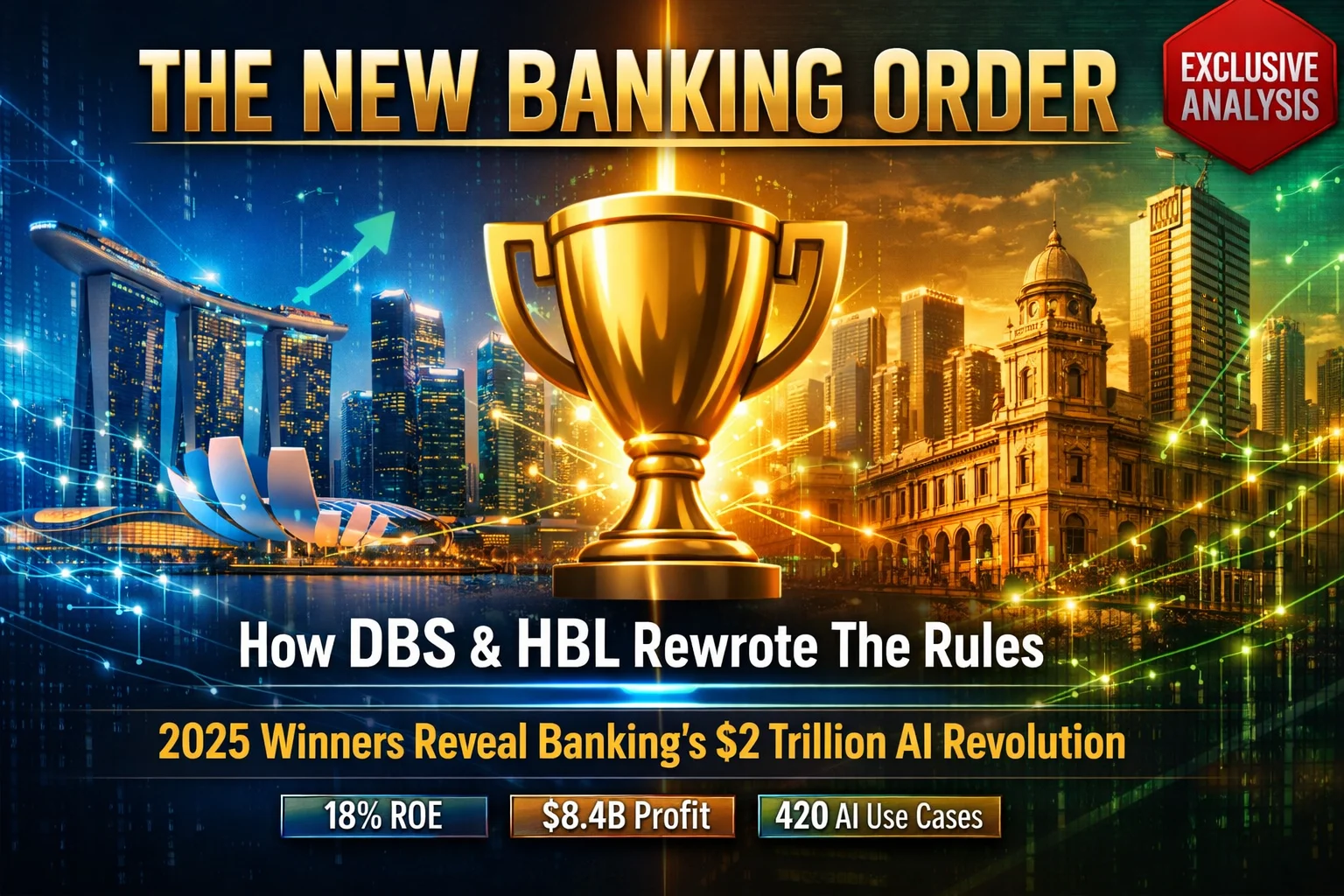
How DBS and HBL’s Historic Victories Reveal the New Architecture of 21st Century Finance
When DBS Bank claimed its third Global Bank of the Year title from The Banker in December 2025, defeating 294 competing institutions, the Singapore-based giant didn’t just win an award. It marked the moment when the tectonic plates beneath global finance shifted irreversibly eastward—and when traditional Western banking supremacy became historical footnote rather than contemporary reality.
But here’s what the champagne celebrations in Marina Bay and the perfunctory congratulations from New York missed: DBS’s achievement, along with its capture of Asia Bank of the Year, Singapore Bank of the Year, and Investment Bank of the Year titles, represents far more than institutional excellence. It signals the emergence of a new banking paradigm where artificial intelligence deployment, digital-first infrastructure, and emerging market agility trump legacy balance sheets and century-old brand prestige.
Meanwhile, 6,000 miles west in Karachi, another revolution quietly unfolded. HBL’s recognition as Pakistan’s best bank, achieving record profit before tax of Rs 120.3 billion ($431.9 million)—a 6.9% increase year-over-year—tells an equally compelling story about resilience, innovation under constraint, and the surprising dynamism of frontier market banking in 2025.
These dual narratives—one from Asia’s most sophisticated financial hub, another from a nation navigating economic stabilization—illuminate the defining question of our era: What does banking excellence actually mean when the rules of engagement have fundamentally changed?
The Digital Dividend: Why Traditional Banks Are Playing Catch-Up
Let’s confront an uncomfortable truth that establishment banking would prefer remained unspoken: DBS’s 18.0% return on equity in 2024, achieved alongside an SGD 11.4 billion ($8.4 billion) net profit, didn’t emerge from conventional banking wisdom. It resulted from a deliberate, decade-long dismantling of every assumption that defined 20th-century financial services.
Consider the numbers that should alarm every legacy institution. By 2030, generative AI will be fully integrated into every aspect of banking, with the technology contributing up to $2 trillion to the global economy through innovative strategies and improved efficiency. DBS has already deployed AI in approximately 420 use cases across its operations, from customer support via chatbots to private banking personalization platforms, generating economic value exceeding SGD 750 million in 2024—more than double the previous year.
This isn’t incremental improvement. This is categorical transformation.
The conventional banking playbook—physical branches as trust anchors, relationship managers as revenue drivers, legacy systems as necessary evils—has become actively counterproductive. Scale is emerging as the ultimate competitive advantage, with the largest institutions leveraging unmatched efficiencies, technological innovation, and global reach to outpace competitors. But here’s the twist: scale no longer correlates with geographic footprint or century-old establishment pedigree.
DBS operates in 19 markets. JPMorgan Chase, by comparison, has operations across more than 100 countries. Yet DBS has captured nine global ‘Best Bank’ awards from leading financial publications since 2018, a frequency that would have been inconceivable a generation ago for an Asian regional player.
The explanation? Digital architecture as competitive moat.
Seventy-five percent of banks with over $100 billion in assets are expected to fully integrate AI strategies by 2025, but integration depth matters exponentially more than adoption announcement. DBS didn’t bolt AI onto legacy infrastructure—it reconstructed banking from first principles with AI as foundational layer, not cosmetic upgrade.
Pakistan’s Paradox: Excellence Amid Economic Turbulence
If DBS represents banking’s aspirational future, Pakistan’s 2025 landscape reveals something equally instructive: how institutions achieve excellence despite—perhaps because of—economic constraint.
Pakistan’s economy expanded by 2.7% in fiscal year 2025, with inflation declining sharply to 4.7% during the first ten months—down from 26% in the previous year. This macroeconomic stabilization, achieved through disciplined fiscal consolidation and tight monetary policy under the IMF’s Extended Fund Facility, created the operating environment where banking excellence could emerge.
Yet the numbers tell a more complex story than simple recovery narrative. Pakistan’s banking sector aggregate profits soared beyond Rs 600 billion in 2025, with tax contributions exceeding Rs 650 billion. This isn’t accident or windfall—it’s strategic positioning within a transforming economy.
HBL achieved record profit before tax of Rs 120.3 billion ($431.9 million), earning per share surging to Rs 39.85 ($0.14), while contributing Rs 62.5 billion to the national treasury. These metrics demonstrate profitability, certainly, but more critically they reveal institutional capacity to navigate volatility that would cripple less adaptive organizations.
Meezan Bank, as Pakistan’s foremost Islamic bank, achieved unprecedented profit of Rs 101.5 billion, with pre-tax profits recorded at Rs 222 billion and substantial tax contribution of Rs 121 billion. This performance occurred within Pakistan’s constitutional mandate requiring shift to Riba-free banking system by 2028, positioning Sharia-compliant institutions for structural advantage as regulatory landscape transforms.
The Pakistan banking story illuminates a crucial insight: constraint breeds innovation when institutions choose adaptation over entrenchment. The banking sector contributed approximately 35% to the KSE-100 Index’s historic rally from 50,000 to 150,000 points since June 2023, demonstrating how financial sector dynamism can catalyze broader economic confidence.
The Technology Arms Race: Where Winners Pull Away
Here’s where the 2025 banking excellence narrative becomes genuinely consequential for industry trajectory: the technology gap between leaders and laggards isn’t narrowing—it’s accelerating toward irreversibility.
DBS surpassed its goal of contributing €300 billion to sustainable finance by 2025, a year ahead of schedule, but this achievement masks the more significant development. The French banking giant Societe Generale, which won Global Finance’s World’s Best Bank designation while generating €4.2 billion in group net income (up 69% from previous year) on €26.8 billion in revenue (up 6.7%), demonstrated that multiple institutions can achieve excellence through different pathways.
Yet technology deployment remains the differentiating factor separating good from exceptional.
AI will contribute $2 trillion to the global economy through banking innovation and efficiency improvements, but this value creation won’t distribute evenly. More than half of banks now have mature cloud programs, with respondents planning to double the share of applications on cloud in next three years from 30-40% today to up to 70%, creating divergence between cloud-native operations and legacy system constraints.
Consider the implications. Generative AI is reversing the impersonal nature of digital banking, creating emotionally engaging experiences that feel like personalized service of the past. Banks achieving this transformation—DBS prominent among them—create customer experiences that legacy institutions literally cannot replicate without wholesale infrastructure replacement.
The technology gap manifests in every dimension of operations. Generative AI will drive ‘waste out’ by automating manual processes like risk and compliance testing, reducing costs by up to 60% in the next two to three years. Institutions capturing this efficiency gain compound advantages across customer acquisition costs, operational margins, and innovation velocity.
Pakistan’s leading banks demonstrate that technology adoption isn’t geography-dependent. BankIslami, awarded Best Bank of the Year in mid-sized banks category, pioneered deploying biometric ATMs and introducing Pakistan’s first Islamic digital banking solution, proving that innovation can emerge from unexpected quarters when institutions prioritize transformation over tradition.
The Regulatory Reckoning: How Policy Shapes Excellence
Banking excellence in 2025 cannot be understood separately from regulatory environment—and here again, we see bifurcation between enabling frameworks and constraining structures.
Global banking industry operated within environment of significant complexity in past year, with economic headwinds, high interest rates, persistent inflation, and geopolitical tensions all shaping banking strategies worldwide. Yet regulatory response varied dramatically across jurisdictions, creating asymmetric competitive landscapes.
Pakistan’s Finance Act 2025 drew significant controversy due to stringent taxation measures and expanded enforcement powers granted to Federal Board of Revenue, with key provisions allowing arrest of individuals without prior notice. This regulatory intensity creates operational friction that banks must navigate while maintaining profitability—a constraint that simultaneously burdens institutions and forces operational excellence.
Meanwhile, Singapore’s regulatory approach fostered the environment enabling DBS’s leadership. DBS has been accorded ‘Safest Bank in Asia’ award by Global Finance for 17 consecutive years from 2009 to 2025, reflecting not just institutional risk management but regulatory framework supporting prudent growth over reckless expansion.
The divergence extends to emerging technology regulation. Regulatory evolution will bring more specific AI requirements focusing on algorithmic transparency, standardized risk frameworks, and enhanced consumer protection. Jurisdictions that balance innovation enablement with consumer protection create competitive advantage for domestic institutions—those that overregulate or underregulate both create vulnerabilities.
Pakistan’s 26th constitutional amendment mandating shift to Riba-free banking system by 2028 represents regulatory transformation with profound competitive implications. Islamic banks positioned for this transition—Meezan Bank, BankIslami, and others—gain structural advantages as regulatory tailwinds accelerate their growth trajectories.
The Profitability Puzzle: Why Returns Diverge
Understanding 2025’s banking excellence requires examining the profitability architecture separating exceptional from mediocre performers.
DBS achieved net profit of SGD 11.4 billion with return on equity of 18.0%, one of the highest among developed market banks globally. This ROE—sustained across multiple years—reflects not cyclical advantage but structural superiority in capital deployment.
Compare this against broader industry dynamics. Pakistan’s banking sector recorded highest-ever profit after tax at $1.15 billion in first half of 2025, a 19% year-on-year increase, demonstrating that profitability growth opportunities exist across development stages and market sophistication levels.
Yet profitability sources matter critically. Limited private sector lending remains concern in Pakistan, as banks continue to rely heavily on government securities for profits. This revenue model—lucrative in high-interest-rate environment—creates vulnerability as monetary policy normalizes and yields compress.
United Bank Limited witnessed 34% surge in profits reaching Rs 75.7 billion, with pre-tax profits escalating to Rs 150 billion and significant strides in expanding Islamic banking operations across KPK and Balochistan. This growth trajectory reflects diversification across business lines and geographic markets—the sustainable profitability model versus concentration risk.
DBS’s profitability architecture offers instructive contrast. Total income rose 10% to SGD 22.3 billion, with net interest income increasing 6% due to balance sheet growth deployed into low-risk securities amid tepid loan growth, while non-interest income was star performer as market clarity buoyed investor confidence and fueled wealth management activity. Diversified revenue streams—interest income, wealth management fees, treasury operations—create resilience that monoline institutions cannot replicate.
The profitability lesson from 2025’s excellence winners: sustainable returns emerge from diversified revenue streams, operational efficiency through technology, and prudent risk management—not from concentrated bets on single revenue sources or excessive risk-taking.
The Wealth Management Inflection: Where Value Migrates
Perhaps no trend better explains 2025’s banking excellence pattern than wealth management emergence as primary value driver.
BBVA claims title of World’s Best Corporate Bank for third consecutive year, expanding market share and deal leadership during 2024, leading 86 deals across telecommunications, energy, infrastructure, consumer goods and services for total volume of €5.16 billion. Yet even corporate banking excellence increasingly depends on ancillary wealth management capabilities for high-net-worth executives and family offices.
The numbers reveal the magnitude of this shift. DBS serves over 18.4 million Consumer Banking/Wealth Management customers, but customer count tells incomplete story—revenue per customer in wealth management segments dwarfs traditional retail banking metrics.
DBS expects commercial book non-interest income to grow in high-single digits led by wealth management fees and treasury customer sales, positioning wealth management as primary growth engine even as interest income stabilizes. This strategic reorientation—from balance sheet size toward fee-based services—represents fundamental reconception of banking value proposition.
Pakistan’s market demonstrates similar dynamics at different sophistication level. Banking sector accounts for $15.12 billion of PSX’s $64.76 billion total market capitalization—representing about 23% of overall market, yet wealth management penetration remains nascent compared to developed markets, representing enormous growth runway for institutions positioned to capture affluent segment.
The wealth management inflection creates winner-take-most dynamics. Institutions with digital platforms enabling seamless omnichannel experiences, AI-powered personalization, and comprehensive product suites capture disproportionate market share. Those lacking these capabilities face commoditization pressure and margin compression in traditional banking services.
The Geopolitical Dimension: How Power Shifts Reshape Finance
Banking excellence in 2025 cannot be divorced from broader geopolitical realignment—and here the story becomes genuinely fascinating.
Geopolitical disruptions are reshaping trade, technology, and finance, with three factors—security, emerging resource and industrial battlegrounds, and ‘transactionalism’—testing globalization’s staying power. These forces create asymmetric opportunities and vulnerabilities across banking systems.
DBS’s position in Singapore—financial Switzerland of Asia with relationships spanning both Western and Eastern spheres—provides geopolitical optionality that institutions headquartered in explicitly aligned jurisdictions cannot replicate. This strategic ambiguity, combined with operational excellence, creates competitive advantage as global trade patterns fragment and regionalize.
Pakistan’s banking sector faces different geopolitical calculus. IMF’s 2025 Governance and Corruption Diagnostic Assessment estimates Pakistan’s economy loses 5-6.5 percent of GDP to corruption due to entrenched ‘elite capture,’ where influential groups shape public policy for their own benefit. This structural challenge constrains banking sector development even as individual institutions achieve excellence within imperfect ecosystem.
Yet geopolitical realignment creates opportunities alongside challenges. Pakistan’s exports have declined from 16 percent of GDP in 1990s to around 10 percent in 2024, leaving growth dependent on debt and remittance-driven consumption which underlies Pakistan’s recurrent boom-bust cycles. Banking institutions facilitating export sector transformation position themselves for structural tailwinds if policy reforms materialize.
The geopolitical lesson: banking excellence requires navigation of political economy realities that extend far beyond institution-level decisions. Winners in 2025 demonstrated not just operational superiority but strategic positioning within geopolitical landscapes enabling—rather than constraining—their growth trajectories.
The Sustainability Imperative: Beyond Greenwashing to Strategic Advantage
Banking excellence in 2025 increasingly correlates with sustainability leadership—not as reputational exercise but as strategic positioning for regulatory and market shifts.
Societe Generale surpassed its goal of contributing €300 billion to sustainable finance by 2025, a year ahead of schedule, demonstrating that sustainability commitments, when genuine, create business development opportunities rather than merely compliance costs.
DBS committed SGD 89 billion in sustainable financing net of repayments, representing substantial capital deployment toward transition finance, renewable energy, and climate-resilient infrastructure. This isn’t altruism—it’s recognition that sustainable finance represents among fastest-growing banking segments with improving risk-adjusted returns.
The sustainability shift creates competitive separation. BBVA led €383 million project financing of Repsol Renovables’ Gallo portfolio, a 777-megawatt solar and battery storage facility spanning Texas and New Mexico, while directing €51.1 billion into sustainable financing throughout year. Institutions building capabilities in sustainability assessment, transition finance structuring, and climate risk management capture market share in high-growth segments.
Pakistan’s context reveals sustainability’s differentiated impact across development stages. Pakistan’s recent floods imposed significant human costs and economic losses, dampening growth prospects and adding pressure on macroeconomic stability. Banking institutions offering climate-resilient lending products and disaster recovery financing demonstrate sustainability’s immediate, practical relevance beyond long-term carbon neutrality commitments.
The sustainability imperative separates 2025’s winners from institutions merely mimicking ESG rhetoric without operational transformation.
What 2026 Holds: The Acceleration Ahead
As 2025 closes, the trajectory for banking excellence becomes simultaneously clearer and more volatile. Several forces will shape which institutions sustain leadership and which fall behind.
First, AI deployment will separate winners from losers with increasing finality. Only 8% of banks were developing generative AI systematically in 2024, with 78% having tactical approach, but as banks move from pilots to execution, more are redefining strategic approach to service expansion including agentic AI. The institutions moving from experimentation to industrialization will compound advantages impossible for laggards to overcome without wholesale transformation.
Second, regulatory divergence will accelerate. Regulatory evolution will bring more specific AI requirements focusing on algorithmic transparency, standardized risk frameworks, and enhanced consumer protection, creating asymmetric compliance burdens that favor institutions with mature governance frameworks and technology infrastructure.
Third, macroeconomic volatility will test institutional resilience. Pakistan’s growth is projected to remain at 3.0 percent in FY26 due to flood impacts on agriculture sector before picking up in medium term as stability and reforms enhance growth prospects. Economic shocks separate well-capitalized, diversified institutions from fragile competitors dependent on benign conditions.
DBS expects net interest income to be slightly higher than 2024 levels as impact of lower interest rates is more than offset by loan growth, with commercial book non-interest income growing in high-single digits and pretax profits around record 2024 levels. This guidance reflects confidence born from operational excellence rather than optimistic assumptions about external conditions.
The banking excellence template for 2026 and beyond: technology-enabled operations, diversified revenue streams, prudent risk management, sustainability leadership, and strategic positioning within favorable regulatory and geopolitical landscapes. Institutions possessing these attributes will thrive. Those lacking them will struggle regardless of legacy brand strength or balance sheet size.
The Uncomfortable Truth
Let’s return to where we began: DBS’s third Global Bank of the Year award and HBL’s Pakistan leadership aren’t just institutional success stories. They’re harbingers of comprehensive restructuring of global financial architecture.
The uncomfortable truth that establishment banking must confront: traditional competitive advantages—century-old brands, physical branch networks, legacy relationship management approaches—have transformed from assets into liabilities. The future belongs to institutions that rebuilt themselves from first principles with technology as foundation rather than ornament.
DBS’s exceptional performance stood out among 294 participating banks, underscoring its sustained leadership and profound impact in global financial industry. This wasn’t victory through marginal superiority but categorical difference in institutional DNA.
For Pakistan’s banking sector, the excellence achieved in 2025 demonstrates that frontier markets can produce world-class institutions when leaders prioritize transformation over incrementalism. HBL remains undisputed leader as Pakistan’s best bank, demonstrating standout financial growth and continuous improvement in digital space—proving that excellence transcends market sophistication when institutions embrace change.
The question confronting every banking CEO as 2025 closes isn’t whether to transform—it’s whether they possess courage to dismantle organizational structures and cultural assumptions that delivered past success but guarantee future irrelevance.
DBS and HBL didn’t win Bank of the Year 2025 awards by being incrementally better. They won by being fundamentally different. That’s the lesson that separates next decade’s survivors from its casualties.
The remaking of global banking isn’t coming. It has arrived. The only question remaining: which institutions recognize this reality quickly enough to adapt, and which will insist on defending obsolete models until market forces render the decision moot?
Excellence in banking—real excellence, not the cosmetic variety celebrated in aspirational mission statements—requires confronting these uncomfortable realities. The 2025 winners demonstrated this courage. The 2026 winners will be those who learn from their example.
Abdul Rahman is Senior Political Economy Columnist covering global financial systems, emerging market dynamics, and regulatory policy. His analysis has appeared in leading English Newspapers and Magazines .
Data Sources: The Banker (Financial Times), Global Finance Magazine, Euromoney, World Bank, International Monetary Fund, Asian Development Bank, State Bank of Pakistan, DBS Annual Reports, Accenture Banking Research, McKinsey Global Banking Studies, IBM Institute for Business Value, CFA Society Pakistan.



Why the AI Revolution Is Breaking the Link Between Output and Labor Income
Artificial intelligence is transforming the modern workplace at a breathtaking pace. Generative AI tools are drafting legal briefs, diagnosing medical images, writing software code, and managing supply chains with superhuman efficiency. Yet a landmark report from the International Labour Organization, released on June 15, 2026, reveals a troubling disconnect: while global labor productivity has accelerated to a 3.2% annual clip, real median wages in advanced economies have risen a mere 0.8% (ILO World Employment and Social Outlook, June 2026). The AI boom, it appears, is delivering a productivity miracle that primarily rewards capital owners and the highest‑skilled technologists, leaving the typical worker behind.
The Labour Share in Freefall
The ILO’s most alarming finding is the labor share decline. The labor income share—the slice of national income that goes to workers in the form of wages, salaries, and benefits—has fallen to a historic low of 51% globally, down from 54% in 2004. The decline is sharpest in the United States and Northern Europe, where AI adoption is most advanced. In the US, the labor share has dropped to 56.5%, a level not seen since the Gilded Age. The ILO attributes 40% of this decline since 2020 to technological displacement, with AI being the primary driver.
The mechanism is subtle but powerful. AI automates cognitive routine tasks, not just physical ones. When a financial analyst’s report that once took five days can be produced by an AI in five minutes, the marginal value of that analyst’s time plummets. The analyst may keep her job, but her bargaining power for raises evaporates. Meanwhile, the firm’s profits surge because output per worker rises dramatically. The ILO found that in the top 500 AI‑adopting firms globally, operating margins expanded by an average of 4.8 percentage points between 2022 and 2026, but the wage‑to‑revenue ratio contracted by 2.3 points (McKinsey Global Institute, “The State of AI in 2026”).
Technology Unemployment 2.0
The term “technological unemployment” has moved from academic journals to mainstream policy debates. The ILO estimates that while AI will create 50 million net new jobs by 2030, it will displace or fundamentally transform 400 million roles. The occupations most exposed are those that involve information processing, pattern recognition, and language generation: paralegals, accountants, call‑center agents, radiologists, and software developers themselves. In a striking case, a major global bank announced in April 2026 that it had reduced its compliance department headcount by 35% while simultaneously cutting error rates, replacing human reviewers with a combination of natural‑language processing and robotic process automation (Financial Times).
What makes this wave different from previous automation cycles is the speed and the educational threshold. Historically, automation hit blue‑collar manufacturing; this time, it is hitting white‑collar, university‑educated professionals. A paper from the National Bureau of Economic Research circulated in May 2026 shows that for the first time, workers with a bachelor’s degree are seeing a negative return to experience in AI‑exposed roles; their earnings trajectory is flattening relative to peers in less automatable trades such as plumbing or elderly care (NBER Working Paper 31050).
The Gig Economy Entrenchment
AI is also accelerating the fissuring of the traditional employment relationship. Platforms that match freelancers with tasks, from graphic design to legal research, are increasingly using AI to manage work allocation, evaluate performance, and even set piece‑rate prices. The ILO found that 38% of the global workforce is now engaged in some form of non‑standard employment, up from 34% in 2019. While this provides flexibility, it strips away the training, benefits, and career progression that traditional employment offered. Workers in these arrangements have seen their real incomes stagnate or fall, as algorithmic management squeezes task‑by‑task compensation.
Policy Responses: From AI Taxes to Universal Basic Capital
Governments and international bodies are scrambling to rewrite the social contract. The European Parliament’s Committee on Employment is debating an AI training levy that would require firms deploying automation to contribute 1% of payroll to a reskilling fund. The idea, inspired by Singapore’s SkillsFuture credit, has drawn support from trade unions and even some tech leaders. Sam Altman’s concept of a “universal basic capital”—an ownership stake in the AI‑driven economy distributed to all citizens—has moved from concept to pilot in Finland and Kenya, where blockchain‑based digital trusts allocate shares in a portfolio of AI‑intensive public companies to citizens (World Economic Forum, “AI Governance in Practice”).
The OECD has issued new guidelines urging members to strengthen collective bargaining rights in the digital economy and to enforce antitrust laws that prevent algorithmic wage‑fixing (OECD Employment Outlook 2026). In the United States, the Federal Trade Commission has opened investigations into several large HR‑tech platforms over allegations that their “optimal wage” algorithms constitute illegal coordination among employers.
What Workers and Employers Can Do
For individuals, the advice is increasingly nuanced. The ILO recommends “AI literacy” not as a coding skill but as the ability to supervise, critique, and collaborate with AI outputs. Skills in emotional intelligence, complex negotiation, and ethical judgment are commanding a premium. Employers, on the other hand, are facing a talent paradox: they need workers who can manage AI, but if they hollow out the middle tier of employees, they lose the pipeline for future managers. Firms that invest in robust apprenticeship programs and internal mobility, such as Bosch and Siemens, are finding that they can deploy AI without triggering the toxic wage compression that hurts morale and long‑term innovation (Harvard Business Review, “The Smart Way to Automate”).
The AI productivity boom is real, but the ILO’s message is stark: without deliberate policy intervention, the link between rising output and rising living standards will remain broken. The labor share decline is not an iron law of technology; it is a consequence of institutional choices. Whether nations choose to tax, redistribute, or upskill will determine whether the 2020s are remembered as the decade of shared prosperity or of deepening divide.

A growing effort is underway across financial markets to transform raw AI computing power into a tradeable commodity — a development some are already comparing to the emergence of oil as a globally traded resource. The push reflects how central compute capacity has become to the modern economy, and how badly investors want exposure to it.
From Infrastructure to Asset Class
For years, computing power has been treated purely as infrastructure — something companies build, lease, or rent, but rarely trade as a financial instrument in its own right. That is starting to change as demand for AI training and inference capacity has exploded, creating scarcity dynamics that look increasingly similar to those in traditional commodity markets.
The comparison to oil isn’t accidental. Like crude, computing power is a finite resource with significant production costs, geographically concentrated supply, and demand that touches nearly every sector of the economy. Proponents of commoditizing compute argue that a tradeable market could help allocate scarce GPU capacity more efficiently while giving investors a new way to express views on the pace of AI adoption.
The Mechanics Being Explored
Efforts in this space are looking at structures that would allow compute capacity to be bought, sold, and potentially hedged much like energy contracts — with futures-style instruments tied to access to processing power rather than physical commodities. The idea is still in relatively early stages, but the level of attention it’s drawing from both traditional financial institutions and AI infrastructure providers suggests it’s being taken seriously as a long-term structural shift.
Why It Matters Beyond Wall Street
If compute power does become a standardized, tradeable asset, the implications would stretch well beyond financial markets. Pricing transparency could help smaller AI companies and startups better plan their infrastructure costs, while large-scale data center operators could use new instruments to hedge against demand volatility.
It would also mark a significant evolution in how markets value the AI boom — shifting some of the speculative energy currently concentrated in AI-linked equities toward a more direct, infrastructure-based asset class.
The Road Ahead
Turning any new resource into a liquid, well-functioning commodity market typically takes years of work on standardization, regulation, and trust-building among market participants. But the early momentum behind treating AI compute as “the new oil” signals just how foundational computing power has become to the next phase of the global economy.
AI
Meta’s First AI Model Since Zuckerberg’s $100-Billion+ Spending Spree: A Turning Point or Expensive Echo?

The Day the Invoice Came Due
There is a particular silence that follows a very expensive promise. For the better part of three years, Mark Zuckerberg has made the kind of declarations that either define a legacy or haunt one — that Meta would build artificial general intelligence, that open-source AI was a moral and commercial imperative, that the company would spend whatever it took to avoid being left behind. On Wednesday morning, that silence finally broke.
Meta unveiled Muse Spark, the inaugural model from its newly formed Meta Superintelligence Labs, developed under the leadership of Chief AI Officer Alexandr Wang. The announcement landed like a thunderclap in the markets — Meta shares surged nearly nine percent on the day — and it lands, intellectually, with considerably more complexity. This is the first meaningful model to emerge from the company since Zuckerberg embarked on what has become a $100-billion-plus infrastructure and talent overhaul that reshaped Meta’s internal architecture more dramatically than any shift since the pivot to mobile a decade ago.
The question worth asking — not by breathless press releases, but by anyone who manages capital, writes policy, or builds on these platforms — is whether Muse Spark represents a genuine inflection in Meta’s AI trajectory, or whether it is the world’s most expensive game of catch-up, dressed in the language of superintelligence.
The Spending Spree: A Reckoning in Scale
To understand what Muse Spark means, one must first understand what Zuckerberg bet to produce it.
The numbers are, by any honest accounting, staggering. Meta has committed between $115 billion and $135 billion in capital expenditures for 2026 alone — nearly double the prior year — with AI infrastructure costs as the primary engine of that figure. This follows years of accelerating spend on GPU clusters, custom silicon, and data center buildouts that have repositioned the company as one of the largest private AI infrastructure operators on earth.
But the dollar figures tell only part of the story. The more consequential inflection came last year, when Zuckerberg, reportedly dissatisfied with how far Meta had fallen behind OpenAI and Google in the frontier model race, moved decisively on talent. The company structured a $14.3 billion acquisition of Scale AI — more accurately an acqui-hire of scale — and brought Wang in as Chief AI Officer to build a dedicated superintelligence division from scratch. Around that same time, Meta reportedly offered individual engineers compensation packages worth hundreds of millions of dollars to staff the new team. The financial press called it audacious. Zuckerberg called it necessary.
Wang rebuilt the company’s AI stack entirely, from the infrastructure layer upward. According to Meta’s own technical blog, the Superintelligence Labs team spent nine months constructing new infrastructure, new architecture, and new data pipelines — a wholesale reimagining, not an iteration. Muse Spark, codenamed internally as “Avocado,” is the first output of that rebuild.
What makes this moment particularly pointed is its implicit acknowledgment. Llama 4, released in April 2025, was publicly celebrated but privately conceded — even by Meta executives — to be a “catching up” play rather than a market-defining one. The open-source ecosystem it nurtured was real and enthusiastic, with over 650 million downloads across the Llama lineage. But enthusiasm from developers does not automatically translate into enterprise revenue, and it certainly does not close the reasoning gap with GPT-5 or Gemini. The creation of Meta Superintelligence Labs, the Wang hire, and now the launch of a closed, proprietary model are not the actions of a company confident in its existing strategy. They are the actions of a company that has diagnosed a structural problem and chosen to spend its way through it.
Muse Spark: What It Is, What It Isn’t
Precision matters here, because the AI industry is awash in overclaiming, and Muse Spark’s launch is notable precisely because Meta was, by its own admission, measured in its assertions.
Muse Spark is a natively multimodal reasoning model — it accepts voice, text, and image inputs, producing text output — built on what Meta describes as a mixture-of-experts architecture rebuilt from the ground up. It operates across three modes: an Instant mode for rapid, low-latency queries; a Thinking mode for more demanding analytical tasks such as parsing legal documents or breaking down scientific problems; and a Contemplating mode, which runs multiple agents in parallel to tackle the most complex reasoning challenges. A fourth — Shopping mode — reflects Meta’s unique commercial geography: it integrates large language model reasoning with behavioral data drawn from Meta’s social platforms to support purchase decisions.
On benchmarks, Muse Spark’s Contemplating mode scored 50.4% on the Humanity’s Last Exam (HLE) with tools and 58% in HLE standalone, while reaching 38% in FrontierScience Research tasks — benchmarks that sit at the bleeding edge of what AI systems can currently attempt. The model benchmarks favorably against Anthropic’s Claude Opus 4.6 Max, Google’s Gemini 3.1 Pro High, OpenAI’s GPT-5.4, and xAI’s Grok 4.2 on STEM-focused tasks. Meta is also opening a private API preview for select partners, with paid access to a wider audience to follow.
Here, however, is where intellectual honesty demands a pause. Meta has acknowledged gaps — meaningful ones — particularly in coding tasks, where the model trails competitors. And an unnamed Meta executive, speaking to Bloomberg, framed the model as competitive in certain domains rather than universally dominant. That candor is refreshing, but it also confirms that Muse Spark is not a state-of-the-art model across the board. It is a competitive model in specific verticals, released to signal strategic momentum and to begin monetizing one of the largest user bases in human history.
The model is also, notably, closed-source — a stark reversal of Zuckerberg’s long-held philosophical position on open AI development. The pivot is strategic, not accidental. Meta now quietly operates on two tracks: open Llama models for ecosystem and developer loyalty; proprietary Muse models for competitive positioning and, eventually, revenue. Microsoft understood this duality years ago. Meta has arrived at it later, more expensively, and under duress.
The Strategic Calculation: Is the Gamble Paying Off?
Here is where the analyst must resist the gravitational pull of both triumphalism and cynicism.
The bull case for Meta’s trajectory is real and worth stating clearly. No other technology company sits on 3.5 billion active users as a distribution network for an AI assistant. While OpenAI must convince the world to adopt ChatGPT as a new habit, Meta can embed Muse Spark into WhatsApp conversations already happening, Instagram feeds already scrolling, Facebook interactions already occurring. The friction of adoption is, for Meta, essentially zero. That is not a model capability advantage — it is a structural one, and in consumer technology, distribution often matters more than raw performance.
The shopping mode is, in this context, particularly telling. By combining language model reasoning with Meta’s proprietary behavioral graph — what users browse, share, and respond to across its platforms — the company is building something that OpenAI and Google cannot easily replicate: personalized AI commerce at social-media scale. If it works even partially, it creates an advertising and commerce flywheel that could justify Zuckerberg’s infrastructure gamble without needing to win a single benchmark competition.
The bear case, however, is also grounded in structural reality. OpenAI has a two-to-three-year head start in enterprise API relationships. Google has Gemini baked into Workspace, Android, and Cloud. Anthropic, though smaller, has staked out a credibility position in high-stakes professional environments — legal, medical, financial — that proprietary model newcomers struggle to displace. Meta’s pivot to closed models is strategically rational, but it creates a credibility gap: its identity as the champion of open AI, now complicated, and its enterprise track record, essentially nonexistent.
There is also the China dimension, which elite policymakers increasingly cannot ignore. As U.S.-China tensions over AI capabilities continue to escalate, and as the Biden-to-Trump-era export controls on advanced chips reshape the global compute landscape, Meta’s massive infrastructure investment is partly a bet on American AI supremacy being maintained long enough for that infrastructure to deliver returns. If DeepSeek and its successors continue to demonstrate frontier-level performance at dramatically lower compute costs, the economics of Meta’s capital expenditure program become harder to defend.
The Geopolitical Frame: AI Arms Race, Meta’s Position, and the Regulatory Shadow
Any serious analysis of Meta’s AI position in April 2026 must situate it within the broader geopolitical contest that has redefined technology competition over the past eighteen months.
The AI arms race has stratified into distinct tiers. At the frontier, OpenAI and Anthropic are competing in a race defined as much by safety policy as by raw capability — Anthropic’s newly announced Mythos model, reportedly so powerful that its initial release is limited to a handful of companies for cybersecurity defense purposes, exemplifies how the most advanced systems are being handled with sovereign-level caution. Google is attempting to out-scale everyone on infrastructure while maintaining Gemini’s deep integration with its core product suite. xAI’s Grok series continues to position itself as the anti-establishment option, riding Elon Musk’s platform access at X.
Meta, in this hierarchy, occupies a genuinely unusual position. It is simultaneously one of the most significant AI infrastructure investors in the world and one of the least consequential AI model brands in enterprise circles. That tension is what Muse Spark is attempting to resolve. The model’s release is less a technical announcement than a political one — a signal to investors, regulators, partners, and competitors that Meta is no longer content to operate as the open-source benefactor of an ecosystem it cannot monetize.
The regulatory implications deserve serious attention. European regulators, already engaged with Meta’s data practices under GDPR, will scrutinize with particular interest a model that explicitly integrates behavioral data from social platforms into its reasoning and shopping capabilities. The privacy policy accompanying Meta AI sets, according to Axios, “few limits on how the company can use any data shared with its AI system.” That is an invitation for regulatory escalation that could limit European rollout and create template precedents for U.S. state-level privacy legislation.
The Verdict: Inflection Point, With Asterisks
There is a genre of technology announcement designed principally to change a narrative. Muse Spark is partly that — a declaration that the investment has begun to yield, that Alexandr Wang’s nine-month rebuild has produced something worth showing to the world. In that narrow sense, the launch succeeds. Meta’s stock market reaction was not irrational.
But the deeper question — whether Zuckerberg’s $100-billion-plus AI bet has produced a model that genuinely advances the frontier, or whether it has produced a credible entry-level proprietary play that will need two or three more iterations before it commands true enterprise respect — remains open. Muse Spark is the beginning of an argument, not its conclusion.
For investors, the signal is directional rather than definitive: Meta has demonstrated that its superintelligence infrastructure can produce a competitive model on an accelerated timeline, and it has a distribution advantage that no competitor can immediately replicate. Whether that translates into AI revenue at the scale the market now expects is a 2027-and-beyond question.
For policymakers, the more significant story may not be Muse Spark itself but what it represents about the concentration of AI capability in a handful of American platforms that also control the world’s most significant social infrastructure. The European Union’s AI Act, still being operationalized, will need to reckon with models that are not just reasoning engines but behavioral-data-integrated social commerce systems.
For the technologists, researchers, and builders who make up the Llama ecosystem, the message from Menlo Park is more ambiguous than it appears: we still believe in open AI, but we are now also building something else, something proprietary, something that may eventually leave the open stack as a deliberate limitation rather than a principled philosophy.
The invoice for Zuckerberg’s spending spree has, at last, produced its first payment. Whether it covers the debt is a question that only time — and a great deal more compute — will answer.

Pakistan’s Remittance Lifeline: Why Gulf Exposure Is a Hidden Risk

Dubai’s Rise to the World’s 7th Financial Hub: Inside the D33 Push

China EV Exports Hit Record High in 2026

UK’s “National Contributions Tax” Explained: Burnham-Era Reform 2026

Russia’s Strange Problem in 2026: Its Currency Is Too Strong

Section 301 Forced Labor Tariffs 2026: 60 Countries Affected

UK National Contributions Tax: Burnham’s Radical Tax Plan

Global Central Bank Divergence 2026: Why the Fed, BoE, BoJ, and PBoC Are All Moving Differently

Japan’s Bond Market Just Cracked. It Could Take the Rest of the World’s Debt With It

Malaysia’s Ringgit Is Holding Up. Economists Say the Real Test Is Still Coming

Climate Finance Delivery 2026: Trillion‑Dollar Promise Still Unmet

AI Impact on Wages 2026: Productivity Soars, Paychecks Stagnate

SpaceX IPO 2026: $2 Trillion AI Bubble, OpenAI & Anthropic — What Investors Must Know

China Economy 2026: Property Crisis, AI Investment & Export Surplus Explained

Top 15 Stocks for Investment in 2026 in PSX: Your Complete Guide to Pakistan’s Best Investment Opportunities
Top 15 Stocks for Investment in 2026 in PSX: Your Complete Guide to Pakistan’s Best Investment Opportunities

Debunking IMF Program Myths: Reconfiguring Engagement for True National Ownership in a Volatile World

Top 10 Mutual Fund Managers in Pakistan for Investment in 2026: A Comprehensive Guide for Optimal Returns

What the U.S. Attack on Venezuela Could Mean for Oil and Canadian Crude Exports: The Economic Impact

China’s 50% Domestic Equipment Rule: The Semiconductor Mandate Reshaping Global Tech

15 Most Lucrative Sectors for Investment in Pakistan: A 2025 Data-Driven Analysis

Pakistan’s Export Goldmine: 10 Game-Changing Markets Where Pakistani Businesses Are Winning Big in 2025
15 Most Lucrative Sectors for Investment in Pakistan: A 2025 Data-Driven Analysis
15 Most Lucrative Sectors for Investment in Pakistan: A 2025 Data-Driven Analysis

Pakistan’s Economic Outlook 2025: Between Stabilization and the Shadow of Stagnation
Pakistan’s Economic Outlook 2025: Between Stabilization and the Shadow of Stagnation

China’s Property Woes Could Last Until 2030—Despite Beijing’s Best Censorship Efforts
China’s Property Woes Could Last Until 2030—Despite Beijing’s Best Censorship Efforts
-
 Markets & Finance7 months ago
Top 15 Stocks for Investment in 2026 in PSX: Your Complete Guide to Pakistan’s Best Investment Opportunities
-
Markets & Finance7 months ago
Top 15 Stocks for Investment in 2026 in PSX: Your Complete Guide to Pakistan’s Best Investment Opportunities
-
 Analysis6 months ago
Debunking IMF Program Myths: Reconfiguring Engagement for True National Ownership in a Volatile World
-
 Investment6 months ago
Top 10 Mutual Fund Managers in Pakistan for Investment in 2026: A Comprehensive Guide for Optimal Returns
-
 Global Economy7 months ago
What the U.S. Attack on Venezuela Could Mean for Oil and Canadian Crude Exports: The Economic Impact
-
 Asia7 months ago
China’s 50% Domestic Equipment Rule: The Semiconductor Mandate Reshaping Global Tech
-
 AI7 months ago
15 Most Lucrative Sectors for Investment in Pakistan: A 2025 Data-Driven Analysis
-
 Exports7 months ago
Pakistan’s Export Goldmine: 10 Game-Changing Markets Where Pakistani Businesses Are Winning Big in 2025