
Analysis
Ethiopian Airlines Regional Jet Order: A Strategic Pivot in African Aviation


Addis Ababa Bole International Airport is, at its core, a study in industrial friction. Every day, narrow-body workhorses and wide-body giants cycle through the hub, serving as the connective tissue for a continent whose geography has historically punished transit. Now, that efficiency is about to be recalibrated. As the mid-year mark passes in 2026, Ethiopian Airlines—the undisputed heavyweight of African aviation—is preparing to finalize a critical regional jet order, a move that will effectively dictate the pace of connectivity across the continent for the next decade.
The decision, expected within the next three months, isn’t merely a procurement exercise. It is a fundamental declaration of the airline’s “Vision 2035” strategy. For the manufacturers vying for the contract, the stakes are existential in this market. For the passenger, it determines the reliability of transit between secondary African cities. The window is closing, and the choice between the Airbus A220 and the Embraer E2 family will ripple far beyond the tarmac in Addis Ababa.
The Context: A Continent in Transit
To understand why this specific order matters, one must first look at the macroeconomic data provided by IATA regarding African aviation. The continent currently accounts for a fraction of global air traffic, yet it possesses the highest projected growth rate in passenger numbers over the next two decades. Ethiopian Airlines has successfully captured a massive slice of this growth by perfecting the hub-and-spoke model, turning Addis Ababa into a global transit point that rivals the major gulf carriers.
However, a hub is only as strong as its feeder network. The current fleet, reliant on a mixture of De Havilland Dash 8-400 turboprops and older narrow-bodies, faces a capacity gap. High-altitude operations in East Africa demand aircraft that can perform efficiently in “hot and high” conditions—a technical constraint that frequently compromises payload. As Bloomberg has noted in recent industry reporting, the ability to bypass the hub for point-to-point regional travel is becoming a competitive necessity, not a luxury. Ethiopian Airlines is currently managing a delicate balance: maintaining the economies of scale that drive its profitability while preventing the stagnation of secondary routes that are ripe for development.
The Core Development: Choosing the Future Fleet
The upcoming order focuses on the 100-to-130-seat category. This is the “Goldilocks” zone of regional aviation—small enough to operate profitably on thin routes, yet large enough to provide a mainline experience for business travelers. Sources close to the airline indicate that negotiations have entered the final price-and-delivery slot phase.
Why the urgency? The global supply chain logjam in aviation has rendered “off-the-shelf” acquisitions impossible. If an airline wants a delivery slot in 2028 or 2029, they must commit today. The primary contenders present a stark divergence in operational philosophy. The Airbus A220, with its clean-sheet design, offers transcontinental range and best-in-class fuel efficiency, which is vital when operating in markets where fuel costs are volatile. Yet, its maintenance requirements are intensive, requiring a specialized support infrastructure that the airline would need to scale.
Contrast this with the Embraer E195-E2. The Brazilian manufacturer has built its reputation on the “Profit Hunter” moniker, specifically engineering an aircraft that thrives on the shorter, high-frequency segments that dominate Ethiopian’s intra-African network. Embraer’s offering presents a lower barrier to entry for maintenance and pilot transition training. Mesfin Tasew, the Chief Executive Officer, has been notably circumspect, stating only that the decision will rest on “total cost of ownership and network compatibility.” With the fiscal year-end approaching, the leadership is under pressure to lock in a price before the OEMs push delivery slots further into the next decade.
Analytical Layer: The Economics of Regional Connectivity
The choice of a regional jet isn’t just about the hardware; it’s an assertion of the airline’s future network architecture. Why is the regional jet segment so critical for the carrier’s expansion? It allows for the densification of the route map without the financial risk associated with operating larger narrow-bodies like the Boeing 737 MAX or the Airbus A321neo on underperforming routes.
Why is Ethiopian Airlines expanding its regional fleet?
The expansion is driven by the need to capture point-to-point demand across Africa, reducing reliance on the hub-and-spoke model. By deploying 100-to-130-seat regional jets, the airline can increase flight frequency, improve passenger convenience, and lower the unit cost per trip on routes where larger aircraft would fly with empty seats, thereby maximizing asset utilization in high-altitude environments.
This strategy is a hedge against the volatility of the African market. By controlling the regional flow, Ethiopian Airlines essentially controls the pipeline of passengers that eventually feed their long-haul international flights. If the airline opts for the A220, they are betting on long-term route development and transcontinental expansion. If they select the Embraer E2, they are doubling down on the regional dominance that has made them the most profitable carrier on the continent. The decision reflects a deeper structural reality: to maintain its growth, Ethiopian must move from being a connector of continents to a connector of cities.
Implications & Second-Order Effects
The decision will send tremors through the regional aviation supply chain. Should Ethiopian Airlines select one OEM, that manufacturer will effectively gain a near-monopoly on technical support infrastructure in the Horn of Africa. This creates a “lock-in” effect. The secondary effects for local economies are equally significant. Increased connectivity is a prerequisite for the African Continental Free Trade Area (AfCFTA) to succeed. Business travelers require the predictability of daily, direct flights to foster trade; they cannot wait for the sporadic schedules that plague many current regional routes.
Furthermore, consider the implications for the airport ecosystem. A shift toward a heavier, more frequent regional jet fleet requires adjustments in ground handling, gate management, and runway maintenance at Addis Ababa Bole. The investment isn’t limited to the price tag of the planes; it requires a concomitant upgrade in capital expenditure across the airport’s infrastructure. As reported by the World Bank on regional development, logistics remain the single greatest barrier to intra-African trade. By finalizing this order, Ethiopian Airlines is acting less like a private company and more like a quasi-state utility, providing the infrastructure that allows commerce to flow. It is a heavy mantle, but one they have worn effectively for years.
Competing Perspectives: The Case for Caution
There is, however, a dissenting school of thought within the industry. Some analysts argue that Ethiopian Airlines should postpone the purchase, citing the “OEM crisis.” With both Airbus and Embraer struggling to meet production targets, there is a risk that ordering now locks the airline into a delivery schedule that could slip by years, tying up capital in pre-delivery payments for assets that may not arrive when needed.
Critics point to the maintenance burden of modern engines as a potential drag on profitability. The Pratt & Whitney geared turbofan engines, while efficient, have been plagued by premature wear issues. In the harsh, dusty, and high-altitude operating conditions common in African hubs, these engines may require more frequent, costly servicing than in more temperate climates. A more conservative approach—extending the life of the existing fleet or leasing second-hand aircraft—might preserve the cash pile. Yet, inaction has a cost, too. In the aviation business, falling behind on fleet renewal is a form of slow-motion obsolescence. By the time the market stabilizes, the airline would find itself at a severe competitive disadvantage.
The Synthesis
The upcoming decision represents a pivot point in the trajectory of Ethiopian Airlines. It is a choice between aggressive expansion and prudent caution, played out against a backdrop of global supply shortages and regional economic ambition. The airline is not just choosing a piece of metal; it is choosing the speed at which it intends to integrate the African market.
What emerges clearly is that the airline has grown too large to operate as a niche carrier, yet it remains too nimble to succumb to the inertia of a massive, lumbering flag carrier. Whether they choose the range of the A220 or the efficiency of the E2, the path forward is defined by the necessity of scale. In the hyper-competitive skies of 2026, the only capital that matters more than money is time. Ethiopian Airlines is currently racing against the clock, and the next three months will reveal whether they have the runway to reach cruising altitude.



Almost every support team is now using AI. Far fewer customers say it solves their problem. That gap is the real story of AI customer service in 2026, and it decides which deployments pay off.
Key Takeaways
- Adoption doubled fast: Salesforce’s May 2026 survey of 3,075 service professionals found AI agent adoption rose from 39% to 66% in a year. getmacha
- Results lag: Only 24% of consumers said their last AI service interaction was fully resolved by AI alone, per an Ada and NewtonX study. getmacha
- Value shows up quickly: 70% of organizations deploying agents saw measurable value within 60 days. agilebrandguide
- Data is the blocker: 72% of service operations professionals call data readiness a major obstacle. agilebrandguide
- Forecast: Gartner expects agentic AI to autonomously resolve 80% of common customer service issues by 2029. raftlabs
What “AI Customer Service” Means Now
The first wave was scripted chatbots. The current wave is agentic AI: systems that interpret open-ended intent, read live customer data and resolve issues across connected systems without following a script. cygnet
The difference is action. A chatbot answers “where’s my order?” An agent checks the order system, issues the refund and updates the CRM.
The Adoption Numbers
| Metric | Figure | Source |
|---|---|---|
| Service orgs using AI agents | 66% (up from 39%) | Salesforce, May 2026 |
| Orgs using at least one form of AI | 85% | Salesforce |
| Teams at mature AI deployment | 10% | Intercom, Jan 2026 |
| Consumers fully resolved by AI alone | 24% | Ada/NewtonX, Mar 2026 |
| Agent use across customer-facing and internal work | 77% | Salesforce |
One caution applies to the headline adoption figures: Salesforce sells AI agents for service, so it has a commercial reason to publish momentum numbers. The Salesforce data is useful, but read it as a vendor’s view. Salesforce’s own service product page promotes the AI Agents Edition report, if you want to see how it frames the findings. getmacha
The Trust Gap
The most important number in this market isn’t adoption. It’s the 24% full-resolution rate. Companies are deploying AI faster than customers are being helped by it.
One compilation of 2026 statistics adds that 64% of customers wish companies would stop using AI in customer service, according to a Lorikeet survey. That’s a single-vendor figure, so use it as a directional signal rather than a settled fact. It still matches what most people have experienced: the bot that can’t escalate, the loop that never reaches a human. coworker
Where AI service typically fails:
- No escalation path: The customer can’t reach a person.
- Stale or fragmented data: The agent can’t see order history or account status.
- Overreach: The agent attempts complex or emotional cases it shouldn’t.
- Hidden AI: Customers feel tricked when they don’t know it’s a bot.
Where It Works
AI customer service performs best on narrow, high-volume, low-emotion requests: order status, password resets, returns and refunds, appointment changes and billing questions. 95% of service professionals say they trust AI for simple requests. Trust drops sharply as complexity rises. agilebrandguide
The ROI Question
Return figures vary widely. One 2026 compilation puts average ROI at $3.50 for every $1 spent, with leading organizations reaching 8x. Treat those as ceilings, not promises. The same compilation also notes 62% of service leaders worry about unpredictable AI costs. Usage-based pricing can erase savings if volume spikes. ringlyringly
A practical ROI model needs four inputs:
- Containment rate: Share of contacts fully resolved without a human
- Cost per contact: Human-handled versus AI-handled
- Quality impact: CSAT and repeat-contact rate, not just deflection
- Total AI cost: Licenses, usage fees, integration and ongoing tuning
Deflection that frustrates customers is a hidden cost. If containment rises while CSAT falls, you’re borrowing against retention.
Platform Landscape
Enterprise buyers commonly compare these platforms: Salesforce Agentforce, IBM watsonx Assistant, Microsoft Copilot Studio, Cognigy and Kore.ai. Each has strengths, so match the platform to your stack: cygnet
| If you already run… | Consider first |
|---|---|
| Salesforce CRM | Agentforce |
| Microsoft 365 and Dynamics | Copilot Studio |
| Heavy voice and contact-center volume | Cognigy |
| Multi-function (support, IT, HR) automation | Kore.ai |
| Regulated or hybrid environments | IBM watsonx Assistant |
This table is a starting framework, not a ranking. Integration depth with your CRM and ticketing systems usually matters more than headline features.
What the Workforce Impact Looks Like
Estimates of job impact are speculative and vary by source. One forecast says Gartner predicts organizations will replace 20% to 30% of service agents with generative AI by 2026. What’s more certain is that roles change: simpler tickets disappear, and humans handle harder, more emotional cases. That requires different training and often different pay structures. raftlabs
A Buyer’s Checklist
Before signing a contract, answer these:
- Data readiness: Is customer data clean, unified and accessible to the agent?
- Escalation design: Can customers reach a human in one step?
- Transparency: Do customers know they’re talking to AI?
- Governance: Who audits agent decisions and refunds?
- Metrics: Are you tracking resolution and CSAT, not only deflection?
- Pricing: What happens to cost when volume doubles?
What’s Next
Salesforce’s research frames the next phase around governance and workforce roles, recommending clear roles for AI architects and data specialists, plus transparent interactions with clear escalation to humans. That advice is sensible regardless of vendor. agilebrandguide
The Bottom Line
AI customer service works when it’s narrow, well-fed with data and honest about its limits. It fails when companies treat it as a headcount-cutting shortcut. With adoption now past 60%, competitive advantage will come less from having AI and more from deploying it without losing customer trust. Start with simple, high-volume requests, measure resolution rather than deflection, and keep a human exit visible.
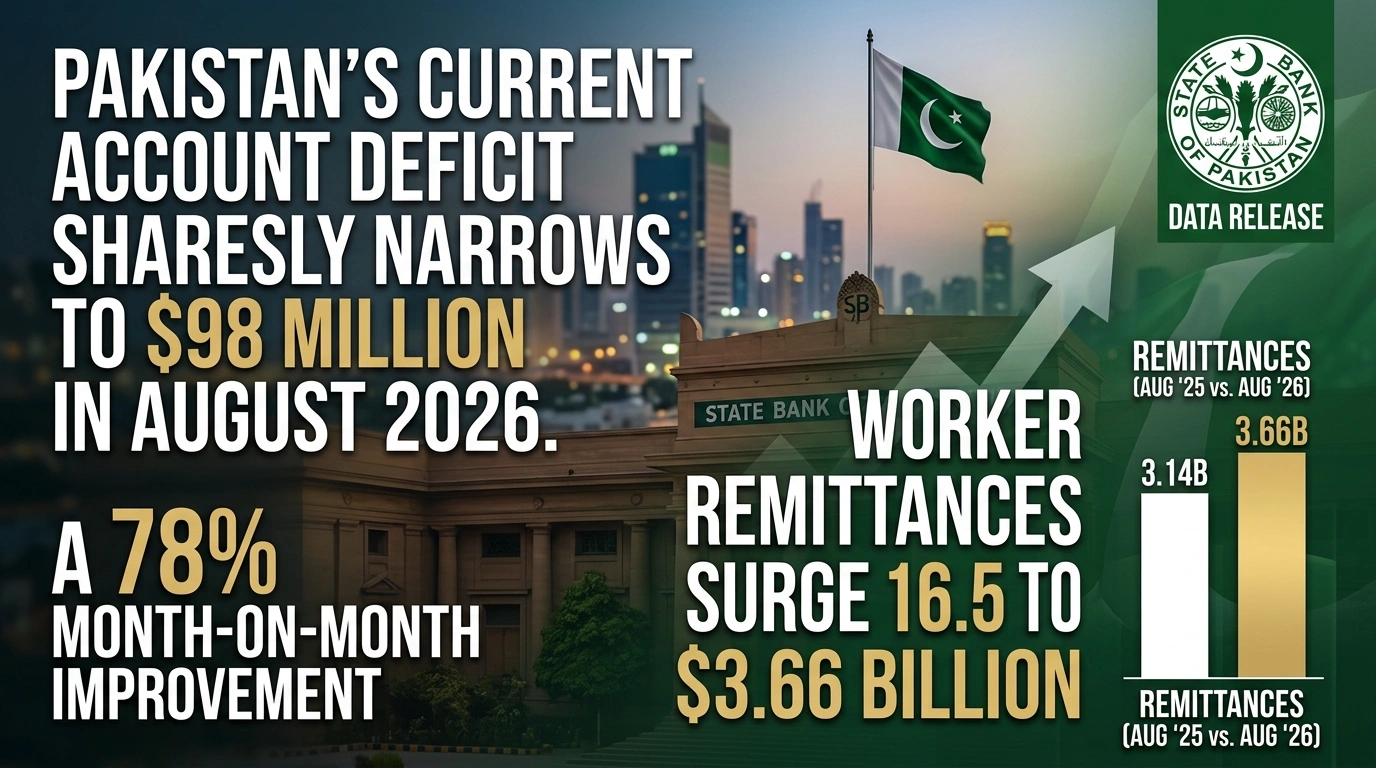
Karachi — Pakistan’s external balance demonstrated significant resilience as the monthly Current Account Deficit (CAD) contracted sharply to $98 million in August 2026, down 78% month-on-month from $445 million recorded in July 2026. Official data released by the State Bank of Pakistan (SBP) highlights that strong worker remittance inflows and steady export growth offset a surging import bill, providing crucial relief to the nation’s balance of payments.
Compared to the same period last year, the monthly shortfall narrowed by 69.7.3% from the $324 million deficit registered in August 2025. Cumulatively, during the first two months of the current fiscal year (2MFY27), Pakistan’s current account deficit stood at $543 million, marking a 36.3% reduction compared to the $853 million deficit incurred in 2MFY26, according to official economic indicators compiled by Dawn News Financial Analysis.
Key Drivers Behind August 2026 External Account Performance
1. Robust Remittance Inflows as the Core Anchor
Overseas Pakistani workers remitted $3.656 billion during August 2026, registering a 16.5% year-on-year (YoY) increase compared to $3.14 billion in August 2025 and a 0.7% month-on-month growth over July’s $3.63 billion.
- Saudi Arabia: Remained the largest contributor, accounting for $873.5 million (+19% YoY).
- United Arab Emirates (UAE): Inflows rose to $749.8 million (+17% YoY).
- United Kingdom & EU: Remittances from the UK totaled $563.7 million (+22% YoY), while European Union corridors dispatched $496 million (+7% MoM).
- United States: Inflows reached $308.9 million (+16% YoY).
Cumulative remittance inflows for 2MFY27 reached $7.29 billion, representing a 14.7% YoY increase from $6.36 billion recorded during the same period in FY26, as reported by Express Tribune Business.
2. Trade Balance and Import-Export Dynamics
- Exports of Goods & Services: Reached $3.33 billion in August 2026, reflecting a 5.0% YoY rise compared to $3.17 billion in August 2025.
- Imports of Goods & Services: Expanded to $6.64 billion, an increase of 8.0% YoY from $6.15 billion in August 2025, driven largely by essential industrial raw materials and energy imports required to support ongoing economic revival.
Macroeconomic Comparison Matrix: Current Account Breakdown
The table below illustrates the shift across key trade and primary income metrics for Pakistan’s balance of payments, as monitored by Trading Economics – Pakistan Balance of Payments:
| Economic Metric | August 2026 | July 2026 | August 2025 | 2MFY27 Cumulative | 2MFY26 Cumulative | YoY Shift (%) |
| Current Account Balance | -$98M | -$445M | -$324M | -$543M | -$853M | -36.3% |
| Worker Remittances | $3.656B | $3.630B | $3.140B | $7.286B | $6.353B | +14.7% |
| Total Exports (Goods & Services) | $3.330B | $3.180B | $3.170B | $6.510B | $6.120B | +6.37% |
| Total Imports (Goods & Services) | $6.640B | $6.520B | $6.150B | $13.160B | $12.380B | +6.30% |
| Foreign Exchange Reserves (Excl. CRR) | $17.280B | $16.900B | $14.520B | $17.280B | $14.520B | +19.0% |
| Net Foreign Direct Investment (FDI) | $315.9M | $185.2M | $175.1M | $501.1M | $342.0M | +46.5% |
Exchange Rate Competitiveness & FDI Momentum
REER and NEER Movements
Alongside the current account update, SBP data revealed that Pakistan’s Real Effective Exchange Rate (REER) index recorded a minor increase of 0.02% MoM, reaching 107.92 in August 2026 compared to 107.89 in July 2026.
Meanwhile, the Nominal Effective Exchange Rate (NEER) index depreciated by 0.79% MoM to 38.02 in August from 38.32 in July. While a REER above 100 indicates mild export price pressure, analysts cited by Reuters Global Markets note that exchange rate stability has helped maintain import predictability without severely penalizing key manufacturing sectors.
Surge in Foreign Direct Investment
Net Foreign Direct Investment (FDI) inflows saw a sharp increase, totaling $315.9 million in August 2026—an 80.4% YoY expansion compared to $175.1 million in August 2025. Key capital inflows targeted energy, telecommunications, and infrastructure projects, underscoring rising investor confidence supported by ongoing fiscal discipline and structural economic reforms monitored by Bloomberg Markets.
Macroeconomic Implications & Policy Outlook
- Foreign Reserve Buffer Expansion: Total SBP-held foreign exchange reserves (excluding CRR/SCRR) expanded to $17.28 billion, an increase of 19% YoY. This build-up strengthens Pakistan’s external liquidity buffer, providing over 2.6 months of import cover.
- Impact on Monetary Policy: The narrowing CAD and stable exchange rate dynamics offer the State Bank of Pakistan headroom to maintain a measured monetary easing cycle, encouraging domestic capital formation without reigniting demand-pull inflation.
- IMF Program Benchmark Compliance: Lower current account vulnerabilities position Pakistan favorably for ongoing review under international financial assistance programs, ensuring sustained access to multilateral funding channels.

Key Takeaways
- Japan is considering nearly doubling its midterm defense spending target to 3.5% of GDP — up from current levels of roughly 1.9% — under pressure from the Trump administration to match commitments made by NATO members and South Korea.
- A 3.5% target would amount to roughly ¥24 trillion annually, based on current GDP forecasts, more than double today’s spending level; a lower 3.0% target is also reportedly under consideration.
- Japanese 10-year government bond yields have already climbed to their highest levels since 1996, reflecting investor concern about how Japan — which carries the world’s highest debt-to-GDP ratio among advanced economies at nearly 240% — would finance the increase.
- Defense contractor stocks on the Tokyo Stock Exchange have risen in anticipation of the spending shift, even as broader market strategists warn the announcement could “send a shockwave through financial markets” concerned about PM Sanae Takaichi’s overall fiscal trajectory.
- A new five-year defense spending plan is expected by the end of 2026, meaning markets will be watching for confirmation of the final target — 3.0% or 3.5% — in the coming months.
Japan’s defense budget has broken its own record for 14 consecutive years, but the shift now under consideration in Tokyo represents something categorically different: a near-doubling of the country’s spending target, driven not by regional threat assessments alone but by direct pressure from Washington. For global economy watchers, the implications reach well beyond defense contractors into Japanese government bond markets, the yen, and the Bank of Japan’s already delicate policy path.
The New Target Under Consideration
According to people familiar with the matter, Japan’s government — under Prime Minister Sanae Takaichi — is weighing a new midterm defense spending target of 3.5% of GDP, aligning with commitments already made by NATO members and, more strikingly, by South Korea, which has pledged to reach that level over 10 years. Japanese defense officials have reportedly already signaled willingness to sharply increase spending in meetings with their US counterparts, though a lower 3.0% target remains an alternative under discussion.
To put the scale of this shift in context: until 2022, Japan maintained an informal spending ceiling around just 1% of GDP — a figure rooted in the country’s post-war pacifist constitutional framework. Takaichi has already accelerated Japan toward the more modest 2% target two years ahead of schedule, reaching nearly that level in the fiscal year ended March 2026. A jump to 3.5% would represent roughly ¥24 trillion in annual spending based on current GDP projections — more than double the current outlay, and a figure that dwarfs the roughly ¥9-10 trillion currently being requested for the next fiscal year’s defense budget alone.
Why Now: US Pressure and the NATO Benchmark
The push traces directly to the Trump administration’s broader effort to have allies shoulder more of their own defense costs and reduce reliance on the American military umbrella. The 3.5%-of-GDP figure has effectively become a global benchmark for US allies since NATO members adopted it, with Japan’s neighbors South Korea and Taiwan reportedly making similar pledges. For Tokyo specifically, the pressure carries added urgency given ongoing regional security concerns and the broader reassessment of US alliance commitments happening globally in 2026.
Notably, even Takaichi’s more modest current-year progress — nearing 2% of GDP two years ahead of schedule — already drew praise in Washington, but analysts at the Center for Strategic and International Studies have noted this success is likely to raise expectations for even further increases in Japan’s next defense buildup program, expected to be finalized by the end of 2026.
The Fiscal Math Problem
Japan’s fiscal starting position makes this proposal considerably more fraught than a simple budget-line adjustment. The country already carries the world’s highest debt-to-GDP ratio among advanced economies, at nearly 240% — meaning any large new spending commitment raises immediate questions about financing, whether through new bond issuance, tax increases, or some combination. Takaichi has publicly pledged to pursue a “responsible, proactive fiscal policy,” but bond markets are already signaling skepticism: Japanese 10-year government bond yields have climbed to their highest levels since 1996, reflecting growing investor concern about debt sustainability even before any formal 3.5% commitment is finalized.
Bond Market and Equity Reaction
The market response so far has bifurcated in a telling way. On one hand, major Japanese defense companies have risen on the Tokyo Stock Exchange as investors price in the prospect of substantially higher government contracts. On the other, the broader bond market reaction has been notably more cautious — rising JGB yields reflect concern that large new debt issuance to fund the buildup could strain Japan’s already stretched fiscal position, with potential knock-on effects for borrowing costs across the economy.
Spending Target Comparison
| Scenario | Target (% of GDP) | Est. Annual Spending | Status |
|---|---|---|---|
| Pre-2022 informal ceiling | ~1.0% | N/A | Historical baseline |
| Current target (achieved early) | ~2.0% | ~¥9-10 trillion | Reached FY2026, 2 years ahead of schedule |
| Under consideration (lower option) | 3.0% | N/A | Reportedly discussed |
| Under consideration (NATO-aligned option) | 3.5% | ~¥24 trillion | Reportedly discussed; matches South Korea’s 10-year pledge |
Why This Matters for the BOJ and Global Markets
A defense-spending shift of this magnitude complicates an already difficult picture for the Bank of Japan, which has been gradually moving away from decades of ultra-loose monetary policy even as it monitors the same Middle East-driven inflation pressures affecting central banks globally. Rising JGB yields tied to defense-spending concerns could interact with — and potentially amplify — the BOJ’s separate rate-hike considerations tied to domestic inflation, creating a more complex policy balancing act than either factor would present alone.
There’s also a broader global bond-market angle: some strategists have pointed to Japan’s rising rates as a factor behind a potential unwinding of the long-popular yen carry trade, in which investors borrow cheaply in Japan to invest in higher-yielding assets elsewhere. As Japanese yields climb — whether from defense spending, BOJ policy, or both — that trade becomes progressively less attractive, a dynamic some analysts have linked to recent volatility in global government bond markets more broadly, including the US Treasury market’s own yield surge this same week.
Frequently Asked Questions
Why is Japan considering raising defense spending to 3.5% of GDP?
The shift is driven primarily by pressure from the Trump administration for US allies to spend more on their own defense, aligning with commitments already made by NATO members and Japan’s neighbor South Korea, which pledged to reach 3.5% of GDP over 10 years.
How would Japan pay for a defense spending increase to 3.5% of GDP?
This remains unresolved and is a major market concern — Japan already carries the world’s highest debt-to-GDP ratio among advanced economies at nearly 240%, and rising Japanese government bond yields suggest investors are pricing in financing concerns ahead of any formal commitment.
When will Japan finalize its new defense spending target?
A new five-year defense spending plan is expected to be released by the end of 2026, which should clarify whether Japan settles on the 3.0% or 3.5% of GDP target currently under consideration.

Pakistan Freelancers Tax 2026: Payments, Documentation and Formal Growth

Strait of Hormuz Crisis: What the Latest Tanker Attacks Mean for Oil, Shipping and Global Trade

AI Customer Service in 2026: What’s Working, What’s Failing, and What to Buy

Open a Savings Account Online: How to Actually Earn 10x the National Average Rate

Global Housing Market 2026: Where Prices Rise, Where They Don’t

PSX and KSE-100 Record Highs: An Insider’s Guide to Pakistan Stocks

So Delicious Dessert Recall: Affected Products, FDA Guidelines, and Consumer Action

Pakistan’s Current Account Deficit Narrows Sharply to $98 Million in August 2026

Japan Eyes 3.5% Defense Spending: What It Means for Bonds, Stocks, and the BOJ

PSX & KSE Forecast 2026: Navigating the Latest IMF Reports & World Bank Metrics

Trump Administration’s Crypto Policy: Deregulation and the Future of Digital Assets

Monetary Policy and the Policy Rate

Gold, Silver & Bitcoin Prices Q4 2026: Wealth Management Strategies

Business Insurance for Digital Exports: Protecting Your Company in the AI Era

Top 15 Stocks for Investment in 2026 in PSX: Your Complete Guide to Pakistan’s Best Investment Opportunities
Top 15 Stocks for Investment in 2026 in PSX: Your Complete Guide to Pakistan’s Best Investment Opportunities

Debunking IMF Program Myths: Reconfiguring Engagement for True National Ownership in a Volatile World

Top 10 Mutual Fund Managers in Pakistan for Investment in 2026: A Comprehensive Guide for Optimal Returns

China’s 50% Domestic Equipment Rule: The Semiconductor Mandate Reshaping Global Tech

What the U.S. Attack on Venezuela Could Mean for Oil and Canadian Crude Exports: The Economic Impact

15 Most Lucrative Sectors for Investment in Pakistan: A 2025 Data-Driven Analysis

Pakistan’s Export Goldmine: 10 Game-Changing Markets Where Pakistani Businesses Are Winning Big in 2025
15 Most Lucrative Sectors for Investment in Pakistan: A 2025 Data-Driven Analysis

Pakistan’s Stock Market Renaissance: How 2025’s Hottest Investment Opportunity Is Democratizing Wealth—A Complete Beginner’s Guide
15 Most Lucrative Sectors for Investment in Pakistan: A 2025 Data-Driven Analysis

How to Become an Active Taxpayer on Pakistan’s FBR Active Taxpayer List (ATL) in 2026: A Step-by-Step Guide

Pakistan’s Economic Outlook 2025: Between Stabilization and the Shadow of Stagnation

Best Investments in Pakistan 2026: Top 10 Low-Price Shares and Long-Term Picks for the PSX
-
 Markets & Finance10 months ago
Top 15 Stocks for Investment in 2026 in PSX: Your Complete Guide to Pakistan’s Best Investment Opportunities
-
Markets & Finance10 months ago
Top 15 Stocks for Investment in 2026 in PSX: Your Complete Guide to Pakistan’s Best Investment Opportunities
-
 Analysis9 months ago
Debunking IMF Program Myths: Reconfiguring Engagement for True National Ownership in a Volatile World
-
 Investment9 months ago
Top 10 Mutual Fund Managers in Pakistan for Investment in 2026: A Comprehensive Guide for Optimal Returns
-
 Asia10 months ago
China’s 50% Domestic Equipment Rule: The Semiconductor Mandate Reshaping Global Tech
-
 Global Economy10 months ago
What the U.S. Attack on Venezuela Could Mean for Oil and Canadian Crude Exports: The Economic Impact
-
 AI10 months ago
15 Most Lucrative Sectors for Investment in Pakistan: A 2025 Data-Driven Analysis
-
 Exports10 months ago
Pakistan’s Export Goldmine: 10 Game-Changing Markets Where Pakistani Businesses Are Winning Big in 2025