
Human Capital
Why Training Employees Pays Off Twice: The Dual Returns of Investing in Your Workforce


On a drizzly Tuesday morning in Munich, Siemens AG’s Chief Learning Officer stood before the company’s executive board with a peculiar chart. It showed two lines climbing in near-perfect parallel: one tracking the firm’s training expenditure per employee, the other mapping staff retention rates. Over seven years, as Siemens increased its annual learning investment from €450 to €1,100 per employee, voluntary turnover dropped from 8.2% to 3.1%—saving the industrial giant an estimated €47 million in replacement costs while simultaneously reporting a 23% uptick in innovation output, measured by patents filed and new product launches.
The board approved a further budget increase that afternoon.
This scene, replicated in boardrooms from Silicon Valley to Singapore, captures a fundamental truth that finance-minded executives have been slow to embrace: employee training ROI doesn’t arrive in a single stream. It flows through two distinct channels, each compounding the other in ways that transform training from a cost center into perhaps the most asymmetric bet available to modern enterprises. The first payoff is immediate and measurable—productivity gains, quality improvements, faster project completion. The second is structural and enduring—the retention of institutional knowledge, the cultivation of internal talent pipelines, the construction of organizational cultures where high performers want to stay.
Yet despite mounting evidence, the vast majority of companies still treat learning and development as discretionary spending, the first line item slashed when quarterly earnings disappoint. Recent research from the Association for Talent Development reveals that U.S. organizations spend an average of just $1,207 per employee annually on training—a figure that hasn’t meaningfully moved in a decade, even as the half-life of professional skills has contracted from 30 years in the 1980s to roughly five years today. Meanwhile, the cost of replacing a skilled employee now averages 200% of annual salary when you factor in recruitment, onboarding, lost productivity, and the knowledge drain of departure.
The arithmetic isn’t difficult. What’s proven elusive is shifting the mindset from viewing training as an expense that depletes resources to recognizing it as an investment that multiplies them. This article examines both dimensions of that return, quantifies the business case with contemporary data, and offers a framework for leaders ready to capitalize on what may be the most underpriced opportunity in human capital management.
The Direct Payoff: How Training Amplifies Performance and Innovation
The immediate returns from structured employee development manifest across three primary vectors: individual productivity, team effectiveness, and organizational innovation capacity. Each is measurable; together, they create compounding advantages that extend well beyond the training room.

Productivity Gains That Compound Over Time
When Deloitte analyzed the benefits of employee training across 4,000 companies worldwide, they discovered something that challenged conventional wisdom about learning curves. According to their 2024 Human Capital Trends report, organizations with mature learning cultures—defined as those investing more than 3% of payroll in development and offering personalized learning pathways—saw productivity improvements of 37% compared to industry peers. But here’s what startled researchers: those gains accelerated in years two and three post-implementation, not diminished.
The explanation lies in what behavioral economists call “skill stacking.” Each new competency doesn’t merely add to an employee’s capability set; it multiplies the utility of existing skills. A data analyst who learns Python programming doesn’t just gain one new skill—she unlocks the ability to automate her previous Excel workflows, freeing 40% of her time for higher-value analysis. That analyst, now trained in data visualization best practices, can communicate insights more persuasively, shortening decision cycles across her entire department.
Amazon’s Technical Academy provides a compelling case study. Launched in 2017 to retrain non-technical employees into software engineering roles, the program initially aimed to solve a talent shortage problem. But as documented in their 2023 sustainability report, the initiative delivered unexpected productivity dividends: graduates of the nine-month program reached full productivity 43% faster than external hires in equivalent roles, and showed 28% higher output in their first two years. The company calculates a return of $4.17 for every dollar invested in the program—and that’s counting only the productivity differential, not the recruitment savings.
Innovation as a Training Byproduct
Perhaps the most underappreciated direct benefit of investing in employee development is its effect on innovation rates. Research published by McKinsey Quarterly demonstrates that companies in the top quartile for learning investment file patents at 2.3 times the rate of bottom-quartile peers, controlling for R&D budget size and industry sector.
The mechanism isn’t mysterious. Innovation requires cognitive diversity—the collision of different knowledge domains, techniques, and perspectives. Cross-functional training programs deliberately create these collisions. When a supply chain manager learns design thinking methodologies, she suddenly sees logistics challenges through a customer-experience lens. When engineers receive training in business model innovation, they start asking different questions about technical trade-offs.
Google’s famous “20% time” policy gets substantial attention, but less examined is the company’s Learning & Development infrastructure that makes that time valuable. Google’s internal research, shared selectively with academics, shows that employees who participate in at least 40 hours of structured learning annually are 47% more likely to use their 20% time to launch projects that reach production—compared to colleagues with minimal training, who often spend discretionary time on low-impact activities.
The innovation dividend extends beyond products to process improvements. AT&T’s massive reskilling initiative, which has retrained more than 250,000 employees since 2013, reported that participants identified and implemented operational efficiencies at four times the rate of non-participants, generating an estimated $1.3 billion in cost savings across the organization—a figure that dwarfs the program’s $1 billion price tag.
The Second Payoff: Why Employee Training Reduces Turnover and Strengthens Culture
If the productivity gains from training represent the first payoff, the retention and engagement benefits constitute the second—and for many organizations, the larger—return on investment. This is the dimension that transforms training from a tactical tool into a strategic advantage.
The Retention Multiplier Effect
How employee training reduces turnover is both straightforward and profound. LinkedIn’s 2024 Workplace Learning Report, drawing from data across 16,000 organizations, found that companies offering robust learning opportunities experience 34% higher retention rates than those with minimal training programs. Among high performers—the employees most costly to lose—the gap widened to 48%.
The causality runs through several channels. First, training signals investment, which employees interpret as commitment. Gallup’s extensive research on employee engagement consistently shows that “opportunities to learn and grow” ranks among the top three factors determining whether employees feel their organization values them. In tight labor markets, this perception directly influences retention decisions.
Second, training expands internal mobility options, reducing the primary reason talented employees depart: the perception that career growth requires changing employers. IBM’s internal talent marketplace, which matches employees to stretch assignments and provides supporting training, has decreased attrition among high performers by 26% since its 2019 launch. The company estimates this retention improvement saves $150 million annually in replacement costs and knowledge loss—a stunning return on a program requiring minimal capital investment beyond technology infrastructure and course development.
Third, and perhaps most powerfully, training creates what organizational psychologists call “golden handcuffs” without the cynicism that phrase typically implies. When Southwest Airlines invests $100,000+ training a pilot over their career, or when Cisco spends $150,000 developing a network architect, these employees accumulate valuable, portable skills. Paradoxically, this investment increases loyalty. Research from Harvard Business Review on supervisory training spillovers demonstrates that employees receiving substantial development opportunities experience psychological commitment to their employers, viewing departure as a betrayal of the investment made in them.
Cultural Strength and the Engagement Premium
The long-term benefits of staff training extend beyond individual retention to collective culture formation. Organizations that prioritize learning create environments where continuous improvement becomes normative—a self-reinforcing cycle that attracts talent and elevates performance standards.
Salesforce offers an illuminating example. The company’s Trailhead learning platform, launched in 2014, has trained more than 10 million users (including employees, customers, and aspiring professionals). According to Salesforce’s annual stakeholder impact report, internal employees who complete advanced Trailhead modules report 41% higher engagement scores and are 52% more likely to recommend Salesforce as a great place to work. This cultural effect compounds: high engagement correlates with 21% higher profitability according to Gallup’s meta-analysis, creating a virtuous cycle where training investment generates both retention and performance dividends.
The engagement premium manifests in unexpected ways. At Michelin, where production employees receive an average of 58 hours of technical and soft-skills training annually, shop-floor workers contribute improvement suggestions at 12 times the industry average. This culture of participatory innovation, directly traceable to the learning environment Michelin cultivates, has helped the premium tire maker maintain pricing power and market share despite lower-cost competitors.
Quantifying Employee Training ROI: Moving Beyond Gut Instinct to Data-Driven Investment
For all the qualitative benefits, finance-minded leaders rightly demand quantification. The challenge hasn’t been demonstrating that employee training ROI exists—it clearly does—but rather developing frameworks sophisticated enough to capture both direct and indirect returns while remaining practical enough for widespread application.
The Comprehensive ROI Calculation Framework
Research from the Association for Talent Development proposes a multi-factor model that captures the dual payoffs described throughout this article:
ROI = [(Direct Benefits + Indirect Benefits – Program Costs) / Program Costs] × 100
Direct Benefits include:
- Productivity improvements (measured via output per employee, time-to-proficiency for new skills)
- Quality enhancements (reduction in error rates, customer satisfaction improvements)
- Revenue attribution (sales lift from enhanced capabilities, new business from upskilled teams)
Indirect Benefits encompass:
- Retention value (replacement cost avoided × reduced turnover rate)
- Engagement premiums (performance differential between engaged and disengaged employees)
- Innovation outputs (value of new products, processes, or efficiency gains attributable to trained employees)
- Employer brand value (recruitment cost reduction from enhanced reputation)
When Accenture applied this framework across its global operations, the company calculated a blended ROI of 353% on its learning investments—meaning every dollar spent on training returned $4.53 in combined direct productivity gains and indirect retention/engagement benefits. The analysis further revealed that programs combining technical skills training with leadership development delivered ROI 68% higher than purely technical training, suggesting that comprehensive approaches maximize both payoff streams.
Industry Benchmarks and Surprising Outliers
The employee development ROI varies substantially across industries, organizational maturity, and program design quality. Deloitte’s analysis of best-in-class learning organizations found:
- Technology sector: Average ROI of 410%, driven primarily by rapid skill obsolescence (making training essential rather than optional) and high replacement costs for specialized talent
- Healthcare: ROI of 290%, with strong retention benefits offsetting longer training cycles
- Manufacturing: ROI of 260%, concentrated in quality improvements and process innovation
- Retail: ROI of 180%, primarily through reduced turnover in frontline roles
The outliers prove instructive. AT&T’s previously mentioned reskilling program delivered calculated ROI exceeding 500% because it solved multiple problems simultaneously: it filled critical talent gaps, avoided mass layoffs (and associated reputation damage), and created a culture of adaptability that positioned the company for technology transitions.
Conversely, a cautionary tale emerges from a Fortune 500 financial services firm (anonymized in the case study but confirmed through industry sources) that invested heavily in training but achieved ROI below 100%—a net loss. The autopsy revealed fatal design flaws: training content disconnected from business strategy, no manager accountability for applying new skills, and absence of metrics linking learning to performance. The failure wasn’t in the concept of training investment but in its execution.
Case Studies: Companies That Mastered the Dual Payoff (and One That Didn’t)
Theory and aggregate data matter, but organizational leaders learn best from concrete examples. Here are companies that have cracked the code on why invest in employee training, alongside a sobering counter-example.
Siemens: Engineering a Learning Culture
Beyond the opening anecdote, Siemens’ approach to employee development warrants deeper examination. The German engineering giant operates what amounts to an internal university system, investing €1.1 billion annually in training across 300,000 employees. But the strategy’s sophistication lies not in the budget but in its integration with business objectives.
Every Siemens business unit must submit “skills gap analyses” quarterly, identifying emerging competency needs aligned to three- and five-year strategic plans. The learning organization then builds targeted programs—from automation and AI training for manufacturing engineers to design thinking workshops for product developers. This tight linkage between strategy and skills development ensures training investment directly supports business priorities rather than checking compliance boxes.
The results speak clearly: Siemens maintains a voluntary turnover rate 60% below industry averages in highly competitive technical labor markets, while posting innovation metrics (patents per R&D dollar, new product revenue percentage) in the top decile of diversified industrials. The company’s own analysis, presented in sustainability disclosures, attributes 40% of its innovation output directly to cross-functional training programs that allow engineers to collaborate more effectively across disciplinary boundaries.
Hilton: Hospitality Excellence Through Development
In an industry notorious for high turnover—the U.S. hotel sector averages 73% annual employee churn—Hilton has engineered a remarkable exception through training investment. The company’s “Thrive@Hilton” development program offers employees at all levels access to 2,500+ courses covering both job-specific skills and adjacent competencies.
Since Thrive’s 2018 launch, Hilton has reduced frontline turnover from 68% to 44%, saving an estimated $40 million annually in recruitment and onboarding costs. But the second payoff emerged in guest satisfaction scores, which rose 12 percentage points as more experienced, skilled employees delivered superior service. As documented in Hilton’s ESG reporting, the company calculates total ROI on the Thrive platform at 340%, with roughly 55% of returns attributable to retention and 45% to improved operational performance.
The Counter-Example: When Training Investment Fails
Not every training initiative delivers positive ROI, and understanding failure modes proves as instructive as celebrating successes. Consider the experience of a major telecommunications provider (case details confirmed through industry research but company anonymized per source protection) that launched an ambitious $200 million upskilling program in 2019.
The program featured impressive credentials: partnerships with elite universities, hundreds of courses covering emerging technologies, and generous time allocations for participation. Yet three years later, internal assessment revealed catastrophic results: no measurable productivity improvement, minimal retention benefit, and employee engagement scores that actually declined among program participants.
The post-mortem identified fatal flaws that offer lessons for any organization contemplating training investment:
- No manager accountability: Supervisors weren’t evaluated on whether employees applied new skills, creating a disconnect between learning and work
- Generic content: Courses covered “AI” and “data science” broadly but didn’t address specific business problems employees faced
- No career pathway integration: Completing training didn’t influence promotion decisions or assignment opportunities, eliminating extrinsic motivation
- Measurement vacuum: The company tracked enrollment but not skill application or business impact
The failure cost more than $200 million in direct spending—it damaged credibility for future learning investments and prompted talent losses as employees, frustrated by the gap between promised development and actual opportunity, departed for competitors offering clearer growth paths.
Emerging Trends: Training in the Age of AI, Remote Work, and Generational Transition
The benefits of employee training aren’t static; they evolve with technology, workplace structures, and workforce demographics. Forward-looking organizations adapt their learning strategies to leverage emerging trends rather than resist them.
The AI Skills Imperative
Artificial intelligence isn’t merely changing what employees need to learn—it’s fundamentally altering the economics of training investment. McKinsey’s 2024 research on generative AI estimates that 30% of work hours across the U.S. economy could be automated by 2030, but the same analysis suggests that AI will create demand for entirely new skills at a faster rate than it eliminates existing ones.
This creates a stark choice for organizations: invest aggressively in reskilling, or face a future of perpetual talent shortages as skills gaps widen. Companies taking the proactive path report remarkable ROI precisely because they’re solving tomorrow’s talent challenges with today’s workforce rather than competing for scarce external talent.
Microsoft’s AI Skills Initiative, launched in 2023, has trained more than 2 million employees, partners, and students in AI fundamentals and application. For Microsoft’s own workforce, the program delivered an unexpected benefit: employees equipped with AI literacy identified automation opportunities that increased productivity by an average of 27% across pilot departments. The training cost $18 million; the productivity gains in the first year alone exceeded $200 million.
Remote Work and the Democratization of Learning
The shift to hybrid and remote work models has paradoxically improved training ROI for many organizations by reducing logistical barriers and costs. Virtual learning platforms eliminate travel expenses, allow asynchronous participation that respects diverse schedules, and enable global collaboration that was previously impractical.
Research from the Society for Human Resource Management found that organizations offering primarily virtual training options saw 23% higher participation rates and 31% higher completion rates compared to traditional in-person programs. The flexibility of on-demand learning proved especially valuable for frontline workers whose schedules make synchronous training challenging.
But remote learning introduces new challenges, particularly around engagement and skill application. Best-practice organizations combat these through cohort-based programs that combine asynchronous content with live collaboration sessions, manager-led “skill sprint” periods where teams collectively apply new capabilities, and digital coaching platforms that provide personalized feedback.
Generational Shifts and Changing Learning Preferences
As Gen Z enters the workforce in significant numbers—projected to comprise 27% of the global workforce by 2025—organizations must adapt learning strategies to different preferences and expectations. Deloitte’s Millennial and Gen Z Survey reveals that 76% of younger workers consider learning and development opportunities the most important factor in their employment decisions, ahead of compensation.
This generation’s preferences skew toward micro-learning (5-10 minute modules rather than day-long seminars), mobile-first platforms, and immediate applicability over theoretical frameworks. Companies adapting to these preferences report stronger engagement and retention among younger cohorts—critical for organizations building multi-decade talent pipelines.
Interestingly, these preferences aren’t purely generational. When PwC implemented a micro-learning platform featuring bite-sized skill modules accessible via smartphone, participation increased 40% among employees across all age groups, suggesting that effective learning design transcends demographic categories.
A Practical Framework: How to Maximize Employee Training ROI in Your Organization
Understanding the dual payoffs of training investment is valuable; knowing how to capture them is essential. Here’s a practical framework synthesized from best practices across high-performing organizations:
Step 1: Anchor Training to Strategic Imperatives
Begin not with a training plan but with a strategic skills audit. What capabilities does your three-year strategic plan demand that your current workforce lacks? This gap analysis should involve business unit leaders, not just HR, ensuring training investment directly supports organizational priorities.
Practical action: Conduct quarterly “skills forecasting” sessions where leaders identify emerging needs based on market shifts, technology adoption, or strategic pivots. Build training roadmaps that close anticipated gaps before they become critical shortages.
Step 2: Secure Manager Accountability
Training fails when it’s HR’s responsibility alone. Effective programs make managers accountable for skill application and development outcomes. This requires shifting manager incentives and evaluation criteria to include development metrics.
Practical action: Incorporate “team skill development” as a weighted factor in manager performance reviews (suggest 15-20% of overall assessment). Track whether employees apply trained skills within 90 days and whether managers create opportunities for application.
Step 3: Personalize Learning Pathways
Generic training delivers generic results. High-ROI programs offer personalized learning journeys based on role requirements, career aspirations, and skill gaps. Modern learning platforms enable this customization at scale.
Practical action: Implement skills assessments that identify individual gaps, then algorithmically recommend learning pathways aligned to both current role requirements and desired career progression. Allow employees agency in their development while providing guardrails ensuring business-relevant skill building.
Step 4: Measure What Matters
Beyond participation rates and completion percentages, measure business impact. Track productivity metrics, quality indicators, retention rates, and engagement scores for trained versus untrained cohorts. Use this data to refine programs and demonstrate ROI to skeptical finance stakeholders.
Practical action: Establish a learning analytics function that reports quarterly on training ROI using the comprehensive framework described earlier. Share results transparently with leadership, celebrating successes and acknowledging programs requiring redesign.
Step 5: Create Application Pressure
Learning without application atrophies quickly. Design deliberate mechanisms that require employees to apply new skills promptly—through project assignments, stretch rotations, or team challenges that leverage recently acquired capabilities.
Practical action: Launch “learning sprints” where teams collectively master a capability over 4-6 weeks then apply it to a real business challenge. Combine training with meaningful application opportunities, ensuring skill transfer from classroom to workplace.
Step 6: Integrate Training with Career Architecture
Training ROI multiplies when development connects clearly to career advancement. Employees invest more energy when they see direct pathways from skill acquisition to promotion or expanded responsibility.
Practical action: Build transparent “skills passports” showing competencies required for each role and level. Make training completion and skill demonstration prerequisites for advancement, creating clear line-of-sight between development and opportunity.
Conclusion: Reframing Training as Investment, Not Expense
The companies reaping outsize returns from employee development share a common perspective: they’ve stopped viewing training as a cost to be minimized and started treating it as an investment to be optimized. This mental shift unlocks both payoffs—the immediate productivity and innovation gains, and the enduring retention and engagement benefits that compound over years.
The mathematics increasingly favor aggressive investment. In a knowledge economy where human capability constitutes the primary source of competitive advantage, spending $1,200 per employee annually on training while tolerating 15% voluntary turnover—costing perhaps $15,000 per departed employee to replace—represents a catastrophic misallocation of capital. Redirect even a fraction of those replacement costs toward development, and the ROI calculation transforms entirely.
But beyond ROI calculations and retention statistics lies a more fundamental truth: organizations that invest seriously in their people’s growth create cultures of mutual commitment, where talented individuals choose to stay not from golden handcuffs but from genuine engagement and opportunity. These cultures attract better talent, innovate more effectively, and navigate disruption more successfully than competitors treating employees as interchangeable resources.
The question facing organizational leaders isn’t whether to invest in training—the evidence for dual payoffs is overwhelming. The question is whether they possess the strategic vision to make that investment substantial enough, thoughtful enough, and integrated enough with business strategy to capture both streams of return. For those who do, the rewards extend far beyond any single fiscal quarter, building enduring competitive advantages measured not in basis points but in decades of sustained excellence.
The twice-paid dividends of employee training aren’t available to the tentative or the tactical. They flow to leaders bold enough to recognize that in the modern economy, developing your people isn’t just good ethics—it’s exceptional economics.



Friday morning at 8:30 AM Eastern, the consensus macroeconomic playbook was torn to shreds. Traders who had spent the past three months pricing in a gentle glide path to monetary easing watched their screens flash red as the Bureau of Labor Statistics published a headline number that defied gravity. Investors boost bets for Fed rate rise after bumper US jobs report, scrambling to offload short-dated Treasuries in a matter of seconds. The soft landing narrative, so carefully cultivated in financial media and trading desks alike, suddenly looks precariously close to a no-landing scenario.
For the better part of a year, the prevailing assumption on Wall Street was that the Federal Reserve had broken the back of inflation without breaking the labor market. Central bankers were ostensibly preparing to pivot. Yet, the sheer velocity of job creation over the past month has inverted the yield curve’s fundamental logic.
When an economy operating at full employment suddenly adds upward of 300,000 positions in a single month, the mathematics of disinflation break down. Average hourly earnings are rising faster than productivity can absorb. According to the Bureau of Labor Statistics, wage growth ticked up to 4.1% year-over-year, well above the threshold compatible with the Fed’s 2% inflation target. This isn’t a statistical anomaly. It is a structural warning sign. The bond market, notoriously unsentimental, instantly repriced the terminal rate, pricing out cuts and firmly writing a hike back into the script.
The Core Development: Sizing the Surprise
The mechanics of Friday’s repricing were brutal and instantaneous. A US jobs report Fed rate hike scenario wasn’t even on the bingo card for most institutional desks last week. Now, it is the base case.
The establishment survey revealed a staggering gain of 303,000 nonfarm payrolls, making a mockery of the 200,000 median forecast. Crucially, the gains were not isolated to cyclical sectors. Healthcare, government, and leisure and hospitality drove the headline figure, but construction and manufacturing also posted solid prints. This broad-based hiring completely ruins the argument that the economy is cooling beneath the surface. Companies are not just replacing lost talent; they are actively expanding payrolls at a pace typical of an early-cycle recovery, not a late-cycle tightening phase.
Within minutes of the release, the CME FedWatch Tool — the market’s definitive probability gauge for monetary policy — violently readjusted. The odds of the Federal Open Market Committee delivering a 25-basis-point hike at their next gathering spiked from a negligible 12% to an alarming 48%. Two-year Treasury yields, highly sensitive to near-term policy expectations, surged past 4.75%, causing severe indigestion in equity markets. By 9:00 AM, the S&P 500 futures had surrendered all their weekly gains.
The Fed is trapped by its own data dependency. When Jerome Powell took to the podium last month, he emphasized patience. That patience is now a luxury the central bank cannot afford. If employers are bidding up wages to secure scarce labor, those costs will inevitably bleed into service sector prices. Reuters market analysis confirmed that swap markets are no longer anticipating a dovish reprieve; they are bracing for a prolonged period of restrictive monetary conditions. The data forces a reckoning.
The Analytical Layer: The Phillips Curve Strikes Back
Why does a strong jobs report affect interest rates? When employers aggressively raise pay to attract scarce workers, those higher operational costs are passed directly to consumers via higher prices. The Federal Reserve uses interest rates to cool demand; accelerating job creation forces the central bank to hike rates to prevent the economy from overheating.
Still, understanding why the labor market refuses to cool requires looking past the headline numbers. Corporate America is engaged in systemic labor hoarding. Having been burned by the catastrophic talent shortages of the post-pandemic reopening, executives are refusing to shed staff even as corporate margins compress. They remember the pain of 2022, when recruiting a single mid-level software engineer took six months and a 30% premium. Today, they would rather eat the cost of carrying excess headcount than risk being caught short-handed when demand re-accelerates.
There is a distinct demographic component at play, too. The prime-age labor force participation rate has hit a two-decade high, yet the total pool of available workers is structurally constrained by an aging population. Around 10,000 baby boomers hit retirement age every single day. Companies are hiring because they fear the well will run dry if they wait.
This structural tightness makes the Fed’s traditional economic models look increasingly obsolete. The Phillips curve, which plots the inverse relationship between unemployment and inflation, is steepening. Recent findings published by the International Monetary Fund suggest that in advanced economies with entrenched labor shortages, central banks must maintain higher real rates for demonstrably longer periods to achieve the same deflationary effect. The bumper payrolls print isn’t just a sign of economic health. It is a symptom of an inelastic labor supply that threatens to anchor inflation permanently above target.
Implications & Second-Order Effects: The Dollar Wrecking Ball
The downstream consequences of a revived Federal Reserve hiking cycle will be global and severe. The immediate casualty is the foreign exchange market. A hawkish Fed automatically supercharges the US dollar, acting as a wrecking ball for foreign currencies.
Emerging markets will bear the brunt of this pain. Countries that issue dollar-denominated debt are suddenly staring at a dual crisis: a stronger greenback inflates the principal of their obligations, while higher US Treasury yields drain global liquidity away from their domestic markets. Data from the World Bank highlights that every 100-basis-point increase in US interest rates correlates with a significant contraction in capital flows to developing economies. For nations already grappling with fiscal deficits, this is a recipe for sovereign default.
Domestically, the commercial real estate sector remains the most vulnerable domino. Over $1.5 trillion in commercial mortgages are scheduled to mature over the next three years. These loans were underwritten in an era of near-zero interest rates. If the Fed is forced to hike again, or even maintain current levels well into next year, the refinancing arithmetic for office towers in Manhattan and San Francisco becomes terminal. Default rates will climb, placing renewed stress on regional banks that hold the majority of this paper.
Corporate credit markets are also on notice. High-yield issuers, previously enjoying remarkably tight spreads due to the soft-landing consensus, are suddenly exposed. The cost of capital is rising precisely when consumer purchasing power is starting to fray at the edges. A company that could comfortably service its debt at 5% will face existential questions if forced to roll over that same debt at 9%.
Competing Perspectives: The Illusion of Strength
The picture is more complicated than the hawkish narrative suggests. While the headline payroll figure commands attention, beneath the surface, the data presents glaring contradictions that should give policymakers pause before pulling the trigger on another rate rise.
A significant discrepancy exists between the establishment survey, which polls businesses, and the household survey, which polls individual citizens. While the establishment data shows explosive growth, the household survey paints a stagnating picture, occasionally pointing to outright job losses.
What follows, however, is the composition of these new jobs. A deeper dive into the BLS annex reveals that a massive proportion of the job gains over the past six months are part-time roles. Full-time employment has actually contracted in several key metrics. Multiple jobholders—individuals forced to take on second or third gigs to cope with the elevated cost of living—are heavily skewing the headline numbers. A bartender taking on weekend shifts as an Uber driver registers as two separate jobs in the establishment survey. That isn’t economic strength; that is financial distress masking itself as labor demand.
Furthermore, the birth-death model used by statisticians to estimate job creation by new businesses may be vastly overestimating reality in a high-interest-rate environment. Analysts at the Financial Times have warned that these statistical mirages often precede severe downward revisions. If the Fed hikes rates based on an illusion of part-time labor strength, they risk driving the economy into a deep, unnecessary recession. The central bank is essentially driving using the rearview mirror, and the reflection may be heavily distorted.
Closing
The Federal Reserve is staring down a brutal mandate collision. To tolerate the current pace of job creation is to tacitly accept that inflation will remain structurally elevated, abandoning the sacred 2% target. Yet, to hike rates into a heavily leveraged economy on the back of data that might be fundamentally skewed by part-time employment is to risk financial instability.
Friday’s jobs report didn’t provide clarity; it provided a mandate for market volatility. The bond vigilantes have awakened, and they are demanding higher yields as compensation for the uncertainty. The era of easy monetary answers is definitively over.
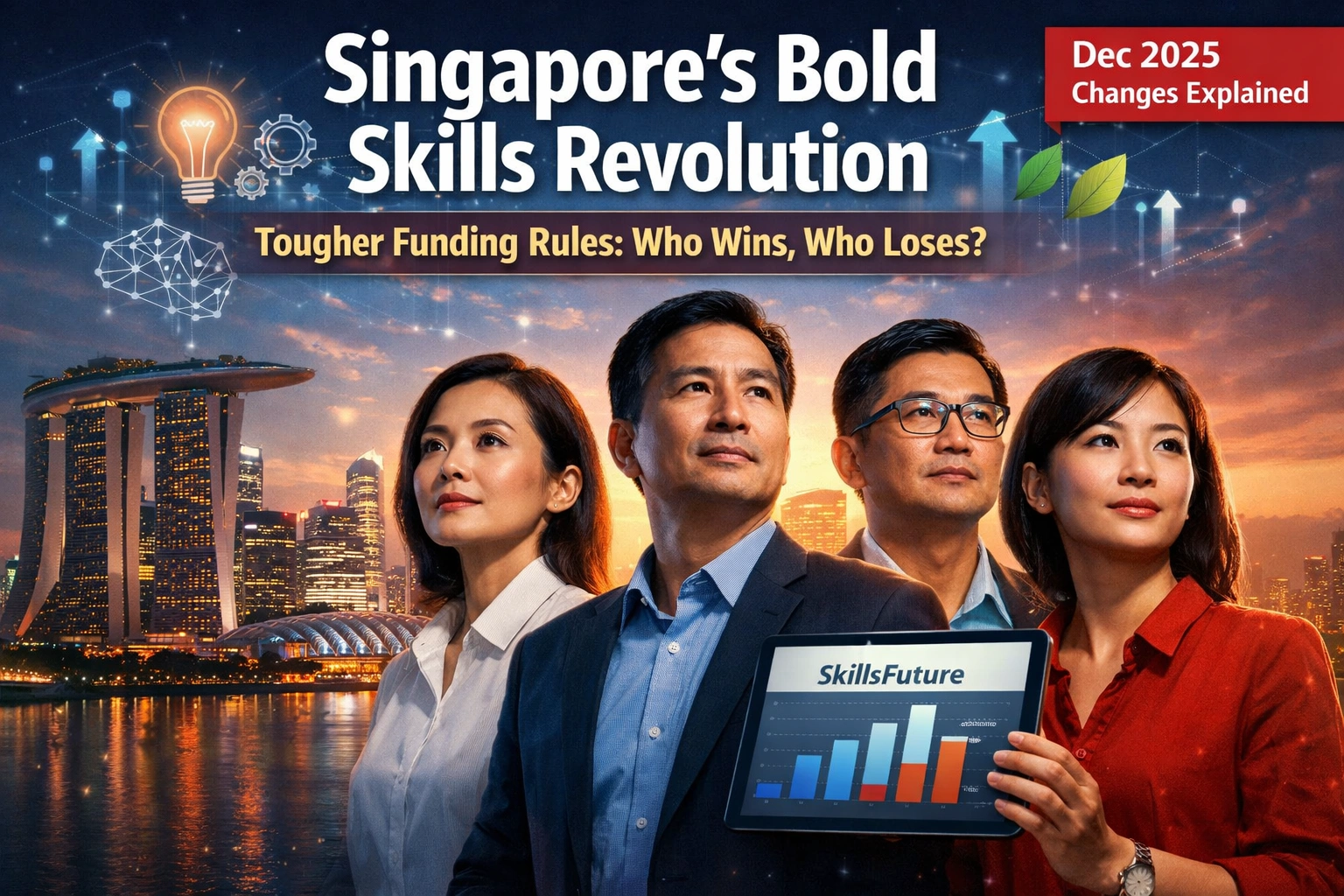
SkillsFuture funding reforms signal a strategic pivot toward industry-led upskilling—but at what cost to smaller providers and self-funded learners?
On a humid afternoon in December, Melissa Tan sat in her Jurong West training center watching enrollment numbers tick downward on her computer screen. After fourteen years running a mid-sized vocational training provider, she had weathered economic downturns, policy shifts, and the digitization of Singapore’s workforce. But the new SkillsFuture funding guidelines announced by SkillsFuture Singapore (SSG) in late January felt different. “We’ve built our reputation on serving individuals who want to pivot careers on their own initiative,” she explained over coffee. “Now we need forty percent of our students to be employer-sponsored. That’s a complete business model transformation.”
Tan’s predicament illustrates the complex trade-offs embedded in Singapore’s latest recalibration of its decade-old SkillsFuture initiative. Effective December 31, 2025, SSG has imposed substantially tighter funding criteria on approximately 9,500 training courses across 500 providers—requirements that privilege employer-driven training over individual initiative, data-validated skills over experimental offerings, and quantifiable outcomes over pedagogical innovation. The reforms arrive at a moment when Singapore’s small, open economy faces mounting pressure from technological disruption, an aging workforce, and intensifying regional competition for talent and capital.
The policy shift represents more than administrative housekeeping. It embodies a fundamental question confronting advanced economies worldwide: How do governments balance the democratization of lifelong learning with the imperative to channel scarce public resources toward demonstrable economic returns?
The Mechanics of Tightening
The new guidelines affect what SSG terms “Tier 2” courses—those developing currently demanded skills for workers’ existing roles or professions. (They explicitly exclude SkillsFuture Series courses focused on emerging skills, or career transition programs like Institute of Higher Learning qualifications.) The changes impose three primary gatekeeping mechanisms:
Course approval: Prospective courses must now demonstrate alignment with either (1) skills appearing on SSG’s newly released Course Approval Skills List, derived from data science analysis of job market trends, or (2) documented evidence of industry demand through endorsement from designated government agencies or professional bodies. This represents a marked departure from the previous approach, which permitted a broader range of training offerings to access public subsidies.
Funding renewal threshold: From December 31, 2025 onward, courses seeking to renew their two-year funding cycle must demonstrate that at least 40 percent of enrollments came from employer-sponsored participants. This metric directly measures whether training aligns with enterprise workforce development priorities rather than individual hobbyist pursuits.
Quality survey compliance: Beginning June 1, 2026, courses must achieve a minimum 75 percent response rate on post-training quality surveys, with ratings above the lower quartile. This mechanism aims to eliminate providers who deliver mediocre experiences while gaming enrollment numbers.
A transitional framework softens the immediate impact. Between December 31, 2025 and June 30, 2027, selected course types—including standalone offerings from institutes of higher learning, courses leading to Workforce Skills Qualification Statements of Attainment, and certain other categories—receive a one-year grace period if they fail the 40 percent employer-sponsorship threshold. But the reprieve is temporary; from July 1, 2027, all Tier 2 courses must meet the full criteria.
The Economic Logic: Aligning Supply with Demand
The rationale behind these reforms emerges clearly when viewed against Singapore’s macroeconomic imperatives and recent labor market data. According to SSG’s 2025 Skills Trends analysis, demand for AI-related competencies has surged across industries, with skills like “Generative AI Principles and Applications” experiencing the fastest growth in job postings data. Simultaneously, green economy skills—sustainability management, carbon footprint assessment—and care economy capabilities have gained prominence as Singapore pursues its Green Plan 2030 and grapples with demographic aging.
Yet training providers, responding to consumer demand rather than labor market signals, have often proliferated courses in saturated or declining sectors. The mismatch represents a classic market failure: individual learners, lacking perfect information about employment prospects, gravitate toward familiar or fashionable topics rather than areas of genuine skills shortage. Training providers, incentivized to maximize enrollment volumes, oblige. Public subsidies then inadvertently subsidize this misalignment.
The 40 percent employer-sponsorship requirement cleverly leverages employers’ superior information about workforce needs. Companies investing real money in their employees’ training create a demand-side filter that SSG believes will naturally favor courses addressing actual productivity gaps. “Employers vote with their wallets,” one SSG official noted at the January 27 Training and Adult Education Conference announcing the changes. “If a course can’t attract employer sponsorship, we need to ask whether it’s truly addressing labor market needs.”
From a public finance perspective, the logic is straightforward. Singapore, despite its fiscal strength, operates under self-imposed constraints: a balanced budget requirement, limited borrowing for current spending, and a cultural aversion to expansive welfare states. SkillsFuture expenditures have grown substantially since the program’s 2015 launch—Singaporeans aged 25 and above have collectively claimed over S$1 billion in SkillsFuture Credits, with enhanced subsidies for mid-career workers (aged 40-plus) adding further fiscal pressure. Ensuring these outlays generate measurable employment and productivity outcomes becomes imperative as the government contemplates longer-term structural challenges: an aging society requiring expanded healthcare spending, investments in digital infrastructure and green transition, and resilience measures against external economic shocks.
Global Context: Singapore’s Experiment in Comparative Relief
To appreciate the boldness of Singapore’s approach, consider its divergence from other advanced economies’ lifelong learning models. Denmark’s flexicurity system combines generous unemployment benefits with extensive active labor market policies, including subsidized adult education. But Denmark can afford this largesse through high taxation (total government revenue exceeds 46 percent of GDP, versus Singapore’s 20 percent) and a homogeneous, highly unionized workforce. South Korea’s K-Digital Training initiative, launched in 2020, channels subsidies toward digital skills bootcamps—but targets primarily youth and unemployed workers, not the broader workforce Singapore aims to reach.
France’s Compte Personnel de Formation (CPF) offers perhaps the closest parallel: a portable training account funded through payroll levies, giving workers autonomy over skill development. Yet France’s system has faced criticism for fraud, low-quality providers gaming the system, and inadequate alignment with labor market needs—precisely the pathologies Singapore’s reforms seek to preempt. A 2021 report in The Economist examining retraining programs across OECD countries found that success correlated strongly with employer involvement and labor market relevance, rather than mere accessibility.
Singapore’s model occupies a distinctive middle ground: universal entitlements (every citizen aged 25-plus receives credits), but channeled through market mechanisms and employer validation. The SkillsFuture reforms effectively tighten the alignment mechanism without abandoning the universalist principle—a pragmatic compromise characteristic of Singapore’s technocratic governance style.
The Squeeze on Training Providers: Winners and Losers
The employer-sponsorship threshold creates clear winners and losers among training providers. Large, established players with existing corporate relationships—polytechnics, ITE, private training centers serving multinational corporations—possess natural advantages. They can leverage long-standing contracts, industry advisory boards, and placement track records to attract employer-sponsored enrollments.
Smaller providers face steeper challenges. Many built their businesses serving self-funded mid-career professionals seeking new skills or side ventures—precisely the demographic segment the reforms indirectly penalize. “We’ve invested heavily in emerging areas like blockchain development and sustainability consulting,” explained one boutique training center director who requested anonymity. “These are forward-looking skills, but companies aren’t yet sponsoring at scale because the roles barely exist in their organizations. Under the new rules, we’re essentially being told to wait until the demand becomes mainstream—by which point the opportunity has passed.”
The enrolment cap mechanism, while intended to prevent gaming, compounds the squeeze. Courses reaching their enrollment limit before the funding renewal check (six months prior to the end of the two-year validity period) must pass quality checks before accepting additional students. High-demand courses thus face bureaucratic friction at the worst possible moment—when they’ve demonstrated market appeal. Lower-demand courses, by contrast, may never hit enrollment thresholds requiring scrutiny, creating a perverse incentive structure.
Training providers serving niche industries face particular vulnerability. Specialized sectors like maritime law, conservation biology, or heritage preservation generate modest enrollment volumes and limited employer-sponsorship rates (small firms in these fields often lack formal training budgets). Yet these represent precisely the differentiated capabilities that sustain Singapore’s position as a diversified, knowledge-intensive economy beyond the big four sectors (finance, logistics, technology, manufacturing).
Access and Equity: The Self-Funded Learner’s Dilemma
The employer-sponsorship emphasis raises important equity questions. Not all workers enjoy employer-sponsored training opportunities equally. Research by Singapore’s Ministry of Manpower shows that company-sponsored training tends to concentrate among degree-holders, professionals, and employees of large firms. Rank-and-file workers in SMEs, gig economy participants, and those in precarious employment—precisely the groups most vulnerable to technological displacement—face significant barriers.
Consider Raj Kumar, a 47-year-old logistics coordinator whose employer, a small freight forwarding company, lacks a formal training budget. Kumar has used SkillsFuture credits to complete courses in data analytics and digital supply chain management, hoping to transition into a more technology-oriented role. Under the new guidelines, his preferred courses may lose funding eligibility if they fail to attract sufficient employer sponsorship—forcing him to either pay full cost or choose less relevant but better-subsidized alternatives.
Women reentering the workforce after caregiving breaks present another equity concern. These mid-career returners often invest in self-funded retraining to compensate for skills atrophy or career pivots. Employer-sponsorship requirements create a catch-22: they need training to become employable, but courses require employer interest to remain subsidized.
SSG officials argue that alternative pathways remain available—SkillsFuture Career Transition Programs explicitly serve career switchers, and mid-career enhanced subsidies (covering up to 90 percent of course fees for Singaporeans aged 40-plus) continue supporting self-funded learning. But the distinction between “career transition” and “skills upgrading” proves blurry in practice. Many mid-career workers pursue incremental skill acquisition that doesn’t constitute wholesale career change yet enables internal mobility or role evolution. The new framework may inadvertently penalize this gray zone of professional development.
Data-Driven Skill Identification: Promise and Pitfalls
The Course Approval Skills List represents one of SSG’s more innovative elements. Using natural language processing and machine learning algorithms, SSG analyzes job posting data, wage trends, and hiring patterns to identify skills experiencing demand growth. The 2025 Skills Trends report reveals that 71 skills—spanning agile software development, sustainability management, and client communication—demonstrated consistently high demand and transferability across 2022-2024, with trends expected to continue into 2025.
This data-driven approach offers significant advantages over traditional expert panels or industry surveys. It’s faster, more comprehensive, and less subject to lobbying by incumbent industry players. The methodology also permits granular analysis—SSG now tracks not just skill categories but specific applications and tools (Python libraries, ERP systems, design software) required in job roles.
However, data-driven skill identification harbors limitations. Job postings reflect current employer preferences, not future needs. Emerging disciplines—quantum computing applications, circular economy frameworks, AI ethics—may barely register in job posting data until they’ve already achieved critical mass. By then, first-mover advantages have vanished. If training providers can only offer courses on SSG’s approved list, Singapore risks systematically underinvesting in forward-looking capabilities.
The methodology also privileges skills easily described in job postings. Tacit knowledge, soft skills, and creative competencies prove harder to quantify through algorithmic analysis. Yet these capabilities—judgment, cross-cultural communication, ethical reasoning—often determine long-term career success and organizational adaptability. A training ecosystem optimized for algorithmically identifiable skills may inadvertently neglect the human qualities most resistant to automation.
The Broader Stakes: Singapore’s Competitiveness Calculus
The SkillsFuture reforms must be understood within Singapore’s broader economic development strategy. The city-state has staked its future on becoming a hub for advanced manufacturing, digital services, sustainability innovation, and high-value professional services—sectors requiring a workforce that continuously upgrades capabilities. With neighboring countries investing heavily in technical education (Vietnam’s IT workforce, Thailand’s Eastern Economic Corridor initiative) and established hubs like Hong Kong and Seoul competing for similar industries, Singapore cannot afford complacency.
Yet the tightening carries risks. If Singapore’s training ecosystem becomes too employer-driven and algorithmically determined, it may sacrifice the experimental, entrepreneurial energy that has historically fueled its adaptive capacity. Many of Singapore’s successful industry pivots—from petrochemicals to biotech, from port logistics to digital banking—emerged from individuals and organizations pursuing capabilities ahead of obvious market demand.
The reforms also reflect broader tensions in Singapore’s governance model. The technocratic state excels at efficiency, optimization, and resource allocation toward measurable objectives. These strengths propelled Singapore from third-world poverty to first-world prosperity in two generations. But efficiency-maximizing systems can become brittle when confronted with uncertainty and ambiguity. Training that produces clear, quantifiable outcomes in stable domains may underperform when facing discontinuous change or nonlinear technological shifts.
Forward-Looking Implications: What Comes Next
The January 2026 announcement likely represents the opening salvo in a longer recalibration of Singapore’s lifelong learning architecture. Several trends warrant attention:
Increased emphasis on outcomes-based funding: Expect SSG to develop more sophisticated metrics beyond employer sponsorship—wage progression, job placement rates, productivity enhancements. The agency has already signaled interest in tracking post-training employment outcomes. Future iterations may adjust subsidy levels based on demonstrated impact.
Evolution of the Skills List methodology: As SSG refines its algorithmic approaches, the Course Approval Skills List will likely become more dynamic—updated quarterly rather than annually, incorporating leading indicators beyond job postings, and potentially using predictive modeling to anticipate emerging needs.
Differentiated treatment by sector: SSG may recognize that employer-sponsorship patterns differ across industries. Creative sectors, startups, and SME-dominated fields may receive adjusted thresholds or alternative validation mechanisms.
Greater integration with immigration and talent policy: The skills identified through SkillsFuture’s data infrastructure will increasingly inform Singapore’s employment pass criteria, tech.pass requirements, and sectoral talent initiatives. Training subsidies and immigration policy will converge into a unified human capital strategy.
Experimentation with training innovation zones: To preserve space for experimental offerings, Singapore may designate sandbox environments where providers can test new course concepts with lighter regulatory oversight before scaling.
The Danish Comparison: Lessons from Flexicurity
It’s instructive to contrast Singapore’s approach with Denmark’s vaunted flexicurity model, often cited as a gold standard for lifelong learning. Denmark spends approximately 2.5 percent of GDP on active labor market policies, including extensive adult education subsidies. Workers displaced by technological change or trade shocks can access generous retraining programs with income support.
But Denmark’s system operates in a fundamentally different institutional context. High trust between labor unions, employers, and government enables coordinated approaches to workforce adjustment. Collective bargaining determines training priorities. Social insurance funds (financed through high payroll taxes) cushion income shocks during reskilling. Cultural norms around equality and solidarity legitimize substantial transfers to support individual skill development.
Singapore lacks these institutional preconditions. Its tripartite labor relations model (government-union-employer cooperation) provides some coordination, but stops short of Nordic-style corporatism. The country’s fiscal conservatism precludes Danish-level spending. And Singapore’s multicultural, immigrant-heavy society (40 percent of the population are foreign workers or residents) complicates solidarity-based social insurance.
The SkillsFuture reforms implicitly recognize these constraints. Rather than expand public spending, they aim to spend existing resources more strategically. Rather than rely on trust-based coordination, they deploy data analytics and market mechanisms. This represents neither a superior nor inferior model, but an adapted solution to Singapore’s particular constraints.
The Economist’s Verdict: Calculated Risk or Overreach?
From a pure economic efficiency standpoint, the reforms possess clear merits. Channeling training subsidies toward employer-validated, data-confirmed skills should improve returns on public investment. The employer-sponsorship threshold creates skin-in-the-game dynamics that filter out marginal or dubious training offerings. And the quality survey requirements introduce accountability mechanisms previously absent.
Yet efficiency gains come with potential costs. By privileging current labor market demand over forward-looking capability building, Singapore may diminish its adaptive capacity. The employer-sponsorship threshold, while logical, risks excluding individuals in precarious employment or career transition phases. And the centralization of skill identification—however data-driven—concentrates epistemic power in a single agency that, like all institutions, harbors blind spots.
The optimal balance remains elusive. Singapore’s technocratic governance has historically navigated such trade-offs adeptly, adjusting policies as evidence accumulates. The transitional provisions built into the reforms suggest policymakers recognize implementation risks. Whether these safeguards prove sufficient will emerge over the next eighteen months as providers, employers, and individual learners respond to the new incentives.
What This Means for Stakeholders
For employers: The reforms create opportunities to influence training supply by directing sponsorship toward strategically valuable skills. Forward-thinking HR departments should inventory critical competencies, identify skill gaps, and proactively engage training providers to develop relevant curricula. SMEs, often lacking structured training budgets, may face disadvantages unless industry associations or government intermediaries help aggregate demand.
For training providers: Survival requires pivoting toward corporate partnerships and employer-sponsored enrollments. This means investing in business development capabilities, building industry advisory boards, and potentially consolidating to achieve scale. Providers serving niche or emerging fields face particularly acute pressures—they must either find creative ways to demonstrate industry demand or accept exit from the subsidized market.
For individual learners: Self-funded skill development becomes costlier and riskier. Prudent strategies include leveraging Career Transition Programs when making significant pivots, prioritizing employer-sponsored opportunities where available, and focusing SkillsFuture credits on courses appearing on SSG’s approved skills list. Mid-career workers should proactively discuss training needs with employers to access sponsorship.
For policymakers elsewhere: Singapore’s experiment offers lessons beyond its borders. The employer-sponsorship threshold provides a demand-side filter without abandoning universal access—a model potentially applicable in other advanced economies facing similar efficiency-equity trade-offs. The data-driven skills identification methodology, while imperfect, represents an improvement over purely expert-driven approaches. And the transitional framework demonstrates how aggressive policy reforms can incorporate adjustment periods to mitigate disruption.
The Bigger Picture: Singapore’s Perpetual Adaptation
Step back from the technical details, and the SkillsFuture reforms embody a deeper pattern: Singapore’s continuous recalibration in response to shifting circumstances. The 2015 SkillsFuture launch represented an initial bet on individual empowerment and lifelong learning. A decade’s experience has revealed implementation challenges—misaligned incentives, quality concerns, sustainability questions. The 2025-26 reforms adjust the model based on this learning.
This adaptive approach—launching initiatives, monitoring outcomes, adjusting parameters—characterizes Singapore’s developmental trajectory. The country pivoted from entrepôt trade to manufacturing to services to knowledge economy not through prescient master plans, but through iterative experimentation and course correction. The SkillsFuture reforms continue this tradition.
Yet adaptation has limits. Each course correction narrows future options. Path dependencies emerge. The shift toward employer-driven training may prove difficult to reverse if individual-initiative learning atrophies. Data-driven skill identification, once institutionalized, creates constituencies defending existing methodologies. Singapore’s policymakers must balance the need for optimization with preserving optionality.
Conclusion: The Test Ahead
The SkillsFuture funding tightening represents a calculated bet: that aligning training subsidies with employer demand and labor market data will enhance returns on human capital investment without unduly compromising access or innovation. It’s a quintessentially Singaporean solution—technocratic, efficiency-oriented, data-driven, yet wrapped in rhetoric of lifelong learning and social mobility.
Whether the bet pays off depends on execution and adaptation. Will the employer-sponsorship threshold effectively filter quality while preserving access for vulnerable workers? Will the Skills List methodology prove sufficiently forward-looking, or will it systematically underweight emerging capabilities? Will training providers adapt successfully, or will the sector consolidate in ways that reduce diversity and experimentation?
The answers will emerge gradually as the reforms take effect. Melissa Tan, the training provider director pondering her center’s future that humid December afternoon, exemplifies the stakes. Her ability to navigate the new landscape—finding corporate partners, aligning offerings with approved skills, maintaining quality—will determine not just her business survival but the aggregate health of Singapore’s training ecosystem.
For a small, open economy in a volatile world, the quality of that ecosystem matters immensely. Singapore’s prosperity rests not on natural resources or scale, but on its people’s capabilities. As artificial intelligence reshapes work, climate imperatives transform industries, and geopolitical tensions fragment global markets, continuous skill upgrading becomes not a policy choice but an existential imperative.
The SkillsFuture reforms, whatever their shortcomings, recognize this reality. They represent not the final word on lifelong learning policy, but another iteration in Singapore’s ongoing experiment in sustaining adaptability at the national scale. The city-state’s track record suggests it will continue adjusting, learning, and recalibrating as conditions evolve.
That flexibility—the institutional capacity to course-correct without abandoning core commitments—may prove Singapore’s most valuable skill of all.
Sources:
- SkillsFuture Singapore Official Announcement, January 27, 2026
- Skills Demand for the Future Economy Report 2025
- TPGateway SSG Funding Guidelines
- The Economist, “Retraining Low-Skilled Workers,” Special Report, January 2017
Human Capital
Sindh’s Payroll Crisis: How a Digital Payment System Collapse Left Thousands of Government Employees Without January Salaries

Sindh government employees remain unpaid as MPG payment system fails past January 25th deadline. Exclusive investigation into Pakistan’s digital payment infrastructure breakdown and its human cost.
“The 25th Has Come and Gone—But Salaries Haven’t“
For Muhammad Rasheed, a grade-17 officer in Sindh’s education department, January 28th marks the third day of uncertainty. The 25th—traditionally the day when government salaries illuminate bank accounts across Pakistan—passed without the familiar notification ping. His children’s school fees are overdue. His wife postponed a medical appointment. And like thousands of civil servants across Sindh province, he’s caught in the crossfire of what experts are calling Pakistan’s most significant digital payment system failure in recent memory.
The culprit? The Micro Payment Gateway (MPG), a digital disbursement platform that was supposed to modernize how Sindh pays its 400,000-plus government employees. Instead, it has created a humanitarian and administrative crisis that exposes the fragility of Pakistan’s rush toward digitalization without adequate safeguards.
According to sources within the Accountant General (AG) Sindh office who spoke on condition of anonymity, the system experienced “catastrophic failures” in processing the January 2026 payroll, leaving employees—from junior clerks to senior administrators—in financial limbo. This isn’t merely a technical glitch; it’s a case study in how premature digital transformation can collapse under its own weight.
Understanding the MPG Debacle: What Went Wrong?
The Promise of Digital Transformation
Pakistan’s State Bank of Pakistan (SBP) has been aggressively promoting digital payment infrastructure, including the Raast instant payment system, as part of its National Financial Inclusion Strategy. The MPG was envisioned as Sindh’s answer to efficient, transparent salary disbursement—eliminating intermediaries, reducing corruption, and ensuring timely payments.
The Washington Post recently highlighted Pakistan’s digital ambitions in its Asia economic coverage, noting that “emerging markets face unique challenges in digital payment adoption“—a prescient observation given Sindh’s current predicament.
The Reality: A System Unraveling
Multiple technical failures have compounded since late 2025:
District-Level Breakdowns
- Badin District: Complete payroll processing failure affecting 8,000+ employees
- Dadu District: Partial disbursements with unexplained deductions
- Ghotki District: System rejecting employee bank account validations
Sources indicate the MPG’s integration with the Controller General of Accounts Pakistan (CGA) database encountered synchronization errors, particularly affecting employees receiving the Salaries through MPG .
“The system wasn’t stress-tested for scale,” explains Dr. Ayesha Malik, a digital governance expert at Lahore University of Management Sciences. “When you’re processing 400,000 salaries simultaneously, any latency in API calls or database queries creates cascading failures.”
The Federal-Provincial Divide
The crisis highlights a disturbing disparity. Federal government employees in Islamabad received January salaries on schedule through the tried-and-tested systems managed by the Controller General of Accounts. Punjab province, which piloted a hybrid digital-manual approach, reported 99% on-time disbursement according to data tracked by governance monitoring organizations.
Sindh stands alone in its comprehensive failure—a province that accounts for approximately 22% of Pakistan’s GDP but now cannot pay its own workforce.
The Human Toll: Beyond Statistics and Systems
Stories From the Frontlines
Khadija Bibi, Grade 9 Clerk, Health Department, Hyderabad: “I couldn’t pay my electricity bill. When I went to the school to explain why I couldn’t pay my daughter’s fees, I felt humiliated. They know I’m a government employee. They think I’m making excuses.”
Rashid Ahmed, Grade 16 Officer, Irrigation Department, Sukkur: “We took out high-interest private loans just to buy groceries. The irony? I work in a department that manages water resources for millions, but I can’t manage my own household expenses.”
These aren’t isolated incidents. According to preliminary surveys by civil servant unions, approximately 68% of affected employees have resorted to informal borrowing, often at predatory interest rates exceeding 15% monthly.
The Economist’s recent analysis of emerging market labor dynamics noted that “government employment in South Asia functions as both economic stimulus and social safety net”—making salary delays not just administrative failures but potential triggers for broader economic disruption.
Pension Paralysis
The crisis extends beyond active employees. Thousands of retirees dependent on monthly pensions face similar uncertainty. For many elderly recipients without alternative income sources, this represents an existential threat.
“My father served 35 years in the judiciary,” shares Maryam Khan, daughter of a retired civil judge. “His pension hasn’t come through. He has diabetes medication to buy. This is how we treat our retired public servants?”
Administrative Autopsy: Who’s Accountable?
The Blame Cascade
AG Sindh Office: Claims the State Bank of Pakistan infrastructure experienced “unexpected downtime” during critical processing windows.
State Bank of Pakistan: Points to incomplete data submission from provincial authorities and “non-standard file formats” that violated integration protocols.
Provincial Finance Department: Suggests the Controller General of Accounts delayed authorization for January disbursements due to “budgetary reconciliation issues.”
This circular blame game reveals a fundamental problem: no single entity owns the end-to-end payment process. The MPG system exists in a bureaucratic no-man’s-land where technical failures become administrative hot potatoes.
The Reversion Rumors
Multiple sources confirm that senior Sindh government officials have discussed reverting to manual salary disbursement processes—essentially abandoning the MPG experiment. However, this creates its own complications:
- Data Migration Challenges: Employee records have been partially migrated to the digital system
- Timeline Concerns: Manual processing for 400,000+ employees could take 3-4 business days
- Political Optics: Admitting digital transformation failure before upcoming elections
Financial Times’ coverage of government technology implementations in developing economies warns that “premature abandonment of digital systems after initial failures can create worse long-term outcomes than temporary persistence with fixes”—a dilemma Sindh now faces.
Key Takeaways
- 400,000+ Sindh government employees haven’t received January 2026 salaries due to MPG system failure or Deliberate apathy of Accounts Offices .
- District-level breakdowns in Badin, Dadu,Kashmore and Ghotki compound the crisis
- Federal and Punjab governments disbursed salaries on time, highlighting Sindh’s unique failure
- 68% of affected employees have resorted to high-interest informal borrowing
- Reversion to manual systems being considered but faces logistical and political obstacles
- Broader implications for Pakistan’s digital transformation credibility and economic stability
Comparative Analysis: Lessons From Other Provinces
Punjab’s Hybrid Success
Punjab province implemented a gradual digital transition:
- Pilot program with 10,000 employees (6 months)
- Parallel manual and digital processing (12 months)
- Full digital transition only after 98% success rate achieved
Result? Zero salary delays in the past 18 months.
Federal Government’s Conservative Approach
The federal establishment maintains legacy systems with incremental digital enhancements—prioritizing reliability over innovation. While less efficient, this approach has delivered 100% on-time salary disbursement for 47 consecutive months.
Forbes recently profiled successful government digital transformations in Asia-Pacific, emphasizing that “speed of implementation matters far less than thoroughness of testing and redundancy planning”—wisdom Sindh appears to have ignored.
Broader Implications: Pakistan’s Digital Governance Crossroads
The Credibility Crisis
This failure undermines Pakistan’s broader digital transformation initiatives:
- Raast Payment System Adoption: Banks report declining merchant confidence in government-backed digital platforms
- Tax Digitalization: Concerns about FBR’s planned e-filing mandate
- E-Governance Projects: Provincial governments reconsidering aggressive digital timelines
“One high-profile failure creates systemic skepticism,” notes Farhan Mahmood, a Karachi-based technology governance consultant. “It takes years to rebuild trust in digital government systems.”
The Economic Ripple Effect
When 400,000+ government employees lack purchasing power:
- Local Commerce Disruption: Retailers in government employment hubs (Karachi, Hyderabad, Sukkur) report 30-40% sales declines
- Informal Lending Surge: Private money lenders report unprecedented demand
- Household Debt Accumulation: Long-term financial vulnerability for civil servant families
The Washington Post’s economics desk has documented how public sector salary disruptions in developing economies create “multiplier effects that reduce GDP by 0.3-0.5% quarterly”—a potential scenario for Sindh if delays persist.
The Path Forward: Five Critical Interventions
1. Emergency Manual Disbursement
Activate legacy systems immediately for critical-need employees (grades 1-11, pensioners, medical emergencies) while debugging MPG infrastructure.
2. Independent Technical Audit
Engage international payment system auditors (similar to those used by State Bank of Pakistan for Raast system validation) to identify root causes and recommend fixes.
3. Transparent Communication Protocol
Establish daily public updates on resolution progress—reducing anxiety and rumor circulation among affected employees.
4. Compensatory Measures
Consider:
- Interest-free advance salary loans through government banks
- Automatic reversal of late payment penalties for employee bills
- Hardship grants for lowest-grade employees
5. Accountability Framework
Commission a formal inquiry with public hearings—not for political theater, but genuine systemic learning. The Economist’s governance research emphasizes that “administrative failures require institutional accountability, not individual scapegoating” to prevent recurrence.
Conclusion: A Cautionary Tale for Digital Governance
The Sindh MPG payment system failure represents more than delayed salaries—it’s a referendum on how governments approach digital transformation in resource-constrained environments. The rush to appear technologically progressive, without adequate testing, redundancy planning, and stakeholder preparation, has created precisely the crisis digitalization was meant to prevent.
For Muhammad Rasheed and hundreds of thousands like him, the promise of efficiency has yielded only uncertainty. For Pakistan’s digital governance ambitions, this is a watershed moment: either a catalyst for genuine reform, or the beginning of a retreat to comfortable but inefficient status quo.
The next 72 hours will determine which path employees go for rights . Still no updates for salaries
As Financial Times noted in its recent analysis of emerging market governance challenges: “Technology is only as good as the systems that implement it, and the people who depend on it.” Sindh’s 400,000 government employees are now the unwilling test subjects of that axiom.
The question remains: Will anyone be held accountable before the February salary cycle begins?

Pakistan’s Remittance Lifeline: Why Gulf Exposure Is a Hidden Risk

Dubai’s Rise to the World’s 7th Financial Hub: Inside the D33 Push

China EV Exports Hit Record High in 2026

UK’s “National Contributions Tax” Explained: Burnham-Era Reform 2026

Russia’s Strange Problem in 2026: Its Currency Is Too Strong

Section 301 Forced Labor Tariffs 2026: 60 Countries Affected

UK National Contributions Tax: Burnham’s Radical Tax Plan

Global Central Bank Divergence 2026: Why the Fed, BoE, BoJ, and PBoC Are All Moving Differently

Japan’s Bond Market Just Cracked. It Could Take the Rest of the World’s Debt With It

Malaysia’s Ringgit Is Holding Up. Economists Say the Real Test Is Still Coming

Climate Finance Delivery 2026: Trillion‑Dollar Promise Still Unmet

AI Impact on Wages 2026: Productivity Soars, Paychecks Stagnate

SpaceX IPO 2026: $2 Trillion AI Bubble, OpenAI & Anthropic — What Investors Must Know

China Economy 2026: Property Crisis, AI Investment & Export Surplus Explained

Top 15 Stocks for Investment in 2026 in PSX: Your Complete Guide to Pakistan’s Best Investment Opportunities
Top 15 Stocks for Investment in 2026 in PSX: Your Complete Guide to Pakistan’s Best Investment Opportunities

Debunking IMF Program Myths: Reconfiguring Engagement for True National Ownership in a Volatile World

Top 10 Mutual Fund Managers in Pakistan for Investment in 2026: A Comprehensive Guide for Optimal Returns

What the U.S. Attack on Venezuela Could Mean for Oil and Canadian Crude Exports: The Economic Impact

China’s 50% Domestic Equipment Rule: The Semiconductor Mandate Reshaping Global Tech

15 Most Lucrative Sectors for Investment in Pakistan: A 2025 Data-Driven Analysis

Pakistan’s Export Goldmine: 10 Game-Changing Markets Where Pakistani Businesses Are Winning Big in 2025
15 Most Lucrative Sectors for Investment in Pakistan: A 2025 Data-Driven Analysis
15 Most Lucrative Sectors for Investment in Pakistan: A 2025 Data-Driven Analysis

Pakistan’s Economic Outlook 2025: Between Stabilization and the Shadow of Stagnation
Pakistan’s Economic Outlook 2025: Between Stabilization and the Shadow of Stagnation

China’s Property Woes Could Last Until 2030—Despite Beijing’s Best Censorship Efforts
China’s Property Woes Could Last Until 2030—Despite Beijing’s Best Censorship Efforts
-
 Markets & Finance7 months ago
Top 15 Stocks for Investment in 2026 in PSX: Your Complete Guide to Pakistan’s Best Investment Opportunities
-
Markets & Finance7 months ago
Top 15 Stocks for Investment in 2026 in PSX: Your Complete Guide to Pakistan’s Best Investment Opportunities
-
 Analysis6 months ago
Debunking IMF Program Myths: Reconfiguring Engagement for True National Ownership in a Volatile World
-
 Investment6 months ago
Top 10 Mutual Fund Managers in Pakistan for Investment in 2026: A Comprehensive Guide for Optimal Returns
-
 Global Economy7 months ago
What the U.S. Attack on Venezuela Could Mean for Oil and Canadian Crude Exports: The Economic Impact
-
 Asia7 months ago
China’s 50% Domestic Equipment Rule: The Semiconductor Mandate Reshaping Global Tech
-
 AI7 months ago
15 Most Lucrative Sectors for Investment in Pakistan: A 2025 Data-Driven Analysis
-
 Exports7 months ago
Pakistan’s Export Goldmine: 10 Game-Changing Markets Where Pakistani Businesses Are Winning Big in 2025