
AI
The Hidden Cost of AI ‘Workslop’: Why Professionals Are Creating It — and How Organisations Can Stop It

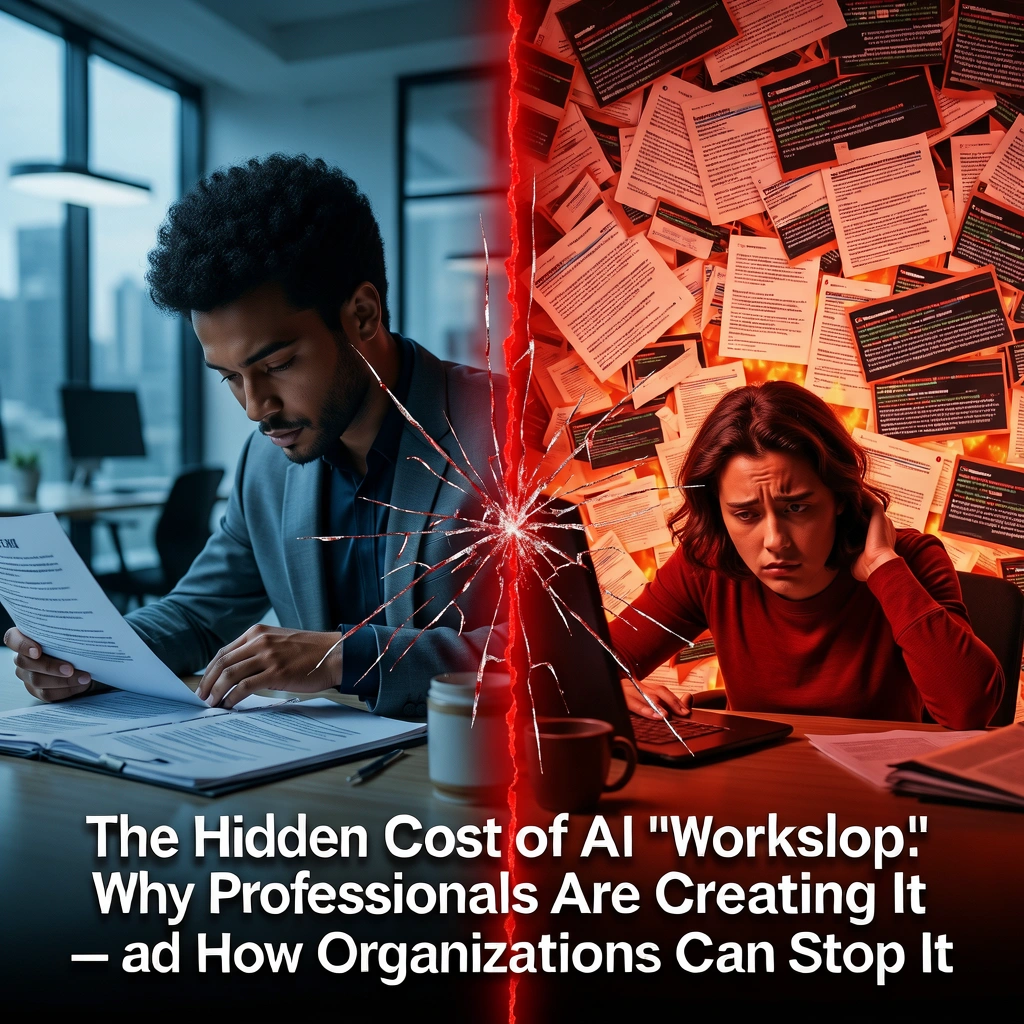
On a frigid Tuesday morning in January, a senior product manager at a Fortune 500 technology company opened what appeared to be a thoughtful three-page strategy memo from her colleague. The formatting was impeccable. The executive summary promised “actionable insights.” But as she read deeper, something felt wrong. The prose was oddly verbose yet strangely hollow—sentences that said everything and nothing simultaneously. Bullet points proliferated without prioritisation. Key decisions were buried in passive constructions. By the third paragraph, she recognised the telltale signs: this was AI-generated work, polished just enough to seem legitimate, but fundamentally empty.
She’d just encountered workslop.
Welcome to 2026’s defining workplace problem—one that paradoxically intensifies even as organisations invest billions in generative AI to boost productivity. While executives herald artificial intelligence as the great accelerator of knowledge work, something darker is emerging from the spreadsheets: a flood of low-quality AI generated content that masquerades as professional output while offloading cognitive labour onto everyone else.
What Is AI Workslop—and Why Should Leaders Care?
The term “workslop,” coined by researchers at Stanford University and BetterUp in 2025, describes AI-generated workplace content that meets minimum formatting standards but lacks substance, clarity, or genuine insight. Think of it as the professional equivalent of content farm articles: superficially plausible, fundamentally worthless, and designed more to signal effort than to communicate ideas.
Workslop AI manifests across every digital workplace surface. That rambling email that could’ve been two sentences. The slide deck with stock phrases like “synergistic opportunities” and “strategic imperatives” but no actual strategy. The meeting summary that somehow requires three pages to convey what everyone already discussed. The report that reads like a thesaurus exploded onto a template.
Unlike obviously bad writing, workslop is insidious precisely because it appears acceptable at first glance. It has proper grammar, professional vocabulary, formatted headers. It follows templates. But consuming it—trying to extract actual meaning—becomes exhausting cognitive work that the creator has outsourced to the reader.
According to research published in Harvard Business Review in January 2026, the average knowledge worker now encounters workslop in roughly 35% of internal communications, up from virtually zero two years ago. More alarmingly, the same research found that processing workslop consumes approximately four hours per week of professional time—time spent deciphering, clarifying, and essentially doing the cognitive work the original creator avoided.
The math is brutal. For a 1,000-person organisation where the average employee earns $80,000 annually, that’s approximately $9.2 million in annual productivity loss. And that’s the conservative estimate, accounting only for direct time costs. It excludes strategic errors from misunderstood communications, damaged professional relationships, and the slow erosion of organisational trust.
The Generative AI Productivity Paradox Takes Shape
Here’s the uncomfortable truth: we’re witnessing a generative AI productivity paradox.
Organisations have embraced AI tools at unprecedented speed. Forbes reported in late 2025 that 78% of Fortune 1000 companies now provide employees with access to ChatGPT, Claude, or similar platforms. Microsoft Copilot has penetrated 65% of enterprise customers. The promise seemed obvious: automate routine communications, accelerate document creation, amplify individual productivity.
Yet productivity gains remain stubbornly elusive. Research from the National Bureau of Economic Research found that while individuals using AI tools report feeling more productive, their colleagues frequently report the opposite—spending more time on email, meetings, and clarifications. The pattern emerging is stark: AI doesn’t eliminate work; it redistributes it, often unfairly.
When one person uses AI to generate a meandering three-page email in 30 seconds, they’ve saved themselves time. But if that email requires five recipients to spend 10 minutes each deciphering it, the organisation has lost 50 minutes to save one person half a minute of careful writing. It’s productivity theatre masquerading as innovation.
“We’re creating a tragedy of the commons in corporate communications,” explains Dr. Sarah Chen, an organisational psychologist who studies technology adoption. “Every individual has an incentive to use AI to reduce their own cognitive load, but when everyone does it simultaneously, the collective burden actually increases.”
Why Intelligent Professionals Create Workslop: The Psychology of Cognitive Offloading
Understanding how to avoid AI workslop begins with understanding why people create it—and the answer is more nuanced than simple laziness.
The Seduction of Effortless Output
Generative AI tools offer something intoxicating to overwhelmed knowledge workers: instant competence. Faced with a blank screen and a looming deadline, the ability to summon 500 professionally formatted words with a single prompt feels like magic. The cognitive relief is immediate and powerful.
Neuroscience research shows that our brains are wired to take the path of least resistance. When AI offers to handle the “tedious” work of structuring arguments, finding synonyms, or expanding bullet points into paragraphs, declining feels almost irrational. Why struggle with phrasing when the machine can do it instantly?
But here’s what’s lost in that exchange: the struggle is the work. Transforming vague thoughts into precise language forces clarity. Wrestling with how to structure an argument reveals which ideas actually matter. The friction of writing is where understanding happens. When we outsource that friction to AI, we outsource the thinking itself.
Performance Pressure and the AI Arms Race
Many professionals create AI slop workplace content not from laziness but from fear.
In organisations where colleagues are using AI, abstaining feels like unilateral disarmament. If your peer can produce a 20-slide deck in an hour while you’re still outlining yours, are you falling behind? If the team expects rapid-fire email responses and AI makes that possible, can you afford to slow down and craft thoughtful replies?
This dynamic creates a vicious cycle. As The Washington Post reported, many professionals describe feeling “obligated” to use AI tools even when they suspect the output is inferior. The perception that everyone else is using AI—whether accurate or not—becomes self-fulfilling.
“I know my AI-generated status reports aren’t as clear as what I used to write by hand,” admitted one consultant who spoke on condition of anonymity. “But leadership expects them weekly now instead of monthly, and I simply don’t have time to write four thoughtful reports a month. So I prompt, I polish for ten minutes, and I send. I hate that my name is on something mediocre, but what choice do I have?”
Organisational Incentives That Reward Volume Over Value
The workslop epidemic isn’t solely a people problem—it’s a systems problem.
Many organisations have inadvertently created incentive structures that reward the appearance of productivity over actual value creation. When success metrics emphasise deliverables completed, emails sent, or reports filed rather than decisions improved or problems solved, AI becomes an enabler of performative work.
Consider the phenomenon of “AI mandates without guidance.” CNBC documented how several major corporations have encouraged or even required employees to use generative AI tools—framed as “staying competitive” or “embracing innovation”—without providing clear frameworks for appropriate use. The message employees receive is essentially: use AI more, but we won’t tell you when or how.
The result is predictable. If using AI is valorised regardless of outcome, and quality is difficult to measure, employees will use AI for everything. Quantity becomes the proxy for competence.
Tool Design Flaws: When AI Makes Slop Too Easy
Finally, we must acknowledge that current generative AI tools are almost designed to produce workslop.
Most AI assistants operate on a principle of prolixity—when uncertain, they add words. A single sentence of input can yield paragraphs of output, all grammatically correct, much of it filler. The tools don’t naturally distinguish between situations requiring depth and those requiring brevity. They don’t ask, “Is this the right medium for this message?” or “Have I actually said anything meaningful?”
Moreover, the friction required to create workslop is near-zero, while the friction required to create something genuinely good remains high. Generating mediocre content takes one prompt. Creating exceptional content still requires human judgment, iteration, editing—the very work AI was supposed to eliminate.
Until tool designers build in more friction for low-value outputs or more support for high-value thinking, the path of least resistance will continue producing slop.
The Real Cost: Why AI Reduces Productivity Despite Individual Gains
The damage from AI workslop extends far beyond wasted time.
The Productivity Tax Compounds
Research from Axios and workplace analytics firm ActivTrak found that processing low-quality AI content doesn’t just consume time—it fragments attention and depletes decision-making capacity.
When professionals encounter workslop, they face a choice: invest energy trying to extract meaning, or request clarification (which creates more work for everyone). Either option imposes costs. The first depletes cognitive resources needed for strategic work. The second generates additional communication overhead and delays.
Over time, these micro-costs accumulate into macro-dysfunction. Teams spend more time in “alignment meetings” because written communications no longer align anyone. Projects stall because requirements documents are simultaneously verbose and vague. Strategic initiatives falter because the business case was generated rather than reasoned.
“We’re seeing organisations where 60% of email volume is essentially noise,” notes Michael Torres, a management consultant who advises on digital workplace practices. “People have started assuming that anything longer than three paragraphs can be safely ignored, which means genuinely important communications are now getting buried alongside the slop.”
Trust Erosion in Professional Relationships
Perhaps more corrosive than the time cost is the damage to professional credibility and trust.
When colleagues recognise that someone is routinely submitting AI-generated work with minimal thought, respect diminishes. The implicit message is clear: “I don’t value your time enough to think carefully before communicating with you.” Over time, this erodes the social capital required for effective collaboration.
Several organisations interviewed for this article reported a concerning trend: professionals increasingly ignore communications from colleagues known to produce workslop. One executive described creating an informal “filter list” of people whose emails he automatically skims for essential information while disregarding analysis or recommendations.
“It’s a tragedy,” he acknowledged. “Some of these are talented people. But I’ve learned that their AI-generated memos are unreliable, so I just extract the data and ignore their conclusions. That’s probably causing me to miss good ideas, but I don’t have time to sift through the filler.”
This dynamic is particularly damaging for early-career professionals who haven’t yet established reputations. When senior leaders encounter workslop from junior team members, they form lasting impressions about competence and judgment—impressions that may be undeserved but difficult to reverse.
Decision-Making Degradation
Most dangerous is workslop’s impact on organisational decision-making.
AI-generated work problems often hide in the space between what’s written and what’s meant. A strategy recommendation might sound plausible but rest on flawed assumptions the AI didn’t understand. A risk assessment might list generic concerns without identifying the actual specific vulnerabilities. A project post-mortem might catalogue events without extracting lessons.
When leaders make decisions based on AI-generated analysis they assume was human-reasoned, they’re building on potentially unstable foundations. Several executives described situations where strategic decisions were made based on compelling-sounding recommendations, only to discover later that the underlying analysis was superficial—the product of AI summarising publicly available information rather than domain expertise.
“We nearly acquired the wrong company because the due diligence memo was beautifully formatted nonsense,” confided one private equity principal. “The analyst had used AI to expand his notes into a full report, but the AI didn’t understand our investment thesis. We only caught it when someone noticed a logical inconsistency buried in paragraph fourteen.”
Workslop in the Wild: Real-World Examples Across Sectors
To understand the phenomenon’s pervasiveness, consider these anonymised examples from different industries:
Technology sector: A product team at a major software company implemented a policy requiring weekly written updates. Within a month, these updates—once concise and insightful—had bloated to multi-page documents filled with phrases like “optimising for synergistic outcomes” and “leveraging agile methodologies to drive stakeholder value.” Product managers were spending 90 minutes weekly generating these reports and roughly the same reading everyone else’s. Actual status could have been communicated in a 5-minute standup.
Professional services: At a global consulting firm, junior consultants began using AI to draft client deliverables, then having senior partners review and approve. Partners initially appreciated the time savings—until clients started providing feedback that reports were “generic” and “lacking industry insight.” The firm’s differentiation had always been deep contextual understanding; AI was systematically stripping that away. Client renewals declined 12% year-over-year.
Financial services: A European investment bank encouraged traders and analysts to use AI for market commentary and research notes. Within weeks, recipients were complaining that the analysis had become “undifferentiated” and “obvious.” The AI could summarise public information beautifully but couldn’t offer the proprietary insights that justified premium fees. The bank quietly reversed its AI encouragement policy.
Government/public sector: A national regulatory agency (outside the US) began using AI to draft policy guidance documents. The resulting materials were so dense and jargon-heavy that compliance officers reported spending more time interpreting the guidance than they would have under the previous, simpler system. What was intended to accelerate regulatory clarity instead created confusion.
These aren’t isolated incidents. They represent a pattern: organisations adopting AI for efficiency gains, initially seeing positive signals, then discovering that quality degradation imposes costs that eventually exceed the efficiency benefits.
How Organisations Can Stop the Workslop Epidemic: Evidence-Based Solutions
Addressing workslop requires interventions at multiple levels: cultural, structural, and technological. Leading organisations are pioneering approaches that preserve AI’s benefits while preventing its misuse.
1. Establish Clear Guidelines for Appropriate AI Use
The most effective organisations don’t ban AI—they define when and how it should be used.
Financial Times documented how several European firms have implemented “traffic light” frameworks:
- Green (encouraged): Using AI for initial research, brainstorming, formatting assistance, grammar checking, translation
- Yellow (use with caution): Drafting external communications, summarising complex documents, creating templates
- Red (prohibited or requires disclosure): Final client deliverables without human verification, strategic recommendations, performance reviews, legal documents
The key is specificity. Generic guidance like “use AI responsibly” proves meaningless in practice. Concrete rules—”all client-facing documents must be reviewed and edited by a human, with AI assistance disclosed if substantial”—provide actionable boundaries.
2. Train for Human-in-the-Loop Best Practices
Simply providing AI tools without training is like distributing scalpels without medical school. Leading organisations are investing in structured training programmes that teach effective AI collaboration.
These programmes emphasise several principles:
- Use AI as a thought partner, not a ghostwriter: Engage AI in dialogue to refine your thinking, then write the final version yourself
- Never send AI-generated content without substantial editing: If you can’t improve the AI’s output meaningfully, you probably don’t understand the topic well enough
- Apply the “telephone test”: If you couldn’t explain the content verbally with the same clarity, don’t send the written version
- Favour brevity over AI-generated expansion: If AI suggests adding paragraphs to your bullet points, resist unless each addition adds genuine value
Some organisations have implemented “AI literacy” certification programmes, similar to data security training, ensuring all employees understand both capabilities and limitations.
3. Redesign Incentives to Reward Quality Over Quantity
Stopping workslop ultimately requires addressing the organisational conditions that incentivise it.
Progressive firms are shifting metrics:
- Instead of tracking “reports completed,” measure “decisions improved” or “clarity ratings” from recipients
- Replace requirements for lengthy updates with brief, structured formats (Amazon’s famous six-page memos, but actually written by humans)
- Implement 360-degree feedback that specifically assesses communication quality and efficiency
- Recognise and reward professionals who communicate effectively with fewer, better-crafted messages
One technology company experimented with a provocative policy: any email longer than 200 words required VP approval. While ultimately too restrictive, the initial trial dramatically reduced communication volume and improved clarity. The modified version—any email over 200 words must include a three-sentence summary at the top—proved sustainable.
4. Build Technical Controls and Transparency
Some organisations are implementing technical measures to create accountability:
- Watermarking or disclosure requirements: Some enterprise AI tools now include metadata indicating AI involvement, allowing recipients to calibrate expectations
- Usage monitoring: Analytics that identify individuals generating unusually high volumes of AI content, triggering coaching conversations
- Quality checking tools: AI-powered systems that ironically detect AI-generated content and flag it for human review before sending
While these approaches raise legitimate privacy concerns and shouldn’t become surveillance systems, transparent implementation can help organisations understand usage patterns and identify where intervention is needed.
5. Model Alternative Behaviour from Leadership
Perhaps most critically, senior leaders must demonstrate that thoughtful, concise human communication is valued and rewarded.
When executives send brief, carefully considered emails rather than AI-generated essays, they signal priorities. When leaders openly discuss their AI use—”I used ChatGPT to research this topic, then wrote this analysis based on what I learned”—they model appropriate transparency. When promotions go to people who communicate with clarity rather than volume, the message resonates.
“I started ending important emails with a note: ‘This email was written by me without AI assistance because this decision matters,'” shared one CFO. “It sounds almost comical, but the feedback was overwhelmingly positive. People told me they noticed the difference and appreciated the care.”
The Path Forward: Will Workslop Fade or Persist?
Looking ahead, several scenarios could unfold.
The optimistic view suggests that workslop represents growing pains—an inevitable phase as organisations learn to integrate powerful new tools. As AI literacy improves, social norms against slop solidify, and tools become more sophisticated at generating genuinely useful content, the problem may naturally recede.
Some evidence supports this optimism. The Economist noted in late 2025 that organisations in their second or third year of widespread AI adoption show better usage patterns than those in their first year. Cultures develop antibodies. People learn what works and what doesn’t.
The pessimistic view holds that workslop may be symptomatic of deeper limitations in how we’re deploying generative AI. If the fundamental value proposition is “create more content with less effort,” we shouldn’t be surprised when people create more low-value content. The problem isn’t user education—it’s the mismatch between the tool’s capabilities and the actual needs of knowledge work.
This perspective suggests we need different tools entirely. Rather than AI that helps you write more, perhaps we need AI that helps you think more clearly, summarise more concisely, or communicate more precisely. Tools designed for quality rather than quantity.
The likely reality probably lies between these poles. Workslop won’t disappear entirely—it’s too easy to create and too tempting under pressure. But organisations that take it seriously as a cultural and operational challenge can substantially mitigate it. Those that don’t will find themselves drowning in a flood of plausible-sounding nonsense, watching productivity gains evaporate despite significant AI investment.
The broader question is whether the current generation of generative AI tools will prove to be genuinely transformative for knowledge work or merely another technology that seems revolutionary until organisations discover its hidden costs. Workslop may be our first clear signal that the answer is more complicated than the hype suggested.
Conclusion: Choose Clarity Over Convenience
Two years into the generative AI revolution, we’re learning an uncomfortable truth: tools that make it easier to create content don’t automatically make communication more effective. Sometimes, they make it worse.
The solution isn’t to reject AI—the technology offers genuine value when deployed thoughtfully. But we must resist the siren call of effortless output and recognise that good communication, like good thinking, requires effort. There are no shortcuts to clarity.
For leaders, the imperative is clear: establish guardrails, model best practices, and redesign systems that inadvertently reward slop. Create cultures where concision is prized and where the quality of thinking matters more than the volume of deliverables.
For individual professionals, the choice is equally stark: you can either do the cognitive work yourself and build a reputation for clear thinking, or you can outsource that work to AI and accept the professional consequences. Your colleagues will notice the difference, even if they don’t say so.
The hidden cost of AI workslop isn’t just measured in dollars or hours. It’s measured in degraded decision-making, eroded trust, and the slow corrosion of professional standards. We’re at a fork in the road: one path leads toward more thoughtful integration of AI that amplifies human judgment; the other leads toward increasingly automated mediocrity.
Which path your organisation takes isn’t determined by technology. It’s determined by choices—about what you value, what you reward, and what you’re willing to tolerate.
Choose carefully. The clarity of your communications may determine the quality of your future.



Why the AI Revolution Is Breaking the Link Between Output and Labor Income
Artificial intelligence is transforming the modern workplace at a breathtaking pace. Generative AI tools are drafting legal briefs, diagnosing medical images, writing software code, and managing supply chains with superhuman efficiency. Yet a landmark report from the International Labour Organization, released on June 15, 2026, reveals a troubling disconnect: while global labor productivity has accelerated to a 3.2% annual clip, real median wages in advanced economies have risen a mere 0.8% (ILO World Employment and Social Outlook, June 2026). The AI boom, it appears, is delivering a productivity miracle that primarily rewards capital owners and the highest‑skilled technologists, leaving the typical worker behind.
The Labour Share in Freefall
The ILO’s most alarming finding is the labor share decline. The labor income share—the slice of national income that goes to workers in the form of wages, salaries, and benefits—has fallen to a historic low of 51% globally, down from 54% in 2004. The decline is sharpest in the United States and Northern Europe, where AI adoption is most advanced. In the US, the labor share has dropped to 56.5%, a level not seen since the Gilded Age. The ILO attributes 40% of this decline since 2020 to technological displacement, with AI being the primary driver.
The mechanism is subtle but powerful. AI automates cognitive routine tasks, not just physical ones. When a financial analyst’s report that once took five days can be produced by an AI in five minutes, the marginal value of that analyst’s time plummets. The analyst may keep her job, but her bargaining power for raises evaporates. Meanwhile, the firm’s profits surge because output per worker rises dramatically. The ILO found that in the top 500 AI‑adopting firms globally, operating margins expanded by an average of 4.8 percentage points between 2022 and 2026, but the wage‑to‑revenue ratio contracted by 2.3 points (McKinsey Global Institute, “The State of AI in 2026”).
Technology Unemployment 2.0
The term “technological unemployment” has moved from academic journals to mainstream policy debates. The ILO estimates that while AI will create 50 million net new jobs by 2030, it will displace or fundamentally transform 400 million roles. The occupations most exposed are those that involve information processing, pattern recognition, and language generation: paralegals, accountants, call‑center agents, radiologists, and software developers themselves. In a striking case, a major global bank announced in April 2026 that it had reduced its compliance department headcount by 35% while simultaneously cutting error rates, replacing human reviewers with a combination of natural‑language processing and robotic process automation (Financial Times).
What makes this wave different from previous automation cycles is the speed and the educational threshold. Historically, automation hit blue‑collar manufacturing; this time, it is hitting white‑collar, university‑educated professionals. A paper from the National Bureau of Economic Research circulated in May 2026 shows that for the first time, workers with a bachelor’s degree are seeing a negative return to experience in AI‑exposed roles; their earnings trajectory is flattening relative to peers in less automatable trades such as plumbing or elderly care (NBER Working Paper 31050).
The Gig Economy Entrenchment
AI is also accelerating the fissuring of the traditional employment relationship. Platforms that match freelancers with tasks, from graphic design to legal research, are increasingly using AI to manage work allocation, evaluate performance, and even set piece‑rate prices. The ILO found that 38% of the global workforce is now engaged in some form of non‑standard employment, up from 34% in 2019. While this provides flexibility, it strips away the training, benefits, and career progression that traditional employment offered. Workers in these arrangements have seen their real incomes stagnate or fall, as algorithmic management squeezes task‑by‑task compensation.
Policy Responses: From AI Taxes to Universal Basic Capital
Governments and international bodies are scrambling to rewrite the social contract. The European Parliament’s Committee on Employment is debating an AI training levy that would require firms deploying automation to contribute 1% of payroll to a reskilling fund. The idea, inspired by Singapore’s SkillsFuture credit, has drawn support from trade unions and even some tech leaders. Sam Altman’s concept of a “universal basic capital”—an ownership stake in the AI‑driven economy distributed to all citizens—has moved from concept to pilot in Finland and Kenya, where blockchain‑based digital trusts allocate shares in a portfolio of AI‑intensive public companies to citizens (World Economic Forum, “AI Governance in Practice”).
The OECD has issued new guidelines urging members to strengthen collective bargaining rights in the digital economy and to enforce antitrust laws that prevent algorithmic wage‑fixing (OECD Employment Outlook 2026). In the United States, the Federal Trade Commission has opened investigations into several large HR‑tech platforms over allegations that their “optimal wage” algorithms constitute illegal coordination among employers.
What Workers and Employers Can Do
For individuals, the advice is increasingly nuanced. The ILO recommends “AI literacy” not as a coding skill but as the ability to supervise, critique, and collaborate with AI outputs. Skills in emotional intelligence, complex negotiation, and ethical judgment are commanding a premium. Employers, on the other hand, are facing a talent paradox: they need workers who can manage AI, but if they hollow out the middle tier of employees, they lose the pipeline for future managers. Firms that invest in robust apprenticeship programs and internal mobility, such as Bosch and Siemens, are finding that they can deploy AI without triggering the toxic wage compression that hurts morale and long‑term innovation (Harvard Business Review, “The Smart Way to Automate”).
The AI productivity boom is real, but the ILO’s message is stark: without deliberate policy intervention, the link between rising output and rising living standards will remain broken. The labor share decline is not an iron law of technology; it is a consequence of institutional choices. Whether nations choose to tax, redistribute, or upskill will determine whether the 2020s are remembered as the decade of shared prosperity or of deepening divide.

A growing effort is underway across financial markets to transform raw AI computing power into a tradeable commodity — a development some are already comparing to the emergence of oil as a globally traded resource. The push reflects how central compute capacity has become to the modern economy, and how badly investors want exposure to it.
From Infrastructure to Asset Class
For years, computing power has been treated purely as infrastructure — something companies build, lease, or rent, but rarely trade as a financial instrument in its own right. That is starting to change as demand for AI training and inference capacity has exploded, creating scarcity dynamics that look increasingly similar to those in traditional commodity markets.
The comparison to oil isn’t accidental. Like crude, computing power is a finite resource with significant production costs, geographically concentrated supply, and demand that touches nearly every sector of the economy. Proponents of commoditizing compute argue that a tradeable market could help allocate scarce GPU capacity more efficiently while giving investors a new way to express views on the pace of AI adoption.
The Mechanics Being Explored
Efforts in this space are looking at structures that would allow compute capacity to be bought, sold, and potentially hedged much like energy contracts — with futures-style instruments tied to access to processing power rather than physical commodities. The idea is still in relatively early stages, but the level of attention it’s drawing from both traditional financial institutions and AI infrastructure providers suggests it’s being taken seriously as a long-term structural shift.
Why It Matters Beyond Wall Street
If compute power does become a standardized, tradeable asset, the implications would stretch well beyond financial markets. Pricing transparency could help smaller AI companies and startups better plan their infrastructure costs, while large-scale data center operators could use new instruments to hedge against demand volatility.
It would also mark a significant evolution in how markets value the AI boom — shifting some of the speculative energy currently concentrated in AI-linked equities toward a more direct, infrastructure-based asset class.
The Road Ahead
Turning any new resource into a liquid, well-functioning commodity market typically takes years of work on standardization, regulation, and trust-building among market participants. But the early momentum behind treating AI compute as “the new oil” signals just how foundational computing power has become to the next phase of the global economy.
AI
Meta’s First AI Model Since Zuckerberg’s $100-Billion+ Spending Spree: A Turning Point or Expensive Echo?

The Day the Invoice Came Due
There is a particular silence that follows a very expensive promise. For the better part of three years, Mark Zuckerberg has made the kind of declarations that either define a legacy or haunt one — that Meta would build artificial general intelligence, that open-source AI was a moral and commercial imperative, that the company would spend whatever it took to avoid being left behind. On Wednesday morning, that silence finally broke.
Meta unveiled Muse Spark, the inaugural model from its newly formed Meta Superintelligence Labs, developed under the leadership of Chief AI Officer Alexandr Wang. The announcement landed like a thunderclap in the markets — Meta shares surged nearly nine percent on the day — and it lands, intellectually, with considerably more complexity. This is the first meaningful model to emerge from the company since Zuckerberg embarked on what has become a $100-billion-plus infrastructure and talent overhaul that reshaped Meta’s internal architecture more dramatically than any shift since the pivot to mobile a decade ago.
The question worth asking — not by breathless press releases, but by anyone who manages capital, writes policy, or builds on these platforms — is whether Muse Spark represents a genuine inflection in Meta’s AI trajectory, or whether it is the world’s most expensive game of catch-up, dressed in the language of superintelligence.
The Spending Spree: A Reckoning in Scale
To understand what Muse Spark means, one must first understand what Zuckerberg bet to produce it.
The numbers are, by any honest accounting, staggering. Meta has committed between $115 billion and $135 billion in capital expenditures for 2026 alone — nearly double the prior year — with AI infrastructure costs as the primary engine of that figure. This follows years of accelerating spend on GPU clusters, custom silicon, and data center buildouts that have repositioned the company as one of the largest private AI infrastructure operators on earth.
But the dollar figures tell only part of the story. The more consequential inflection came last year, when Zuckerberg, reportedly dissatisfied with how far Meta had fallen behind OpenAI and Google in the frontier model race, moved decisively on talent. The company structured a $14.3 billion acquisition of Scale AI — more accurately an acqui-hire of scale — and brought Wang in as Chief AI Officer to build a dedicated superintelligence division from scratch. Around that same time, Meta reportedly offered individual engineers compensation packages worth hundreds of millions of dollars to staff the new team. The financial press called it audacious. Zuckerberg called it necessary.
Wang rebuilt the company’s AI stack entirely, from the infrastructure layer upward. According to Meta’s own technical blog, the Superintelligence Labs team spent nine months constructing new infrastructure, new architecture, and new data pipelines — a wholesale reimagining, not an iteration. Muse Spark, codenamed internally as “Avocado,” is the first output of that rebuild.
What makes this moment particularly pointed is its implicit acknowledgment. Llama 4, released in April 2025, was publicly celebrated but privately conceded — even by Meta executives — to be a “catching up” play rather than a market-defining one. The open-source ecosystem it nurtured was real and enthusiastic, with over 650 million downloads across the Llama lineage. But enthusiasm from developers does not automatically translate into enterprise revenue, and it certainly does not close the reasoning gap with GPT-5 or Gemini. The creation of Meta Superintelligence Labs, the Wang hire, and now the launch of a closed, proprietary model are not the actions of a company confident in its existing strategy. They are the actions of a company that has diagnosed a structural problem and chosen to spend its way through it.
Muse Spark: What It Is, What It Isn’t
Precision matters here, because the AI industry is awash in overclaiming, and Muse Spark’s launch is notable precisely because Meta was, by its own admission, measured in its assertions.
Muse Spark is a natively multimodal reasoning model — it accepts voice, text, and image inputs, producing text output — built on what Meta describes as a mixture-of-experts architecture rebuilt from the ground up. It operates across three modes: an Instant mode for rapid, low-latency queries; a Thinking mode for more demanding analytical tasks such as parsing legal documents or breaking down scientific problems; and a Contemplating mode, which runs multiple agents in parallel to tackle the most complex reasoning challenges. A fourth — Shopping mode — reflects Meta’s unique commercial geography: it integrates large language model reasoning with behavioral data drawn from Meta’s social platforms to support purchase decisions.
On benchmarks, Muse Spark’s Contemplating mode scored 50.4% on the Humanity’s Last Exam (HLE) with tools and 58% in HLE standalone, while reaching 38% in FrontierScience Research tasks — benchmarks that sit at the bleeding edge of what AI systems can currently attempt. The model benchmarks favorably against Anthropic’s Claude Opus 4.6 Max, Google’s Gemini 3.1 Pro High, OpenAI’s GPT-5.4, and xAI’s Grok 4.2 on STEM-focused tasks. Meta is also opening a private API preview for select partners, with paid access to a wider audience to follow.
Here, however, is where intellectual honesty demands a pause. Meta has acknowledged gaps — meaningful ones — particularly in coding tasks, where the model trails competitors. And an unnamed Meta executive, speaking to Bloomberg, framed the model as competitive in certain domains rather than universally dominant. That candor is refreshing, but it also confirms that Muse Spark is not a state-of-the-art model across the board. It is a competitive model in specific verticals, released to signal strategic momentum and to begin monetizing one of the largest user bases in human history.
The model is also, notably, closed-source — a stark reversal of Zuckerberg’s long-held philosophical position on open AI development. The pivot is strategic, not accidental. Meta now quietly operates on two tracks: open Llama models for ecosystem and developer loyalty; proprietary Muse models for competitive positioning and, eventually, revenue. Microsoft understood this duality years ago. Meta has arrived at it later, more expensively, and under duress.
The Strategic Calculation: Is the Gamble Paying Off?
Here is where the analyst must resist the gravitational pull of both triumphalism and cynicism.
The bull case for Meta’s trajectory is real and worth stating clearly. No other technology company sits on 3.5 billion active users as a distribution network for an AI assistant. While OpenAI must convince the world to adopt ChatGPT as a new habit, Meta can embed Muse Spark into WhatsApp conversations already happening, Instagram feeds already scrolling, Facebook interactions already occurring. The friction of adoption is, for Meta, essentially zero. That is not a model capability advantage — it is a structural one, and in consumer technology, distribution often matters more than raw performance.
The shopping mode is, in this context, particularly telling. By combining language model reasoning with Meta’s proprietary behavioral graph — what users browse, share, and respond to across its platforms — the company is building something that OpenAI and Google cannot easily replicate: personalized AI commerce at social-media scale. If it works even partially, it creates an advertising and commerce flywheel that could justify Zuckerberg’s infrastructure gamble without needing to win a single benchmark competition.
The bear case, however, is also grounded in structural reality. OpenAI has a two-to-three-year head start in enterprise API relationships. Google has Gemini baked into Workspace, Android, and Cloud. Anthropic, though smaller, has staked out a credibility position in high-stakes professional environments — legal, medical, financial — that proprietary model newcomers struggle to displace. Meta’s pivot to closed models is strategically rational, but it creates a credibility gap: its identity as the champion of open AI, now complicated, and its enterprise track record, essentially nonexistent.
There is also the China dimension, which elite policymakers increasingly cannot ignore. As U.S.-China tensions over AI capabilities continue to escalate, and as the Biden-to-Trump-era export controls on advanced chips reshape the global compute landscape, Meta’s massive infrastructure investment is partly a bet on American AI supremacy being maintained long enough for that infrastructure to deliver returns. If DeepSeek and its successors continue to demonstrate frontier-level performance at dramatically lower compute costs, the economics of Meta’s capital expenditure program become harder to defend.
The Geopolitical Frame: AI Arms Race, Meta’s Position, and the Regulatory Shadow
Any serious analysis of Meta’s AI position in April 2026 must situate it within the broader geopolitical contest that has redefined technology competition over the past eighteen months.
The AI arms race has stratified into distinct tiers. At the frontier, OpenAI and Anthropic are competing in a race defined as much by safety policy as by raw capability — Anthropic’s newly announced Mythos model, reportedly so powerful that its initial release is limited to a handful of companies for cybersecurity defense purposes, exemplifies how the most advanced systems are being handled with sovereign-level caution. Google is attempting to out-scale everyone on infrastructure while maintaining Gemini’s deep integration with its core product suite. xAI’s Grok series continues to position itself as the anti-establishment option, riding Elon Musk’s platform access at X.
Meta, in this hierarchy, occupies a genuinely unusual position. It is simultaneously one of the most significant AI infrastructure investors in the world and one of the least consequential AI model brands in enterprise circles. That tension is what Muse Spark is attempting to resolve. The model’s release is less a technical announcement than a political one — a signal to investors, regulators, partners, and competitors that Meta is no longer content to operate as the open-source benefactor of an ecosystem it cannot monetize.
The regulatory implications deserve serious attention. European regulators, already engaged with Meta’s data practices under GDPR, will scrutinize with particular interest a model that explicitly integrates behavioral data from social platforms into its reasoning and shopping capabilities. The privacy policy accompanying Meta AI sets, according to Axios, “few limits on how the company can use any data shared with its AI system.” That is an invitation for regulatory escalation that could limit European rollout and create template precedents for U.S. state-level privacy legislation.
The Verdict: Inflection Point, With Asterisks
There is a genre of technology announcement designed principally to change a narrative. Muse Spark is partly that — a declaration that the investment has begun to yield, that Alexandr Wang’s nine-month rebuild has produced something worth showing to the world. In that narrow sense, the launch succeeds. Meta’s stock market reaction was not irrational.
But the deeper question — whether Zuckerberg’s $100-billion-plus AI bet has produced a model that genuinely advances the frontier, or whether it has produced a credible entry-level proprietary play that will need two or three more iterations before it commands true enterprise respect — remains open. Muse Spark is the beginning of an argument, not its conclusion.
For investors, the signal is directional rather than definitive: Meta has demonstrated that its superintelligence infrastructure can produce a competitive model on an accelerated timeline, and it has a distribution advantage that no competitor can immediately replicate. Whether that translates into AI revenue at the scale the market now expects is a 2027-and-beyond question.
For policymakers, the more significant story may not be Muse Spark itself but what it represents about the concentration of AI capability in a handful of American platforms that also control the world’s most significant social infrastructure. The European Union’s AI Act, still being operationalized, will need to reckon with models that are not just reasoning engines but behavioral-data-integrated social commerce systems.
For the technologists, researchers, and builders who make up the Llama ecosystem, the message from Menlo Park is more ambiguous than it appears: we still believe in open AI, but we are now also building something else, something proprietary, something that may eventually leave the open stack as a deliberate limitation rather than a principled philosophy.
The invoice for Zuckerberg’s spending spree has, at last, produced its first payment. Whether it covers the debt is a question that only time — and a great deal more compute — will answer.

Pakistan’s Remittance Lifeline: Why Gulf Exposure Is a Hidden Risk

Dubai’s Rise to the World’s 7th Financial Hub: Inside the D33 Push

China EV Exports Hit Record High in 2026

UK’s “National Contributions Tax” Explained: Burnham-Era Reform 2026

Russia’s Strange Problem in 2026: Its Currency Is Too Strong

Section 301 Forced Labor Tariffs 2026: 60 Countries Affected

UK National Contributions Tax: Burnham’s Radical Tax Plan

Global Central Bank Divergence 2026: Why the Fed, BoE, BoJ, and PBoC Are All Moving Differently

Japan’s Bond Market Just Cracked. It Could Take the Rest of the World’s Debt With It

Malaysia’s Ringgit Is Holding Up. Economists Say the Real Test Is Still Coming

Climate Finance Delivery 2026: Trillion‑Dollar Promise Still Unmet

AI Impact on Wages 2026: Productivity Soars, Paychecks Stagnate

SpaceX IPO 2026: $2 Trillion AI Bubble, OpenAI & Anthropic — What Investors Must Know

China Economy 2026: Property Crisis, AI Investment & Export Surplus Explained

Top 15 Stocks for Investment in 2026 in PSX: Your Complete Guide to Pakistan’s Best Investment Opportunities
Top 15 Stocks for Investment in 2026 in PSX: Your Complete Guide to Pakistan’s Best Investment Opportunities

Debunking IMF Program Myths: Reconfiguring Engagement for True National Ownership in a Volatile World

Top 10 Mutual Fund Managers in Pakistan for Investment in 2026: A Comprehensive Guide for Optimal Returns

What the U.S. Attack on Venezuela Could Mean for Oil and Canadian Crude Exports: The Economic Impact

China’s 50% Domestic Equipment Rule: The Semiconductor Mandate Reshaping Global Tech

15 Most Lucrative Sectors for Investment in Pakistan: A 2025 Data-Driven Analysis

Pakistan’s Export Goldmine: 10 Game-Changing Markets Where Pakistani Businesses Are Winning Big in 2025
15 Most Lucrative Sectors for Investment in Pakistan: A 2025 Data-Driven Analysis
15 Most Lucrative Sectors for Investment in Pakistan: A 2025 Data-Driven Analysis

Pakistan’s Economic Outlook 2025: Between Stabilization and the Shadow of Stagnation
Pakistan’s Economic Outlook 2025: Between Stabilization and the Shadow of Stagnation

China’s Property Woes Could Last Until 2030—Despite Beijing’s Best Censorship Efforts
China’s Property Woes Could Last Until 2030—Despite Beijing’s Best Censorship Efforts
-
 Markets & Finance7 months ago
Top 15 Stocks for Investment in 2026 in PSX: Your Complete Guide to Pakistan’s Best Investment Opportunities
-
Markets & Finance7 months ago
Top 15 Stocks for Investment in 2026 in PSX: Your Complete Guide to Pakistan’s Best Investment Opportunities
-
 Analysis6 months ago
Debunking IMF Program Myths: Reconfiguring Engagement for True National Ownership in a Volatile World
-
 Investment6 months ago
Top 10 Mutual Fund Managers in Pakistan for Investment in 2026: A Comprehensive Guide for Optimal Returns
-
 Global Economy7 months ago
What the U.S. Attack on Venezuela Could Mean for Oil and Canadian Crude Exports: The Economic Impact
-
 Asia7 months ago
China’s 50% Domestic Equipment Rule: The Semiconductor Mandate Reshaping Global Tech
-
 AI7 months ago
15 Most Lucrative Sectors for Investment in Pakistan: A 2025 Data-Driven Analysis
-
 Exports7 months ago
Pakistan’s Export Goldmine: 10 Game-Changing Markets Where Pakistani Businesses Are Winning Big in 2025