
Analysis
How US Debt, Gold Chaos, and a Stalled Middle East Are Rewriting the Rules of Investing

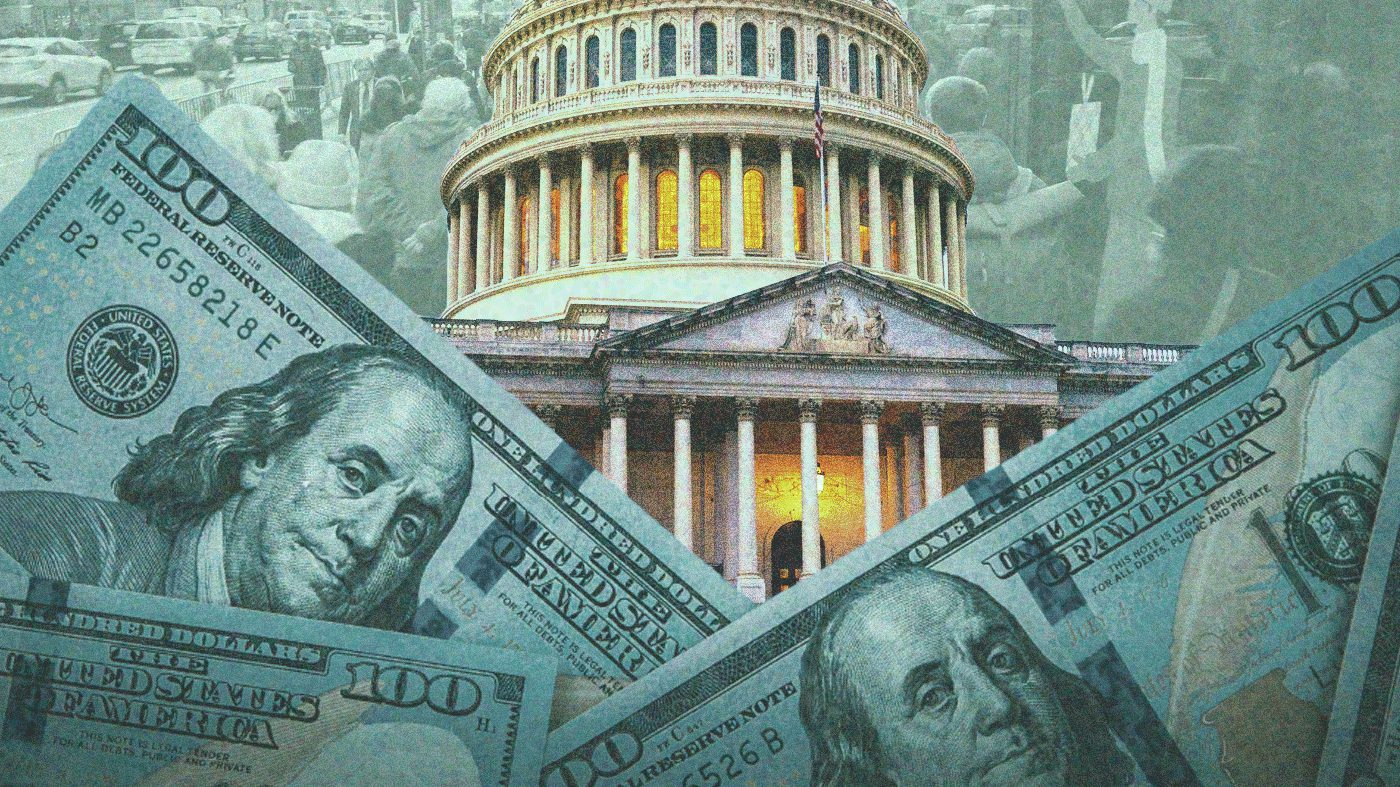
When the Shelter Becomes the Storm
There is a particular kind of dread that spreads quietly through trading floors and portfolio committees — not the loud panic of a flash crash, but the slow, cold recognition that the instruments you trusted to protect you are no longer behaving the way the textbook said they would.
That dread is now fully operational.
Gold, the asset class that has served as civilization’s oldest financial refuge, has become one of the most volatile instruments on the market — lurching hundreds of dollars in either direction within a single week. The US Treasury bond, long regarded as the world’s risk-free benchmark, is selling off precisely when institutional investors need it most. And in the background, a number that financial historians had hoped never to see again has quietly materialized: United States national debt has now formally surpassed the total size of its economy, a threshold last breached in the aftermath of the Second World War.
At the same time, the conflict reshaping the Middle East — from Gaza and Lebanon to the Red Sea shipping lanes and beyond — shows no coherent path toward resolution. Peace talks have stalled, escalation timescales are unpredictable, and the energy markets tied to that region remain on hair-trigger alert. Central banks that, for a generation, moved in rough coordination under a shared inflation mandate, are now diverging sharply: the Federal Reserve is navigating stubborn domestic price pressures while the Bank of Japan dismantles the last vestiges of yield curve control, and the European Central Bank manages a recession-adjacent eurozone economy.
The result is a macroeconomic environment that has simultaneously broken the traditional safe-haven thesis, the classic hedging playbook, and the assumption — held for thirty years — that American sovereign debt remains the ultimate backstop of global finance.
This is not a correction. This is a structural reconfiguration. And the investors who recognize it soonest will be the ones who survive it with capital intact.
Gold: The Ancient Shield, Now a Double-Edged Sword
To understand gold’s current behavior, it helps to remember what gold is supposed to do: decline in correlation with risk assets, preserve value against currency debasement, and spike predictably when geopolitical uncertainty escalates. For most of modern financial history, it performed this function with reasonable reliability.
That reliability has fractured.
Gold prices crossed $3,000 per troy ounce in early 2025 — a milestone that briefly triggered the triumphalism of every gold-bug newsletter on the internet. Yet within weeks of reaching new nominal records, gold experienced intraday swings exceeding $80 — volatility more associated with speculative commodities than with a supposedly stable store of value. The World Gold Council’s own data showed that institutional demand surged even as retail sentiment seesawed, with central bank purchasing — particularly from China, Poland, and Turkey — providing a structural bid that masked the underlying fragility of price discovery.
The paradox is this: gold is being bought for the right reasons — debt monetization fears, currency diversification away from dollar-denominated reserves, and genuine geopolitical anxiety — but it is also being traded by algorithmic desks, leveraged ETF products, and momentum-chasing hedge funds who treat it like a high-beta equity. The result is an instrument that looks like a safe haven in narrative but behaves like a risk asset in practice.
The deeper issue is that gold’s performance has increasingly decoupled from the real interest rate framework that traditionally governed it. The classic model — gold rises when real yields fall, gold falls when real yields rise — has broken down in multiple episodes since 2022, leaving quantitative models misfiring and discretionary managers second-guessing their allocation frameworks. When your safety net produces outcome variance that rivals your growth portfolio, it has ceased to function as insurance.
For institutional allocators, this creates a genuinely uncomfortable position: reduce gold exposure and accept increased vulnerability to the scenarios gold was supposed to hedge against, or maintain it and accept that the volatility profile now imposes its own form of portfolio risk.
The Bond Market: When the Risk-Free Asset Becomes a Source of Risk
If gold’s transformation is unsettling, the bond market’s evolution is categorically more dangerous — because the Treasury market is not merely an asset class. It is the foundation upon which global financial plumbing operates. Repo markets, money market funds, insurance company balance sheets, bank capital ratios, and sovereign reserve portfolios are all built on the premise that US Treasuries are liquid, stable, and approximating risk-free.
That premise is under its most serious challenge since the 1970s.
The 10-year Treasury yield has spent the better part of two years in a range that would have seemed extraordinary a decade ago, oscillating not in response to domestic economic data alone, but also to auction demand signals, foreign central bank reserve management decisions, and the growing fiscal premium that bond markets are beginning to price into long-duration US debt.
The term premium — the extra yield investors demand to hold longer-dated bonds rather than rolling short-term instruments — has returned to levels not seen since before the global financial crisis. This is not a technical footnote. It signals that the market is now pricing in genuine uncertainty about the fiscal trajectory of the United States government, not merely about the short-term path of interest rates.
That fiscal trajectory leads directly to the most consequential data point of this decade.
The Number No One Wanted to See: US Debt Exceeds GDP for the First Time Since WWII
The United States debt-to-GDP ratio — tracking total federal government debt as a share of annual economic output — has now crossed 100% and is trending toward 125% on current Congressional Budget Office projections. The last time America operated at or above this threshold was in the immediate post-war years of the late 1940s, when the debt burden was a direct artifact of financing the most destructive conflict in human history.
The difference this time is that there is no comparable catalyst — no world war, no existential mobilization — to explain the debt trajectory. The accumulation reflects a decades-long combination of tax policy choices, structural entitlement spending, two major financial crises, a pandemic-era spending surge, and the compound interest effect of debt servicing costs that are now, for the first time in memory, material in their own right. The Treasury Department is now spending more on net interest payments annually than on either defense or Medicare — a fiscal dynamic that constrains every future policy option.
The IMF’s most recent Fiscal Monitor flagged the United States alongside a small group of advanced economies where debt sustainability analysis now warrants “enhanced scrutiny” — diplomatic language that, translated into plain English, means the Fund is concerned. The Peterson Foundation has projected that without legislative action, annual deficits will exceed $2 trillion on a structural basis within this decade.
For the bond market, the implications are self-reinforcing in a troubling way. Higher debt requires more issuance. More issuance requires higher yields to attract buyers. Higher yields increase debt service costs. Higher debt service costs increase the deficit. The deficit increases issuance. This loop does not resolve itself without either substantial revenue measures, meaningful expenditure reform, or — the option that history suggests is most likely when political will is absent — a degree of inflation that gradually erodes the real value of the debt burden.
Each of these outcomes is negative for holders of long-duration nominal Treasuries. Which means the asset class traditionally used to hedge against precisely this kind of uncertainty is now itself a vector of the risk it was meant to offset.
Why Traditional Hedging Strategies May No Longer Apply
For most of the post-Bretton Woods era, institutional portfolio construction operated on a relatively stable set of correlations. Equities and bonds moved inversely under most conditions, providing natural diversification. Gold spiked when both fell simultaneously. Duration provided income and capital preservation. This was the architecture of the classical 60/40 portfolio and its many variants.
Three simultaneous developments are now undermining each of these assumptions.
First: The correlation structure has broken. The 2022 bear market was the worst year for the 60/40 portfolio since 1937 — equities and bonds fell together as inflation forced rate hikes that repriced all duration-sensitive assets simultaneously. That experience was widely described as an anomaly. It was not. It was a preview of a structural environment where the inflation regime, not the growth cycle, determines correlation patterns — and in an inflationary or fiscally stressed regime, the diversification benefit of bonds collapses precisely when portfolios most need it.
Second: The geopolitical risk premium is unquantifiable. Standard portfolio models treat geopolitical events as discrete, dateable shocks with mean-reverting effects on asset prices. The current configuration of risk — a multi-party Middle East conflict with no clear resolution pathway, a Taiwan Strait that remains on slow boil, and a European security architecture under fundamental reconstruction — does not fit that model. These are chronic, not acute, stressors. They raise the floor of uncertainty without providing clear hedgeable timelines.
Third: Central bank policy is no longer a coordinating mechanism. When the Fed, ECB, Bank of England, and Bank of Japan broadly aligned their policy stances, global rates provided a common discount rate anchor. That anchor has dissolved. The BOJ is raising rates into a world where other major central banks are holding or cutting. The Fed remains constrained by fiscal dynamics as much as by its dual mandate. Divergence of this kind produces currency volatility, cross-border capital flow instability, and arbitrage conditions that destabilize carry trades and emerging market debt simultaneously.
In this environment, the standard playbook — buy gold, hold bonds, let duration work — is not merely suboptimal. It can actively amplify portfolio risk in the scenarios it was designed to mitigate.
The Global Perspective: Who Is Most Exposed?
The implications of this structural shift are not evenly distributed. Three categories of institutional investor face particularly acute recalibration challenges.
Emerging market sovereigns and central banks are caught in a particularly difficult position. Many hold large allocations to US Treasuries as foreign exchange reserves — not by choice, but by necessity, because dollar liquidity and Treasury market depth have no equivalent elsewhere. As those holdings produce both credit risk and currency risk simultaneously (a dollar that is being diluted by fiscal excess is a less attractive reserve asset even if its nominal yield rises), the long-telegraphed diversification away from dollar reserves is accelerating. China’s central bank has continued expanding gold holdings. Saudi Arabia’s Public Investment Fund has been increasing allocations to real assets and private markets. The shift is gradual but directional, and it matters enormously for dollar demand at the margin.
Pension funds and insurance companies in developed markets face a structural mismatch that is growing harder to ignore. Their liability structures — long-dated, inflation-linked, or both — require assets that can match those characteristics. Traditional bonds increasingly fail this test when yields are driven by fiscal dynamics rather than economic fundamentals. The search for liability-matching alternatives is pushing institutional flows toward infrastructure debt, private credit, and inflation-linked real assets at a pace that is straining the capacity of those markets to absorb them efficiently.
Sovereign wealth funds, particularly the large Gulf-based funds enriched by the sustained elevation in energy prices that Middle East tensions have partially underwritten, find themselves in the unusual position of having both the firepower and the motivation to reshape global asset allocation norms. The Abu Dhabi Investment Authority, Norway’s Government Pension Fund Global, and Singapore’s GIC are all publicly navigating the question of how to maintain real returns in an environment where the instruments they have historically used for capital preservation are compromised. Their answers — more private equity, more infrastructure, more diversified currency exposure, more allocation to Asian and emerging market growth — are themselves moving markets.
Forward-Looking: What Investors Must Watch
The path ahead is not without navigable signals. Investors who can separate the structural from the cyclical, and the durable from the noise, will find the current environment genuinely full of strategic opportunity — but only if they are watching the right indicators.
Policy pivot timing at the Federal Reserve remains the single most important variable in the near-term. Not because a rate cut will resolve the structural issues described above, but because the degree of divergence between where rates need to be to control inflation and where they need to be to manage debt service costs will determine which constraint the Fed ultimately chooses to relax — and that choice will cascade through every other market.
Middle East escalation pathways and Red Sea resolution matter for both the energy complex and the inflation outlook. A sustained normalization of Red Sea shipping lanes would reduce a persistent, if underappreciated, input cost pressure that has kept goods inflation stickier than services models predicted. Conversely, any expansion of the conflict toward Iranian energy infrastructure or Gulf chokepoints would produce an oil price shock that would force central banks into impossible choices between tightening against inflation and easing to cushion growth.
Congressional fiscal trajectory and debt ceiling dynamics in the United States will determine whether the fiscal premium now embedded in long-term Treasuries expands further or stabilizes. Any credible medium-term fiscal consolidation signal — even a partial one — could provide meaningful relief to bond markets. The absence of such a signal, conversely, risks a self-accelerating dynamic in which rising yields make fiscal consolidation mathematically harder, not easier.
Central bank gold accumulation trajectories — particularly among BRICS-adjacent economies — will continue to provide structural support beneath the gold price even during the volatility episodes that shake out leveraged positioning. The diversification motive is durable in a way that momentum-driven positioning is not. Investors who can distinguish between these two demand sources will be better positioned to distinguish genuine price floors from speculative froth.
Dollar milestones and reserve currency dynamics are worth watching with a longer lens. The dollar’s share of global foreign exchange reserves has been declining gradually for two decades. That decline has not been accompanied by a viable alternative reserve currency — the euro, the renminbi, and gold each have significant limitations as universal replacements. But the direction of travel matters even if the destination is distant. Any acceleration of reserve diversification, particularly if triggered by a US fiscal event rather than by the organic emergence of an alternative, could produce dollar weakness that has broad implications for commodity pricing, emerging market debt, and global liquidity conditions.
The New Architecture: What a Rebuilt Playbook Looks Like
The death of the traditional safe-haven framework does not mean the death of risk management. It means the need for a more sophisticated, dynamic, and intellectually honest approach to it.
Real assets — specifically, assets whose returns are mechanically linked to inflation (infrastructure, commodity royalties, real estate in supply-constrained markets) — offer a form of protection that nominal bonds have historically been presumed to provide but structurally cannot in a high-inflation, high-debt regime.
Short-duration instruments and floating rate exposure mitigate the specific risk of duration in an environment where the term premium is rising and the Fed’s ability to cut rates is constrained.
Geographic diversification of currency exposure — not as a tactical call on specific exchange rates, but as a structural hedge against dollar debasement — is more relevant now than at any point since the 1970s.
Commodities as inflation proxies (particularly industrial metals critical to the energy transition) provide both geopolitical risk exposure and structural demand support that gold, in its increasingly speculative incarnation, no longer reliably provides alone.
And perhaps most importantly: intellectual humility about model uncertainty. The scenario planning desks at major institutions are running more tail scenarios than at any point since the global financial crisis — not because catastrophe is the central case, but because the distribution of outcomes has genuinely widened. An investment strategy that cannot survive a 30% probability scenario is no longer defensible as a risk management framework.
Conclusion: The Map Has Changed. The Territory Is Still There.
The anxiety gripping institutional and retail investors alike is not irrational. The instruments that provided financial sanctuary for generations are behaving in ways that their theoretical foundations do not predict or explain. The US national debt is at a post-WWII milestone that carries genuine long-term consequences. The Middle East conflict has moved from a containable regional crisis to a persistent restructuring of global supply chains, energy markets, and security expenditure profiles. And central banks, once the great stabilizers of modern financial capitalism, are operating in conditions where their traditional tools produce outcomes that are, at best, unpredictable.
But anxiety, unlike analysis, does not generate alpha.
The investors who will navigate this period most effectively are not those who wait for clarity that may not come, nor those who double down on frameworks that have ceased to work. They are the ones who accept that the map has been redrawn — that gold is no longer simply gold, that bonds are no longer simply bonds, and that the first duty of capital preservation in a structurally altered regime is to understand the alteration clearly enough to act on it.
The old safe havens are not necessarily dead. But they need new definitions, new position sizes, and new companion instruments to function as the anchors they were always supposed to be.
The storm is real. The shelter just needs rebuilding.
REFERENCES
- IMF Fiscal Monitor — Debt sustainability and US fiscal trajectory data: https://www.imf.org/en/Publications/FM
- World Gold Council — Gold Demand Trends — Central bank accumulation data: https://www.gold.org/goldhub/research/gold-demand-trends
- Bank for International Settlements — Working Papers on Bond Markets: https://www.bis.org/publ/work.htm
- Federal Reserve — FOMC Projections and Policy Guidance: https://www.federalreserve.gov/monetarypolicy/fomccalendars.htm
- Congressional Budget Office — Long-Term Budget Outlook: https://www.cbo.gov/topics/budget/long-term-budget-outlook
- Peterson Foundation — US Fiscal Analysis: https://www.pgpf.org/national-debt-clock
- IMF Global Financial Stability Report: https://www.imf.org/en/Publications/GFSR
- Norway Government Pension Fund Global — Annual Report: https://www.nbim.no/en/the-fund/reports/


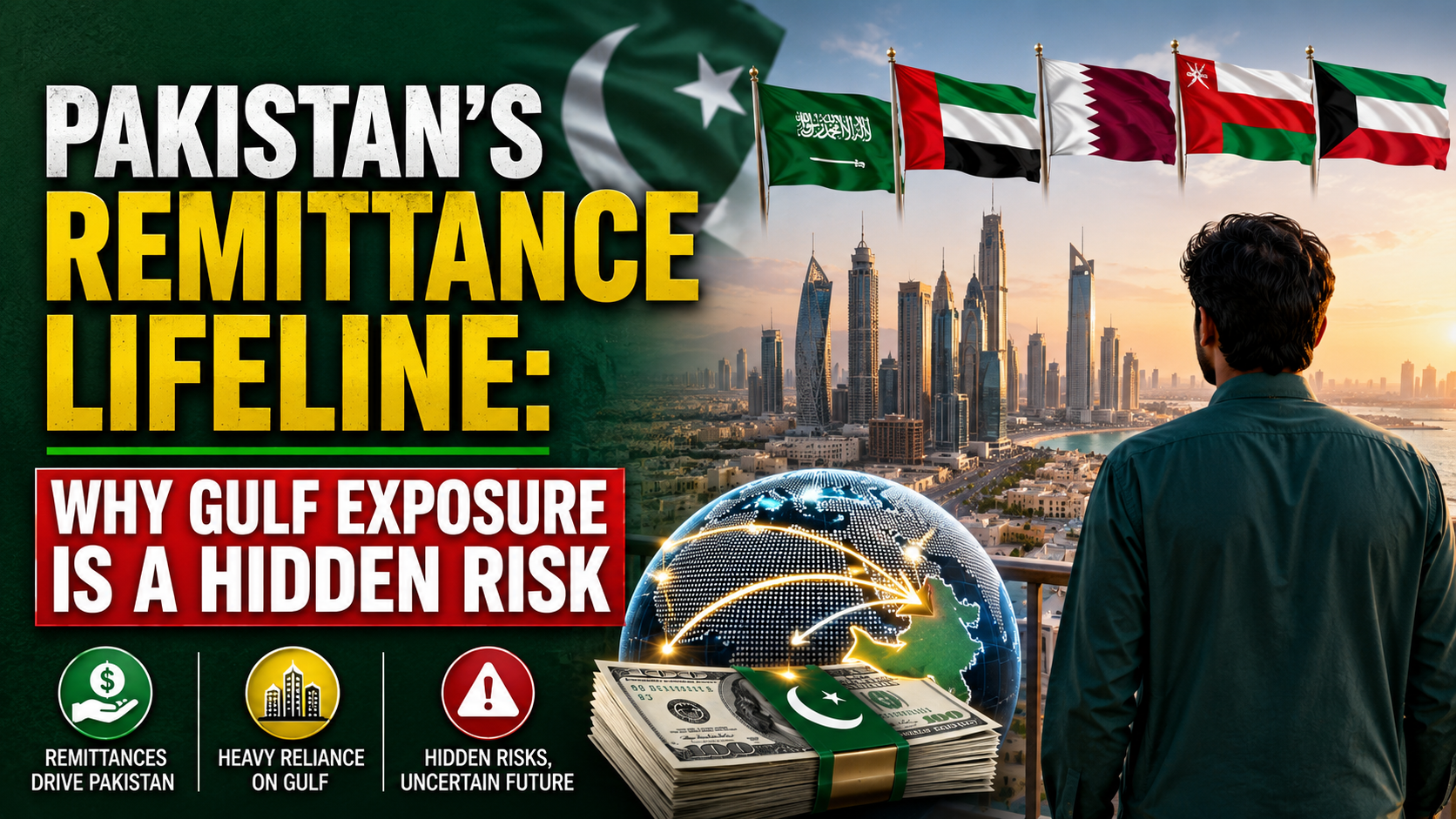
Buried inside the IMF’s latest Pakistan country report is a dependency that receives far less attention than headline GDP or inflation numbers, but arguably carries more immediate risk for millions of households: Pakistan’s economy is structurally exposed to whatever happens next in the Gulf.
The Numbers That Matter
Pakistan receives annual remittances amounting to roughly 9 percent of GDP, of which 55 percent originate from Gulf Cooperation Council countries, according to the IMF’s May 2026 country report. That single funding channel is one of the largest and most stable sources of foreign exchange available to the country — larger, in most years, than export revenue growth or foreign direct investment inflows combined.
The IMF’s own language is unambiguous about the risk this concentration creates: a significant disruption to GCC economies, or a forced return of migrant workers, could weigh heavily on these flows — a major source of financing for both household consumption and Pakistan’s broader balance of payments.
Why This Risk Is Live, Not Theoretical
This is not an abstract stress-test scenario. The Strait of Hormuz disruption, detailed extensively elsewhere in this series, has placed the entire Gulf region’s economic stability under genuine pressure for the first time in years. Should the conflict escalate further or trigger a broader regional economic slowdown, the transmission channel to Pakistan is direct and fast: fewer construction projects and reduced hiring across the GCC translates almost immediately into lower remittance flows from the millions of Pakistani workers employed there.
Capital Flows Are Already Reacting
The IMF has flagged early evidence that this dynamic is not purely hypothetical. Deteriorating global financial conditions have already resulted in capital outflows from Pakistan, which are likely to intensify further if the regional crisis extends, with the Fund specifically noting that access to short-term commercial financing — largely sourced from GCC banks — could also be affected if risk sentiment deteriorates further across the region.
This creates a double exposure that is easy to overlook in headline coverage: Pakistan depends on the Gulf both for the remittance income that supports household consumption, and for the short-term commercial bank financing that helps bridge its external funding gaps between IMF disbursements.
The State Bank’s Reserve Buffer
Pakistan’s own policy response has been to build reserves as a shock absorber. The State Bank of Pakistan has been projecting reserves to continue rising to roughly $18 billion by June 2026 on the back of planned inflows, a level implying that expected capital inflows currently exceed any current account shortfall — but only as long as Pakistan remains within an active IMF programme and maintains access to external funding on favourable terms.
The risk scenario flagged by policy researchers is specific: if monetary easing is mismanaged and confidence in Pakistan’s reform path falters, capital inflows could slow or reverse at the same time imports surge, opening an external funding gap that would draw down reserves and pressure the rupee — a scenario made materially more likely by any Gulf-region shock large enough to simultaneously dent remittances and tighten GCC bank lending.
How much of Pakistan’s remittances come from the Gulf?
Roughly 55% of Pakistan’s remittances — which fund about 9% of GDP — originate from Gulf Cooperation Council countries, making Pakistan’s balance of payments directly exposed to any economic disruption or capital-flow tightening in the Gulf region.
The Agricultural Wildcard
A related, more immediate risk sits in the agricultural supply chain. The IMF notes that disrupted DAP fertiliser supply chains linked to regional tensions could affect the Kharif planting season in June-July, with knock-on effects for food import prices — a second, more direct channel through which Gulf and broader Middle East instability could hit Pakistani households, independent of the remittance and capital-flow risks.
The Policy Takeaway
Pakistan’s economic stabilisation narrative in 2026 — a rebuilding KSE-100, falling inflation, a completed EFF review, covered in depth in our companion article — is real, but it rests on a foundation more exposed to Gulf regional stability than most headline coverage acknowledges. For policymakers in Islamabad, and for the Pakistani diaspora sending capital home each month, the Strait of Hormuz situation is not a distant geopolitical story. It is, in a very direct sense, a domestic economic risk factor.
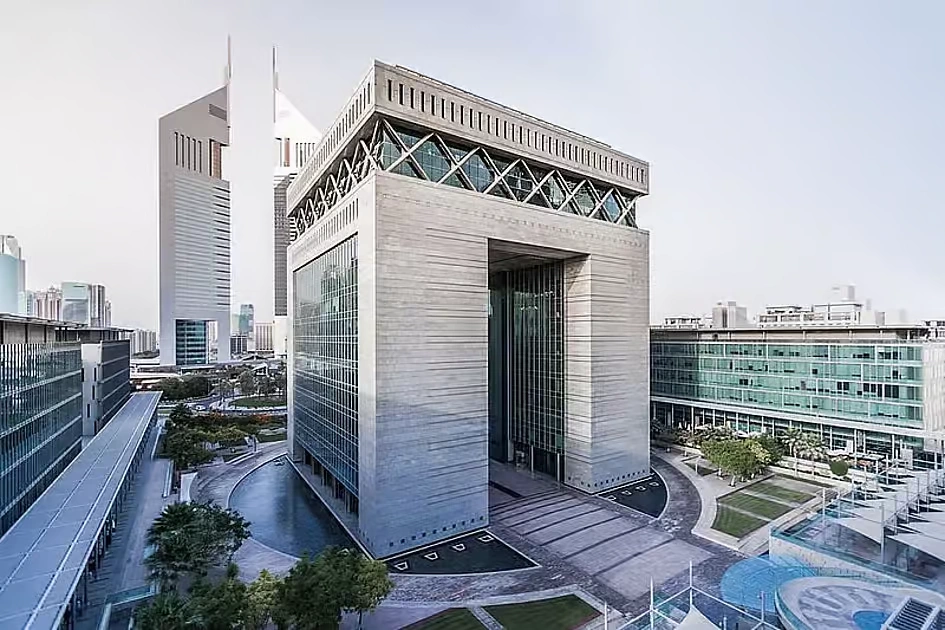
Dubai has climbed to its highest position ever on one of finance’s most closely watched rankings, and the achievement is no accident — it is the direct output of a decade-long, numerically explicit government strategy that few other financial centres have attempted to execute with this level of precision.
The Ranking Itself
The Dubai International Financial Centre has recorded its highest-ever position on the Global Financial Centres Index at seventh place worldwide, the highest ranking ever achieved by any financial centre across the Middle East, Africa and South Asia region, and the only MEASA-region centre to feature in the global top 20 — underscoring both its regional dominance and genuine global competitiveness.
The D33 Strategy Behind the Number
The ranking is explicitly tied to Dubai’s own stated ambitions. The GFCI result is described as pivotal to Dubai’s goal of becoming one of the world’s top four financial centres by 2033, in line with the Dubai Economic Agenda, or D33, which targets a doubling of the emirate’s economy over the decade. Separately, Dubai Chambers has confirmed the plan targets cumulative economic output of AED 32 trillion, or roughly $8.7 trillion, over the decade, supported by 100 transformative projects centred on trade expansion, digital innovation and sustainable growth.
The Underlying Economic Engine
The financial-centre ambitions are backed by genuine current-quarter growth. Dubai’s economy reached AED 232 billion in first-quarter 2026 GDP, a 2.4 percent year-on-year increase, with the finance, construction, healthcare, wholesale and retail trade, and real estate sectors all contributing to the broad-based expansion. Middle East Briefing separately projects the wider UAE economy will expand around 5 percent in 2026, with local banks positioned to increase lending both domestically — supporting SMEs, consumers and project finance — and across borders into markets like Saudi Arabia, where UAE banks’ comparatively lower interbank rates create an arbitrage opportunity.
Real Money Behind the Ranking
The GFCI climb is being validated by tangible transaction volume rather than sentiment alone. Weekly UAE business tracking shows a steady drumbeat of institutional activity: Sharjah Islamic Bank reported AED 803.9 million in net profit, up 15.3 percent, ADI Chain secured a $50 million investment to build sovereign digital infrastructure, and Capital.com reported $1.1 trillion in second-quarter trading volume routed through the jurisdiction. Separately, UAE and Saudi banks are projected to lead GCC credit growth in 2026, reinforcing Dubai and Abu Dhabi’s combined position as the region’s default financial gateway.
Why This Matters for Pakistan and South Asia
Dubai’s ascent as a financial hub carries direct relevance for Pakistan, where — as detailed in our companion coverage of Pakistan’s remittance exposure — roughly 55 percent of the country’s substantial remittance inflows originate from the Gulf Cooperation Council. A deepening, increasingly sophisticated DIFC-anchored financial ecosystem in Dubai means more efficient, lower-cost channels for that capital, alongside growing opportunities for Pakistani and South Asian firms to access GCC-sourced project finance and cross-border credit as UAE banks expand lending beyond their domestic market.
What is Dubai’s global financial centre ranking in 2026?
Dubai’s DIFC recorded its highest-ever ranking on the Global Financial Centres Index at 7th place worldwide in 2026 — the highest ever achieved by any Middle East, Africa or South Asia financial centre — as part of its stated goal to become a top-four global financial hub by 2033.
The Risk Beneath the Growth Story
Not every signal points to unambiguous strength. AGBI’s own reporting notes that UAE banks’ second-quarter results are likely to show weaker profits, slower lending and narrower margins, even as analysts characterise the underlying sector as fundamentally resilient — a reminder that Dubai’s financial-hub ambitions are being pursued against a genuinely more difficult regional operating environment shaped by the Strait of Hormuz disruption and broader Gulf security concerns, not in isolation from them.
The Bottom Line
Dubai’s climb to seventh in the GFCI rankings is less a one-off achievement than a measurable checkpoint on an explicitly numbered, decade-long strategic roadmap — one increasingly backed by real GDP growth, credit expansion, and institutional trading volume rather than ambition alone.

China’s monthly car exports surpassed one million units for the first time in June 2026, according to trade data released alongside the country’s second-quarter GDP figures, while overall imports rose 36% year-over-year to a five-year high even as Beijing cut monthly crude imports to near decade lows, down 41.3% from a year earlier (CNN). The result: China’s trade surplus widened to $125.62 billion in June alone.
The Uncovered Mechanism: Oil Shock as Green-Tech Accelerant
Most coverage has treated China’s electric vehicle and battery export surge as a story purely about domestic manufacturing subsidy and industrial policy. What has received far less attention is the direct causal link to the Iran war: the oil crisis has itself boosted global demand for Chinese clean-energy technology, as energy importers around the world accelerate efforts to reduce fossil-fuel reliance precisely when oil prices are most volatile (CNN). In other words, the same Strait of Hormuz disruption that is damaging Pakistan’s current account and pushing UK inflation higher is simultaneously functioning as a demand accelerant for Chinese EV exports — a direct transmission mechanism linking two of this year’s biggest global stories that is rarely discussed together.
The EU Is Already Losing Patience
China’s widening trade surplus is compounding tensions with the European Union, which has repeatedly criticised Beijing for flooding its market with subsidised industrial exports, a dynamic that predates this year’s conflict but has intensified as Chinese manufacturers redirect capacity toward markets less willing or able to erect the tariff barriers the United States has deployed (CNN; IndexBox).
Why This Is Also a Southeast Asia and Pakistan Story
Malaysia’s own export strength this year has been built substantially on its role in the semiconductor and electronics supply chain feeding the broader AI and green-tech manufacturing boom, meaning Kuala Lumpur benefits indirectly from the same dynamics driving China’s export surge, rather than competing head-on in finished vehicles (The Rakyat Post). Pakistan’s position is more exposed: as a market with its own nascent auto and manufacturing base and limited tariff leverage against Chinese imports, a sustained surge in low-cost Chinese EV and battery exports risks crowding out domestic industrial development at precisely the moment Islamabad is trying to broaden its export base beyond textiles under IMF-monitored reform targets.
The Domestic Trade-Off Beijing Is Managing
China’s export strength is masking, not solving, its domestic consumption weakness. Retail sales rose just 1% year-over-year in June, and analysts including Natixis’s Alicia Garcia-Herrero describe an economy where growth “all about exports” is “really quite unsustainable, to be frank” (CNN). Beijing’s newly released five-year plan to lift annual retail sales toward $9 trillion by 2030 is a direct policy response to this imbalance, but the export engine currently doing the heavy lifting for headline GDP is the same one generating friction with trading partners.
What to Watch
The July Politburo meeting is expected to signal the composition of any new stimulus. A consumption-focused package would ease, over time, the export dependence generating trade friction; an infrastructure-heavy package would likely deepen it, with direct consequences for how aggressively Chinese EV and battery exports continue to expand into markets across Southeast Asia, South Asia and Europe over the second half of 2026.

Pakistan’s Remittance Lifeline: Why Gulf Exposure Is a Hidden Risk

Dubai’s Rise to the World’s 7th Financial Hub: Inside the D33 Push

China EV Exports Hit Record High in 2026

UK’s “National Contributions Tax” Explained: Burnham-Era Reform 2026

Russia’s Strange Problem in 2026: Its Currency Is Too Strong

Section 301 Forced Labor Tariffs 2026: 60 Countries Affected

UK National Contributions Tax: Burnham’s Radical Tax Plan

Global Central Bank Divergence 2026: Why the Fed, BoE, BoJ, and PBoC Are All Moving Differently

Japan’s Bond Market Just Cracked. It Could Take the Rest of the World’s Debt With It

Malaysia’s Ringgit Is Holding Up. Economists Say the Real Test Is Still Coming

Climate Finance Delivery 2026: Trillion‑Dollar Promise Still Unmet

AI Impact on Wages 2026: Productivity Soars, Paychecks Stagnate

SpaceX IPO 2026: $2 Trillion AI Bubble, OpenAI & Anthropic — What Investors Must Know

China Economy 2026: Property Crisis, AI Investment & Export Surplus Explained

Top 15 Stocks for Investment in 2026 in PSX: Your Complete Guide to Pakistan’s Best Investment Opportunities
Top 15 Stocks for Investment in 2026 in PSX: Your Complete Guide to Pakistan’s Best Investment Opportunities

Debunking IMF Program Myths: Reconfiguring Engagement for True National Ownership in a Volatile World

Top 10 Mutual Fund Managers in Pakistan for Investment in 2026: A Comprehensive Guide for Optimal Returns

What the U.S. Attack on Venezuela Could Mean for Oil and Canadian Crude Exports: The Economic Impact

China’s 50% Domestic Equipment Rule: The Semiconductor Mandate Reshaping Global Tech

15 Most Lucrative Sectors for Investment in Pakistan: A 2025 Data-Driven Analysis

Pakistan’s Export Goldmine: 10 Game-Changing Markets Where Pakistani Businesses Are Winning Big in 2025
15 Most Lucrative Sectors for Investment in Pakistan: A 2025 Data-Driven Analysis
15 Most Lucrative Sectors for Investment in Pakistan: A 2025 Data-Driven Analysis

Pakistan’s Economic Outlook 2025: Between Stabilization and the Shadow of Stagnation
Pakistan’s Economic Outlook 2025: Between Stabilization and the Shadow of Stagnation

China’s Property Woes Could Last Until 2030—Despite Beijing’s Best Censorship Efforts
China’s Property Woes Could Last Until 2030—Despite Beijing’s Best Censorship Efforts
-
 Markets & Finance7 months ago
Top 15 Stocks for Investment in 2026 in PSX: Your Complete Guide to Pakistan’s Best Investment Opportunities
-
Markets & Finance7 months ago
Top 15 Stocks for Investment in 2026 in PSX: Your Complete Guide to Pakistan’s Best Investment Opportunities
-
 Analysis6 months ago
Debunking IMF Program Myths: Reconfiguring Engagement for True National Ownership in a Volatile World
-
 Investment6 months ago
Top 10 Mutual Fund Managers in Pakistan for Investment in 2026: A Comprehensive Guide for Optimal Returns
-
 Global Economy7 months ago
What the U.S. Attack on Venezuela Could Mean for Oil and Canadian Crude Exports: The Economic Impact
-
 Asia7 months ago
China’s 50% Domestic Equipment Rule: The Semiconductor Mandate Reshaping Global Tech
-
 AI7 months ago
15 Most Lucrative Sectors for Investment in Pakistan: A 2025 Data-Driven Analysis
-
 Exports7 months ago
Pakistan’s Export Goldmine: 10 Game-Changing Markets Where Pakistani Businesses Are Winning Big in 2025