
Banks
Open a Savings Account Online: How to Actually Earn 10x the National Average Rate

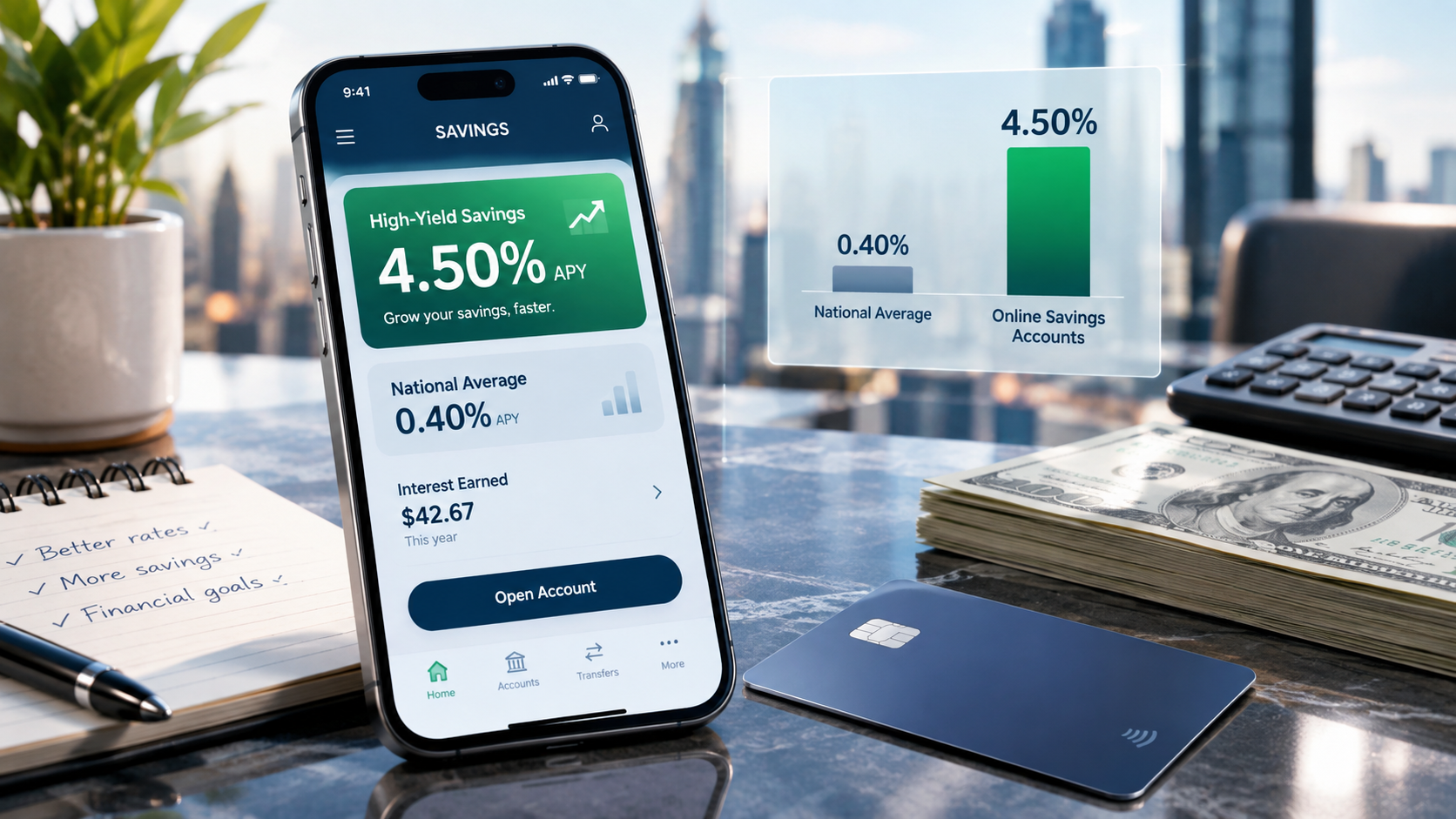
The national average savings account rate sits at roughly 0.38%–0.45% APY, while top online high-yield savings accounts pay upward of 4%–4.70% APY — meaning the bank you choose, not just how much you save, can be the single biggest factor in your interest earnings.
Opening a savings account online has become the default choice for rate-conscious savers, since digital-only banks and online divisions of traditional banks consistently outpace brick-and-mortar savings rates by a wide margin. But comparing accounts requires looking past the advertised headline rate to understand balance tiers, promotional periods, and what happens to your rate after an introductory offer ends.
This guide explains how online savings accounts actually work, what drives the rate you’ll really earn, and how to choose between the many competing options.
How Online Savings Accounts Work
Online banks can typically offer higher rates than traditional brick-and-mortar banks because they carry lower overhead — no branch network to maintain — and pass some of that savings on to depositors in the form of better APY.
Key takeaway: The national average savings account rate is approximately 0.38%–0.45% APY, while top online high-yield savings accounts regularly offer 4.00%–4.70% APY — roughly ten times the national average. On a $10,000 balance, that difference amounts to hundreds of dollars in additional interest per year with zero additional risk.
What to Check Before Opening an Account
- APY (Annual Percentage Yield) — the actual compounded return you’ll earn, not to be confused with a simple interest rate.
- Minimum balance to earn the advertised APY — some accounts pay the top rate only above a certain balance, with a much lower rate below it.
- Minimum opening deposit — ranges from $0 to $500 or more depending on the institution.
- FDIC or NCUA insurance — standard coverage protects deposits up to $250,000 per depositor, per institution, per ownership category.
- Whether the rate is promotional or ongoing — some “welcome” APYs apply only for a limited introductory period before reverting to a lower standard rate.
- Withdrawal limitations — some accounts retain federal transaction limits or impose their own monthly withdrawal caps.
Step-by-Step: Opening a Savings Account Online
- Compare APY, fees, and minimum balance requirements across several online banks rather than defaulting to your existing checking account’s bank.
- Complete the online application — typically name, address, Social Security number, and identity verification.
- Link a funding source — an existing bank account, debit card, or mailed check, depending on the provider.
- Fund the account — minimum opening deposits are commonly $0 to $50 for online-only high-yield accounts, though some require more.
- Set up automatic transfers, if desired, to build consistent savings habits without manual deposits.
- Monitor the rate periodically — since APYs on high-yield accounts are variable and can change based on broader interest rate movements.
Financial and Strategic Implications: What Your Rate Actually Earns You
The gap between average and top-tier rates compounds meaningfully over time, particularly for larger balances or longer savings horizons.
| Savings Scenario | At National Average (~0.40% APY) | At High-Yield Rate (~4.50% APY) |
|---|---|---|
| $5,000 balance, 1 year | ~$20 interest | ~$225 interest |
| $10,000 balance, 1 year | ~$40 interest | ~$450 interest |
| $25,000 balance, 1 year | ~$100 interest | ~$1,125 interest |
| $10,000 balance, 5 years (compounded) | ~$202 total interest | ~$2,461 total interest |
Expert insight: FDIC insurance protects deposits up to $250,000 per depositor, per insured bank, per ownership category — meaning a saver with more than $250,000 in cash should consider splitting funds across multiple FDIC-insured institutions, or using accounts with expanded coverage structures, to ensure full protection.
Watch for Rate Cliffs and Tiered Balances
Some accounts advertise an attractive headline APY that only applies below a certain balance threshold or above a specific minimum — with a meaningfully lower rate applying outside that band. Always check the full rate schedule, not just the number in the advertisement, since the effective blended rate on your actual balance can be lower than the headline figure suggests.
Promotional Rates vs. Standing Rates
A number of online banks offer an elevated introductory APY for new customers for a limited window (commonly 3 months), after which the rate reverts to the bank’s standard ongoing rate. This can still be worthwhile for short-term savings goals, but shouldn’t be confused with the account’s long-term earning rate when comparing options for a multi-year savings strategy.
How to Choose the Right Online Savings Account
- Compare the ongoing rate, not just the promotional rate — a lower “everyday” APY may still beat a competitor’s post-promotion rate.
- Confirm there’s no monthly maintenance fee, or that any fee is easily waived, since a fee can offset meaningful interest earnings on smaller balances.
- Check transfer speed to and from linked accounts — since online-only banks rely on electronic transfers, which can take one to three business days depending on the institution.
- Verify FDIC or NCUA insurance explicitly before depositing significant funds.
- Consider a cash management account as an alternative if you want features like debit card access alongside a competitive yield, since some non-bank cash management accounts offer similar or higher rates with added flexibility.
- Match the account structure to your goal — a basic high-yield savings account suits an emergency fund, while a CD may suit money you won’t need for a fixed period, often at a comparably competitive or higher rate.
Key takeaway: The single most impactful decision most savers make isn’t picking the absolute highest APY on a comparison table — it’s simply moving money out of a near-zero-interest traditional savings account at all, since even a “merely good” online rate typically represents a 5–10x improvement over the national average.
Future Outlook: Savings Rate Trends Through 2027
- Online savings rates remain closely tied to broader interest rate policy. As monetary policy shifts, high-yield savings APYs typically move in the same direction with a short lag, meaning current top rates are not guaranteed to persist indefinitely.
- Competition among online banks and fintech platforms continues to compress the rate-comparison gap. New entrants regularly launch promotional rates to attract deposits, rewarding savers who periodically re-shop rather than staying with the same account indefinitely.
- Cash management accounts are increasingly competing directly with traditional savings accounts. Several non-bank financial platforms now offer FDIC-insured cash accounts with yields competitive with — or exceeding — dedicated high-yield savings products, often with additional liquidity features.
- Inflation-adjusted “real return” awareness is growing among savers. As savers increasingly compare APY against inflation expectations rather than viewing it in isolation, the gap between a merely adequate rate and a genuinely strong rate is becoming a more prominent part of account-selection decisions.
Frequently Asked Questions
What’s a good APY for an online savings account right now?
Top online high-yield savings accounts commonly offer APYs in the 4.00%–4.70% range, substantially above the national average of roughly 0.38%–0.45%.
Is an online savings account as safe as a traditional bank savings account?
Yes, as long as the institution is FDIC-insured (or NCUA-insured for credit unions), your deposits receive the same $250,000 per-depositor protection regardless of whether the bank has physical branches.
Do I need a minimum balance to open a savings account online?
It varies by institution — many online banks allow you to open an account with $0 to $50, while some require a larger minimum deposit, commonly in the $100–$500 range.
Will my online savings account rate stay the same over time?
Not necessarily. High-yield savings APYs are variable and generally move with broader interest rate conditions, and some accounts feature limited-time promotional rates that revert to a lower standard rate after an introductory period.
Can I have more than one online savings account?
Yes, and many savers deliberately do — both to compare rates across institutions and to spread balances above $250,000 across multiple FDIC-insured banks for full deposit insurance coverage.


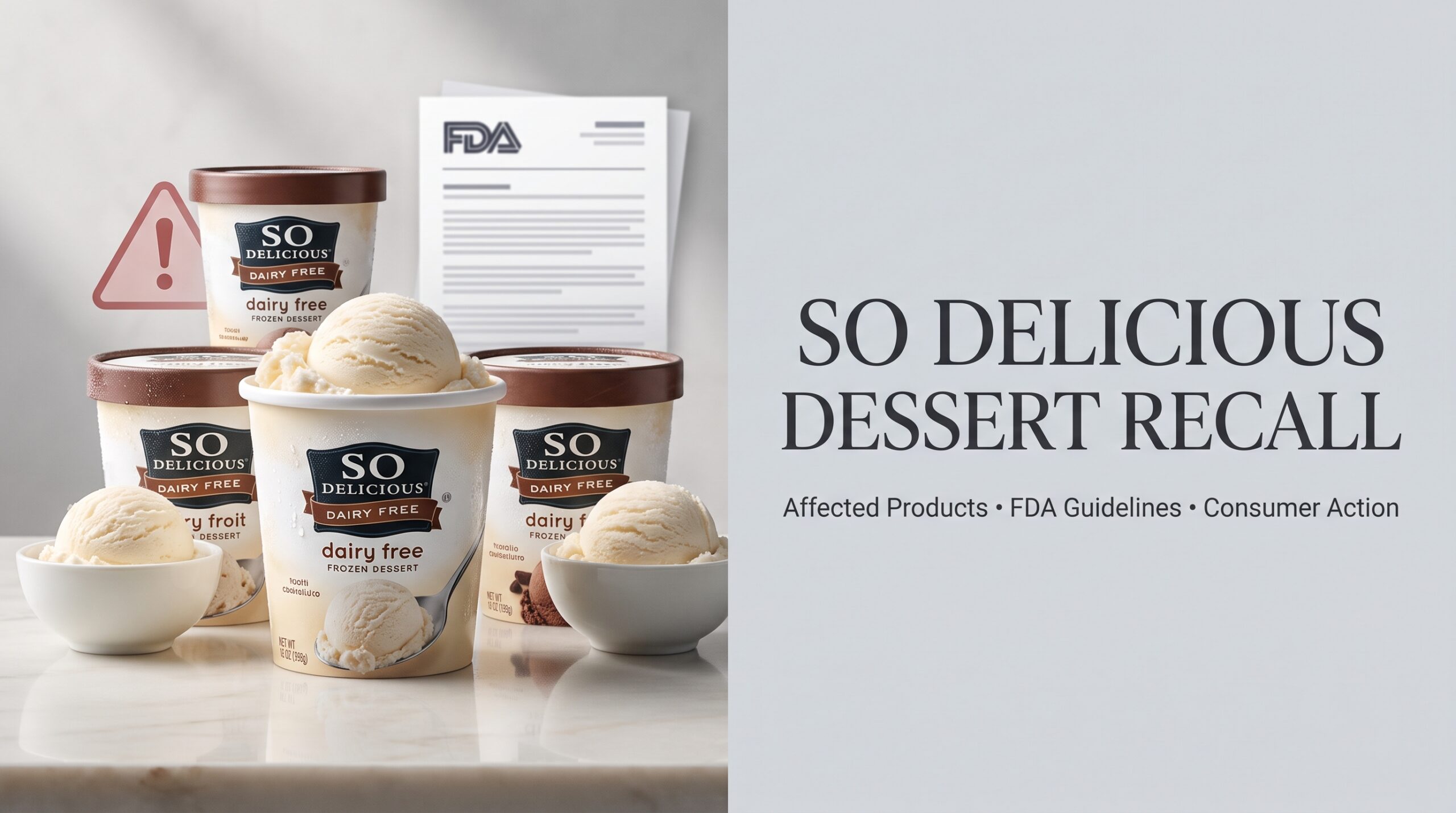
Danone recalled So Delicious Salted Caramel Cluster pints on Sept 15, 2026. Check UPC 744473476138 and best-by dates on or before April 3, 2028.
- Danone USA issued a voluntary recall on 15 September 2026 of So Delicious Dairy Free Salted Caramel Cluster Non-Dairy Frozen Dessert pints, posted by the FDA.
- The reason: potential presence of foreign materials, such as small stones and other hard objects, within the cashew inclusions.
- Affected product: SKU 136603, UPC 744473476138, best-by dates on and before 3 April 2028. Pints with a later best-by date are not affected.
- No other So Delicious flavours, codes or products are involved. Distribution was nationwide to US retail stores.
- This is the second such recall in under a year — an identical issue prompted a December 2025 recall of the same product.
1. Introduction & Immediate Context
If you have a pint of So Delicious Dairy Free Salted Caramel Cluster in your freezer, check it before reading anything else.
Danone USA is recalling So Delicious Dairy Free Salted Caramel Cluster Non-Dairy Frozen Dessert pints with best-by dates on and before 3 April 2028 due to the potential presence of foreign materials, such as small stones and other hard objects, within the cashew inclusions, according to the company announcement posted by the FDA on 15 September 2026. The issue was identified through consumer complaints, and the FDA has been informed of the voluntary recall.
Danone is working with retail partners to remove affected product from shelves. Unaffected product remains available, and product shipped going forward is not affected.
2. Instant Product-Matching Table
Check all three fields. Flavour name alone is not sufficient, because packaging varies by retailer and the brand rebranded during 2026.
| Field | What to look for | Where to find it |
|---|---|---|
| Product name | So Delicious Dairy Free® Salted Caramel Cluster Non-Dairy Frozen Dessert (pints) | Front label |
| SKU | 136603 | Product listing / retailer receipt |
| UPC | 744473476138 | Back of container |
| Best-by date | On and before 3 April 2028 | Bottom of container |
| Package size | Pint | — |
| Distribution | Nationwide, US retail stores | — |
If all fields match: do not consume the product.
For a refund or replacement coupon: contact the So Delicious Dairy Free Consumer Care Line at 1-833-367-8975, available Monday to Friday, 9 a.m. to 6 p.m. ET.
If your best-by date falls after 3 April 2028: your pint is not part of this recall.
2.1 Comparison with the December 2025 recall
Households that checked their freezers last winter should check again — the date ranges are different.
| Recall | Date issued | Best-by range affected | SKU / UPC | Status |
|---|---|---|---|---|
| December 2025 | 15 December 2025 | Before 08 Aug 2027 | 136603 / 744473476138 | Completed; FDA terminated |
| September 2026 | 15 September 2026 | On and before 3 April 2028 | 136603 / 744473476138 | Active |
The September 2026 range extends roughly eight months beyond the earlier one. Product that passed the December check may still fall inside the current recall.
3. Structural Drivers and Competitor Gaps: Why Twice?
Almost all coverage of this recall stops at the checklist. The pattern is the more useful part of the story.
The stated cause is word-for-word identical to the December 2025 recall — foreign materials such as small stones and hard objects within cashew inclusions — as Fast Company noted in observing that this is now a pattern rather than an isolated incident. The company’s public language has also closely mirrored its statements from the previous year, including the assurance that the issue has been identified and corrected.
The mechanism points upstream. Small stones in cashew inclusions is a raw-material sorting failure, not a manufacturing-line failure. Tree nuts are harvested from the ground or from drying floors, and the standard controls are optical sorting, density separation and metal or X-ray detection at intake. Stones are specifically the contaminant these systems exist to catch, and they are difficult for downstream detection to find because their density can be close to that of the nut itself. A recurrence of the same contaminant in the same inclusion implies the corrective action taken after December 2025 did not resolve the root cause — most plausibly at a supplier or sorting-specification level rather than at the plant.
The recall also reached other jurisdictions. The Canadian Food Inspection Agency issued a Class 2 recall for a related So Delicious Dairy Free cashew-base salted caramel product over plastic-like and gravel-like fragments, indicating a supply-chain rather than single-facility scope.
There are no confirmed injury reports in the current recall documentation, and the FDA categorises this as a consumer-level alert. Foreign-object recalls carry dental-fracture and choking risk rather than illness risk, which is why the guidance is disposal rather than medical monitoring.
4. Key Implications for Stakeholders
Consumers with dietary restrictions. Dairy-free frozen dessert buyers often have limited substitutes, and repeat recalls in a narrow category are disproportionately disruptive. Only this single flavour is affected; other So Delicious products remain unaffected in both recalls.
Allergy-tracking households. Note that this is a foreign-object recall, not an allergen recall. No undeclared allergen is involved, so the standard cross-contamination protocols do not apply here — physical inspection and disposal do.
Retailers. The overlapping date ranges across two recalls create genuine shelf-audit complexity. Scanning by UPC alone will flag unaffected stock; the best-by date is the discriminating field.
Food safety professionals. A repeat of an identical contaminant within nine months is the type of event that typically attracts closer FDA attention to the corrective-action plan filed after the first recall.
How to verify anything you read about this. The FDA recalls, market withdrawals and safety alerts database is updated continuously and is the authoritative source. Secondary coverage has circulated conflicting date ranges by mixing the 2025 and 2026 notices.
5. Frequently Asked Questions
Q1: Which So Delicious products are recalled?
Only So Delicious Dairy Free Salted Caramel Cluster Non-Dairy Frozen Dessert pints with SKU 136603, UPC 744473476138 and a best-by date on or before 3 April 2028. No other flavours, codes or products from the brand are involved.
Q2: What should I do if I have the recalled product?
Do not eat it. Dispose of it and contact the So Delicious Dairy Free Consumer Care Line at 1-833-367-8975, open Monday to Friday, 9 a.m. to 6 p.m. ET, for a refund or replacement coupon.
Q3: Why was So Delicious recalled?
Because of the potential presence of foreign materials such as small stones and other hard objects within the cashew inclusions. The issue was identified through consumer complaints, and the FDA was informed of the voluntary recall.
Q4: Is this the same as the previous So Delicious recall?
It is the same product and the same stated cause, but a different date range. The December 2025 recall covered best-by dates before 8 August 2027 and has been terminated; the September 2026 recall covers dates on and before 3 April 2028.
Q5: Has anyone been hurt?
No confirmed injury reports appear in the current recall documentation. The FDA has categorised the action as a consumer-level alert.
Barclays reported second-quarter income of £8.3 billion, up £1.2 billion from a year earlier, and upgraded its full-year 2026 income target even as operating expenses climbed 7% year-on-year — a mixed but ultimately reassuring signal for UK banking-sector health as the country navigates elevated gilt yields and a new premiership.
Income Growth Outpaces a Rise in Costs
Barclays reported second-quarter operating expenses of £4.5 billion, up 7% year-on-year, which the bank attributed to business growth, inflation, and increased investment spending, according to CNBC’s markets coverage. Despite the cost increase, income rose to £8.3 billion, and adjusted earnings per share beat Wall Street consensus, prompting shares to initially react positively before falling more than 7% amid broader market volatility on the results day.
Group Chief Executive C.S. Venkatakrishnan struck a confident tone on the outlook, saying the bank was upgrading its 2026 Group income target to approximately £31.5 billion and remained committed to delivering all financial and distribution targets through 2028, according to the same CNBC report.
Why the Results Matter Beyond Barclays
The results land at a delicate moment for UK financial markets more broadly. Ten-year gilt yields have been trading near 5% amid uncertainty over new Prime Minister Andy Burnham’s fiscal programme, while 30-year yields — sensitive to long-term fiscal credibility — have hovered near multi-year highs. A major UK bank posting income growth and raising its full-year guidance amid that backdrop offers a data point suggesting the underlying corporate and consumer credit environment remains healthier than the gilt market’s elevated risk pricing might suggest on its own.
Context: A Resilient Consumer Backdrop
Barclays’ results also arrive alongside broader UK data that has surprised to the upside. UK retail sales rose 1% in June against expectations for a 0.3% decline, while consumer confidence climbed to a six-month high in July, supported by warmer weather and a spending lift tied to the football World Cup — trends that plausibly support the credit and transaction-fee income underpinning Barclays’ income beat. Annual consumer price inflation, meanwhile, slowed to a 15-month low of 2.6% in June, giving the Bank of England room to hold interest rates steady at its policy meeting this week.
The Cost Pressure Story Isn’t Unique to Barclays
The 7% rise in Barclays’ operating expenses reflects a broader pattern across UK banking: inflation-driven wage costs, continued investment in technology and compliance infrastructure, and the general cost of doing business in a higher-rate environment. How rival UK lenders navigate the same pressures in their own upcoming results will be a key signal of whether Barclays’ income upgrade reflects bank-specific execution strength or a sector-wide tailwind from resilient consumer activity.
What to Watch
Barclays’ upgraded £31.5 billion income target sets a clear benchmark against which the rest of 2026 results will be measured, while the sustainability of the current cost growth rate — set against a Bank of England policy backdrop still calibrated around inflation risk — will determine whether margin expansion continues into 2027. Investors will also be watching how the bank’s guidance holds up if gilt-market volatility around the new government’s fiscal plans intensifies.
Analysis
Global Central Bank Divergence 2026: Why the Fed, BoE, BoJ, and PBoC Are All Moving Differently

The world’s major central banks are no longer moving in anything resembling lockstep. The Federal Reserve is watching a weakening labor market while weighing energy-driven inflation risk, the Bank of Japan is scaling back bond purchases into a fiscal expansion, the Bank of Russia is cutting rates through sanctions-driven stagnation, and the Bank of England is openly discussing a hike rather than the cuts it signaled just months ago, a divergence in global monetary policy that reflects how unevenly the Iran war’s economic shock has landed across different economies.
The Fed’s Data-Dependent Pivot
Federal Reserve Chairman Kevin Warsh has explicitly asked markets to look to incoming data rather than central bank guidance to map the path for US interest rates, a communication shift that took on new significance after June’s jobs report showed just 57,000 new positions, roughly half the expected pace, according to Yahoo Finance’s markets coverage. Warsh has separately said inflation risks have eased substantially, a combination that has markets betting on a more accommodative Fed even as the central bank has offered no formal commitment ahead of its July 30 decision.
The Bank of England’s Reversal
Few central banks illustrate the scale of the pivot as clearly as the Bank of England. Governor Andrew Bailey said market pricing for two rate cuts this year had looked reasonable before the Iran war lifted inflation risks, according to the Credit Protection Association’s reporting, a statement that effectively closed the door on the easing path the Bank had signaled entering 2026. With UK inflation forecast to climb back toward 3.5% by year end and the base rate held at 3.75%, RSM UK’s analysis suggests a hike, not a cut, is now the more live possibility for the Bank’s July 30 decision, timed to land the same day as the Fed’s own announcement.
Canada and the Bank of Canada’s Cautious Hold
The Bank of Canada has held its policy rate at 2.25% since the spring, balancing a genuinely fragile domestic economy, technically in recession by some measures, against the same energy-driven inflation pressure affecting the UK, according to the central bank’s own announcement. Unlike the Fed or Bank of England, the Bank of Canada’s dilemma is compounded by an unresolved CUSMA trade review, meaning its policy path depends as much on trade negotiation outcomes as on conventional inflation and employment data.
Russia’s Disinflation Campaign, Slowed but Not Abandoned
At the opposite extreme sits the Bank of Russia, which has cut its key rate eight consecutive times since June 2025, from a record 21% down to 14.25% by its June 2026 decision, even as annual inflation remains at 5.6%, well above its 4% target, according to the central bank’s own data. Governor Elvira Nabiullina’s cutting cycle reflects a fundamentally different set of pressures than Western central banks face: a wartime economy where fiscal policy, not conventional demand, drives the inflation picture, and where the central bank’s June cut of just 25 basis points, smaller than the market’s expected 50, signals genuine caution about cutting too fast into persistent pro-inflationary risk from higher domestic energy costs.
Asia’s Split Response
Indonesia and Malaysia illustrate how differently emerging Asian economies are navigating the same global energy shock. Bank Indonesia has held its rate at 4.75% for seven consecutive meetings specifically to defend the rupiah, which has weakened 3.6% year-to-date, according to McKinsey’s regional review, prioritizing currency stability over the growth-supportive easing its 5.61% GDP growth might otherwise justify. Bank Negara Malaysia, by contrast, has benefited from a currency that has held relatively firm, giving it more flexibility, though inflation drifting toward the top of its 1.5% to 2.5% target range, per The Edge Malaysia’s reporting, suggests that flexibility may narrow through the second half of the year.
Japan sits furthest from the rest of the pack. The Bank of Japan has been reducing its own bond purchases even as 10-year Japanese government bond yields have climbed above 2.75%, their highest level since May 2026, according to Trading Economics, a tightening-adjacent move driven as much by concern over Prime Minister Sanae Takaichi’s fiscal expansion plans as by conventional inflation targeting.
China’s Different Problem Entirely
China’s central bank faces a problem none of its peers share: six consecutive quarters of deflation rather than inflation. Societe Generale economist Wei Yao has suggested Chinese bond yields could fall to record lows in 2026 as the People’s Bank of China continues easing, a view consistent with Beijing’s own base case of roughly RMB 1 trillion in additional fiscal stimulus alongside 20 basis points of rate cuts and 50 basis points of reserve requirement ratio cuts, according to Citi Research’s 2026 outlook, cited via Asia Times’ coverage of the Politburo’s domestic demand pivot.
What This Divergence Actually Means
The practical consequence of seven major central banks pursuing seven distinct policy paths is a global capital markets environment where currency volatility, carry trade dynamics, and cross-border capital flows have become considerably harder to forecast using any single macro framework. When Japan’s ultra-low yields anchored global borrowing costs and most Western central banks moved in broad cyclical alignment, currency and rate forecasting rested on relatively stable assumptions about global monetary conditions. That anchor is now gone. Investors positioning across UK gilts, US Treasurys, Japanese government bonds, and emerging Asian debt in the second half of 2026 face a genuinely fragmented policy landscape, one where the same global shock, the Iran war’s energy price spike, has produced hikes, holds, and cuts in near-equal measure depending entirely on each economy’s starting fiscal position, currency exposure, and domestic political constraints.

Open a Savings Account Online: How to Actually Earn 10x the National Average Rate

Global Housing Market 2026: Where Prices Rise, Where They Don’t

PSX and KSE-100 Record Highs: An Insider’s Guide to Pakistan Stocks

So Delicious Dessert Recall: Affected Products, FDA Guidelines, and Consumer Action

Pakistan’s Current Account Deficit Narrows Sharply to $98 Million in August 2026

Japan Eyes 3.5% Defense Spending: What It Means for Bonds, Stocks, and the BOJ

PSX & KSE Forecast 2026: Navigating the Latest IMF Reports & World Bank Metrics

Trump Administration’s Crypto Policy: Deregulation and the Future of Digital Assets

Monetary Policy and the Policy Rate

Gold, Silver & Bitcoin Prices Q4 2026: Wealth Management Strategies

Business Insurance for Digital Exports: Protecting Your Company in the AI Era

Real Estate Crash Predictions 2026: Data-Backed Regional Guide

What is a “Lead-Left” Bank? Unpacking Morgan Stanley’s Role in Anthropic’s Mega-IPO

Is SPY Overvalued in September 2026? Fed Rate Hike Odds & Intrinsic Value

Top 15 Stocks for Investment in 2026 in PSX: Your Complete Guide to Pakistan’s Best Investment Opportunities
Top 15 Stocks for Investment in 2026 in PSX: Your Complete Guide to Pakistan’s Best Investment Opportunities

Debunking IMF Program Myths: Reconfiguring Engagement for True National Ownership in a Volatile World

Top 10 Mutual Fund Managers in Pakistan for Investment in 2026: A Comprehensive Guide for Optimal Returns

China’s 50% Domestic Equipment Rule: The Semiconductor Mandate Reshaping Global Tech

What the U.S. Attack on Venezuela Could Mean for Oil and Canadian Crude Exports: The Economic Impact

15 Most Lucrative Sectors for Investment in Pakistan: A 2025 Data-Driven Analysis

Pakistan’s Export Goldmine: 10 Game-Changing Markets Where Pakistani Businesses Are Winning Big in 2025
15 Most Lucrative Sectors for Investment in Pakistan: A 2025 Data-Driven Analysis
15 Most Lucrative Sectors for Investment in Pakistan: A 2025 Data-Driven Analysis

Pakistan’s Stock Market Renaissance: How 2025’s Hottest Investment Opportunity Is Democratizing Wealth—A Complete Beginner’s Guide

Pakistan’s Economic Outlook 2025: Between Stabilization and the Shadow of Stagnation
Pakistan’s Economic Outlook 2025: Between Stabilization and the Shadow of Stagnation

China’s Property Woes Could Last Until 2030—Despite Beijing’s Best Censorship Efforts
-
 Markets & Finance9 months ago
Top 15 Stocks for Investment in 2026 in PSX: Your Complete Guide to Pakistan’s Best Investment Opportunities
-
Markets & Finance9 months ago
Top 15 Stocks for Investment in 2026 in PSX: Your Complete Guide to Pakistan’s Best Investment Opportunities
-
 Analysis8 months ago
Debunking IMF Program Myths: Reconfiguring Engagement for True National Ownership in a Volatile World
-
 Investment9 months ago
Top 10 Mutual Fund Managers in Pakistan for Investment in 2026: A Comprehensive Guide for Optimal Returns
-
 Asia9 months ago
China’s 50% Domestic Equipment Rule: The Semiconductor Mandate Reshaping Global Tech
-
 Global Economy9 months ago
What the U.S. Attack on Venezuela Could Mean for Oil and Canadian Crude Exports: The Economic Impact
-
 AI9 months ago
15 Most Lucrative Sectors for Investment in Pakistan: A 2025 Data-Driven Analysis
-
 Exports9 months ago
Pakistan’s Export Goldmine: 10 Game-Changing Markets Where Pakistani Businesses Are Winning Big in 2025