
Policy
Monetary Policy and the Policy Rate

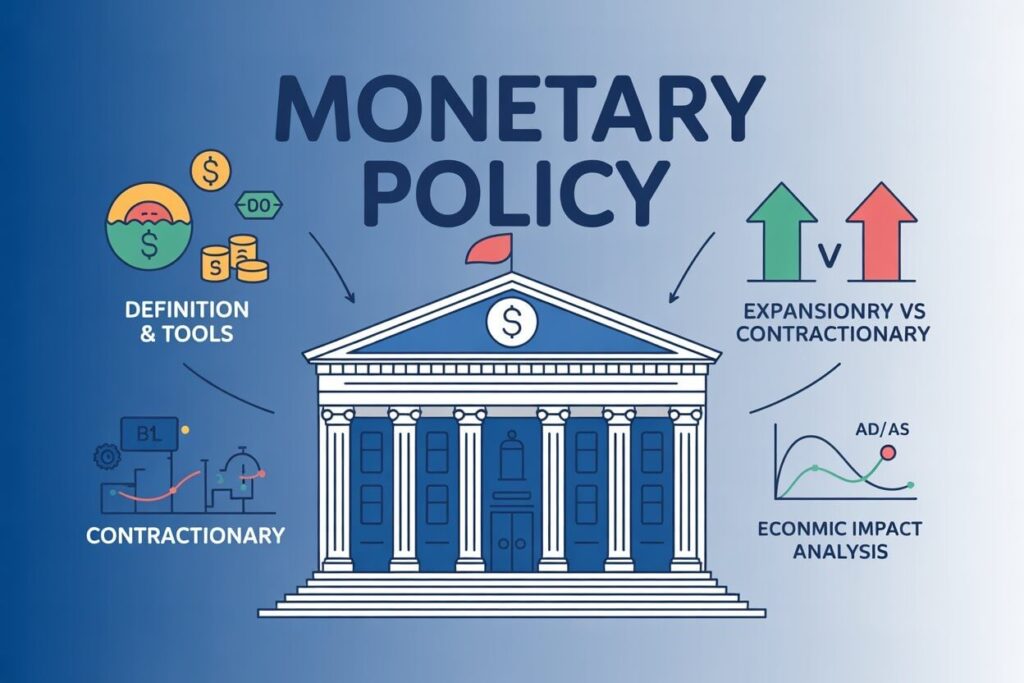
How Central Banks Steer the Economy and Control Inflation
Monetary Policy consists of the macroeconomic strategies, tools, and actions implemented by a country’s central bank to manage the money supply, control inflation, and ensure sustainable economic growth. The primary instrument for executing this policy is the Policy Rate (often referred to as the benchmark interest rate or target rate).
For financial professionals, investors, and the audience of economist.media, the central bank’s monetary policy decisions are the most closely watched economic events of the year. The policy rate acts as the financial gravity of an economy; every other interest rate—from corporate loans to auto financing and savings accounts—is anchored to it.
The Mandate of the Central Bank
Most modern central banks, including the State Bank of Pakistan (SBP) and the US Federal Reserve, operate with a specific legal mandate. Generally, their primary goal is price stability (keeping inflation low and predictable). Secondary mandates often include maximizing employment and maintaining the stability of the financial system.
Central banks use the policy rate to balance the economy on a tightrope. If the economy grows too fast, it risks hyperinflation. If it grows too slowly, it risks recession and mass unemployment.
The Policy Rate Mechanism: Expansionary vs. Contractionary
The central bank’s Monetary Policy Committee (MPC) meets regularly to assess macroeconomic indicators (like CPI, GDP growth, and trade balances) and decides whether to alter the policy rate.
1. Contractionary Monetary Policy (Hawkish Stance): When inflation is running too high, the central bank implements a contractionary policy by increasing the policy rate.
- How it works: By raising the benchmark rate, the central bank makes it more expensive for commercial banks to borrow money. The commercial banks pass these higher costs onto their customers by raising interest rates on corporate loans, mortgages, and credit cards.
- The Result: Borrowing becomes expensive, so businesses delay expansion and consumers cut back on big-ticket purchases. Simultaneously, higher rates on savings accounts encourage people to save rather than spend. This aggregate drop in demand forces businesses to halt price increases, effectively cooling down inflation.
2. Expansionary Monetary Policy (Dovish Stance): When the economy is sluggish, facing a recession, or experiencing high unemployment, the central bank implements an expansionary policy by decreasing the policy rate.
- How it works: Lowering the rate makes borrowing cheap. Commercial banks slash rates on business loans and consumer credit.
- The Result: Businesses take out loans to build new factories and hire workers. Consumers borrow money to buy houses and cars. Because savings accounts offer negligible returns, people are incentivized to spend or invest in the stock market. This surge in economic activity stimulates GDP growth and creates jobs.
Tools of Monetary Policy
While the policy rate is the headline tool, central banks utilize a suite of mechanisms to control the money supply:
- Open Market Operations (OMOs): This is the most frequently used tool. The central bank buys or sells government securities (like Treasury Bills) in the open market. When the central bank buys securities, it injects cash into the banking system, expanding the money supply. When it sells securities, it pulls cash out of the system, tightening the money supply.
- Reserve Requirements (CRR/SLR): The central bank mandates that commercial banks must hold a certain percentage of their total customer deposits in reserve (either as cash in the vault or at the central bank). If the central bank raises the reserve requirement, banks have less money available to lend out, which contracts the money supply.
- Discount Window Lending: The interest rate at which the central bank lends money overnight to commercial banks facing temporary liquidity shortages.
The Transmission Mechanism and Time Lags
A crucial concept in economics is the Monetary Policy Transmission Mechanism—the complex pathway through which a change in the central bank’s policy rate ripples through the financial sector and eventually impacts the real economy (prices and employment).
In Pakistan, when the SBP changes the policy rate, it immediately affects the Karachi Interbank Offered Rate (KIBOR), which is the rate at which banks lend to one another. KIBOR dictates the pricing of corporate loans.
However, monetary policy is notoriously subject to time lags. When a central bank raises interest rates today, the full disinflationary effect on the real economy might not be felt for 12 to 18 months. Businesses do not cancel long-term construction projects overnight, and consumers do not immediately change their spending habits. This delay requires central bankers to be forward-looking, adjusting rates based on where they forecast inflation will be in the future, rather than where it is today.
The Impact on the Exchange Rate
Monetary policy also heavily dictates currency valuation through the principle of interest rate parity. If a country raises its policy rate significantly higher than global averages, it attracts foreign portfolio investors seeking high yields. These investors must buy the local currency to invest in local bonds, which increases demand for the currency and causes it to appreciate. Conversely, cutting rates can lead to capital flight and currency depreciation.
Key Takeaways:
- Monetary policy is managed by the central bank to control inflation and stabilize economic growth.
- The Policy Rate is the benchmark interest rate that dictates borrowing costs across the entire economy.
- To fight inflation, central banks raise rates (contractionary); to fight recessions, they lower rates (expansionary).
- Monetary policy changes take time to filter through the economy, often taking 12 to 18 months to fully impact inflation.
- Higher interest rates generally strengthen a national currency by attracting foreign yield-seeking capital.
Authoritative Sources & Further Reading:


A practical guide to Pakistan freelancer tax documentation, export payments and formal business growth. Check the rules and steps before billing abroad.
Key Takeaways
- Pakistan’s ICT exports reached approximately $4.6 billion in FY2025–26, according to July 2026 reporting of official figures; freelancers contribute within this wider services story.
- The Economic Survey FY2025–26 reported $856.3 million in freelancer earnings in July–March FY26, a different time window from the full-year IT total.
- A foreign client’s invoice, the bank’s receipt record and the worker’s tax filing should tell a consistent story; cash received is not automatically taxable profit.
- The correct withholding treatment depends on current law, service classification, documentation and eligibility; an online flat-rate claim is not a substitute for personalised advice.
A designer in Multan can sell work to a business in Dubai without setting up an office abroad. Receiving the money, proving where it came from and handling Pakistan tax documentation are often more difficult than completing the project. That is why Pakistan freelancers tax 2026 is not simply a question of finding the lowest rate.
Formalising international earnings should offer something in return: dependable payments, an auditable income record, access to housing and business finance, and the ability to hire staff. The country benefits when genuine export receipts pass through regulated channels. Freelancers benefit when banks and tax authorities publish understandable rules and use them consistently. This guide explains the practical system without pretending that every freelancer has the same tax status or every digital service receives identical treatment.
What do current numbers tell us about Pakistan’s freelancers?
The Pakistan Economic Survey FY2025–26 highlights recorded freelance-related foreign exchange earnings of approximately $856.3 million for July–March FY26. The 17 July 2026 ICT exports report placed full-year ICT export earnings around $4.6 billion. Those are not mutually interchangeable statistics: reporting windows, definitions and eligible transactions differ.
| Indicator | Period | Reported amount | What it does not show |
|---|---|---|---|
| Freelancer foreign-exchange earnings | Jul–Mar FY26 | About $856.3m | Total informal freelancing everywhere |
| ICT export receipts | Full FY2025–26 | About $4.6bn | Freelancer earnings alone |
| ICT export remittances | Jul–Mar FY26 | $3.388bn | Number of people earning overseas |
| FY27 fiscal year | Jul 2026–Jun 2027 | Ongoing | Final annual receipts |
A worker using overseas platforms may be paid at irregular intervals. Platform dashboards can show invoiced value, while Pakistani bank statistics usually measure recognised receipts. For policy analysis, these figures should not be added together as if they were independent categories.
The key missing economic question is business formation. How many individual exporters graduate into firms with recurring customers, staff training and intellectual property? Policymakers need clearer longitudinal data before celebrating an unsupported number of new technology jobs.
How should freelancers receive money from overseas clients?
Start with a bank or regulated service that can explain in writing how foreign service payments are received, identified and converted. Confirm required invoice fields, proof of work and any restrictions specific to your profession. Each authorised bank may have its own operational checklist within the applicable SBP rules; payment methods that work for one client may not be suitable for another.
The Economic Survey 2025–26 describes measures intended to ease IT export realisation and documentation. That direction matters because a long delay in crediting a legitimate invoice can disrupt freelancers who must pay rent or subcontractors before a project is finished.
A sensible document set includes the client contract, numbered invoice, evidence of delivery and the bank receipt. Keep a consistent description of the service. When the payer is a platform rather than the end customer, preserve the platform statement connecting the payment to work performed.
Do not rely on informal dollar exchange arrangements simply because they seem convenient. They may create regulatory, fraud and record-keeping risks. Equally, do not assume every bank representative knows the full details of service-export classification. Escalate ambiguous cases through the bank’s compliance channel and ask for a written answer.
What is taxable and what paperwork should be kept?
Tax treatment is determined by the Finance Act, applicable income-tax rules, taxpayer status, whether the earnings meet any export-service conditions and the evidence available. The Federal Board of Revenue’s Finance Act 2026 page is the appropriate starting point for current law. Older blog posts frequently mix fiscal years or state a withholding rate without specifying the conditions.
A freelancer should distinguish gross invoice value, the amount received after platform fees, legitimate deductible expenses and tax actually withheld, if any. They are not identical. Also distinguish advance collection from final liability or credits: those concepts have specific legal definitions.
Example bookkeeping, not a tax assessment
Suppose a client pays $1,000, a platform deducts $50 and the bank credits the local-currency equivalent of $950. Your books should preserve the $1,000 invoice, $50 platform-fee evidence, applicable foreign-exchange conversion rate and actual bank credit. Whether the $50 is deductible and what tax applies depend on current law and professional circumstances. No exchange rate or tax percentage is assumed here.
| Document | Practical purpose |
|---|---|
| Client agreement | Defines work, payer and location of services |
| Original invoice | Shows gross contractual earnings |
| Payment-platform statement | Explains fees and net settlement |
| Pakistani bank credit advice | Evidence of receipt and conversion |
| Expense receipts | Supports claimed business costs |
| Tax return and statements | Reconciles annual declared income |
Ask a qualified tax practitioner to review your specific classification before relying on promotional claims about a universal freelancer tax rate.
Why does formal status matter for getting credit?
A freelance professional may earn more than a salaried employee yet struggle to obtain a mortgage because income arrives irregularly and is not clearly documented. From the bank’s perspective, a reliable history of recurring contracts and deposits is easier to underwrite than an unverified statement of expected overseas payments.
The SBP’s revised SME prudential rules, applicable from 1 January 2026 and its July 2026 revisions show that the banking regulator is updating definitions and financing requirements. A sole professional and a registered enterprise can face different documentation and product eligibility, so ask a bank how it assesses variable foreign-currency income.
Formalisation can also reduce client concentration. If the business can hire and invoice transparently, its founder may manage larger projects. But turning a freelancer into a company is not automatically beneficial. Registration, accounting and compliance create costs. Evaluate whether the structure solves a real business need.
A government that wants export growth should make compliance predictable. It should publish plain-English guidance covering practical invoices, bank documentation, permissible accounts, complaints and tax filing for common freelancer situations.
Would Raast or a digital rupee solve cross-border payments?
Raast is primarily domestic instant-payment infrastructure. It can make local transfers and merchant payments easier, but it does not mean any overseas client can automatically send money through the same interface. Cross-border settlement involves foreign banks, currency conversion, identity verification and international compliance requirements.
The SBP payment-systems publications document the rapid growth of digital banking. In the January–March 2026 quarterly review, the regulator reported widespread digital retail use. That is progress for domestic collections and payments to subcontractors. For export receipts, the key test is whether an approved channel connects to foreign payers at an understandable cost.
Some proposals present a central-bank digital currency as a solution to all international payment problems. A hypothetical digital rupee would still require legal interoperability, market liquidity and user protections. A pilot or policy exploration is not evidence that a widely accessible retail digital rupee has been launched. Check official announcements rather than relying on a promotional application.
Freelancers need functional ordinary rails first: transparent fees, prompt settlement, reliable receipts and a clear process when a legitimate transaction is rejected.
What policy changes would make freelancers a larger export industry?
Publish a standardised bank checklist for common professional services; harmonise the way legitimate transactions are recorded; establish a prompt escalation process for delayed credits; and provide export-service tax guidance that distinguishes individuals, partnerships and incorporated firms.
Then improve access to working capital. International clients may pay 30 or 60 days after work is delivered. A lender can assess documented receivables more responsibly when contracts, invoices and settlement histories are reliable. Regulators must balance that opportunity against fake invoices and concentrated borrowers.
The World Bank’s Pakistan strategy includes productive private-sector investment. A practical export strategy should also fund training in client management, cybersecurity, written communication and contract negotiation. These skills turn a single good project into repeat business.
Finally, report outcomes that matter: average receipt-processing time, complaints resolved, number of recurring service exporters and formal firms formed. The objective is not to force every individual into a costly structure. It is to remove needless penalties from being transparent and compliant.
What is the freelancer tax rate in Pakistan in 2026?
There is no safe universal answer without checking the precise service type, tax status, documentation and applicable law for FY2026–27. Different payment and business structures can lead to different treatment. Consult the final Finance Act 2026 and FBR guidance or a qualified adviser; do not apply a percentage from an older article blindly.
What This Means for You
New freelancer: Set up a separate place to track business payments, issue numbered invoices and maintain proof of project completion. Ask your authorised bank for written foreign-payment requirements before accepting a large contract.
Established exporter: Reconcile platform fees, gross invoices and actual credits monthly. Review tax status ahead of filing deadlines instead of discovering classification issues when a bank asks for proof of income.
Small agency: Keep contracts, client concentration and receivables visible. A sustainable business is less dependent on one platform or subcontractor.
Tax policymaker: Test compliance forms with real freelancers from different income levels and regions. A good rule should be understandable to a designer in Sialkot and an accountant in Peshawar without a specialist intermediary for routine matters.
What to Watch Next
- 26 October 2026: The State Bank monetary-policy decision and any revision to its inflation assessment; verify any schedule change with the SBP.
- Early November 2026, exact release date to be confirmed: Pakistan Bureau of Statistics October inflation and merchandise-trade releases.
- Late October–November 2026, date not yet confirmed: Any IMF Executive Board announcement on the October staff-level agreement; staff agreement is not Board approval.
- Throughout FY2026–27: Updated SBP monthly balance-of-payments and remittance statistics; compare cumulative results rather than one month alone.
Frequently Asked Questions
What is the freelancer tax rate in Pakistan in 2026?
There is no safe universal answer without checking the precise service type, tax status, documentation and applicable law for FY2026–27. Different payment and business structures can lead to different treatment. Consult the final Finance Act 2026 and FBR guidance or a qualified adviser; do not apply a percentage from an older article blindly.
Are freelance payments counted as IT exports?
Some qualifying digital-service receipts are reflected in the ICT export category, but not every freelance activity or dashboard balance is recorded in the same way. The Economic Survey and State Bank track particular receipt concepts. Confirm what your bank records and avoid adding overlapping categories together.
Can Pakistani freelancers be paid directly through Raast by foreign clients?
Raast provides domestic instant-payment infrastructure; access from a foreign sender is a separate cross-border integration question. A foreign business should use a currently approved transfer channel. Ask your bank about available providers, fees and documents rather than assuming a domestic Raast alias is an international receiving account.
Should a freelancer register a company in Pakistan?
Not always. A company can help when hiring, entering larger contracts or seeking finance, but it also creates administrative and tax obligations. Compare sole-professional options, contractual requirements and projected business costs with a registered adviser before restructuring.
How can freelancers prove income to Pakistani banks?
Maintain consistent client contracts, invoices, platform statements and matching bank receipts over time. A bank may also ask for tax filings and source-of-funds explanations. Requirements vary by product and institution, so ask the lender which documented earnings it recognises for underwriting.
The best tax and payment system would make the honest route the easy route. Pakistan has demonstrated that professionals can earn from clients worldwide. The next stage is helping them receive, document, invest and grow that income without needless friction.

In under two years, the regulatory posture toward crypto in the United States has flipped from adversarial to explicitly promotional. What began as an executive order in January 2025 has cascaded into a stablecoin law, a coordinated SEC-CFTC framework, a five-category classification system for digital assets, and — as of this week — a genuine test of whether Congress can finish the job with comprehensive market-structure legislation. Here is the full architecture of Trump-era crypto policy as it stands in September 2026.
The Foundation: Executive Order 14178 and the White House Report
The administration’s crypto agenda traces back to Executive Order 14178, issued at the start of the second Trump term. On July 30, 2025, the President’s Working Group on Digital Asset Markets — established under that order — issued a comprehensive report titled “Strengthening American Leadership in Digital Financial Technology,” according to Practical Law’s coverage. That report became the blueprint both the SEC and CFTC would spend the next year implementing.
SEC’s “Project Crypto” and CFTC’s “Crypto Sprint”
Within 48 hours of the White House report’s release, both major regulators launched dedicated initiatives. SEC Chair Paul Atkins announced “Project Crypto” on July 31, 2025 — an agency-wide effort to implement the White House’s recommendations, with five stated priorities including, notably, “onshoring crypto to the US,” per Practical Law. Chair Atkins directed the SEC’s policy divisions to coordinate with the agency’s Crypto Task Force, led by Commissioner Hester Peirce, a longtime industry-friendly voice at the Commission.
The very next day, then-Acting CFTC Chair Caroline Pham launched a parallel “Crypto Sprint,” a 12-month initiative covering the listing of spot digital assets on CFTC-registered exchanges, allowing derivatives market participants to use tokenized collateral including stablecoins, and establishing a “CEO Innovation Council” of 12 exchange executives, according to K&L Gates. Within months, the CFTC confirmed spot digital assets were available for trading on a CFTC-registered exchange for the first time.
The GENIUS Act: America’s First Federal Stablecoin Law
The most concrete legislative achievement of the period has been the GENIUS Act, the first U.S. federal law specifically governing stablecoins. Its enactment triggered a wave of follow-on rulemaking: K&L Gates noted that the Treasury Department, the Office of the Comptroller of the Currency, and other federal banking agencies all opened rulemakings to implement the law during 2026. The GENIUS Act’s definition of “digital asset” has since become the template other agencies build from — the SEC’s own proposed crypto-asset offering rules explicitly mirror the GENIUS Act’s definitional language.
March 2026: The SEC-CFTC Coordination Breakthrough
The most significant structural shift arrived in March 2026. On March 11, SEC Chairman Paul Atkins and CFTC Chairman Michael Selig signed a Memorandum of Understanding to formally coordinate the two agencies’ historically overlapping and often conflicting jurisdiction over digital assets, according to Latham & Watkins’ policy tracker. The MOU commits both agencies to a “minimum effective dose” of regulation intended to promote innovation while still protecting market integrity.
Six days later, on March 17, 2026, the SEC and CFTC jointly published an interpretive release — their first major coordinated statement since the MOU — sorting digital assets into a five-category framework, according to Holland & Knight: digital commodities, digital collectibles, digital tools, payment stablecoins (aligned with the GENIUS Act definition), and a fifth category covering more traditional securities-like tokens. That classification system is now the reference point nearly every subsequent rulemaking builds from.
Trump-era crypto policy timeline:
| Date | Development | Body |
|---|---|---|
| Jan 2025 | Executive Order 14178 | White House |
| Jul 30, 2025 | Digital asset policy report | Presidential Working Group |
| Jul 31, 2025 | “Project Crypto” launched | SEC (Chair Atkins) |
| Aug 1, 2025 | “Crypto Sprint” launched | CFTC (Acting Chair Pham) |
| — 2025 | GENIUS Act enacted | Congress |
| Mar 11, 2026 | SEC-CFTC MOU signed | SEC + CFTC |
| Mar 17, 2026 | Five-bucket digital asset classification | SEC + CFTC joint release |
| Aug 2026 | “Regulation Crypto Assets” proposed | SEC |
| Sep 10, 2026 | Revised 630-page CLARITY Act released | Senate Republicans |
| Sep 15, 2026 | Procedural vote scheduled | U.S. Senate |
SEC Proposes “Regulation Crypto Assets”
In August 2026, the SEC moved from interpretation to formal rulemaking, proposing “Regulation Crypto Assets” — a bespoke offering regime specifically for crypto investment contracts. According to Sidley Austin’s analysis, Chairman Atkins said the proposed rules “draw heavily from Congressional work over recent years, particularly the CLARITY Act,” explicitly designing the rule to give the industry a regulatory head start pending final legislation. The proposal’s four-year window for a startup exemption mirrors the CLARITY Act’s own timeline for a token project to reach “mature blockchain system” status — a deliberate signal that the SEC expects the legislative and regulatory tracks to converge.
The Unfinished Business: CLARITY Act’s Uncertain Fate
Despite the extensive regulatory groundwork, the industry’s top legislative priority — the Digital Asset Market CLARITY Act, which would legislatively divide SEC/CFTC jurisdiction and create a comprehensive market-structure framework — remains unpassed as of this writing. The House passed its version, but the bill has stalled in the Senate, falling short of the 60 votes needed for passage, according to Holland & Knight.
Senate Republicans released a substantially revised, 630-page version of the bill on September 10, 2026, adding over 100 changes and specifically targeting “decentralized-in-name-only” protocols by requiring them to register with the CFTC, per Investing News Network. A pivotal procedural vote is scheduled for September 15, 2026, after the Senate returns from recess — but the bill already missed one legislative window in August, and CNBC reported that industry insiders, including SALT CEO John Darsie, remain skeptical of passage in 2026 given the difficulty of moving major legislation heading into midterm elections.
What Happens If CLARITY Fails
Crucially, the industry’s regulatory position does not collapse if CLARITY dies in the Senate. As CNBC’s reporting notes, “viewed from a narrow lens, the investment is already paying off, even if Clarity dies” — the SEC and CFTC have already built out much of the practical framework administratively through the MOU, the joint interpretive release, and the proposed Regulation Crypto Assets rule. Legislation would lock the framework into statute, providing durability against a future administration reversing course, but its absence would not undo the deregulatory shift already underway across every major digital-asset regulator, including the Office of the Comptroller of the Currency, which has also moved toward a looser supervisory framework for bank involvement in digital assets.
Final Verdict
The second Trump administration’s crypto policy has been unusually coordinated and fast-moving by regulatory standards: an executive order, a detailed policy report, twin agency initiatives, the first federal stablecoin law, an inter-agency MOU, a joint classification framework, and now a formal rulemaking — all within about 18 months. The remaining variable is whether Congress can convert that administrative groundwork into durable statute via the CLARITY Act, and the September 15 Senate vote is the clearest near-term test of that question. Either outcome, the substantive deregulatory shift toward “onshoring crypto to the US” is already largely in place at the regulatory level — legislation would cement it, not create it.
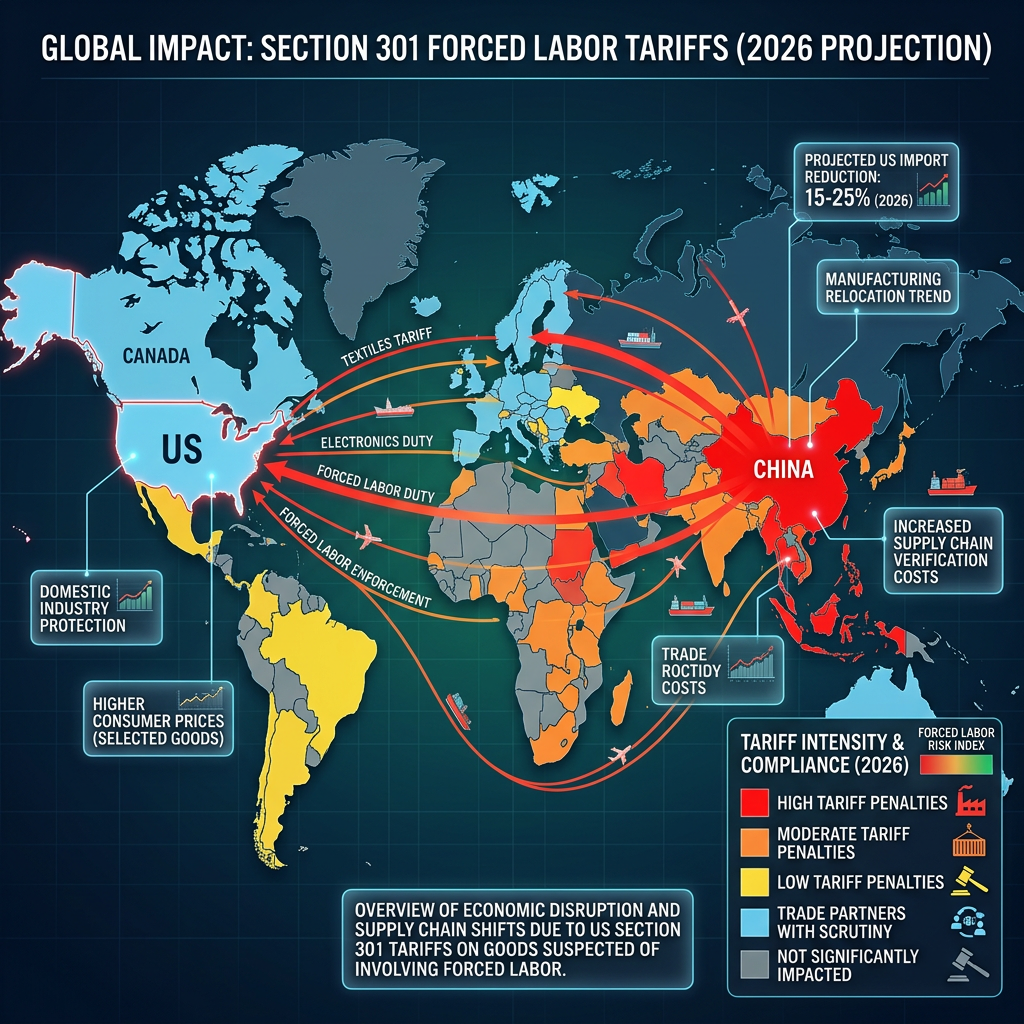
On June 2, 2026, the Office of the United States Trade Representative made a determination that quietly touches nearly every major global trading relationship at once: all 60 economies investigated for failing to adequately prohibit or enforce bans on forced-labor-produced imports were found to be acting unreasonably and burdening US commerce — with proposed tariffs of 10% to 12.5% now on the table for each (USTR).
This isn’t a fringe trade action. The 60 economies under investigation account for over 90% of all imports into the United States (Covington & Burling) — meaning this single proceeding has the potential to reshape tariff exposure across nearly the entire US import base simultaneously.
Why the Legal Framing Matters More Than the Headline
Understanding why USTR chose this specific legal pathway is essential context most coverage skips. Following a Supreme Court ruling that President Trump lacked authority to impose broad tariffs under the International Emergency Economic Powers Act (IEEPA), the administration pivoted to Section 301 of the Trade Act of 1974 — a statutory authority Congress has explicitly delegated to the executive branch for addressing unreasonable or discriminatory foreign trade practices, offering a legally sturdier foundation for longer-term tariffs than the IEEPA route that courts struck down (Covington & Burling).
That legal pivot is the real story: it signals the administration intends to build a more durable, litigation-resistant tariff architecture going forward, rather than relying on emergency powers that face ongoing court challenges.
The Two-Tier Structure, and Who Lands Where
USTR’s proposed action splits the 60 economies into two tariff tiers based on their existing forced-labor enforcement posture. Fourteen unique trading entities — including 13 countries plus the European Union — qualify for the lower 10% rate because they either maintain some form of import prohibition, operate a partial enforcement regime, or have committed to action through an Agreement on Reciprocal Trade (Green Worldwide Shipping).
The remaining 46 economies, which have neither imposed a forced labor import prohibition nor committed to establishing one, face the higher 12.5% rate.
Within the lower tier, USTR specifically identified six economies — Canada, Ecuador, the European Union, Indonesia, Mexico, and Pakistan — as jurisdictions that do maintain a forced labor import prohibition on paper, but have failed to enforce it effectively (Green Worldwide Shipping). That’s a notably diverse list spanning North America, South America, Europe, and South and Southeast Asia — underscoring that this is a genuinely global enforcement action, not one targeted at a specific region or bloc.
What USTR’s Own Report Argues Is at Stake
USTR’s underlying findings frame the economic argument in fairly direct terms: the failure to impose and enforce forced labor import prohibitions undermines global efforts to eliminate forced labor, permits firms using forced labor to produce goods at artificially lower cost, and correspondingly reduces the profitability and competitiveness of firms that don’t rely on forced labor (Green Worldwide Shipping). US Trade Representative Ambassador Jamieson Greer acknowledged some trading partners have taken initial steps — through USMCA commitments and Agreements on Reciprocal Trade — but stated each partner “must do more to ensure that trade does not perversely encourage and entrench forced labor globally” (Thompson Hine SmarTrade).
The Exemptions That Actually Determine Real-World Impact
The headline 10-12.5% figures overstate the action’s uniform impact, because the proposal includes a substantial list of carve-outs that materially change exposure depending on product category and origin. Goods listed in Annex A of the Federal Register notice — organized by Harmonized Tariff Schedule classification rather than product name — are excluded entirely. Also excluded: products already subject to Section 232 sector-specific duties, USMCA-compliant goods from Canada and Mexico, textiles and apparel entering duty-free under CAFTA-DR from Costa Rica, the Dominican Republic, El Salvador, Guatemala, Honduras, or Nicaragua, and informational materials, donations, and accompanied baggage (Covington & Burling).
USTR has also proposed a specific textile mechanism allowing a certain volume of apparel and textile imports to enter at the reduced Section 301 rate, calibrated to the volume of US-manufactured textile inputs (cotton and man-made fibers) that a given trading partner imports from the United States — effectively rewarding countries that maintain reciprocal textile trade relationships with the US (Clark Hill).
The Process Timeline and Why It Matters for Businesses Now
USTR initiated these 60 investigations on March 12, 2026, and moved through the process on what the agency has explicitly called an “accelerated timeframe.” Over the following weeks, USTR held consultations with 46 of the 60 targeted governments, received more than 450 public comments, and conducted two days of public hearings on April 28-29, 2026, with nearly 60 witnesses testifying (Green Worldwide Shipping).
The next critical dates: written public comments on the proposed actions were due July 6, 2026, and the Section 301 Committee held public hearings on the proposed action on July 7, 2026, at the US International Trade Commission in Washington (USTR). Notably, unlike prior Section 301 proceedings, USTR has not indicated it will accept post-hearing rebuttal comments in this instance — suggesting the agency intends to move toward a final determination relatively quickly once the hearing process concludes (Covington & Burling).
Crucially, no new duties are in effect yet — this remains a proposed action pending finalization. But trade law specialists are explicitly advising importers not to wait for finalization before assessing exposure, given how compressed this timeline already is compared to typical Section 301 proceedings (Clark Hill).
What Businesses Should Actually Be Doing Right Now
Trade counsel tracking this proceeding recommend a specific sequence of practical steps for import-exposed businesses. First, map exposure by country of origin and Harmonized Tariff Schedule (HTS) number specifically, pulling 2025-2026 entry data across the 60 investigated economies to identify which product lines would fall outside Annex A or other exclusions. Second, model the proposed 10% and 12.5% duties as an additional tariff layer and stress-test margin impact, pricing strategy, customer cost pass-through capacity, and import bond sufficiency. Third, don’t assume coverage or exemption without verification — confirm Section 232, USMCA, CAFTA-DR, Chapter 98, informational-materials, donation, and Annex A treatment against actual customs documentation rather than general product category assumptions (Clark Hill).
For companies with meaningful exposure, engaging directly in the comment process — either individually or through industry coalitions — remains a live opportunity to influence the final scope, exclusion list, and duty levels before USTR issues its final action.
Why This Story Deserves More Attention Than It’s Getting
Given that this single proceeding touches over 90% of US import volume, spans every major economic region this publication covers — the EU (and by extension UK-adjacent trade dynamics), Canada, Indonesia, and Pakistan are all explicitly named among the six enforcement-gap economies — and represents a structurally more durable tariff mechanism than the IEEPA approach the Supreme Court struck down, it’s genuinely surprising how little mainstream financial coverage has connected these dots into a single comprehensive picture. Most coverage to date has come from specialized trade law and customs compliance publications rather than general business media, leaving a meaningful gap for anyone trying to understand how this action might reshape global trade costs through the second half of 2026 and beyond.
The Bottom Line
The Section 301 forced labor tariff proceeding is one of the most consequential and least-covered trade policy developments of 2026, precisely because its framing — human rights enforcement rather than explicit protectionism — makes it politically harder to challenge than a straightforward tariff action, while its legal foundation under Section 301 makes it more durable than the IEEPA-based tariffs courts have already invalidated. With over 90% of US import volume affected and a compressed timeline that skipped the traditional post-hearing rebuttal period, businesses with meaningful cross-border exposure to any of the 60 named economies — which include major US trading partners across virtually every region — have a narrow and rapidly closing window to assess exposure and engage the process before these tariffs move from proposal to finalized policy.

Diesel Prices 2026–2027: Why Cheaper Crude May Not Mean Cheap Fuel

2027 Social Security COLA: Key Details and Dates

KSE-100 Sees Major Drop Post-SBP Rate Hike

Big Tech’s AI Spending Test: Can Revenue Catch Up With Capital Expenditure?

AI Infrastructure Investment Strategies for 2026

Pakistan Freelancers Tax 2026: Payments, Documentation and Formal Growth

Strait of Hormuz Crisis: What the Latest Tanker Attacks Mean for Oil, Shipping and Global Trade

AI Customer Service in 2026: What’s Working, What’s Failing, and What to Buy

Open a Savings Account Online: How to Actually Earn 10x the National Average Rate

Global Housing Market 2026: Where Prices Rise, Where They Don’t

PSX and KSE-100 Record Highs: An Insider’s Guide to Pakistan Stocks

So Delicious Dessert Recall: Affected Products, FDA Guidelines, and Consumer Action

Pakistan’s Current Account Deficit Narrows Sharply to $98 Million in August 2026

Japan Eyes 3.5% Defense Spending: What It Means for Bonds, Stocks, and the BOJ

Top 15 Stocks for Investment in 2026 in PSX: Your Complete Guide to Pakistan’s Best Investment Opportunities
Top 15 Stocks for Investment in 2026 in PSX: Your Complete Guide to Pakistan’s Best Investment Opportunities

Debunking IMF Program Myths: Reconfiguring Engagement for True National Ownership in a Volatile World

Top 10 Mutual Fund Managers in Pakistan for Investment in 2026: A Comprehensive Guide for Optimal Returns

China’s 50% Domestic Equipment Rule: The Semiconductor Mandate Reshaping Global Tech

What the U.S. Attack on Venezuela Could Mean for Oil and Canadian Crude Exports: The Economic Impact

15 Most Lucrative Sectors for Investment in Pakistan: A 2025 Data-Driven Analysis

Pakistan’s Export Goldmine: 10 Game-Changing Markets Where Pakistani Businesses Are Winning Big in 2025

How to Become an Active Taxpayer on Pakistan’s FBR Active Taxpayer List (ATL) in 2026: A Step-by-Step Guide

Pakistan’s Stock Market Renaissance: How 2025’s Hottest Investment Opportunity Is Democratizing Wealth—A Complete Beginner’s Guide

Best Investments in Pakistan 2026: Top 10 Low-Price Shares and Long-Term Picks for the PSX
15 Most Lucrative Sectors for Investment in Pakistan: A 2025 Data-Driven Analysis
15 Most Lucrative Sectors for Investment in Pakistan: A 2025 Data-Driven Analysis

Pakistan’s Economic Outlook 2025: Between Stabilization and the Shadow of Stagnation
-
 Markets & Finance10 months ago
Top 15 Stocks for Investment in 2026 in PSX: Your Complete Guide to Pakistan’s Best Investment Opportunities
-
Markets & Finance10 months ago
Top 15 Stocks for Investment in 2026 in PSX: Your Complete Guide to Pakistan’s Best Investment Opportunities
-
 Analysis9 months ago
Debunking IMF Program Myths: Reconfiguring Engagement for True National Ownership in a Volatile World
-
 Investment10 months ago
Top 10 Mutual Fund Managers in Pakistan for Investment in 2026: A Comprehensive Guide for Optimal Returns
-
 Asia10 months ago
China’s 50% Domestic Equipment Rule: The Semiconductor Mandate Reshaping Global Tech
-
 Global Economy10 months ago
What the U.S. Attack on Venezuela Could Mean for Oil and Canadian Crude Exports: The Economic Impact
-
 AI11 months ago
15 Most Lucrative Sectors for Investment in Pakistan: A 2025 Data-Driven Analysis
-
 Exports11 months ago
Pakistan’s Export Goldmine: 10 Game-Changing Markets Where Pakistani Businesses Are Winning Big in 2025