
Business
Stock Market Today: Wall Street Rallies Ahead of Fed Decision as Big Tech Earnings Loom


Wall Street opened Wednesday with cautious optimism, as investors positioned for a consequential convergence of monetary policy and corporate earnings that could define the market’s trajectory for months to come. Nasdaq 100 futures rose about 0.5% Yahoo Finance, leading the advance, while S&P 500 futures inched up 0.2% Yahoo Finance. The technology-heavy surge offered a counterpoint to Dow futures, which struggled near the flatline amid sector-specific pressures.
The stock market today reflects a delicate balancing act. The S&P 500 notched a record close on Tuesday of 6,978 Yahoo Finance, placing the benchmark index tantalizingly close to the psychological 7,000 threshold. Yet beneath this surface strength lies a web of uncertainties that few earnings seasons have had to navigate simultaneously: a Federal Reserve caught between political pressure and institutional independence, trillion-dollar questions about artificial intelligence returns, and the specter of policy upheaval at the world’s most powerful central bank.
The Fed Decision: Politics Meets Monetary Policy
Wednesday afternoon’s Federal Reserve announcement marks the central bank’s first rate decision of 2026, and the stakes extend well beyond the expected outcome. CME Group’s Fedwatch tool indicates a 97.2% probability that the Fed will maintain interest rates at the current 3.5% to 3.75% range Stocktwits, effectively pausing the easing cycle that delivered three consecutive quarter-point cuts in the final months of 2025.
The pause itself is unremarkable. What transforms this meeting into a pivotal moment is the extraordinary political backdrop. Earlier this month, the Justice Department served the Fed with subpoenas over testimony Powell made before Congress related to the $2.5bn renovation of the central bank’s headquarters Al Jazeera. In a rare video statement, Powell characterized these moves as pretexts designed to undermine the Fed’s independence, declaring that the threat of criminal charges stemmed from the central bank setting rates based on economic assessment rather than presidential preferences.
The tension between the White House and the Fed has been simmering for months. President Trump has repeatedly called for lower interest rates, even as inflation remains elevated above the Fed’s two percent target. Markets currently expect the Fed to cut once or twice this year — most likely in June and December, according to futures market pricing CNBC. That measured approach stands in sharp contrast to the administration’s more aggressive stance, creating what some economists describe as the most fraught period for central bank independence in modern American history.
According to CNBC, Chair Powell’s press conference will likely become a referendum on Fed autonomy as much as a policy briefing. The question hanging over Wednesday afternoon is whether Powell can navigate this political minefield while maintaining the institutional credibility that underpins effective monetary policy.
Big Tech Earnings: The AI Reckoning Begins
While the Fed commands immediate attention, the real test for equity markets arrives after the closing bell. Microsoft, Meta Platforms, and Tesla report fourth-quarter results Wednesday evening, followed by Apple on Thursday. Collectively, these technology behemoths will provide the first comprehensive read on whether the extraordinary capital expenditures flowing toward artificial intelligence infrastructure are beginning to generate commensurate returns.
The numbers tell a sobering tale of investor expectations. For Microsoft, the expectation is of $3.88 per share in earnings on $80.2 billion in revenues, representing year-over-year growth rates of +20.1% and +15.2% Yahoo Finance. Yet the stock has underperformed recently, pressured by concerns about margin compression as AI-related spending accelerates. Analysts polled by FactSet expect capex to rise to $99 billion this fiscal year CNBC, up substantially from prior periods.
Meta faces perhaps the most acute scrutiny. Analysts expect $8.15 per share in earnings on $58.4 billion in revenues, representing year-over-year growth rates of +1.6% and +20.7% Yahoo Finance. The modest earnings growth belies massive investments in AI and the metaverse. When Meta last reported in October, the stock tumbled despite solid fundamentals, a reaction driven entirely by elevated spending guidance. Investors want clarity on when these investments translate into bottom-line results.
Tesla’s position is equally precarious. The electric vehicle maker faces headwinds from increased competition and margin pressure in its core automotive business, even as it advances autonomous vehicle technology. Apple, meanwhile, must demonstrate that its iPhone supercycle thesis remains intact while addressing questions about its own AI strategy and capital allocation.
Bloomberg reports that the four hyperscalers — Microsoft, Meta, Alphabet, and Amazon — are expected to boost capital expenditures to over $470 billion in 2026 from approximately $350 billion in 2025. That represents an investment surge of historic proportions, predicated on the assumption that artificial intelligence will fundamentally reshape the technology landscape. Whether that thesis proves correct may hinge on the guidance these companies provide this week.
Market Breadth and Underlying Dynamics
The divergence in Wednesday’s pre-market action speaks to broader market tensions. While technology shares lifted Nasdaq futures, the Dow struggled under the weight of sector-specific disappointments. UnitedHealth’s shares tumbled over 15% Yahoo Finance after the Trump administration announced it would keep Medicare payment rates steady, triggering a broader retreat across healthcare insurers.
This uneven performance reflects a market grappling with rotating leadership and uncertain catalysts. The S&P 500’s record close Tuesday marked impressive resilience, yet that strength remains concentrated in a narrow cohort of stocks. The Magnificent Seven technology giants, which once powered market gains with seemingly effortless momentum, have lagged the broader market over the trailing twelve months. Their collective performance through this earnings season will likely determine whether market breadth finally expands or concentration intensifies.
The Path Forward: Scenarios and Implications
As Wednesday’s events unfold, three distinct scenarios emerge. In the first, Powell delivers a dovish hold, signaling patience on rates while emphasizing the Fed’s data-dependent approach. Big Tech earnings meet or exceed expectations, with management teams providing credible paths to AI monetization. Markets rally on reduced uncertainty, and the S&P 500 pushes decisively above 7,000.
The second scenario is less benign. Powell’s press conference devolves into repeated questions about political pressure, undermining confidence in Fed independence. Tech earnings disappoint, or worse, guidance points to continued spending without clear revenue visibility. Volatility spikes as investors reassess both policy support and growth assumptions.
The third possibility splits the difference: The Fed maintains its cautious stance successfully, but tech earnings prove mixed, with some companies demonstrating AI progress while others struggle. Markets digest the results without dramatic moves, entering a period of consolidation as investors await more data.
What seems increasingly clear is that 2026 will test market resilience in ways that 2025’s concentrated leadership never fully addressed. The stock market today stands at an inflection point, caught between political uncertainty, technological transformation, and the timeless challenge of valuation. How these forces resolve may well determine whether this year’s market narrative proves triumphant or cautionary.


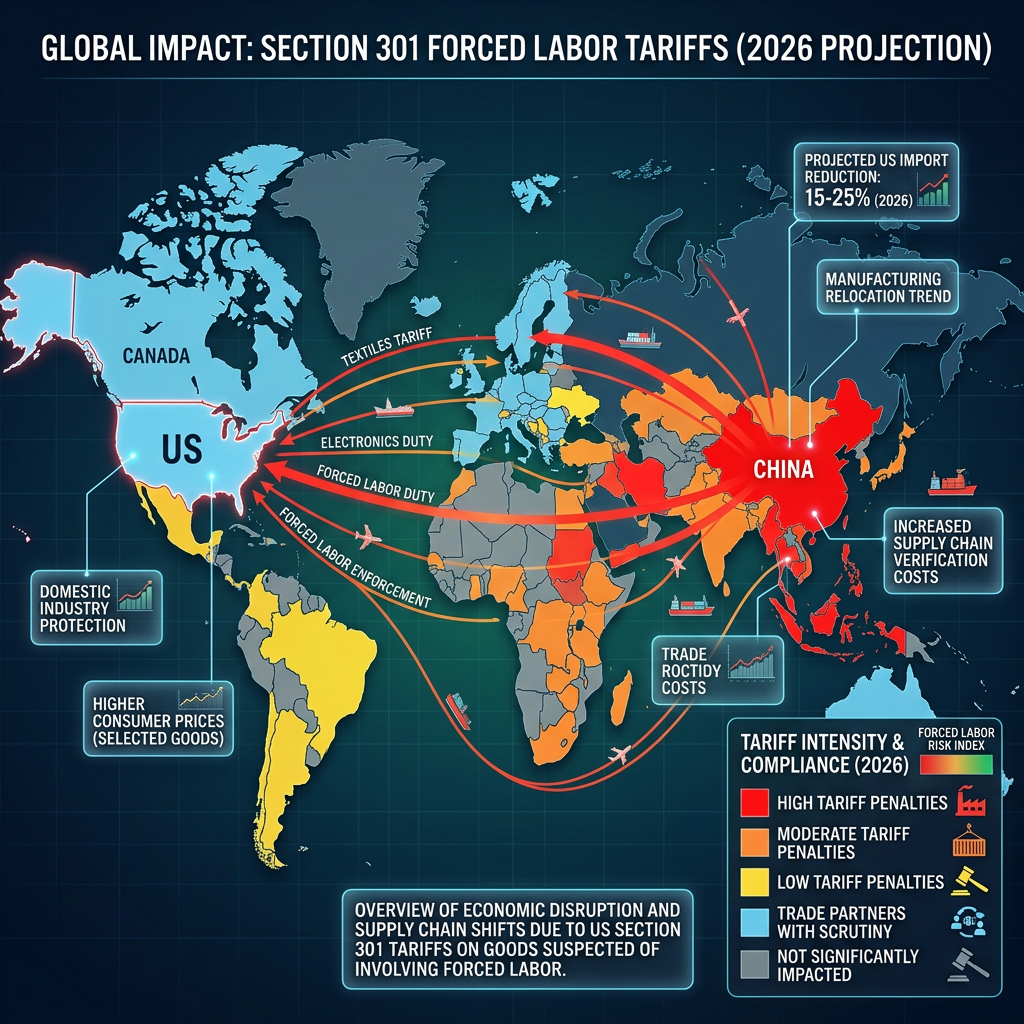
On June 2, 2026, the Office of the United States Trade Representative made a determination that quietly touches nearly every major global trading relationship at once: all 60 economies investigated for failing to adequately prohibit or enforce bans on forced-labor-produced imports were found to be acting unreasonably and burdening US commerce — with proposed tariffs of 10% to 12.5% now on the table for each (USTR).
This isn’t a fringe trade action. The 60 economies under investigation account for over 90% of all imports into the United States (Covington & Burling) — meaning this single proceeding has the potential to reshape tariff exposure across nearly the entire US import base simultaneously.
Why the Legal Framing Matters More Than the Headline
Understanding why USTR chose this specific legal pathway is essential context most coverage skips. Following a Supreme Court ruling that President Trump lacked authority to impose broad tariffs under the International Emergency Economic Powers Act (IEEPA), the administration pivoted to Section 301 of the Trade Act of 1974 — a statutory authority Congress has explicitly delegated to the executive branch for addressing unreasonable or discriminatory foreign trade practices, offering a legally sturdier foundation for longer-term tariffs than the IEEPA route that courts struck down (Covington & Burling).
That legal pivot is the real story: it signals the administration intends to build a more durable, litigation-resistant tariff architecture going forward, rather than relying on emergency powers that face ongoing court challenges.
The Two-Tier Structure, and Who Lands Where
USTR’s proposed action splits the 60 economies into two tariff tiers based on their existing forced-labor enforcement posture. Fourteen unique trading entities — including 13 countries plus the European Union — qualify for the lower 10% rate because they either maintain some form of import prohibition, operate a partial enforcement regime, or have committed to action through an Agreement on Reciprocal Trade (Green Worldwide Shipping).
The remaining 46 economies, which have neither imposed a forced labor import prohibition nor committed to establishing one, face the higher 12.5% rate.
Within the lower tier, USTR specifically identified six economies — Canada, Ecuador, the European Union, Indonesia, Mexico, and Pakistan — as jurisdictions that do maintain a forced labor import prohibition on paper, but have failed to enforce it effectively (Green Worldwide Shipping). That’s a notably diverse list spanning North America, South America, Europe, and South and Southeast Asia — underscoring that this is a genuinely global enforcement action, not one targeted at a specific region or bloc.
What USTR’s Own Report Argues Is at Stake
USTR’s underlying findings frame the economic argument in fairly direct terms: the failure to impose and enforce forced labor import prohibitions undermines global efforts to eliminate forced labor, permits firms using forced labor to produce goods at artificially lower cost, and correspondingly reduces the profitability and competitiveness of firms that don’t rely on forced labor (Green Worldwide Shipping). US Trade Representative Ambassador Jamieson Greer acknowledged some trading partners have taken initial steps — through USMCA commitments and Agreements on Reciprocal Trade — but stated each partner “must do more to ensure that trade does not perversely encourage and entrench forced labor globally” (Thompson Hine SmarTrade).
The Exemptions That Actually Determine Real-World Impact
The headline 10-12.5% figures overstate the action’s uniform impact, because the proposal includes a substantial list of carve-outs that materially change exposure depending on product category and origin. Goods listed in Annex A of the Federal Register notice — organized by Harmonized Tariff Schedule classification rather than product name — are excluded entirely. Also excluded: products already subject to Section 232 sector-specific duties, USMCA-compliant goods from Canada and Mexico, textiles and apparel entering duty-free under CAFTA-DR from Costa Rica, the Dominican Republic, El Salvador, Guatemala, Honduras, or Nicaragua, and informational materials, donations, and accompanied baggage (Covington & Burling).
USTR has also proposed a specific textile mechanism allowing a certain volume of apparel and textile imports to enter at the reduced Section 301 rate, calibrated to the volume of US-manufactured textile inputs (cotton and man-made fibers) that a given trading partner imports from the United States — effectively rewarding countries that maintain reciprocal textile trade relationships with the US (Clark Hill).
The Process Timeline and Why It Matters for Businesses Now
USTR initiated these 60 investigations on March 12, 2026, and moved through the process on what the agency has explicitly called an “accelerated timeframe.” Over the following weeks, USTR held consultations with 46 of the 60 targeted governments, received more than 450 public comments, and conducted two days of public hearings on April 28-29, 2026, with nearly 60 witnesses testifying (Green Worldwide Shipping).
The next critical dates: written public comments on the proposed actions were due July 6, 2026, and the Section 301 Committee held public hearings on the proposed action on July 7, 2026, at the US International Trade Commission in Washington (USTR). Notably, unlike prior Section 301 proceedings, USTR has not indicated it will accept post-hearing rebuttal comments in this instance — suggesting the agency intends to move toward a final determination relatively quickly once the hearing process concludes (Covington & Burling).
Crucially, no new duties are in effect yet — this remains a proposed action pending finalization. But trade law specialists are explicitly advising importers not to wait for finalization before assessing exposure, given how compressed this timeline already is compared to typical Section 301 proceedings (Clark Hill).
What Businesses Should Actually Be Doing Right Now
Trade counsel tracking this proceeding recommend a specific sequence of practical steps for import-exposed businesses. First, map exposure by country of origin and Harmonized Tariff Schedule (HTS) number specifically, pulling 2025-2026 entry data across the 60 investigated economies to identify which product lines would fall outside Annex A or other exclusions. Second, model the proposed 10% and 12.5% duties as an additional tariff layer and stress-test margin impact, pricing strategy, customer cost pass-through capacity, and import bond sufficiency. Third, don’t assume coverage or exemption without verification — confirm Section 232, USMCA, CAFTA-DR, Chapter 98, informational-materials, donation, and Annex A treatment against actual customs documentation rather than general product category assumptions (Clark Hill).
For companies with meaningful exposure, engaging directly in the comment process — either individually or through industry coalitions — remains a live opportunity to influence the final scope, exclusion list, and duty levels before USTR issues its final action.
Why This Story Deserves More Attention Than It’s Getting
Given that this single proceeding touches over 90% of US import volume, spans every major economic region this publication covers — the EU (and by extension UK-adjacent trade dynamics), Canada, Indonesia, and Pakistan are all explicitly named among the six enforcement-gap economies — and represents a structurally more durable tariff mechanism than the IEEPA approach the Supreme Court struck down, it’s genuinely surprising how little mainstream financial coverage has connected these dots into a single comprehensive picture. Most coverage to date has come from specialized trade law and customs compliance publications rather than general business media, leaving a meaningful gap for anyone trying to understand how this action might reshape global trade costs through the second half of 2026 and beyond.
The Bottom Line
The Section 301 forced labor tariff proceeding is one of the most consequential and least-covered trade policy developments of 2026, precisely because its framing — human rights enforcement rather than explicit protectionism — makes it politically harder to challenge than a straightforward tariff action, while its legal foundation under Section 301 makes it more durable than the IEEPA-based tariffs courts have already invalidated. With over 90% of US import volume affected and a compressed timeline that skipped the traditional post-hearing rebuttal period, businesses with meaningful cross-border exposure to any of the 60 named economies — which include major US trading partners across virtually every region — have a narrow and rapidly closing window to assess exposure and engage the process before these tariffs move from proposal to finalized policy.
Friday morning at 8:30 AM Eastern, the consensus macroeconomic playbook was torn to shreds. Traders who had spent the past three months pricing in a gentle glide path to monetary easing watched their screens flash red as the Bureau of Labor Statistics published a headline number that defied gravity. Investors boost bets for Fed rate rise after bumper US jobs report, scrambling to offload short-dated Treasuries in a matter of seconds. The soft landing narrative, so carefully cultivated in financial media and trading desks alike, suddenly looks precariously close to a no-landing scenario.
For the better part of a year, the prevailing assumption on Wall Street was that the Federal Reserve had broken the back of inflation without breaking the labor market. Central bankers were ostensibly preparing to pivot. Yet, the sheer velocity of job creation over the past month has inverted the yield curve’s fundamental logic.
When an economy operating at full employment suddenly adds upward of 300,000 positions in a single month, the mathematics of disinflation break down. Average hourly earnings are rising faster than productivity can absorb. According to the Bureau of Labor Statistics, wage growth ticked up to 4.1% year-over-year, well above the threshold compatible with the Fed’s 2% inflation target. This isn’t a statistical anomaly. It is a structural warning sign. The bond market, notoriously unsentimental, instantly repriced the terminal rate, pricing out cuts and firmly writing a hike back into the script.
The Core Development: Sizing the Surprise
The mechanics of Friday’s repricing were brutal and instantaneous. A US jobs report Fed rate hike scenario wasn’t even on the bingo card for most institutional desks last week. Now, it is the base case.
The establishment survey revealed a staggering gain of 303,000 nonfarm payrolls, making a mockery of the 200,000 median forecast. Crucially, the gains were not isolated to cyclical sectors. Healthcare, government, and leisure and hospitality drove the headline figure, but construction and manufacturing also posted solid prints. This broad-based hiring completely ruins the argument that the economy is cooling beneath the surface. Companies are not just replacing lost talent; they are actively expanding payrolls at a pace typical of an early-cycle recovery, not a late-cycle tightening phase.
Within minutes of the release, the CME FedWatch Tool — the market’s definitive probability gauge for monetary policy — violently readjusted. The odds of the Federal Open Market Committee delivering a 25-basis-point hike at their next gathering spiked from a negligible 12% to an alarming 48%. Two-year Treasury yields, highly sensitive to near-term policy expectations, surged past 4.75%, causing severe indigestion in equity markets. By 9:00 AM, the S&P 500 futures had surrendered all their weekly gains.
The Fed is trapped by its own data dependency. When Jerome Powell took to the podium last month, he emphasized patience. That patience is now a luxury the central bank cannot afford. If employers are bidding up wages to secure scarce labor, those costs will inevitably bleed into service sector prices. Reuters market analysis confirmed that swap markets are no longer anticipating a dovish reprieve; they are bracing for a prolonged period of restrictive monetary conditions. The data forces a reckoning.
The Analytical Layer: The Phillips Curve Strikes Back
Why does a strong jobs report affect interest rates? When employers aggressively raise pay to attract scarce workers, those higher operational costs are passed directly to consumers via higher prices. The Federal Reserve uses interest rates to cool demand; accelerating job creation forces the central bank to hike rates to prevent the economy from overheating.
Still, understanding why the labor market refuses to cool requires looking past the headline numbers. Corporate America is engaged in systemic labor hoarding. Having been burned by the catastrophic talent shortages of the post-pandemic reopening, executives are refusing to shed staff even as corporate margins compress. They remember the pain of 2022, when recruiting a single mid-level software engineer took six months and a 30% premium. Today, they would rather eat the cost of carrying excess headcount than risk being caught short-handed when demand re-accelerates.
There is a distinct demographic component at play, too. The prime-age labor force participation rate has hit a two-decade high, yet the total pool of available workers is structurally constrained by an aging population. Around 10,000 baby boomers hit retirement age every single day. Companies are hiring because they fear the well will run dry if they wait.
This structural tightness makes the Fed’s traditional economic models look increasingly obsolete. The Phillips curve, which plots the inverse relationship between unemployment and inflation, is steepening. Recent findings published by the International Monetary Fund suggest that in advanced economies with entrenched labor shortages, central banks must maintain higher real rates for demonstrably longer periods to achieve the same deflationary effect. The bumper payrolls print isn’t just a sign of economic health. It is a symptom of an inelastic labor supply that threatens to anchor inflation permanently above target.
Implications & Second-Order Effects: The Dollar Wrecking Ball
The downstream consequences of a revived Federal Reserve hiking cycle will be global and severe. The immediate casualty is the foreign exchange market. A hawkish Fed automatically supercharges the US dollar, acting as a wrecking ball for foreign currencies.
Emerging markets will bear the brunt of this pain. Countries that issue dollar-denominated debt are suddenly staring at a dual crisis: a stronger greenback inflates the principal of their obligations, while higher US Treasury yields drain global liquidity away from their domestic markets. Data from the World Bank highlights that every 100-basis-point increase in US interest rates correlates with a significant contraction in capital flows to developing economies. For nations already grappling with fiscal deficits, this is a recipe for sovereign default.
Domestically, the commercial real estate sector remains the most vulnerable domino. Over $1.5 trillion in commercial mortgages are scheduled to mature over the next three years. These loans were underwritten in an era of near-zero interest rates. If the Fed is forced to hike again, or even maintain current levels well into next year, the refinancing arithmetic for office towers in Manhattan and San Francisco becomes terminal. Default rates will climb, placing renewed stress on regional banks that hold the majority of this paper.
Corporate credit markets are also on notice. High-yield issuers, previously enjoying remarkably tight spreads due to the soft-landing consensus, are suddenly exposed. The cost of capital is rising precisely when consumer purchasing power is starting to fray at the edges. A company that could comfortably service its debt at 5% will face existential questions if forced to roll over that same debt at 9%.
Competing Perspectives: The Illusion of Strength
The picture is more complicated than the hawkish narrative suggests. While the headline payroll figure commands attention, beneath the surface, the data presents glaring contradictions that should give policymakers pause before pulling the trigger on another rate rise.
A significant discrepancy exists between the establishment survey, which polls businesses, and the household survey, which polls individual citizens. While the establishment data shows explosive growth, the household survey paints a stagnating picture, occasionally pointing to outright job losses.
What follows, however, is the composition of these new jobs. A deeper dive into the BLS annex reveals that a massive proportion of the job gains over the past six months are part-time roles. Full-time employment has actually contracted in several key metrics. Multiple jobholders—individuals forced to take on second or third gigs to cope with the elevated cost of living—are heavily skewing the headline numbers. A bartender taking on weekend shifts as an Uber driver registers as two separate jobs in the establishment survey. That isn’t economic strength; that is financial distress masking itself as labor demand.
Furthermore, the birth-death model used by statisticians to estimate job creation by new businesses may be vastly overestimating reality in a high-interest-rate environment. Analysts at the Financial Times have warned that these statistical mirages often precede severe downward revisions. If the Fed hikes rates based on an illusion of part-time labor strength, they risk driving the economy into a deep, unnecessary recession. The central bank is essentially driving using the rearview mirror, and the reflection may be heavily distorted.
Closing
The Federal Reserve is staring down a brutal mandate collision. To tolerate the current pace of job creation is to tacitly accept that inflation will remain structurally elevated, abandoning the sacred 2% target. Yet, to hike rates into a heavily leveraged economy on the back of data that might be fundamentally skewed by part-time employment is to risk financial instability.
Friday’s jobs report didn’t provide clarity; it provided a mandate for market volatility. The bond vigilantes have awakened, and they are demanding higher yields as compensation for the uncertainty. The era of easy monetary answers is definitively over.
Analysis
Nidec Accounting Fraud: The Pressure Culture That Built Japan’s Biggest Corporate Scandal in a Decade

There’s a comic book on Nidec’s website — or there was, until recently — called “The Man Hotter Than the Sun.“ It chronicles the rise of Shigenobu Nagamori, who founded the world’s largest precision motor company in a shack in Kyoto in 1973 and built it into a global industrial giant supplying Apple, the automotive sector, and half the data centres on earth. Hard work. Relentless ambition. Numbers that never disappointed. It was a very Japanese success story, and it was also, investigators have now concluded, partly a fiction — one sustained for years by managers who inflated profits rather than face the man whose sun, apparently, could not be allowed to set.
What Is the Nidec Accounting Fraud — and How Big Is It?
The Nidec accounting fraud is Japan’s largest corporate accounting scandal in at least a decade. A third-party committee report released in March 2026 found that Nidec Corporation had committed accounting fraud totalling 166.2 billion yen — roughly $1.1 billion — as of 2023. That figure, staggering on its own, is likely the floor. The company has warned it may be forced to book an additional ¥250 billion, or $1.6 billion, in impairment charges as the full cost of the scandal is tallied, with third-party investigators saying they uncovered at least 1,000 separate instances of improper accounting across the group. Seoul Economic DailyBloomberg
The scandal first showed its face not in Kyoto, where Nidec is headquartered, but in Casalmaggiore, a small town in northern Italy’s Po Valley. It was the company’s Italian subsidiary, Nidec FIR International S.R.L., where possible lapses first surfaced in June 2025, forcing Nidec to delay filing its annual financial results. Within months, a Chinese subsidiary was implicated too, and then the scope widened further: investigators found misconduct at operations in Switzerland and across Nidec’s automotive inverter business. financialcontent
On October 28, 2025, the Tokyo Stock Exchange designated Nidec’s stock as a “security on special alert,” citing substantial need for improving the company’s internal management systems. The move sent shares tumbling by their daily 500 yen limit — a drop of roughly 19% in a single session. By the time the formal third-party report landed on February 27, 2026, Chairman Hiroshi Kobe and three other senior executives had resigned. Moody’s downgraded Nidec’s debt rating three levels into junk territory, and the stock was removed from the Nikkei 225 index. CEO Mitsuya Kishida bowed publicly at a press conference and said he would forfeit his salary until October. NIDEC CORPORATIONMy-cpe
The mechanics of the fraud were, in retrospect, classically mundane. Misconduct confirmed at Nidec Group bases included: avoidance of recognising valuation losses on obsolete raw materials and finished goods; improper avoidance of impairment losses based on sales plans with low probability of achievement; inflated inventory values; misreported customs declarations; government grants booked as revenue. Each individual manipulation was modest. Aggregated across dozens of subsidiaries over multiple years, they added up to a billion-dollar lie. NIDEC CORPORATION
How Did Corporate Culture Drive the Fraud?
This is where the story moves from accounting irregularity to structural pathology. The central finding of the independent investigation is not that Nagamori ordered the fraud — investigators found no evidence he personally directed specific manipulations. What they found was more insidious.
The committee blamed founder Shigenobu Nagamori for “excessive pressure to meet performance targets,” particularly profit targets, and found that many business units attempted to meet their goals using creative accounting. In plain terms: managers across Italy, China, and Switzerland were not cooking the books because they were corrupt. They were doing it because the alternative — telling Nagamori, a man who has written books about his rags-to-riches philosophy and whose image once adorned the company’s public website — that the numbers wouldn’t hit, was something the culture simply didn’t allow. MarketScreener
What caused the Nidec accounting fraud? The third-party investigation concluded that Nagamori’s excessive pressure on staff to meet profit targets created a corporate culture in which managers across multiple countries resorted to improper accounting rather than miss their numbers. Investigators documented more than 1,000 separate instances of misconduct spread across the group’s global subsidiaries.
This mechanism — what organisational theorists sometimes call “performance pressure fraud” — is not unique to Japan. But it finds particularly fertile ground in founder-dominated companies, where the founder’s authority has rarely been formally checked and where decades of success have calcified the idea that the numbers are always achievable if you push hard enough. Nagamori had, famously, sent regular messages to senior managers demanding better performance. As far back as September 2021, after handing over the CEO role, he was telling managers that the company faced its biggest-ever business crisis and that they needed to do more to boost performance and the share price. The message, delivered repeatedly across years, wasn’t lost on the people below him. Bloomberg
Oasis Management, the activist fund that holds approximately 6.7% of Nidec, described the problem bluntly in March 2026: “The problem at Nidec lies in a corporate culture that pressured employees into engaging in improper accounting practices for the sake of performance or share price; a lack of ethical judgment among management that effectively tolerated such improper accounting; the failure to establish appropriate checks and balances.” businesswire
What Are the Implications for Nidec and Japan Inc.?
The immediate picture for Nidec itself is grim. CEO Kishida has announced a plan to spend ¥130 billion over five years on measures to prevent recurrence and rebuild the governance system, including the suspension of the company’s once-aggressive acquisition strategy. Business acquisitions had been Nidec’s primary growth engine for three decades — an irony not lost on investors, since it was precisely that acquisition-driven expansion into Italy, China, and Switzerland that created the dispersed, difficult-to-audit subsidiaries where the fraud took root. The Japan Times
Nidec has also cancelled its year-end dividend for the fiscal year ending March 2026, with the company saying it “has no choice” given the investigation’s material impact on its financial closing for past fiscal years. The Securities and Exchange Surveillance Commission has reportedly begun its own probe, adding a regulatory dimension to what is already a reputational and financial catastrophe. NIDEC CORPORATION
The broader signal for Japanese markets is harder to read, but not easily dismissed. Japan’s corporate governance reform drive — accelerated by the Tokyo Stock Exchange’s 2023 push to force companies trading below book value to justify their capital allocation — was already testing the limits of how far founder-controlled companies would actually change. Nidec was, until recently, considered a model of what Japanese manufacturing could become: globally scaled, technically sophisticated, financially driven. The revelation that its financial sophistication was partly illusory lands badly at precisely the moment foreign investors have been warming to Japan’s equity story.
Academic research published in the Asia Pacific Journal of Management in 2025 found that the combination of foreign investor pressure for short-term gains and inadequately independent boards — particularly at companies with concentrated founder ownership — significantly elevates the risk of corporate misconduct in Japanese firms. Nidec fits the profile precisely. Springer
The Counterargument: Was Nagamori Singled Out Unfairly?
Not everyone is persuaded that Nagamori is the villain this narrative requires. Some analysts argue that to pin a systemic governance failure on one individual’s personality is to let the board, the auditors, and the company’s own internal compliance function off the hook entirely.
PwC, Nidec’s auditor, issued a disclaimer of opinion on the company’s fiscal year 2025 consolidated financial statements — an extraordinary step that signals the auditor could not obtain sufficient evidence to form a view. PwC pointed specifically to accounting practices that could have a “significant impact on consolidated financial statements” due to arbitrary adjustments in the timing of asset write-downs. That’s a significant failure of external oversight, and it raises questions about why red flags were not raised earlier in an audit relationship that spans years. mexc
There’s also a legitimate argument that the third-party committee report, while technically independent, was commissioned by Nidec itself — a structural limitation that critics of Japan’s third-party committee system have long flagged. The Japan Federation of Bar Associations guidelines that govern these panels were designed for transparency, but the panels’ independence is fundamentally constrained by the fact that the company in question controls the scope and, ultimately, bears the costs of the investigation. Whether the 1,000-plus instances of misconduct represent the full picture, or merely the portion the investigation was equipped to find, remains an open question.
Still, that caveat doesn’t fundamentally alter the central finding. A culture doesn’t become fraudulent by accident. Someone has to set the temperature.
A Reckoning That Was Always Coming
Nidec’s Culture Transformation Lab — the body launched on February 1, 2026, to “convey the voices of front-line employees directly to management” — has a name that reads less like a corporate initiative and more like an admission. If front-line voices needed a formal laboratory to be heard, the silence before it was built tells you everything about what the organisation had become.
The Nidec accounting fraud is, at one level, a story about a single company and a single founder’s shadow falling too far across the boardroom. At another level, it’s a test case for whether Japan’s governance reforms have teeth. The TSE’s special alert mechanism worked; Moody’s downgrade worked; the independent investigation worked. What didn’t work, for years, was the ordinary internal machinery that is supposed to catch this kind of thing before it reaches $1.1 billion.
That machinery failed because the people operating it were too afraid to make it fail in the other direction.
The comic book about the man hotter than the sun has been quietly removed from Nidec’s website. What’s left is a company trying to figure out how to build something that doesn’t burn everything around it.

Pakistan’s Remittance Lifeline: Why Gulf Exposure Is a Hidden Risk

Dubai’s Rise to the World’s 7th Financial Hub: Inside the D33 Push

China EV Exports Hit Record High in 2026

UK’s “National Contributions Tax” Explained: Burnham-Era Reform 2026

Russia’s Strange Problem in 2026: Its Currency Is Too Strong

Section 301 Forced Labor Tariffs 2026: 60 Countries Affected

UK National Contributions Tax: Burnham’s Radical Tax Plan

Global Central Bank Divergence 2026: Why the Fed, BoE, BoJ, and PBoC Are All Moving Differently

Japan’s Bond Market Just Cracked. It Could Take the Rest of the World’s Debt With It

Malaysia’s Ringgit Is Holding Up. Economists Say the Real Test Is Still Coming

Climate Finance Delivery 2026: Trillion‑Dollar Promise Still Unmet

AI Impact on Wages 2026: Productivity Soars, Paychecks Stagnate

SpaceX IPO 2026: $2 Trillion AI Bubble, OpenAI & Anthropic — What Investors Must Know

China Economy 2026: Property Crisis, AI Investment & Export Surplus Explained

Top 15 Stocks for Investment in 2026 in PSX: Your Complete Guide to Pakistan’s Best Investment Opportunities
Top 15 Stocks for Investment in 2026 in PSX: Your Complete Guide to Pakistan’s Best Investment Opportunities

Debunking IMF Program Myths: Reconfiguring Engagement for True National Ownership in a Volatile World

Top 10 Mutual Fund Managers in Pakistan for Investment in 2026: A Comprehensive Guide for Optimal Returns

What the U.S. Attack on Venezuela Could Mean for Oil and Canadian Crude Exports: The Economic Impact

China’s 50% Domestic Equipment Rule: The Semiconductor Mandate Reshaping Global Tech

15 Most Lucrative Sectors for Investment in Pakistan: A 2025 Data-Driven Analysis

Pakistan’s Export Goldmine: 10 Game-Changing Markets Where Pakistani Businesses Are Winning Big in 2025
15 Most Lucrative Sectors for Investment in Pakistan: A 2025 Data-Driven Analysis
15 Most Lucrative Sectors for Investment in Pakistan: A 2025 Data-Driven Analysis

Pakistan’s Economic Outlook 2025: Between Stabilization and the Shadow of Stagnation
Pakistan’s Economic Outlook 2025: Between Stabilization and the Shadow of Stagnation

China’s Property Woes Could Last Until 2030—Despite Beijing’s Best Censorship Efforts
China’s Property Woes Could Last Until 2030—Despite Beijing’s Best Censorship Efforts
-
 Markets & Finance7 months ago
Top 15 Stocks for Investment in 2026 in PSX: Your Complete Guide to Pakistan’s Best Investment Opportunities
-
Markets & Finance7 months ago
Top 15 Stocks for Investment in 2026 in PSX: Your Complete Guide to Pakistan’s Best Investment Opportunities
-
 Analysis6 months ago
Debunking IMF Program Myths: Reconfiguring Engagement for True National Ownership in a Volatile World
-
 Investment6 months ago
Top 10 Mutual Fund Managers in Pakistan for Investment in 2026: A Comprehensive Guide for Optimal Returns
-
 Global Economy7 months ago
What the U.S. Attack on Venezuela Could Mean for Oil and Canadian Crude Exports: The Economic Impact
-
 Asia7 months ago
China’s 50% Domestic Equipment Rule: The Semiconductor Mandate Reshaping Global Tech
-
 AI7 months ago
15 Most Lucrative Sectors for Investment in Pakistan: A 2025 Data-Driven Analysis
-
 Exports7 months ago
Pakistan’s Export Goldmine: 10 Game-Changing Markets Where Pakistani Businesses Are Winning Big in 2025