
ASEAN
Southeast Asia’s Export Boom Hides an Uncomfortable Truth About Economic Growth

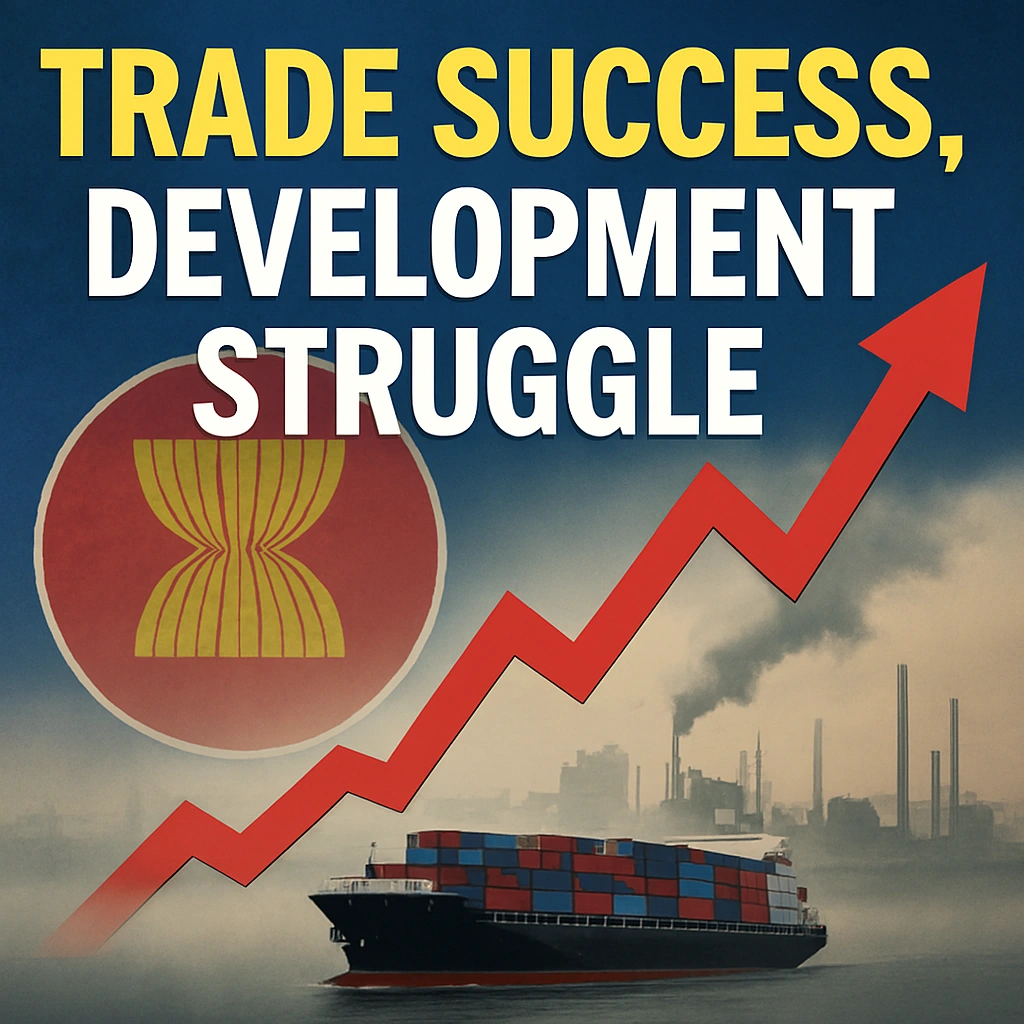
In September 2025, ASEAN’s goods exports to the United States surged 23% compared to the same period in 2024, representing an extraordinary $70 billion in additional annualized exports. Factory floors across Vietnam, Malaysia, and Thailand hum with unprecedented activity. Shipping containers stack higher at ports from Jakarta to Bangkok. By virtually every traditional metric, Southeast Asia appears to be the undisputed winner of the US-China trade war.
Yet walk through the residential neighborhoods surrounding these booming industrial parks, and a different story emerges. Vietnamese garment workers still rely on 80 overtime hours monthly just to earn $400—barely more than they made five years ago. Malaysian semiconductor assemblers package cutting-edge chips but have no pathway to becoming chip designers. Thai automotive workers watch Chinese electric vehicle factories rise around them while wondering if they’ll still have jobs in a decade.
This is ASEAN’s trade war paradox: massive export growth delivering surprisingly little genuine development. The region’s 680 million people find themselves caught in an economic illusion where rising trade numbers mask stagnating wages, limited technology transfer, and deepening dependence on foreign-controlled supply chains. What looks like industrial transformation is actually revealing itself as something far more troubling—a potential dead-end that could trap Southeast Asia in permanent middle-income status.
When Winning Feels Like Losing: ASEAN’s Deceptive Export Surge
The headline numbers tell a seductive story. Vietnam’s exports to the United States stood at $142.48 billion in 2024, making it ASEAN’s largest exporter to America, while collectively, ASEAN’s 10-member countries exported $358.56 billion worth of goods to the United States, representing 10.67% of total US imports. These figures represent extraordinary growth from just eight years ago when the trade war began.
Look closer at what’s actually being exported, and the picture becomes more complicated. Electrical machinery and equipment tops the category of goods exported by ASEAN to the United States, followed by industrial machinery and mechanical appliances. These sound impressive—high-tech products suggesting sophisticated manufacturing capabilities. The reality is more sobering.
Consider Vietnam’s electronics exports, which saw computers and electronics increase by roughly 78% to over $34 billion in just the first ten months of 2025. Yet official Vietnamese government data reveals that foreign-owned enterprises account for an astounding 75.9% of the country’s total exports. This isn’t Vietnamese companies building global competitiveness—it’s foreign corporations using Vietnamese labor to assemble products designed, engineered, and mostly sourced elsewhere.
The distinction between “made in” and “made by” Southeast Asia has never mattered more. An iPhone assembled in Vietnam generates impressive export statistics, but when Apple captures the lion’s share of value, Samsung provides the display, TSMC makes the processor, and Chinese suppliers furnish most components, what exactly does Vietnam gain besides wages for assembly workers?
Here’s where ASEAN trade war benefits diverge sharply from genuine industrial development. Malaysia faces US tariff rates officially listed at 19%, yet its effective US tariff rate stands at only 11%, compared to 0.6% in 2024. This relatively modest increase explains why exports keep growing. But the products Malaysia assembles—semiconductor packages, electronic components, machinery parts—require imported intermediate goods worth far more than the value Malaysia adds through local processing.
The same pattern replicates across Southeast Asia. Thailand’s manufacturing boom centers on automotive and electronics assembly. Indonesia leverages natural resources while struggling to move into genuine manufacturing. Cambodia and Vietnam specialize in garments and low-end assembly. All generate impressive export volumes. None are building the deep technological capabilities that historically separated countries that became rich from those that stayed middle-income.
Trade diversion effects on ASEAN economies amplify this disconnect between growth and development. When a Chinese manufacturer relocates final assembly to avoid US tariffs, ASEAN countries gain jobs and export statistics. They don’t gain the research labs, design studios, advanced component production, or systems integration expertise that China has spent three decades building. The value-added—the portion of production that actually enriches the domestic economy—remains stubbornly low.
The China Shadow: How Beijing Still Controls Southeast Asia’s Export Machine
Here’s the statistic that ASEAN governments would prefer to ignore: imports of Chinese goods to ASEAN were around 30% higher in September 2025 than the same period the previous year—a surge equivalent to almost $150 billion when annualized. This flood of Chinese imports isn’t coincidence. It’s the invisible reality behind ASEAN’s visible export success.
The mechanics of China trade diversion reveal an uncomfortable truth about Southeast Asia supply chains. Chinese companies facing punitive US tariffs have executed a masterful geographic arbitrage. Components manufactured in China—often 60-80% of a finished product’s value—flow into ASEAN countries. Workers perform final assembly, attach a “Made in Vietnam” or “Made in Malaysia” label, and ship the product to America. The export statistics credit Southeast Asia. The value capture remains firmly in China.
Over the last decade, China accounted for 21% of all new project investment in Southeast Asia, up from just 13% in the decade before 2015. This Chinese foreign direct investment ASEAN received isn’t altruistic development assistance. It’s strategic repositioning to bypass US tariffs while maintaining Chinese control over technology, supply chains, and profits.
The Vietnam manufacturing boom illustrates this dynamic. Samsung employs hundreds of thousands of Vietnamese workers in massive electronics facilities. Yet Samsung Vietnam functions primarily as an assembly platform. The sophisticated components—displays, processors, memory chips, camera modules—arrive from Korea, Japan, Taiwan, and increasingly China. Vietnamese suppliers provide packaging materials, basic plastics, and logistics support. The technology remains imported; the knowledge stays elsewhere.
Chinese companies have proven even more reluctant to transfer genuine capabilities. A Chinese solar panel manufacturer relocating to Thailand will build the factory, install Chinese equipment, employ Thai workers for basic tasks, but keep product design, process engineering, and quality control firmly under Chinese management. The promised spillover benefits—where local firms learn from foreign investors and eventually compete—largely fail to materialize.
US customs officials increasingly recognize this pattern. Vietnam faced calculated duty revenue of $11.81 billion over the 12 months through September 2025, with average applied duty rates of 6.55%—rates creeping upward as Washington scrutinizes trade circumvention. ASEAN countries find themselves walking a tightrope: attract enough Chinese investment to maintain export growth, but not so much that America starts treating them as China’s proxies.
The geopolitical dimension adds another layer of complexity. In May 2025, China and ASEAN wrapped up negotiations to upgrade their free trade agreement, expanding it to cover the digital economy, green industries, and other emerging sectors. This ASEAN-China trade relations deepening occurs as Washington demands Southeast Asian countries choose sides in what increasingly looks like a new Cold War.
The hidden costs of ASEAN export growth become clear: every dollar of exports to America requires two dollars of imports from China. The trade surplus with the United States masks a far larger trade deficit with China. ASEAN countries have become, in effect, processing platforms for Chinese manufacturing—earning assembly wages while China captures design, component production, and systems integration profits.
The Wage Trap: When Export Booms Don’t Translate to Worker Prosperity
Behind every export statistic is a human story, and in Southeast Asia, those stories reveal how little prosperity the trade war windfall has actually delivered. Vietnamese garment workers provide a stark example. Survey data shows workers must work overtime every day with about 80 overtime hours per month just to reach average income over $385, while basic salaries remain only slightly above regional minimum wage, and industry wage growth reaches only 3.3% annually—insufficient to offset inflation.
This isn’t what economic development is supposed to look like. When countries industrialize successfully, wages rise substantially as workers move from low-productivity agriculture into higher-productivity manufacturing. Japan, South Korea, and Taiwan all saw dramatic wage increases during their industrial transformation. ASEAN’s experience differs dramatically.
Official statistics paint a misleadingly optimistic picture. Vietnam’s national average monthly income reached about VND 8.3 million (US$317) by mid-2025, suggesting reasonable wage growth. Dig into the details, and problems emerge. Real wage growth of nearly 3% during the first three quarters of 2024 barely exceeds inflation, meaning purchasing power improvement remains minimal. More troublingly, wage growth concentrates in urban centers and foreign-owned enterprises, leaving vast swaths of the workforce behind.
The geographic wage gap tells part of the story. Urban workers in Vietnam earned an average VND 10.4 million (US$397) per month in 2025, compared to just VND 8.4 million (US$321) in rural areas, resulting in a wage gap of roughly 24%. But the foreign-versus-domestic gap matters more for understanding ASEAN’s development challenge. Foreign-invested enterprises typically pay 10-15% more than local companies, creating a dual economy where working for a foreign factory offers significantly better prospects than working for a domestic firm.
Why aren’t wages rising faster given booming exports and ostensibly tight labor markets? The answer reveals why ASEAN exports to the US are increasing without delivering proportionate development benefits. First, the work being performed remains relatively low-skill assembly that can be easily relocated if wages rise too much. Second, automation increasingly threatens even these jobs, putting downward pressure on wage demands. Third, workers lack bargaining power—union organization remains weak across most of ASEAN, leaving workers competing individually rather than collectively negotiating better terms.
Consider the broader economic complexity perspective. Malaysia, Thailand, Indonesia and the Philippines are defined by the World Bank as countries that failed to overcome the “middle income trap,” entering middle-income status in the late 1970s and early 1980s. Four decades later, these countries haven’t escaped despite hosting substantial manufacturing sectors. The explanation lies in what kind of manufacturing they’re doing.
Assembly platforms don’t build innovation capacity. Workers bolt together components manufactured elsewhere. They follow processes designed elsewhere. They produce to specifications created elsewhere. Yes, they gain employment and income above subsistence agriculture. But they don’t acquire the technical knowledge, problem-solving skills, or innovative capabilities that drive sustained wage growth and economic upgrading.
The comparison with electronics workers versus garment workers illustrates the stratification within ASEAN manufacturing. Vietnamese electronics workers might earn $482 monthly while garment workers earn $400, but both remain trapped in a wage band that barely supports middle-class existence. Living wages for Vietnamese garment workers should reach approximately $500 per month—$60 higher than current average income, according to calculations by the Asia Floor Wage Alliance. The gap between survival wages and living wages—incomes that support education, healthcare, and genuine upward mobility—persists despite export booms.
Here’s the deeper structural problem: ASEAN countries need wage growth to build domestic consumer markets, which in turn drive service sector development and create incentives for domestic companies to innovate. But keeping wages low remains the primary competitive advantage attracting foreign investment in the first place. This catch-22 is precisely what the middle-income trap describes—countries get stuck because the strategies that worked to escape poverty don’t work to achieve prosperity.
Between Empires: The Geopolitical Bind Choking ASEAN’s Options
Economic logic suggests ASEAN should deepen integration with China—their largest trading partner, largest investor, and geographic neighbor. Security concerns and political pressure demand closer alignment with the United States. This contradiction has become ASEAN’s defining strategic dilemma, and it’s squeezing their economic options with increasing force.
The numbers illustrate the bind. China-ASEAN trade patterns show deep interdependence built over decades. In early 2025, ASEAN surpassed all other regions to become China’s largest trading partner, with bilateral trade reaching around $420 billion in just five months. This isn’t just trade volume—it represents integration into supply chains, investment relationships, and technology dependencies that can’t be quickly unwound.
Meanwhile, the United States remains ASEAN’s second-largest export market and most important security partner for maritime Southeast Asian nations increasingly concerned about Chinese territorial assertions. The US Indo-Pacific Economic Framework promised an alternative to Chinese economic dominance, but has delivered disappointingly little for ASEAN countries seeking tangible benefits like market access improvements.
Individual ASEAN members face distinct versions of this dilemma. The Philippines under President Marcos Jr. has pivoted toward closer US security cooperation, sharpening Manila’s stance on South China Sea disputes. This shift carries economic risks—potential Chinese investment curtailment, restricted access to Chinese markets, and Beijing’s documented willingness to deploy economic pressure for political ends. Yet accepting Chinese territorial claims proves equally unpalatable for a nation watching foreign vessels operate in waters it considers sovereign territory.
Cambodia represents the opposite extreme, maintaining exceptionally close Chinese ties that bring infrastructure investment and economic support. The trade-off? Cambodia faces US tariff rates up to 49%, reflecting in part America’s concern about Cambodian economic dependence on China, which provides over 40% of Cambodia’s FDI. When Beijing and Washington issue contradictory demands, Phnom Penh faces impossible choices.
Vietnam navigates perhaps the most complex balancing act. Historical tensions with China combine with current territorial disputes, yet economic integration runs deep. Hanoi simultaneously courts US investment and security cooperation while trying to avoid antagonizing its powerful northern neighbor. This hedging strategy—attempting to benefit from both relationships while committing fully to neither—grows increasingly difficult as both powers demand clearer alignment.
The tariff environment exemplifies ASEAN’s shrinking room to maneuver. By October 2025, the effective US tariff rate on China had jumped to 31%, reflecting maintenance of the 10% baseline reciprocal tariff plus 10% “fentanyl” tariffs on all Chinese imports, as well as global sectoral tariffs of 25-50% on steel, aluminum, copper, timber, and automotives. ASEAN countries benefit from lower rates, but only conditionally—Washington watches closely for Chinese circumvention and won’t hesitate to impose punitive measures if it perceives Southeast Asia becoming China’s back door to American markets.
This creates a perverse dynamic where ASEAN countries can’t pursue economically optimal strategies because political constraints limit their options. They can’t fully integrate with China despite clear economic logic, nor can they pivot entirely to Western-led frameworks offering less tangible value. The US-China decoupling impact on Southeast Asia manifests not just in trade flows, but in paralyzed policymaking where countries can’t commit to long-term strategies because geopolitical winds might shift unpredictably.
The broader institutional implications matter enormously. ASEAN unity—always more aspirational than actual—fractures further under superpower pressure. The bloc’s joint statement in April rejected retaliation to US tariffs, opting instead for dialogue and reaffirming multilateralism. But unity in rhetoric disguises divergence in practice. Vietnam pursues frameworks with Washington while deepening production ties with China. Thailand courts Chinese EV investment while maintaining US security cooperation. Indonesia asserts resource nationalism complicating both relationships.
What gets lost in this geopolitical squeeze? The economic policy space to pursue genuine development strategies. Countries that successfully escaped middle-income status—South Korea, Taiwan, Singapore—had clear strategic focus and could implement coherent industrial policies over decades. ASEAN members today lack that luxury, constantly adjusting to external pressures rather than executing domestic development visions.
The Development Illusion: Why Growth Doesn’t Equal Progress
Economic growth and economic development aren’t synonyms, though they’re often treated as such. ASEAN’s trade war experience starkly illustrates the difference. GDP rises. Export volumes surge. Factory employment expands. Yet the fundamental transformation that characterizes genuine development—building productive capabilities, advancing up value chains, creating innovation ecosystems—remains frustratingly elusive.
According to the World Bank, it would be a ‘miracle’ if today’s middle-income economies like Indonesia and Vietnam could accomplish in 50 years what South Korea achieved in just 25. This isn’t mere pessimism—it reflects how different contemporary conditions are from the environment where East Asian Tigers industrialized. Those countries benefited from stable geopolitics, patient capital, technology transfer from friendly Western powers, and crucially, the ability to protect infant industries while building capabilities.
ASEAN countries today face a far harsher environment. Global supply chains demand immediate competitiveness. Intellectual property protections prevent the technology copying that helped earlier developers. Geopolitical tensions create uncertainty that deters long-term investment. And the work itself increasingly involves narrower tasks optimized for global value chains rather than building complete industrial ecosystems.
The economic complexity measurements capture this stagnation quantitatively. The major ASEAN economies are generally well diversified, though with varying degrees of economic complexity, led by Singapore, with countries on the lower end typically having relatively lower levels for education and labor productivity. What matters isn’t just diversity but sophistication—can countries produce complex products requiring diverse, specialized knowledge?
Vietnam exemplifies the challenge. Exports surge impressively, but remain dominated by foreign-owned enterprises performing relatively simple assembly. Domestic Vietnamese companies struggle to move beyond basic supplier roles. The knowledge required for product design, process engineering, quality systems, and supply chain orchestration stays in foreign hands. Vietnam gains GDP growth and employment. It doesn’t gain the capabilities that would allow it to eventually compete with Samsung rather than just assembling Samsung’s products.
The “premature deindustrialization” phenomenon adds another worry. Historically, countries industrialized—shifting workers from agriculture to manufacturing—before transitioning to services once they reached high income. Many ASEAN countries show signs of shifting to services while still middle-income, potentially missing the manufacturing-driven development phase that built prosperity elsewhere.
Thailand provides a cautionary example. The country successfully industrialized through the 1980s and 1990s, building genuine automotive sector capabilities. Yet growth stalled after the 1997 Asian Financial Crisis. Despite hosting substantial manufacturing, Thailand hasn’t broken through to high-income status. Real wage growth remains modest. Thailand’s exports to the United States surged about 30% compared to 2024, yet Bloomberg Economics projects potential contraction in 2026 if trade barriers persist.
Malaysia faces similar challenges. The semiconductor industry showcases the problem perfectly. Malaysia dominates global semiconductor packaging—a critical but relatively low-margin activity. Yet design capabilities, R&D centers, and advanced manufacturing remain elsewhere. Workers assemble components designed by American and Taiwanese engineers. The profits flow accordingly.
Educational systems compound the problem. In Vietnam, only about 28% of workers have received formal training, far below what’s needed for technological upgrading. ASEAN governments haven’t adequately scaled technical education, reformed curriculum to match manufacturing needs, or invested in the engineering capacity that industrial transformation requires.
Is ASEAN stuck in middle-income trap? The evidence increasingly suggests yes, at least for several major economies. Export booms create the illusion of dynamism, but the underlying reality—limited technology absorption, weak domestic firms, inadequate innovation systems, insufficient human capital development—points toward stagnation rather than transformation.
Here’s what genuine development looks like: domestic companies progressively taking on more sophisticated roles, wages rising substantially in line with productivity improvements, economic complexity increasing as countries master more advanced products, and critically, the emergence of indigenous innovation rather than perpetual technology importation. ASEAN has achieved export-led growth. It hasn’t achieved development.
Policy Failures That Turned Windfall Into Mirage
The US-China trade war created a historic opportunity for Southeast Asia. Manufacturing investment seeking alternatives to China, supply chain diversification imperatives, and geopolitical conditions favoring ASEAN should have accelerated development. Instead, short-sighted policies and institutional failures have squandered much of this opportunity, leaving countries with impressive trade statistics but little genuine advancement.
The fundamental failure involves mistaking investment quantity for investment quality. ASEAN countries adopted a “take what we can get” approach to foreign direct investment, measuring success by dollar values rather than developmental impact. Any investment that created jobs and boosted exports counted as victory, regardless of whether it transferred technology, built local capabilities, or integrated domestic firms into supply chains.
Vietnam illustrates both the success and failure. The country brilliantly attracted investment, becoming Southeast Asia’s FDI magnet. Yet that success came at a cost—accepting investments on terms favoring foreign companies over developmental objectives. No meaningful technology transfer requirements. Minimal local content mandates. Little insistence on supplier development programs that would help Vietnamese companies join supply chains. The result? Foreign enterprises dominate exports while domestic firms remain marginal.
IMF research shows that packaging together broad, economy-wide reforms spanning regulation, governance, and education could help major ASEAN emerging market economies increase long-term real economic output by 20% or more over two decades. But comprehensive reform requires political will ASEAN countries have largely lacked. Instead, governments pursued fragmented initiatives without coherent industrial strategy or sustained implementation.
Education failures loom particularly large. Despite knowing for years that manufacturing investment was coming, governments didn’t adequately scale technical training or engineering programs. The skills gap between what factories need and what workers can provide remains stubbornly wide, forcing firms to import expertise or settle for lower-value activities matching available skills. When only 28% of workers have formal training and targets aim for just 30% by 2025 and 45% by 2030, the timelines simply don’t match industrialization’s urgency.
Infrastructure bottlenecks further constrain the export boom’s potential. While the six main ASEAN economies are generally more open than the average emerging market, these countries still have more barriers to trade and are relatively harder to trade with than the median OECD country. Port congestion, unreliable electricity, and inadequate logistics networks raise costs and deter higher-value investment seeking efficient operations.
Corruption and regulatory unpredictability create additional obstacles. Indonesia’s constantly shifting regulations scare long-term investors needing policy stability. Thailand’s political instability undermines confidence. Even relatively well-governed Vietnam and Malaysia struggle with regulatory opacity and arbitrary enforcement favoring connected firms over market competition.
The comparative failure becomes stark when contrasted with East Asian development models. South Korea and Taiwan during industrialization demanded technology transfer as a condition for market access. They implemented local content requirements with graduated timelines. They ran supplier development programs systematically linking foreign and domestic firms. They invested strategically in infrastructure prioritizing manufacturing zones. They reformed education focusing on engineering and technical skills.
ASEAN did almost none of this. Instead, members raced to the bottom, competing to offer investors the best tax breaks, most lenient environmental standards, and weakest labor protections. This zero-sum competition benefited investors while limiting regional benefits. Had ASEAN countries coordinated—jointly demanding better terms, agreeing not to undercut each other, pooling resources for technology development—outcomes might have differed dramatically.
The window for correction narrows rapidly. Automation threatens to eliminate low-wage advantages before ASEAN countries can upgrade capabilities. Chinese manufacturing overcapacity intensifies competition. And the trade war itself could reverse if US-China relations stabilize, suddenly making Southeast Asian platforms less necessary. The opportunity that seemed boundless in 2018 now looks increasingly finite.
Three Futures: How This Story Could End
ASEAN’s trade war experience will ultimately yield one of three broad outcomes. Understanding these scenarios helps clarify what’s at stake and what choices might still alter trajectories.
Scenario One: The Reform Breakthrough
In this optimistic version, current pressures finally catalyze comprehensive reforms. External shocks—perhaps a sudden investment pullback or dramatic tariff changes—create political space for reformist coalitions. Governments implement aggressive industrial upgrading strategies, demanding genuine technology transfer from foreign investors while significantly supporting domestic firms.
Regional cooperation deepens beyond rhetoric. ASEAN functions as an integrated market of 680 million consumers rather than ten competing economies, creating scale advantages that attract higher-quality investment. A more integrated ASEAN could function as a massive ‘domestic’ market of 680 million people and $3.9 trillion in GDP, creating stable demand less vulnerable to external shocks.
Education reforms accelerate, producing the engineers and technicians that advanced manufacturing requires. Infrastructure investments target genuine bottlenecks. Governance improves as middle-class constituencies demand accountability. The trade war’s temporary benefits get transformed into lasting capabilities. Vietnam’s domestic companies move from low-tier suppliers to genuine competitors. Malaysia advances beyond assembly into design and R&D. Thailand successfully navigates the EV transition.
This scenario requires political will, institutional capacity, and frankly, some luck with external conditions. But it’s technically feasible—the resources exist if mobilized effectively. Southeast Asia wouldn’t be the first region leveraging external shocks for transformative change. The question is whether ASEAN countries can execute what South Korea and Taiwan accomplished decades earlier, despite facing a far more challenging global environment.
Scenario Two: Drift and Stagnation
The more probable middle scenario sees current patterns continuing. Exports remain elevated but value capture stays low. Foreign investment continues but on terms perpetuating assembly platform status. Domestic firms struggle to compete. Political elites capture what benefits do accrue while inequality widens.
GDP growth continues at modest 2-4% annually—enough to avoid crisis but insufficient for transformation. The gap between ASEAN and high-income economies persists or widens. The middle-income trap deepens as the strategies that enabled initial growth prove inadequate for reaching prosperity.
Social tensions increase as populations recognize export booms aren’t delivering broad prosperity. Youth unemployment rises despite headline growth, as education systems fail producing skills advanced economies demand. The development promise fades into frustration, potentially destabilizing political systems already under strain.
China’s role intensifies this scenario. As Chinese manufacturing becomes even more efficient through automation and scale, ASEAN’s comparative advantages erode further. The region becomes a perpetual processing platform—earning assembly wages while China, America, Taiwan, and Korea capture design, component production, and systems integration profits. Not collapse, but indefinite stagnation—countries trapped between poverty and prosperity, watching opportunities slip away while lacking will or capacity to seize them.
Scenario Three: Crisis and Reversal
The darkest scenario involves sudden disruption exposing ASEAN’s vulnerabilities. US-China trade normalization—whether through diplomatic breakthrough or political change—eliminates tariff differentials currently favoring Southeast Asian exports. Production that relocated from China suddenly becomes uncompetitive. “China-plus-one” strategies reverse to “China-only” as companies discover Southeast Asian platforms can’t match Chinese efficiency, infrastructure, and supply chain depth.
Capital outflows accelerate as firms relocate back to China or to other newly competitive locations. Factories that sprouted across ASEAN during 2018-2025 become stranded assets. Trade surpluses flip to deficits as Chinese imports continue while exports collapse. Currencies depreciate, importing inflation that erodes what wage gains workers had achieved.
Economic disruption triggers political instability, particularly in countries where growth has legitimized governance systems. Thailand’s recurring political crises intensify. Vietnam faces renewed pressures as the social contract—accept limited freedoms for rising prosperity—breaks down when prosperity stops rising. Indonesia confronts populist nationalism that complicates economic management.
This crisis scenario might paradoxically create conditions for genuine reform, as emergency measures force painful but necessary restructuring. But it could also produce a lost decade or more, setting back development by years and discrediting export-oriented strategies entirely. The risk isn’t hypothetical—Southeast Asian countries remember the 1997 financial crisis and how quickly apparent prosperity can evaporate.
What Hangs in the Balance
This isn’t just about economics. Behind every trade statistic, every FDI figure, every export surge are 680 million people whose life prospects depend on whether their countries can translate temporary advantages into lasting prosperity.
The Vietnamese factory worker assembling smartphones hopes her children will design them. The Malaysian logistics coordinator wants his son managing supply chains, not just working warehouses. The Indonesian farmer who sent his daughter to the city for factory work expects her wages to lift the family from subsistence. These individual aspirations, multiplied across Southeast Asia, define what’s at stake.
Current trends suggest many will be disappointed. The export boom has created jobs but not careers, income but not wealth, growth but not development. Without fundamental changes, ASEAN risks permanent middle-income status—prosperous enough to avoid poverty, unable to achieve affluence.
The comparison with Northeast Asian development remains stark. South Korea transformed from war-torn poverty to global industrial powerhouse in a generation. Singapore went from colonial outpost to First World city-state. Taiwan built a technology ecosystem underpinning global semiconductor supply chains. Southeast Asia possesses comparable human capital, geographic advantages, and market access. What it lacks is strategic vision, institutional capacity, and political will to leverage these advantages effectively.
Global implications extend beyond Southeast Asia. ASEAN’s experience offers lessons about 21st century development more broadly. If countries receiving massive FDI, export opportunities, and favorable geopolitical positioning still can’t escape middle-income status, what hope exists for less fortunately positioned nations? Development models that worked in the past may not function in an era of global value chains, rapid automation, and intensifying geopolitical competition.
For global supply chain resilience, ASEAN’s struggles matter enormously. If Southeast Asian manufacturing proves unsustainable—too dependent on Chinese inputs, too vulnerable to geopolitical shifts, too focused on assembly rather than genuine capabilities—then corporate “China-plus-one” strategies rest on shaky foundations. Real supply chain diversification requires developing robust alternative manufacturing ecosystems, not just relocating final assembly operations.
The next few years will be decisive. Trade war dynamics remain unstable with policies shifting unpredictably. ASEAN countries face a narrow window to implement reforms before external conditions change or opportunities close. The International Monetary Fund projects the US economy to grow by 2.1% in 2026, slightly faster than 2025, suggesting American import demand may remain relatively stable. But geopolitical risks could escalate suddenly, or automation could accelerate faster than expected, fundamentally altering ASEAN’s competitive position.
Watch Vietnam’s domestic firm development as a key indicator. Monitor whether Malaysia can move beyond assembly into design and R&D. Observe if Thailand successfully pivots to higher-value manufacturing or gets stuck hosting Chinese firms pursuing tariff avoidance. Track whether Indonesia’s resource nationalism evolves into genuine industrial policy or devolves into counterproductive protectionism.
The factories are here. The exports are real. The GDP numbers look impressive. But the critical question remains unanswered: Will the prosperity being generated actually stay in Southeast Asia, enriching its people and building lasting capabilities? Or will it continue flowing to shareholders in Beijing, Seoul, Tokyo, and San Francisco, leaving ASEAN permanently trapped between poverty and prosperity?
Southeast Asia’s 680 million people—and anyone watching to see if traditional development paths still exist in our fragmented, competitive global economy—are still waiting for that answer. The export boom is real. Whether it becomes a development breakthrough or just another false dawn depends entirely on choices ASEAN countries make in the brief window that remains open.


Asia
Central Banks Need ‘Heightened Vigilance’ as Middle East Conflict Rewrites the Inflation Playbook
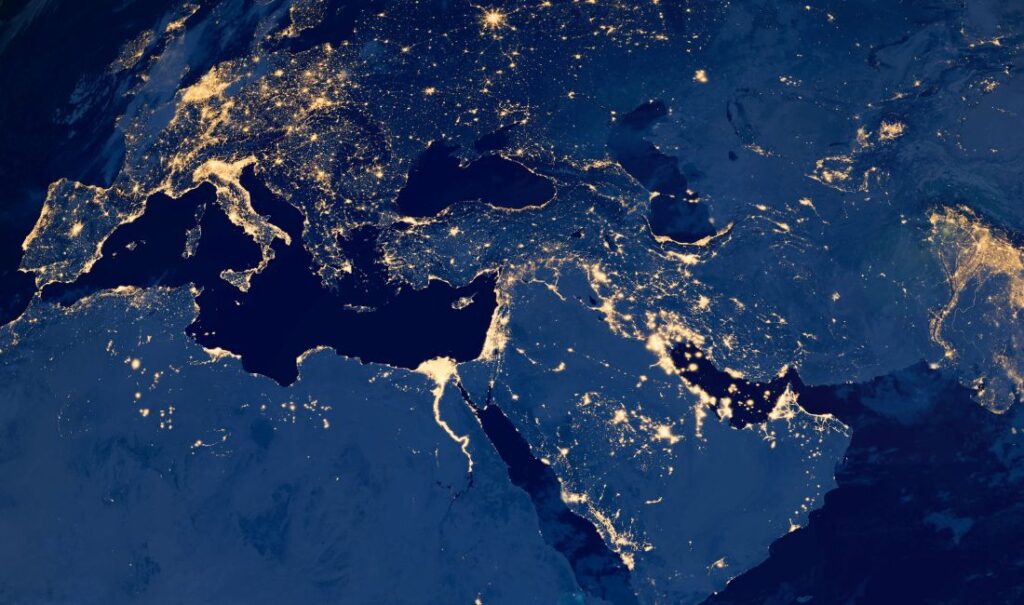
At the Conrad Singapore Orchard hotel on Friday morning, the warning from the Monetary Authority of Singapore landed with unusual bluntness. Central banks, said MAS chief economist Edward Robinson, must maintain “heightened vigilance” as the Middle East conflict feeds a new wave of financial and inflation risks into the global economy. For policymakers who spent the past two years cautiously steering inflation back toward target, the message was unmistakable: the old assumptions no longer hold.
Oil markets have become the transmission mechanism of geopolitical shock. Shipping lanes are under pressure, insurance costs are rising, and the threat of prolonged energy disruption now hangs over economies already carrying heavy debt loads and fragile growth expectations. What once looked like a manageable disinflation cycle is turning into something more complicated, and potentially more dangerous.
The fear in central banking circles isn’t simply higher energy prices. It’s what follows after them.
A New Inflation Shock Is Rippling Through the Global Economy
Edward Robinson’s remarks came during the 13th Asian Monetary Policy Forum in Singapore, where officials gathered amid escalating concern over the economic fallout from the Middle East conflict. Robinson warned that the world faces a “persistent supply shock” with consequences extending well beyond oil markets. Small open economies, he argued, remain especially vulnerable because energy costs pass rapidly into wages, transport prices, and broader consumer inflation.
The timing matters.
Just months ago, many central banks expected 2026 to be the year inflation pressures finally eased enough to justify a sustained rate-cutting cycle. Instead, the geopolitical landscape has reversed the momentum. According to a recent European Commission growth forecast reported by Reuters, eurozone inflation projections have already climbed from 1.9% to 3%, while growth expectations were downgraded sharply to 0.9%.
That combination, slower growth alongside resurgent inflation, revives memories of the stagflation era that haunted policymakers during the 1970s oil crises.
The difference today is structural fragility. Governments are carrying far larger debt burdens. Corporate refinancing costs remain elevated. And global supply chains, despite years of diversification efforts after the pandemic, still depend heavily on shipping corridors linked to the Gulf.
The Strait of Hormuz alone handles roughly one-fifth of global oil shipments. Even limited disruption there creates outsized effects across freight, manufacturing, aviation, agriculture, and sovereign bond markets.
Kristalina Georgieva, managing director of the IMF, warned in April that “all roads” from the conflict point toward higher inflation and slower growth. In remarks reported by Reuters, she said the IMF’s earlier baseline scenario was already becoming obsolete as oil prices stayed elevated above $100 per barrel.
For central banks, this creates a policy trap.
Raise rates too aggressively, and already weak economies risk recession. Cut rates too early, and inflation expectations may become unanchored again.
Neither outcome is attractive.
Why Central Banks Are Reassessing Interest Rate Risks
The phrase “central banks heightened vigilance” is rapidly becoming more than rhetorical caution. It reflects a growing recognition that policymakers may have underestimated how quickly geopolitical shocks can re-enter inflation dynamics.
The Bank of Japan offers a telling example. Reuters recently reported that hawkish voices inside the BOJ are pushing for earlier rate hikes as Middle East-driven energy shocks complicate Japan’s inflation outlook.
That would have seemed improbable a year ago in a country that spent decades battling deflation.
The broader issue is persistence. Central bankers can usually tolerate temporary commodity spikes. What worries them now is second-round inflation: rising wages, embedded pricing expectations, and prolonged cost transmission through the real economy.
What does “heightened vigilance” mean for central banks?
“Heightened vigilance” means central banks are monitoring whether temporary energy shocks evolve into sustained inflation and financial instability. Policymakers are watching wage growth, bond market volatility, credit conditions, and inflation expectations to determine whether geopolitical disruptions require tighter monetary policy or delayed interest-rate cuts.
That shift explains why policymakers increasingly talk about “financial stability” alongside inflation control.
In April, the Financial Stability Board warned G20 finance ministers that several vulnerabilities could collide simultaneously. FSB Chair Andrew Bailey pointed specifically to leveraged non-bank financial institutions, stretched asset valuations, and disorderly bond-market conditions as areas vulnerable to geopolitical stress.
The concern isn’t theoretical.
Government bond markets have already shown signs of strain in several advanced economies. Higher oil prices raise inflation expectations, which then push yields upward. Rising yields increase government borrowing costs precisely when fiscal deficits remain elevated after years of pandemic spending and industrial subsidies.
Singapore’s warning therefore resonates far beyond Asia.
The MAS itself operates differently from most central banks, using exchange-rate policy rather than conventional interest-rate targeting. Yet Robinson’s remarks carried unusual global relevance because Singapore sits at the crossroads of trade, shipping, and commodity flows. Few economies feel supply-chain distortions faster.
That sensitivity often turns Singapore into an early-warning system for broader economic shifts.
Still, not every economist believes a repeat of 2022-style inflation is inevitable. Some argue that weak global demand, aging demographics, and slowing Chinese growth will ultimately cap price pressures. Others point out that renewable energy investment and diversified gas infrastructure have improved resilience since Russia’s invasion of Ukraine.
The picture is more complicated than a simple oil shock narrative.
But markets are clearly reassessing risk.
The Global Economic Fallout Could Extend Far Beyond Energy Markets
The most immediate consequence of the Middle East conflict remains visible in commodity pricing. Yet second-order effects are spreading into areas many investors barely considered six months ago.
Food inflation is one example.
This week, the UN Food and Agriculture Organization warned that prolonged disruption around the Strait of Hormuz could trigger a “systemic agrifood shock” within six to 12 months. Fertilizer, shipping, fuel, and grain transport costs are all vulnerable to sustained disruption.
For emerging economies, that matters enormously.
Countries already battling currency weakness and elevated import costs may face another cycle of food-price instability similar to the pressures seen after Russia’s invasion of Ukraine in 2022. In lower-income economies, food inflation quickly becomes political inflation.
Businesses are also recalculating assumptions that once looked stable. Airlines are rerouting flights. Shipping insurers are raising premiums. Manufacturers dependent on petrochemicals face renewed margin pressure. Energy-intensive industries in Europe and Asia remain particularly exposed.
Then there’s the corporate debt problem.
During the low-rate era of the 2010s and pandemic years, companies accumulated large amounts of cheap borrowing. Many expected refinancing conditions to ease during 2026 as inflation cooled and rate cuts accelerated. If geopolitical shocks keep inflation elevated, those assumptions collapse.
That would tighten financial conditions even without additional central-bank hikes.
The spillover into equity markets could become significant. Technology stocks, especially companies trading at elevated valuations tied to artificial intelligence optimism, are sensitive to rising yields. The Financial Stability Board explicitly warned about “stretched” valuations in sectors vulnerable to abrupt repricing.
What follows, however, may prove even more consequential for governments.
Fiscal policy is losing room for manoeuvre.
High debt servicing costs, rising defence expenditures, and weaker growth leave many advanced economies exposed to political backlash if living costs rise again. In Britain, Germany, and France, policymakers already face public fatigue after several years of inflation-driven pressure on household budgets.
Central banks know this history well. Once inflation expectations shift psychologically, regaining credibility becomes expensive.
That explains the increasingly hawkish tone emerging from institutions that only recently sounded cautiously optimistic.
Not Everyone Believes Another Inflation Spiral Is Coming
There is, however, a serious counterargument.
Several economists argue that markets may be overestimating the inflationary power of the current conflict. Unlike the 1970s, advanced economies are less energy-intensive, more service-oriented, and far more diversified in energy sourcing. Strategic petroleum reserves remain substantial. Renewable energy capacity has expanded rapidly across Europe and parts of Asia.
Some analysts also note that China’s structural slowdown acts as a disinflationary anchor on the global economy. Weak property markets, subdued consumer demand, and excess industrial capacity in China continue to suppress export prices globally.
That dynamic could offset some upward pressure from energy markets.
Others believe central banks themselves have become institutionally more credible since the inflation crises of past decades. Inflation expectations, while rising modestly, remain relatively anchored compared with historical episodes of entrenched stagflation.
Even the IMF, despite its warnings, still projects global growth above 3% under baseline assumptions.
There is also skepticism about whether oil prices can remain elevated for a prolonged period without triggering demand destruction. Consumers facing higher fuel costs often cut discretionary spending quickly, slowing broader economic activity and eventually reducing commodity demand itself.
In that interpretation, the current shock may prove sharp but temporary.
Yet policymakers appear unwilling to rely on optimism alone.
The repeated emphasis on vigilance suggests central banks increasingly see geopolitical fragmentation as a structural feature of the global economy rather than a passing disruption. Supply chains are becoming politicised. Trade corridors face rising security risks. Defence spending is climbing across multiple regions simultaneously.
That changes the inflation equation.
The Return of Geopolitics to Monetary Policy
For much of the past three decades, central banking operated within a relatively predictable framework. Globalisation kept goods cheap. Energy markets remained broadly stable. Inflation shocks, when they appeared, were often short-lived.
That era is fading.
Edward Robinson’s warning in Singapore captured something larger than a regional policy concern. Central banks are confronting a world where geopolitics increasingly shapes monetary outcomes. Oil flows, shipping routes, sanctions, defence alignments, and strategic rivalries now feed directly into inflation models once dominated by labour markets and consumer demand.
The danger isn’t simply another spike in prices.
It’s the gradual erosion of the assumptions that made low inflation seem structurally permanent.
Markets can absorb isolated shocks. What they struggle with is chronic uncertainty. When businesses delay investment, consumers pull back spending, and governments face rising financing costs simultaneously, monetary policy loses much of its precision.
That’s why central banks are talking less about confidence and more about vigilance.
Because the global economy may be entering a phase where geopolitical instability is no longer the exception.
It’s the baseline.

Oil shock Southeast Asia | Strait of Hormuz disruption | Stagflation risk Philippines Thailand | Fuel subsidy bills Asia 2026
Picture a Monday morning in Bangkok’s Chatuchak district. Nattapong, a 34-year-old motorcycle-taxi driver who normally hauls commuters through gridlocked sois for roughly 400 baht a day, is staring at a petrol pump display that has climbed the equivalent of 18% in eight days. He hasn’t raised his fares yet — the app won’t let him — but his margins have almost evaporated. “Before, I could fill up and still send money home,” he says quietly. “Now I’m not sure.”
Multiply Nattapong’s dilemma across 700 million people, eleven countries, and a dozen interconnected supply chains, and you begin to understand what the Strait of Hormuz crisis of March 2026 is doing to South-east Asia. On the morning of Monday, March 9, 2026, Brent crude futures spiked as high as $119.50 a barrel — a session high that will be branded into the memory of every finance minister from Manila to Jakarta — before settling around $110.56, still up nearly 40% in a single month. WTI posted its largest weekly gain in the entire history of the futures contract, a staggering 35.6%, a record stretching back to 1983.
The trigger: joint US-Israeli strikes on Iran beginning February 28, which escalated into a full war and brought Strait of Hormuz shipping to a near-total halt. The choke point — that narrow 33-kilometre-wide passage between Oman and Iran — carries roughly 20 million barrels of oil per day, about one-fifth of global supply. When Iran’s Revolutionary Guard declared the waterway effectively closed and warned vessels they would be targeted, the arithmetic was brutal and immediate. Iraq and Kuwait began cutting output after running out of storage. Qatar’s energy minister told the Financial Times that crude could reach $150 per barrel if tankers remain unable to transit the strait in coming weeks. At Kpler, lead crude analyst Homayoun Falakshahi was blunter: “If between now and end of March you don’t have an amelioration of traffic around the strait, we could go to $150 a barrel,” he told CNN.
For South-east Asia — a region that imports the overwhelming majority of its oil and whose economies run on cheap fuel the way a clock runs on a mainspring — this is not merely a commodity story. It is a cost-of-living crisis, a monetary policy dilemma, and a fiscal time bomb, all detonating simultaneously.
Oil Shock Southeast Asia: Why the Region Is Uniquely Exposed
The geography alone is damning. Japan and the Philippines source roughly 90% of their crude from the Persian Gulf; China and India import 38% and 46% of their oil from the region, respectively. South-east Asia as a whole, with the sole exception of Malaysia, runs a persistent deficit in oil and gas trade. When the Strait of Hormuz tightens, the region doesn’t just pay more — it scrambles for supply.
MUFG Research calculates that every US$10 per barrel increase in oil prices worsens the current account position of Asian economies by 0.2–0.9% of GDP, with Thailand, Singapore, Taiwan, India, and the Philippines taking the largest hits. From a starting price of roughly $60 per barrel in January 2026 to a current print north of $110, that’s a $50-per-barrel shock — implying current account deterioration of potentially 1–4.5% of GDP for the region’s most vulnerable economies. Run that number through to your household electricity bill, your bag of jasmine rice, your morning commute, and the pain becomes visceral.
Nomura’s research team, in a note that has become one of the most-cited documents in Asian trading rooms this week, identified Thailand, India, South Korea, and the Philippines as the most vulnerable economies in Asia. The bank’s reasoning is unforgiving: Thailand carries the largest net oil import bill in Asia at 4.7% of GDP, meaning every 10% oil price change worsens its current account by 0.5 percentage points. The Philippines runs a current account deficit that, at oil above $90 per barrel on a sustained basis, is likely to breach 4.5% of GDP. “In Asia, Thailand, India, Korea, and the Philippines are the most vulnerable to higher oil prices, due to their high import dependence,” Nomura wrote, “while Malaysia would be a relative beneficiary as an energy exporter.”
Country by Country: Winners, Losers, and the Ones Caught in the Middle
The Philippines: Worst in Class, No Cushion
If there is one country in the region for which this crisis reads like a worst-case scenario, it is the Philippines. Manila has nearly 90% of its oil imports sourced from the Middle East and, crucially, operates a largely market-driven fuel pricing mechanism with minimal subsidies. There is no state buffer absorbing the shock before it hits the pump. Retailers in Manila imposed over ₱1-per-liter increases for the tenth consecutive week as of early March, covering diesel, kerosene, and gasoline. The Philippine peso slid back through the ₱58-per-dollar mark on March 9, adding a currency depreciation multiplier to an already brutal import bill.
ING Group estimates the Philippines could see inflation rise by up to 0.4 percentage points for every 10% increase in oil prices. At Nomura, the estimate is 0.5pp per 10% rise — the highest pass-through in the region. Oil at $110 represents roughly an 80% increase over January’s $60 baseline, an inflationary impulse that Capital Economics pegs could push headline CPI well above the Bangko Sentral ng Pilipinas’s 2–4% target. Manila has already announced plans to build a diesel stockpile as an emergency buffer — an admission that supply anxiety, not just price, has entered the conversation.
Thailand: The Biggest Structural Loser
Thailand’s problem isn’t just the size of its oil import bill — it’s the timing. The country is already wrestling with below-potential growth, persistent deflationary pressures in some sectors, and a tourism sector still finding its post-COVID footing. MUFG Research flags Thailand as one of the economies most sensitive to oil price increases from an inflation perspective, with CPI rising up to 0.8 percentage points per US$10/bbl increase — the highest reading in their Asian sensitivity matrix.
The government responded swiftly, announcing a suspension of petroleum exports to protect domestic stocks, an extraordinary measure that signals just how seriously Bangkok is treating supply security. The Thai baht, already vulnerable, has come under selling pressure alongside the Philippine peso, Korean won, and Indian rupee. For Thai factory workers supplying export goods to Western markets, higher transport and energy costs arrive precisely when global demand is wobbling under the weight of US tariffs. It is, as the textbook definition goes, a stagflationary shock — cost pressures rising while growth falters.
Indonesia: The Fiscal Tightrope
Indonesia occupies a peculiar position. It is technically a net importer of petroleum products — paradoxical for a country that was once an OPEC member — but it deploys a system of fuel subsidies (via state-owned Pertamina) that partially shields consumers from global price moves. The catch, of course, is that the shield is funded by the national treasury.
Indonesia’s government budget was built around an Indonesian Crude Price (ICP) assumption of $70 per barrel for 2026. With Brent at $110, that assumption looks almost quaint. Government simulations, according to Indonesia’s fiscal authority, show the state budget deficit could widen to 3.6% of GDP if crude averages $92 per barrel over the year — already above the 3% legal ceiling. At $110 sustained, the numbers are worse. Officials have acknowledged that raising domestic fuel prices — essentially passing the shock to consumers — could become a last resort. Nomura estimates a 10% oil price rise could worsen Indonesia’s fiscal balance by 0.2 percentage points via higher subsidy spending, breaching the 3% deficit ceiling at sufficiently elevated prices. President Prabowo Subianto, who swept to power partly on a cost-of-living platform, faces a politically combustible choice between fiscal discipline and popular anger at the pump.
Malaysia: The Region’s Unlikely Winner
Not everyone in South-east Asia is suffering equally. Malaysia, a net oil and gas exporter and home to Petronas — one of Asia’s most profitable energy companies — finds itself on the rare right side of an oil shock. MUFG Research identifies Malaysia as the only net oil and gas exporter in the region, likely to see a small benefit to its trade balance from higher prices. The ringgit, which has been strengthening as a commodity-linked currency, provides a further buffer.
The complexity lies in Malaysia’s domestic subsidy architecture. Kuala Lumpur has been in the process of a painstaking, politically fraught RON95 fuel subsidy reform — targeting the top income tiers first — which was already reshaping the fiscal landscape before the current crisis. Higher global prices actually make the reform argument easier: the subsidy bill would explode if oil stays elevated, giving Prime Minister Anwar Ibrahim political cover to accelerate rationalization. For Malaysia’s treasury, $110 oil is a revenue windfall and a subsidy headache simultaneously.
Singapore: The Price-Setter That Cannot Escape
Singapore imports everything, including every drop of fuel, but its role as a regional refining and trading hub makes it a price-setter rather than merely a price-taker. The city-state’s commuters are already feeling it: transport costs have risen sharply, and the government’s careful cost-of-living management is under renewed pressure. MUFG’s analysis ranks Singapore among the economies with the highest current account sensitivity to oil price increases, even though its GDP per capita provides a far larger fiscal cushion than its regional neighbours.
Stagflation Risk: The Word Nobody Wanted to Hear
The word “stagflation” is being whispered — and in some trading rooms, shouted — across Asia this week. Nomura’s note explicitly warns of a “stagflationary shock”: the simultaneous combination of rising inflation (from fuel and food cost pass-through) and slowing growth (from weakening consumer purchasing power and export competitiveness). It is the worst of both monetary worlds, leaving central banks without a clean tool. Cut rates to support growth, and you risk stoking inflation. Hold rates to fight inflation, and you choke a slowing economy.
ING Group notes the impact is far from uniform, with several economies partially shielded by subsidies or regulated pricing — but for the Philippines, the stronger inflation hit from market-driven fuel prices creates direct pressure on the BSP to hold rates. Capital Economics, while not abandoning its rate-cut forecasts for the Philippines and Thailand, has flagged that central banks may pause if oil hits and holds above $100 — as it already has. The ripple effects move quickly: higher fuel costs push up food prices (fertilisers, transport, cold chains), which push up core inflation, which pushes up wage demands, which erode manufacturer competitiveness. The chain is well-known. The speed this time is not.
Travel and Tourism: The Invisible Casualty
The oil shock has an airborne dimension that tends to get buried beneath the more immediate news of pump prices and fiscal deficits. Jet fuel — which tracks closely with crude — has surged in lockstep with Brent. Airlines operating regional routes out of Singapore’s Changi, Bangkok’s Suvarnabhumi, and Manila’s NAIA are facing fuel costs that represent 25–35% of operating expenses at normal prices. At current Brent levels, that share rises materially. The consequences are already filtering through: several Gulf carriers have partially resumed flights from Dubai International Airport after earlier disruptions, but route uncertainty and insurance premiums for Gulf overflight remain elevated.
For South-east Asia’s tourism recovery — Bali, Chiang Mai, Phuket, and Palawan were all expecting strong 2026 visitor numbers after several lean post-pandemic years — the arithmetic is uncomfortable. Higher jet fuel costs translate, with a lag of weeks rather than months, into higher airfares. Budget carriers such as AirAsia and Cebu Pacific, which built their business models around cheap fuel enabling cheap tickets, have the least pricing power and the thinnest margins. The traveller contemplating a Bangkok city break or a Bali retreat in Q2 2026 may find the price tag has quietly risen 10–20% since they first searched. That is not a crisis. But it is a headwind — and a reminder that in a globalised economy, no leisure industry is fully insulated from a Persian Gulf conflict.
Could Oil Really Hit $150? The Scenarios
The $150 question is no longer a fringe analyst talking point. Qatar’s energy minister said it publicly. Kpler’s lead crude analyst said it on record. Goldman Sachs wrote to clients that prices are likely to exceed $100 next week if no resolution emerges — a forecast already overtaken by events.
Three scenarios shape the trajectory:
Scenario 1 — Rapid de-escalation (30 days). The US brokers a ceasefire, Hormuz reopens to traffic with naval escorts, and oil retraces toward $80–85. This is the “fast war, fast recovery” template. The damage to South-east Asia is real but contained — a quarter or two of elevated inflation, some current account deterioration, minor growth drag.
Scenario 2 — Prolonged blockade (60–90 days). Tanker insurance remains unavailable or prohibitively expensive, shipping companies stay out, and the physical supply disruption persists. JPMorgan’s Natasha Kaneva has modelled production cuts approaching 6 million barrels per day under this scenario. Brent in the $120–130 range becomes the base case. For South-east Asia, this means inflation breaching targets in the Philippines and Thailand, subsidy bills in Indonesia threatening fiscal rules, and a genuine monetary policy bind across the region.
Scenario 3 — Escalation with infrastructure damage. Further strikes on Gulf energy facilities — as already seen against Iranian oil infrastructure and Qatari and Saudi installations — reduce physical capacity for months, not weeks. $150 becomes plausible. The 1970s-style shock, feared but never fully materialised in the 2022 Ukraine episode, arrives in earnest. South-east Asian growth forecasts get ripped up. The IMF’s 2026 regional outlook, cautiously optimistic as recently as January, would require emergency revision.
The G7 finance ministers were meeting Monday to discuss coordinated strategic reserve releases; the Trump administration announced a $20 billion tanker insurance programme, though shipping companies remain hesitant to transit the region. These measures can dampen prices at the margin. They cannot substitute for an open strait.
Policy Responses and the Green Energy Accelerant
Governments across the region are not waiting passively. Thailand’s petroleum export suspension, Manila’s emergency diesel stockpiling, Indonesia’s scenario planning for domestic fuel price adjustments — these are the short-term reflexes of policymakers who have been through oil shocks before and know that the first 72 hours matter.
The more interesting question is whether this crisis, like previous energy shocks, accelerates structural energy transition. Malaysia’s Petronas has been expanding LNG capacity and renewable partnerships. Indonesia’s vast geothermal resources — the world’s second-largest — have long been under-utilised relative to their potential. The Philippines, which currently imports nearly all its energy, has been pushing solar and wind development under the Clean Energy Act framework. The calculus that kept governments cautious about rapid transition — cheap imported fossil fuels were easy and politically manageable — has just shifted violently.
As ING’s analysis notes, energy makes up a large share of consumer inflation baskets across emerging Asia, meaning the political pain of oil shocks is both immediate and democratically legible. Leaders who endure it once tend to invest in insulation against the next one. The 1973 oil shock gave Japan its world-class energy efficiency. The 2022 Ukraine crisis gave Europe its renewable acceleration. Whether 2026’s Hormuz crisis becomes South-east Asia’s inflection point toward genuine energy security remains the region’s most consequential open question.
The Bottom Line
Brent at $110 and rising is not a number — it is a sentence, handed down to 700 million people who had little say in the conflict that produced it. For the Philippines, it means inflation at the upper edge of tolerance and monetary policy frozen in place when the economy needs easing. For Thailand, it is a stagflationary pressure on a growth story that was already fragile. For Indonesia, it is a fiscal arithmetic problem that risks breaching the legal deficit ceiling. For Malaysia, it is a windfall tempered by subsidy obligations and political exposure. For Singapore, it is a cost-management challenge that tests the city-state’s well-earned reputation for economic resilience.
The $150 scenario is not inevitable. But it is no longer implausible. And in a region that runs on imported energy, the difference between $110 and $150 is not merely financial. It is the cost of a week’s groceries for a Manila family. It is whether a Thai factory orders its next shift. It is whether Nattapong, Bangkok’s motorcycle-taxi driver, can still afford to fill his tank and send money home.
That is the oil shock South-east Asia is living through, right now, in real time.

Singapore stands at an inflection point. For decades, the city-state has built its prosperity on precision, predictability, and prudent risk management—the very qualities that transformed a resource-poor island into one of the world’s wealthiest nations. But on January 29, 2026, Deputy Prime Minister Gan Kim Yong delivered a message that would have seemed heretical a generation ago: Singapore must learn to embrace failure.
The Singapore Economic Strategy Review 2026 mid-term update, unveiled after months of consultation with businesses and workers, marks a striking departure from the nation’s traditional playbook. At its core lies a fundamental recognition that in an era of geopolitical fragmentation, artificial intelligence disruption, and climate imperatives, playing it safe is the riskiest strategy of all. The question now is whether a society built on stability can genuinely cultivate the “spirit of risk-taking” its leaders insist is essential for survival.
A Changed World Demands Changed Thinking
“Today’s crisis is very different,” DPM Gan told reporters at the briefing. “It is going to be a different world that we are going to emerge from. We are never going to go back to where we were.” His words carried unusual weight, spoken by a minister who has spent decades navigating Singapore through economic turbulence—from the Asian financial crisis to the global pandemic.
The seven recommendations emerging from the five Economic Strategy Review committees read less like incremental policy adjustments and more like a cultural manifesto. Developed through over 60 engagements with stakeholders, they acknowledge uncomfortable truths: achieving economic growth will be challenging, and growth can no longer be assumed to generate jobs. The twin objectives—sustaining growth at the higher end of 2-3% annually over the next decade while creating good jobs for Singaporeans—require a fundamentally different approach.
What makes this Singapore ESR risk-taking agenda particularly striking is not just what it proposes, but what it admits. Singapore must move beyond simply attracting multinational corporations and instead nurture enterprises that “dream big and take risks.” The phrase appears repeatedly in committee documents—a deliberate rhetorical choice in a nation where failure has historically carried deep stigma. As Acting Minister Jeffrey Siow emphasized during the briefing, the global economy is being reshaped by forces Singapore cannot control: major power rivalry, security concerns supplanting free trade, and technological advancement that renders traditional comparative advantages obsolete within years rather than decades.
The Seven Pillars of Singapore’s Economic Reinvention
What Are the 7 ESR Recommendations?
The ESR recommendations Singapore announced on January 29 form an interconnected strategy to position the nation for a more volatile future:
1. Establish Global Leadership in Key Growth Sectors
Singapore aims to transform its manufacturing prowess in semiconductors, healthcare, specialty chemicals, and aerospace through aggressive investment in AI, automation, and emissions-reducing technologies. But ambition extends beyond making existing industries more efficient—the goal is “best-in-class and sustainable operations” that serve as global benchmarks. The recommendation includes directing national-level R&D resources toward securing leadership positions rather than merely participating in high-value industries.
2. Pursue Emerging Opportunities to Create New Economic Engines
This represents perhaps the boldest cultural shift. The ESR committees are urging Singapore to place bets on frontier technologies—quantum computing, decarbonization technologies, space exploration—where outcomes remain deeply uncertain. Committee member Lim Hock Heng, former vice-president of British pharmaceutical giant GSK, captured the ambition: “Singapore can be more than just a regional hub. We have the chance to become the global benchmark for advanced manufacturing and modern services, a place where the future of the industry takes shape.”
3. Position Singapore as an AI Leader with an AI-Empowered Economy
Building on the National AI Strategies launched in recent years, this recommendation pushes for Singapore to become “a location of choice for companies and talent to come together to develop, test, deploy, and scale innovative and impactful AI solutions.” Crucially, it emphasizes AI adoption across the entire economy to drive productivity, not just in elite tech sectors. This Singapore AI leader strategy recognizes that AI will reshape every industry—and nations that hesitate will be left behind.
4. Strengthen Connectivity and Support Firms to Internationalize
Rather than relying solely on its position as a regional hub, Singapore must actively help local firms expand abroad. The recommendation calls for enhanced transport links, deeper trade networks, and support for Singaporean companies pursuing international ventures—a recognition that in an age of protectionism, market access cannot be taken for granted.
5. Broaden the Range of Good Jobs
This tackles a more sensitive issue: the concentration of high-quality employment in a narrow band of sectors. The review proposes expanding opportunities in skilled trades, care services, and emerging fields created by AI and frontier technologies. It’s an acknowledgment that Singapore innovation growth 2026 must translate into broad-based prosperity, not just elite prosperity.
6. Make Lifelong Learning Practical
Workers will need to become more agile, acquiring new skills throughout their careers through flexible pathways that blend training and work. The proposal includes developing a national AI workforce strategy to build literacy and fluency across the workforce—not just among data scientists and engineers.
7. Enable Businesses to Navigate Transitions
Companies will receive support to assess their health, plan pivots, and reposition themselves for new opportunities. In a restructuring economy, this amounts to acknowledging that not all businesses will survive—and providing mechanisms to help those that can adapt do so successfully.
The Cultural Chasm: Can Singapore Truly Embrace Failure?
Here’s where theory meets the hard ground of cultural reality. Singapore’s success has been built on the opposite of the risk-embracing, failure-tolerant culture now being advocated. Students face intense pressure to excel in standardized exams. Civil servants advance through proven competence rather than bold experimentation. The bankruptcy laws, though reformed, still carry social stigma. Even the vaunted startup ecosystem tends to favor proven business models over moonshots.
The Singapore economy embrace failure message will require more than policy changes—it demands a generational shift in mindset. When ESR committees urge the government to “go beyond attracting multinational corporations and nurture a new generation of enterprises and start-ups that dream big and take risks,” they’re essentially asking Singapore to become something it has never been: comfortable with ambitious failure.
Consider the contrast with other innovation economies. Israel’s “Startup Nation” culture actively celebrates pivots and failures as learning experiences. Silicon Valley treats bankruptcy as a badge of honor, evidence that you swung for the fences. China’s tech giants grew by launching dozens of products simultaneously, killing the failures quickly. Singapore’s approach has historically been more like Japan’s: careful, consensus-driven, risk-averse.
Yet there are reasons for optimism. Singapore has demonstrated remarkable adaptability before—pivoting from entrepôt trade to manufacturing to financial services to tech hub within two generations. The government’s willingness to convene this review and publicly acknowledge the need for risk-taking is itself significant. As DPM Gan noted, the recommendations and measures being considered “have to be quite different from what we were doing before” precisely because the environment has fundamentally changed.
The AI Gambit: Singapore’s Biggest Bet Yet
If there’s one area where the Singapore economic update risk appetite is most evident, it’s artificial intelligence. The ESR committees are proposing that Singapore position itself as a global AI leader—not just in deployment, but in development and governance.
This is audacious. Singapore lacks the vast data lakes of China, the venture capital ecosystem of the United States, or the deep bench of AI researchers in London or Toronto. What it can offer is something potentially more valuable: a trusted regulatory environment where AI can be tested, deployed, and scaled with both innovation and accountability.
The proposal to create “a location of choice” for AI companies recognizes that geography matters less than governance in the AI era. If Singapore can establish itself as the jurisdiction where controversial applications get fair, intelligent oversight—where privacy, safety, and innovation are balanced—it could capture an outsized share of AI value creation. The Republic has form here: it did something similar with biotech in the 2000s, building Biopolis and attracting pharmaceutical giants through intelligent regulation and infrastructure investment.
But the AI strategy goes beyond attraction. The push for economy-wide AI adoption—helping SMEs integrate AI into operations, building AI literacy across the workforce—addresses a hard truth: the countries that thrive won’t be those with the most AI researchers, but those where AI amplifies human productivity most broadly.
The Global Context: Singapore’s Gamble in Historical Perspective
Singapore’s pivot toward risk-taking arrives at a peculiar moment in global economic history. The post-Cold War consensus that favored open trade, mobile capital, and integrated supply chains—the very system Singapore mastered—is fracturing. Countries are “reconfiguring trade networks and supply chains in the name of resilience and security”, Prime Minister Lawrence Wong warned in December. These aren’t temporary disruptions but “permanent features of a fragmented world.”
The irony is rich: just as protectionism makes Singapore’s traditional strengths less valuable, the ESR is urging the nation to double down on openness and risk-taking. It’s a calculated gamble that in a balkanized world economy, there will be even more value in being the trusted intermediary, the neutral ground where Chinese and American companies can still do business, the place willing to try things others won’t.
History suggests this could work. Small, trade-dependent nations have often thrived during periods of great power competition by becoming indispensable to all sides. The Netherlands did it during the religious wars of the 16th century. Switzerland managed it through two world wars. Singapore itself prospered during the Cold War by maintaining relationships with both camps.
But there’s a crucial difference: those historical examples involved managing existing strengths, not cultivating new ones. Singapore is attempting something harder—transforming its risk culture while maintaining the stability and trust that made it successful in the first place. It’s trying to become both the safe harbor and the daring adventurer simultaneously.
The Uncomfortable Questions
The ESR mid-term update raises questions that deserve frank examination. First, can a government engineer a culture of risk-taking, or is such a culture necessarily organic? Singapore’s top-down approach has worked brilliantly for infrastructure, education, and industrial policy. But risk-taking and innovation may be different beasts—less amenable to five-year plans and committee recommendations.
Second, is Singapore being realistic about the trade-offs? A genuine failure-tolerant culture means accepting that some high-profile bets will fail spectacularly and publicly. It means entrepreneurs will squander government grants. It means brilliant researchers will pursue dead ends. Singapore’s electorate, accustomed to efficiency and accountability, may find this difficult to stomach.
Third, can Singapore compete with economies that have natural advantages in risk-taking cultures? The United States produces more failed startups than successful ones—but it also produces Google, Amazon, and Tesla. China’s tech giants emerged from chaotic, under-regulated environments where failure was ubiquitous and cheap. Singapore cannot replicate either model even if it wanted to.
Perhaps the answer lies not in becoming Silicon Valley or Shenzhen, but in creating a distinctly Singaporean model: calculated risk-taking, not reckless gambling. Failure tolerance within guardrails. Innovation with governance. The ESR’s emphasis on supporting “high-potential, fast-growing start-ups” to scale globally suggests this middle path—identifying promising ventures early and backing them intelligently rather than throwing money at everything.
What Success Looks Like—And What It Costs
If the ESR succeeds, Singapore in 2035 will look different from Singapore in 2025. The economy will be more diversified, with clusters of globally competitive companies in quantum computing, space technology, and climate tech alongside the traditional strengths in finance and manufacturing. Workers will move fluidly between roles and sectors, armed with AI skills and comfortable with career pivots. The startup ecosystem will have produced a handful of global champions—companies valued in the tens of billions that choose to keep their headquarters in Singapore even as they expand worldwide.
The Singapore innovation growth 2026 trajectory will have created not just GDP expansion but meaningful social mobility. The “good jobs” the ESR promises will span a wider range of sectors and skill levels. Care workers and skilled tradespeople will earn professional wages. AI will have automated drudgery without devastating employment, because the workforce adapted fast enough.
But this optimistic scenario requires Singapore to overcome its hardest challenge: accepting that some bets won’t pay off. The quantum computing company that burns through billions before pivoting. The space venture that launches satellites into the wrong orbit. The AI startup whose promising technology fails to find product-market fit. These aren’t policy failures to be avoided—they’re the inevitable price of ambition.
As the government prepares its formal response to the ESR recommendations at Budget 2026 in February, the crucial test will be whether it’s willing to embrace this reality. Will ministers defend failed ventures as necessary learning experiences, or will they retreat to safe, incremental bets at the first sign of trouble?
The Verdict: A Necessary Gamble
The Singapore Economic Strategy Review 2026 represents either a courageous reimagining of what Singapore can become or a risky departure from proven success formulas—possibly both. What’s certain is that standing still isn’t an option. In DPM Gan’s phrasing, doing “more of the same” in a fundamentally changed world guarantees decline.
The review’s power lies not in any single recommendation but in its cumulative message: Singapore must transform its relationship with uncertainty. That means celebrating ambitious failure as much as steady success, supporting companies that dream big over those that play it safe, and accepting that 2-3% GDP growth in a volatile world represents triumph, not mediocrity.
Whether Singapore’s leaders and citizens are truly ready for this psychological shift remains the great unanswered question. The next decade will reveal whether a nation built on calculated prudence can learn to dance with risk—or whether the call to “embrace failure” will itself become a failure to embrace.
For now, Singapore is placing its bet. The world will be watching to see if a 728-square-kilometer city-state can write a new playbook for economic success in the 21st century—one where taking the leap matters more than landing perfectly every time.

Pakistan’s Remittance Lifeline: Why Gulf Exposure Is a Hidden Risk

Dubai’s Rise to the World’s 7th Financial Hub: Inside the D33 Push

China EV Exports Hit Record High in 2026

UK’s “National Contributions Tax” Explained: Burnham-Era Reform 2026

Russia’s Strange Problem in 2026: Its Currency Is Too Strong

Section 301 Forced Labor Tariffs 2026: 60 Countries Affected

UK National Contributions Tax: Burnham’s Radical Tax Plan

Global Central Bank Divergence 2026: Why the Fed, BoE, BoJ, and PBoC Are All Moving Differently

Japan’s Bond Market Just Cracked. It Could Take the Rest of the World’s Debt With It

Malaysia’s Ringgit Is Holding Up. Economists Say the Real Test Is Still Coming

Climate Finance Delivery 2026: Trillion‑Dollar Promise Still Unmet

AI Impact on Wages 2026: Productivity Soars, Paychecks Stagnate

SpaceX IPO 2026: $2 Trillion AI Bubble, OpenAI & Anthropic — What Investors Must Know

China Economy 2026: Property Crisis, AI Investment & Export Surplus Explained

Top 15 Stocks for Investment in 2026 in PSX: Your Complete Guide to Pakistan’s Best Investment Opportunities
Top 15 Stocks for Investment in 2026 in PSX: Your Complete Guide to Pakistan’s Best Investment Opportunities

Debunking IMF Program Myths: Reconfiguring Engagement for True National Ownership in a Volatile World

Top 10 Mutual Fund Managers in Pakistan for Investment in 2026: A Comprehensive Guide for Optimal Returns

What the U.S. Attack on Venezuela Could Mean for Oil and Canadian Crude Exports: The Economic Impact

China’s 50% Domestic Equipment Rule: The Semiconductor Mandate Reshaping Global Tech

15 Most Lucrative Sectors for Investment in Pakistan: A 2025 Data-Driven Analysis

Pakistan’s Export Goldmine: 10 Game-Changing Markets Where Pakistani Businesses Are Winning Big in 2025
15 Most Lucrative Sectors for Investment in Pakistan: A 2025 Data-Driven Analysis
15 Most Lucrative Sectors for Investment in Pakistan: A 2025 Data-Driven Analysis

Pakistan’s Economic Outlook 2025: Between Stabilization and the Shadow of Stagnation
Pakistan’s Economic Outlook 2025: Between Stabilization and the Shadow of Stagnation

China’s Property Woes Could Last Until 2030—Despite Beijing’s Best Censorship Efforts
China’s Property Woes Could Last Until 2030—Despite Beijing’s Best Censorship Efforts
-
 Markets & Finance7 months ago
Top 15 Stocks for Investment in 2026 in PSX: Your Complete Guide to Pakistan’s Best Investment Opportunities
-
Markets & Finance7 months ago
Top 15 Stocks for Investment in 2026 in PSX: Your Complete Guide to Pakistan’s Best Investment Opportunities
-
 Analysis6 months ago
Debunking IMF Program Myths: Reconfiguring Engagement for True National Ownership in a Volatile World
-
 Investment6 months ago
Top 10 Mutual Fund Managers in Pakistan for Investment in 2026: A Comprehensive Guide for Optimal Returns
-
 Global Economy7 months ago
What the U.S. Attack on Venezuela Could Mean for Oil and Canadian Crude Exports: The Economic Impact
-
 Asia7 months ago
China’s 50% Domestic Equipment Rule: The Semiconductor Mandate Reshaping Global Tech
-
 AI7 months ago
15 Most Lucrative Sectors for Investment in Pakistan: A 2025 Data-Driven Analysis
-
 Exports7 months ago
Pakistan’s Export Goldmine: 10 Game-Changing Markets Where Pakistani Businesses Are Winning Big in 2025