Opinion
Pension reforms or financial massacre?


Since the announcement of Budget 2025-2026, the government employees in both centre and the provinces have been immersed in protest for their rightful demands such as Disparity Reduction Allowance (DRA), raise in Salaries given the prevailing inflation and old age benefits such as pension. Millions of employees belonging to various Departments under banner of the Sindh Employees Alliance (SEA) have been protesting in provincial headquarter Karachi and at Division level .
The heat, anger and frustration pervaded Sindh’s air in August. The same scene was repeated from Hyderabad to Nawabshah, from Badin to tiny towns nestled in the rural centre of the province: government workers locking up their offices, getting up from their desks, and taking to the streets. Teachers, clerks, revenue employees, and others who support the province’s operations were now raising slogans together against what they described as the “economic murder” of their future.
Some held handwritten signs, while others carried banners with bold slogans. At the edge of a rally, one of them, Razia Bibi, a primary school teacher with almost 30 years of experience, stood silently. “I taught generations; now I’m left with uncertainty,” was the simple message on her sign. The words spoke for themselves, so she didn’t have to yell. She and thousands of others felt that the government’s new pension regulations were a betrayal rather than merely a change in policy.
The Sindh Finance Department’s announcement of the Sindh Civil Servants (Defined Contribution Pension) Rules 2025 on August 21 served as the impetus for this unrest. The official justification was straightforward: a new system was required to make the pension bill sustainable because it had become too large for the provincial budget. For those impacted, however, the situation was much more chaotic. The old, guaranteed pension system will be replaced by one that is based on market fluctuations under the new regulations, which will be applicable to anyone hired or regularized after 1 July 2024.
A civil servant could retire under the previous arrangement knowing exactly how much they would get each month for the rest of their life. They were able to plan, dream, and feel safe because of that promise. That certainty is no longer there. Workers will be required to deposit 10 percent of their pay into a personal account, with the government contributing the remaining 12 percent. Private pension fund managers will invest the funds, and the ultimate distribution will be solely based on the performance of those investments. The pension may be sufficient if the markets perform well. That’s the retiree’s problem if they don’t.
Furthermore, the changes don’t end there. Even for those who are currently employed, benefits are being subtly reduced by changes to the West Pakistan Civil Services Pension Rules, 1963, which were announced along with the new programme. Instead of using final pay, which is a smaller amount, pensions will be calculated using the average of the last 24 months’ salary. After ten years, some dependents’ family pensions will expire. A person’s pension could be reduced by up to 10 percent if they decide to retire early.
These measures are about numbers for the government. They are about survival for workers. More than just a technical adjustment, the transition from a defined benefit to a defined contribution system involves a risk transfer. That risk was borne by the government under the previous system. The person does in the new one. And that risk feels like a loaded dice in a nation where salaries have only increased by 12 percent, inflation has recently risen above 200 percent, and many workers already make less than their counterparts in other provinces.
The wound is only made worse by the elimination of additional benefits for new hires, like group insurance and the Disparity Reduction Allowance. It creates a two-class system in which those hired after July 2024 must live with uncertainty while those hired before that time retain their guaranteed pensions. This division is destructive in addition to being unfair. It causes animosity, lowers morale, and deters young talent from choosing public service as a career in Sindh.
Amid fear of less pension and cut in pensionary benefits, thousands of teachers and other employees have opted for voluntary retirement before their superannuation being unsure about the future to escape financial loss. Until the promise of public service in Sindh is restored with dignity, that is a cause worth fighting for. Hence, it is believed by various public sector employees that instead of provision of DRA, Sindh Government has committed the financial massacre of employees in the guise of pension reforms.
The contrast with how elected officials are treated is even more painful. Low-paid employees are told to make sacrifices for the sake of fiscal restraint, while lawmakers continue to enjoy lavish benefits and allowances. Discussing shared hardship is challenging when the burden is so unequally divided.
The reaction has been quick. In support of their colleagues who were protesting, the Sindh Professors and Lecturers Association in Hyderabad observed a black day by donning armbands. Clerks in Sanghar staged a sit-in outside the office of the district commissioner. Revenue employees in Moro and Daur locked their offices and participated in protests calling for the reinstatement of job quotas for the surviving family members of deceased workers, a privilege that the new framework had taken away. Female educators have been particularly outspoken in rural areas. For many women, the only way to become financially independent is to work for the government. That independence is jeopardized in the absence of a stable pension.
Public services have already been interrupted by the protests. Thousands of students’ lessons have been delayed as a result of school closures. In many offices, administrative work has slowed or ceased. It is difficult to overlook the irony: the government has incited unrest that is undermining the very services it purports to protect in the name of preserving the province’s finances.
There are alternative paths. Employees would have a stronger foundation for their retirement savings if the government increased its contribution to the new pension plan to at least 15 percent or 20 percent. It could link pensions to inflation to maintain their value over time and guarantee a minimum pension amount, preventing any retiree from falling into poverty. It could address corruption in procurement and budgeting, reduce unnecessary spending elsewhere, and enhance pension fund management. By taking these actions, financial issues would be resolved without fully burdening workers.
Above all, the government could speak with those whose lives these policies are changing. In a ledger, civil servants are more than just numbers. They are the health professionals who work in distant clinics, the teachers who open young minds, and the clerks who keep the government’s machinery running. Their efforts serve as the cornerstone for the province’s future. The services they offer are compromised when their security is compromised.
There is more to the August 2025 protests than just a response to one policy. They serve as a warning, an indication that public employees will not stand by and watch their rights being taken away. They also serve as a reminder of the annoyance that has been brewing for years due to low income, growing expenses, and a feeling of being ignored. Ignoring this puts the government at risk for both ongoing instability and a long-term drop in the calibre and stability of its workforce.
Reforming pensions is not always bad. Numerous nations have had to modify their systems to take into account shifting economic conditions and demographic trends. However, reform needs to be transparent, equitable, and aimed at preserving the honour of those who have dedicated their professional lives to serving the public good. It shouldn’t serve as an excuse to cut costs at the expense of the most vulnerable. That test is not met by the Sindh Defined Contribution Pension Rules 2025 as they currently stand. They remove guarantees without providing sufficient safeguards. Employees are separated into winners and losers. They make retirement a question mark instead of a promise.
Now, the Sindh government must make a decision. It may continue, resulting in short-term cost savings but long-term instability and mistrust. Alternatively, it can pay attention to the voices on the streets, accept the justifiable concerns of its workers, and seek a solution that strikes a balance between social justice and financial responsibility. Although it will be more difficult, the second route is the only one that pays tribute to the sacrifices and service of those who keep this province running.
Pensions are ultimately about more than just money. They are about acknowledgment— a means by which society can tell its public servants, “Your work was important, and we won’t leave you in your old age.” A generation-old bond of trust would be broken if that were taken away. Fairness, respect, and the freedom to retire fearlessly were the main concerns of the August 2025 protests, which went beyond financial figures. Until the promise of public service in Sindh is restored with dignity, that is a cause worth fighting for.
Amid fear of less pension and cut in pensionary benefits, thousands of teachers and other employees have opted for voluntary retirement before their superannuation being unsure about the future to escape financial loss. Until the promise of public service in Sindh is restored with dignity, that is a cause worth fighting for. Hence, it is believed by various public sector employees that instead of provision of DRA, Sindh Government has committed the financial massacre of employees in the guise of pension reforms.



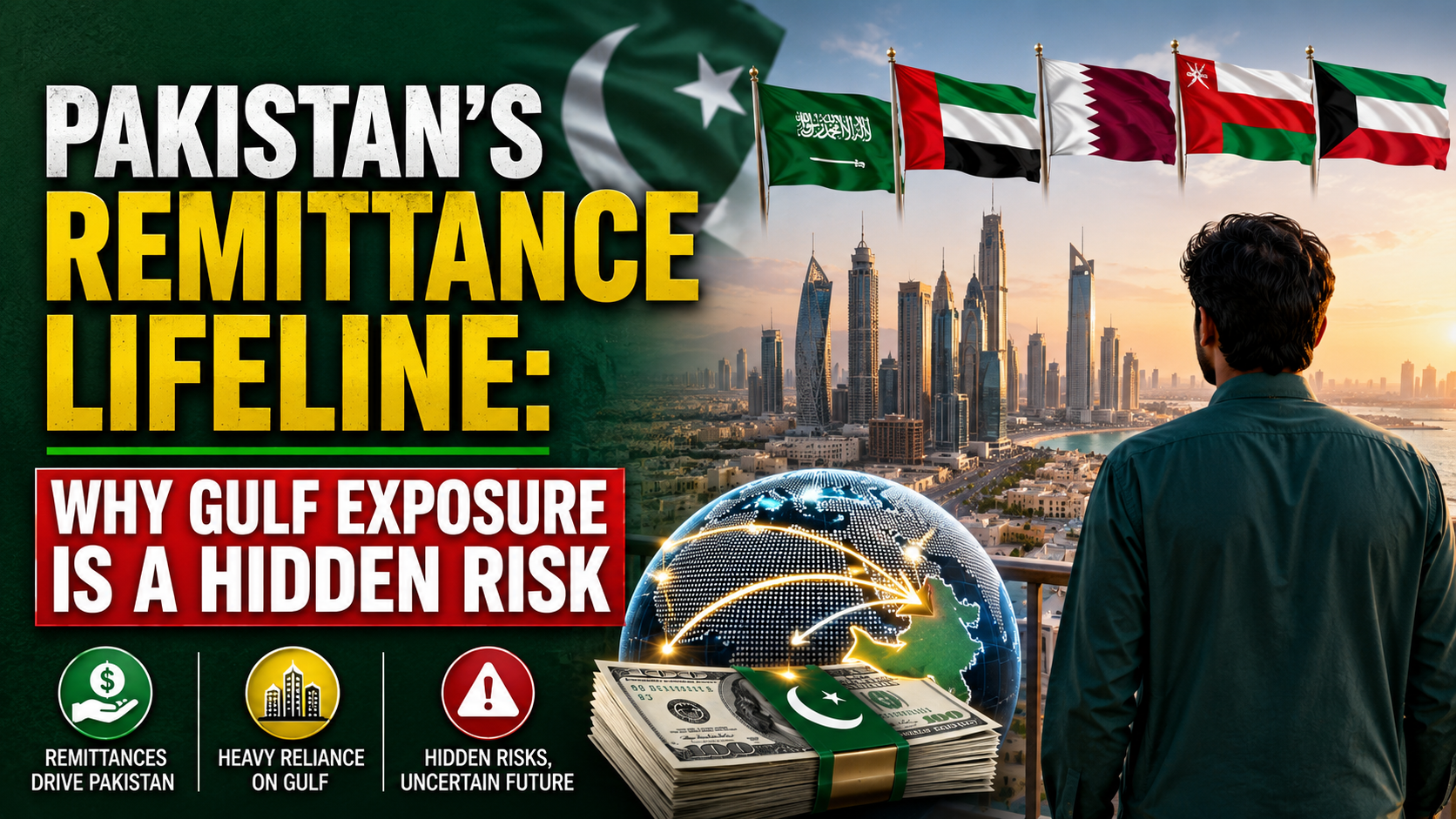
Buried inside the IMF’s latest Pakistan country report is a dependency that receives far less attention than headline GDP or inflation numbers, but arguably carries more immediate risk for millions of households: Pakistan’s economy is structurally exposed to whatever happens next in the Gulf.
The Numbers That Matter
Pakistan receives annual remittances amounting to roughly 9 percent of GDP, of which 55 percent originate from Gulf Cooperation Council countries, according to the IMF’s May 2026 country report. That single funding channel is one of the largest and most stable sources of foreign exchange available to the country — larger, in most years, than export revenue growth or foreign direct investment inflows combined.
The IMF’s own language is unambiguous about the risk this concentration creates: a significant disruption to GCC economies, or a forced return of migrant workers, could weigh heavily on these flows — a major source of financing for both household consumption and Pakistan’s broader balance of payments.
Why This Risk Is Live, Not Theoretical
This is not an abstract stress-test scenario. The Strait of Hormuz disruption, detailed extensively elsewhere in this series, has placed the entire Gulf region’s economic stability under genuine pressure for the first time in years. Should the conflict escalate further or trigger a broader regional economic slowdown, the transmission channel to Pakistan is direct and fast: fewer construction projects and reduced hiring across the GCC translates almost immediately into lower remittance flows from the millions of Pakistani workers employed there.
Capital Flows Are Already Reacting
The IMF has flagged early evidence that this dynamic is not purely hypothetical. Deteriorating global financial conditions have already resulted in capital outflows from Pakistan, which are likely to intensify further if the regional crisis extends, with the Fund specifically noting that access to short-term commercial financing — largely sourced from GCC banks — could also be affected if risk sentiment deteriorates further across the region.
This creates a double exposure that is easy to overlook in headline coverage: Pakistan depends on the Gulf both for the remittance income that supports household consumption, and for the short-term commercial bank financing that helps bridge its external funding gaps between IMF disbursements.
The State Bank’s Reserve Buffer
Pakistan’s own policy response has been to build reserves as a shock absorber. The State Bank of Pakistan has been projecting reserves to continue rising to roughly $18 billion by June 2026 on the back of planned inflows, a level implying that expected capital inflows currently exceed any current account shortfall — but only as long as Pakistan remains within an active IMF programme and maintains access to external funding on favourable terms.
The risk scenario flagged by policy researchers is specific: if monetary easing is mismanaged and confidence in Pakistan’s reform path falters, capital inflows could slow or reverse at the same time imports surge, opening an external funding gap that would draw down reserves and pressure the rupee — a scenario made materially more likely by any Gulf-region shock large enough to simultaneously dent remittances and tighten GCC bank lending.
How much of Pakistan’s remittances come from the Gulf?
Roughly 55% of Pakistan’s remittances — which fund about 9% of GDP — originate from Gulf Cooperation Council countries, making Pakistan’s balance of payments directly exposed to any economic disruption or capital-flow tightening in the Gulf region.
The Agricultural Wildcard
A related, more immediate risk sits in the agricultural supply chain. The IMF notes that disrupted DAP fertiliser supply chains linked to regional tensions could affect the Kharif planting season in June-July, with knock-on effects for food import prices — a second, more direct channel through which Gulf and broader Middle East instability could hit Pakistani households, independent of the remittance and capital-flow risks.
The Policy Takeaway
Pakistan’s economic stabilisation narrative in 2026 — a rebuilding KSE-100, falling inflation, a completed EFF review, covered in depth in our companion article — is real, but it rests on a foundation more exposed to Gulf regional stability than most headline coverage acknowledges. For policymakers in Islamabad, and for the Pakistani diaspora sending capital home each month, the Strait of Hormuz situation is not a distant geopolitical story. It is, in a very direct sense, a domestic economic risk factor.

In most economies, a strengthening currency is treated as evidence of underlying strength. In Russia’s case in 2026, the opposite is true — and this counterintuitive dynamic has received surprisingly little mainstream coverage relative to how directly it undermines Moscow’s ability to finance the war in Ukraine. The ruble touched 69.90 against the dollar in mid-June, its strongest level since February 2023, having gained roughly 45% since the start of the year on some measures. For Russia’s state finances, that appreciation is a genuine problem, not a triumph.
Why a Strong Ruble Hurts, Rather Than Helps, Russia
The mechanism runs through Russia’s fiscal architecture. Oil and gas taxes are calculated as the product of the export oil price and the ruble-dollar exchange rate — meaning that even when the dollar price of Urals crude holds steady, a stronger ruble mechanically reduces the ruble-denominated tax take from every barrel sold. With roughly 80% of Russia’s oil exports now flowing through Rosneft and Lukoil, both under direct US sanctions since late 2025, the currency-driven revenue squeeze compounds a volume-and-price problem that was already severe.
The scale of the shortfall is significant. Analysts at the Bloomsbury Intelligence and Security Institute project Russia faces an energy revenue shortfall of roughly $25–30 billion, driven by the combination of a stronger ruble and falling oil prices cutting the value of Urals crude by around a quarter. Separately, Russia’s Ministry of Finance has had to sell portions of the National Wealth Fund’s gold and yuan holdings to offset the shortfall in oil-and-gas-linked revenue — the Bank of Russia then buys those assets and sells an equivalent value of foreign currency domestically, a so-called “mirror operation” that itself reinforces the ruble’s strength, creating something close to a self-perpetuating cycle.
The Deeper Cause: Sanctions, Not Just Oil Prices
It would be a mistake to attribute the ruble’s strength purely to oil-market dynamics. Analysts at Meduza point to a more structural cause: a drop in imports combined with the Bank of Russia’s historically high interest rate has reduced domestic demand for foreign currency, pushing the ruble higher even as the broader economy stagnates. Compounding this, a large and growing share of Russia’s trade is now settled directly in rubles or yuan — 59.5% of exports and 56% of imports by October 2025 — reducing the currency-market channels through which a weaker ruble might otherwise emerge organically.
Sanctions enforcement has independently cut into export volumes and pricing power. Widened discounts on Russian crude — Urals trading roughly $25 a barrel below Brent as buyers price in the compliance risk of sanctioned suppliers — mean Russia is simultaneously selling less oil, at a bigger discount, for a currency worth mechanically less in tax terms per barrel. It is difficult to construct a more comprehensively unfavourable set of conditions for a state budget built around oil-and-gas revenue.
The Fiscal Math Is Getting Harder to Finance
Russia’s Economic Development Ministry has already revised its own forecasts downward across every major indicator, and the government has been forced into unpopular measures including a VAT increase effective January 2026 and higher domestic borrowing — targeting roughly 5.5 trillion rubles in fresh domestic bond issuance in 2026, with state-owned banks like Sberbank absorbing the bulk of that supply. Analysts note this financing method is among the most inflationary available, functionally similar to money creation, because the primary buyers are state banks rather than independent market participants pricing genuine credit risk.
Why Analysts Don’t Expect Collapse — Just Stagnation
Despite the mounting pressure, multiple assessments converge on the same conclusion: Russia’s economy is not on the verge of collapse. The World Bank’s own forecast trajectory shows growth slowing to around 0.8–1% annually through 2028 rather than contracting outright, describing the outlook as stagnation rather than crisis. As one analysis put it, the state-dependent structure of Russia’s economy — heavy reliance on state-owned enterprises and raw-material exports — is precisely the kind of economic structure that helps authoritarian systems maintain power through prolonged difficulty rather than triggering the kind of acute crisis that would force policy capitulation.
What to Watch
The critical variable for 2026 is whether the Bank of Russia’s interest-rate cuts — already reducing the key rate from 16% toward 15.5% — proceed fast enough to weaken the ruble back toward the Economic Ministry’s own projected average of roughly 92 per dollar. If the ruble instead remains persistently overvalued relative to Russia’s underlying trade fundamentals, the fiscal shortfall — and the resulting drawdown of Russia’s National Wealth Fund — will continue to compress the resources available for financing the war in Ukraine, regardless of headline oil prices.

Why the AI Revolution Is Breaking the Link Between Output and Labor Income
Artificial intelligence is transforming the modern workplace at a breathtaking pace. Generative AI tools are drafting legal briefs, diagnosing medical images, writing software code, and managing supply chains with superhuman efficiency. Yet a landmark report from the International Labour Organization, released on June 15, 2026, reveals a troubling disconnect: while global labor productivity has accelerated to a 3.2% annual clip, real median wages in advanced economies have risen a mere 0.8% (ILO World Employment and Social Outlook, June 2026). The AI boom, it appears, is delivering a productivity miracle that primarily rewards capital owners and the highest‑skilled technologists, leaving the typical worker behind.
The Labour Share in Freefall
The ILO’s most alarming finding is the labor share decline. The labor income share—the slice of national income that goes to workers in the form of wages, salaries, and benefits—has fallen to a historic low of 51% globally, down from 54% in 2004. The decline is sharpest in the United States and Northern Europe, where AI adoption is most advanced. In the US, the labor share has dropped to 56.5%, a level not seen since the Gilded Age. The ILO attributes 40% of this decline since 2020 to technological displacement, with AI being the primary driver.
The mechanism is subtle but powerful. AI automates cognitive routine tasks, not just physical ones. When a financial analyst’s report that once took five days can be produced by an AI in five minutes, the marginal value of that analyst’s time plummets. The analyst may keep her job, but her bargaining power for raises evaporates. Meanwhile, the firm’s profits surge because output per worker rises dramatically. The ILO found that in the top 500 AI‑adopting firms globally, operating margins expanded by an average of 4.8 percentage points between 2022 and 2026, but the wage‑to‑revenue ratio contracted by 2.3 points (McKinsey Global Institute, “The State of AI in 2026”).
Technology Unemployment 2.0
The term “technological unemployment” has moved from academic journals to mainstream policy debates. The ILO estimates that while AI will create 50 million net new jobs by 2030, it will displace or fundamentally transform 400 million roles. The occupations most exposed are those that involve information processing, pattern recognition, and language generation: paralegals, accountants, call‑center agents, radiologists, and software developers themselves. In a striking case, a major global bank announced in April 2026 that it had reduced its compliance department headcount by 35% while simultaneously cutting error rates, replacing human reviewers with a combination of natural‑language processing and robotic process automation (Financial Times).
What makes this wave different from previous automation cycles is the speed and the educational threshold. Historically, automation hit blue‑collar manufacturing; this time, it is hitting white‑collar, university‑educated professionals. A paper from the National Bureau of Economic Research circulated in May 2026 shows that for the first time, workers with a bachelor’s degree are seeing a negative return to experience in AI‑exposed roles; their earnings trajectory is flattening relative to peers in less automatable trades such as plumbing or elderly care (NBER Working Paper 31050).
The Gig Economy Entrenchment
AI is also accelerating the fissuring of the traditional employment relationship. Platforms that match freelancers with tasks, from graphic design to legal research, are increasingly using AI to manage work allocation, evaluate performance, and even set piece‑rate prices. The ILO found that 38% of the global workforce is now engaged in some form of non‑standard employment, up from 34% in 2019. While this provides flexibility, it strips away the training, benefits, and career progression that traditional employment offered. Workers in these arrangements have seen their real incomes stagnate or fall, as algorithmic management squeezes task‑by‑task compensation.
Policy Responses: From AI Taxes to Universal Basic Capital
Governments and international bodies are scrambling to rewrite the social contract. The European Parliament’s Committee on Employment is debating an AI training levy that would require firms deploying automation to contribute 1% of payroll to a reskilling fund. The idea, inspired by Singapore’s SkillsFuture credit, has drawn support from trade unions and even some tech leaders. Sam Altman’s concept of a “universal basic capital”—an ownership stake in the AI‑driven economy distributed to all citizens—has moved from concept to pilot in Finland and Kenya, where blockchain‑based digital trusts allocate shares in a portfolio of AI‑intensive public companies to citizens (World Economic Forum, “AI Governance in Practice”).
The OECD has issued new guidelines urging members to strengthen collective bargaining rights in the digital economy and to enforce antitrust laws that prevent algorithmic wage‑fixing (OECD Employment Outlook 2026). In the United States, the Federal Trade Commission has opened investigations into several large HR‑tech platforms over allegations that their “optimal wage” algorithms constitute illegal coordination among employers.
What Workers and Employers Can Do
For individuals, the advice is increasingly nuanced. The ILO recommends “AI literacy” not as a coding skill but as the ability to supervise, critique, and collaborate with AI outputs. Skills in emotional intelligence, complex negotiation, and ethical judgment are commanding a premium. Employers, on the other hand, are facing a talent paradox: they need workers who can manage AI, but if they hollow out the middle tier of employees, they lose the pipeline for future managers. Firms that invest in robust apprenticeship programs and internal mobility, such as Bosch and Siemens, are finding that they can deploy AI without triggering the toxic wage compression that hurts morale and long‑term innovation (Harvard Business Review, “The Smart Way to Automate”).
The AI productivity boom is real, but the ILO’s message is stark: without deliberate policy intervention, the link between rising output and rising living standards will remain broken. The labor share decline is not an iron law of technology; it is a consequence of institutional choices. Whether nations choose to tax, redistribute, or upskill will determine whether the 2020s are remembered as the decade of shared prosperity or of deepening divide.

Pakistan’s Remittance Lifeline: Why Gulf Exposure Is a Hidden Risk

Dubai’s Rise to the World’s 7th Financial Hub: Inside the D33 Push

China EV Exports Hit Record High in 2026

UK’s “National Contributions Tax” Explained: Burnham-Era Reform 2026

Russia’s Strange Problem in 2026: Its Currency Is Too Strong

Section 301 Forced Labor Tariffs 2026: 60 Countries Affected

UK National Contributions Tax: Burnham’s Radical Tax Plan

Global Central Bank Divergence 2026: Why the Fed, BoE, BoJ, and PBoC Are All Moving Differently

Japan’s Bond Market Just Cracked. It Could Take the Rest of the World’s Debt With It

Malaysia’s Ringgit Is Holding Up. Economists Say the Real Test Is Still Coming

Climate Finance Delivery 2026: Trillion‑Dollar Promise Still Unmet

AI Impact on Wages 2026: Productivity Soars, Paychecks Stagnate

SpaceX IPO 2026: $2 Trillion AI Bubble, OpenAI & Anthropic — What Investors Must Know

China Economy 2026: Property Crisis, AI Investment & Export Surplus Explained

Top 15 Stocks for Investment in 2026 in PSX: Your Complete Guide to Pakistan’s Best Investment Opportunities
Top 15 Stocks for Investment in 2026 in PSX: Your Complete Guide to Pakistan’s Best Investment Opportunities

Debunking IMF Program Myths: Reconfiguring Engagement for True National Ownership in a Volatile World

Top 10 Mutual Fund Managers in Pakistan for Investment in 2026: A Comprehensive Guide for Optimal Returns

What the U.S. Attack on Venezuela Could Mean for Oil and Canadian Crude Exports: The Economic Impact

China’s 50% Domestic Equipment Rule: The Semiconductor Mandate Reshaping Global Tech

15 Most Lucrative Sectors for Investment in Pakistan: A 2025 Data-Driven Analysis

Pakistan’s Export Goldmine: 10 Game-Changing Markets Where Pakistani Businesses Are Winning Big in 2025
15 Most Lucrative Sectors for Investment in Pakistan: A 2025 Data-Driven Analysis
15 Most Lucrative Sectors for Investment in Pakistan: A 2025 Data-Driven Analysis

Pakistan’s Economic Outlook 2025: Between Stabilization and the Shadow of Stagnation
Pakistan’s Economic Outlook 2025: Between Stabilization and the Shadow of Stagnation

China’s Property Woes Could Last Until 2030—Despite Beijing’s Best Censorship Efforts
China’s Property Woes Could Last Until 2030—Despite Beijing’s Best Censorship Efforts
-
 Markets & Finance7 months ago
Top 15 Stocks for Investment in 2026 in PSX: Your Complete Guide to Pakistan’s Best Investment Opportunities
-
Markets & Finance7 months ago
Top 15 Stocks for Investment in 2026 in PSX: Your Complete Guide to Pakistan’s Best Investment Opportunities
-
 Analysis6 months ago
Debunking IMF Program Myths: Reconfiguring Engagement for True National Ownership in a Volatile World
-
 Investment6 months ago
Top 10 Mutual Fund Managers in Pakistan for Investment in 2026: A Comprehensive Guide for Optimal Returns
-
 Global Economy7 months ago
What the U.S. Attack on Venezuela Could Mean for Oil and Canadian Crude Exports: The Economic Impact
-
 Asia7 months ago
China’s 50% Domestic Equipment Rule: The Semiconductor Mandate Reshaping Global Tech
-
 AI7 months ago
15 Most Lucrative Sectors for Investment in Pakistan: A 2025 Data-Driven Analysis
-
 Exports7 months ago
Pakistan’s Export Goldmine: 10 Game-Changing Markets Where Pakistani Businesses Are Winning Big in 2025