
Governance
Beyond the Bailout: 10 Strategic Imperatives to Resolve Pakistan’s Balance of Payments Crisis

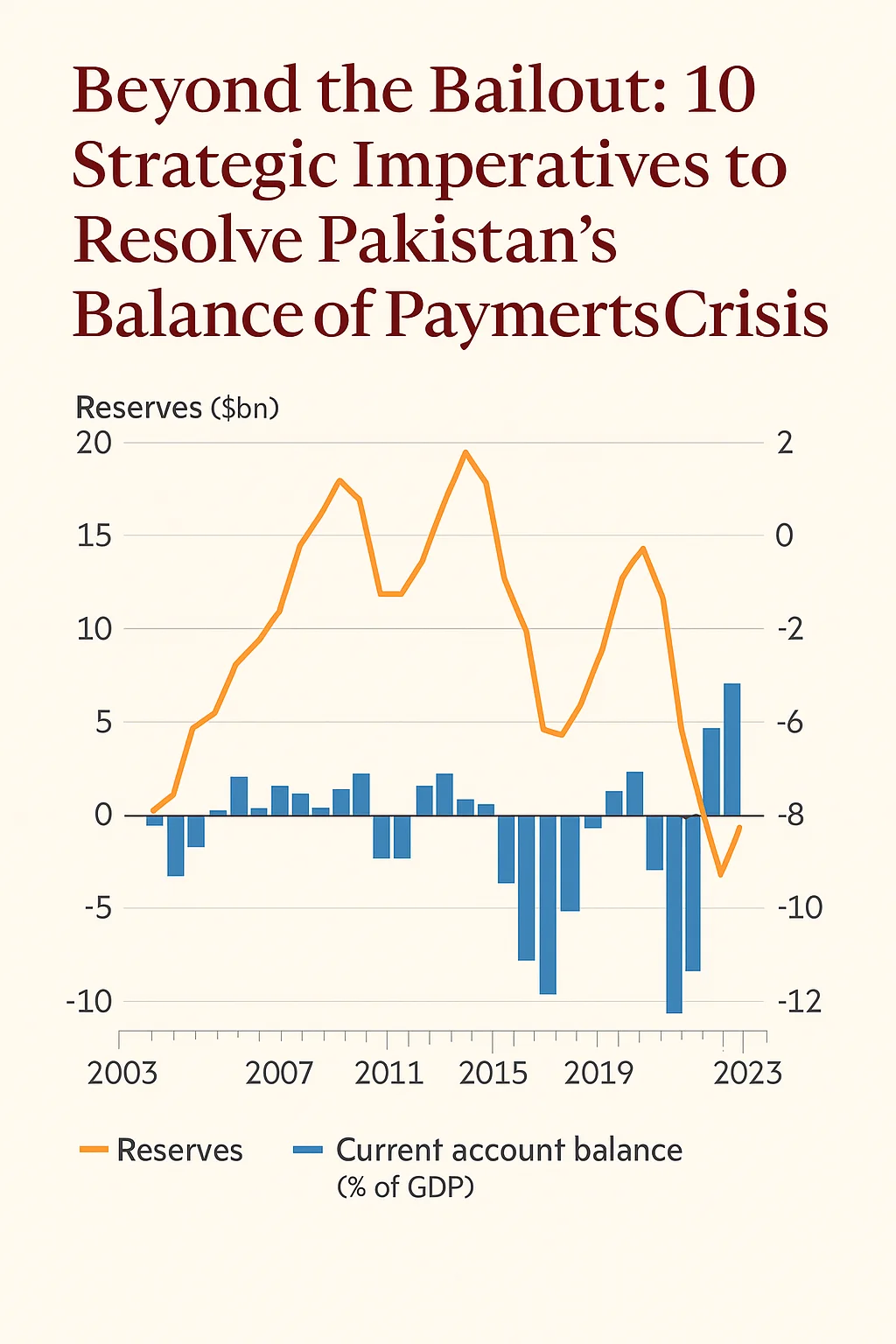
Executive Summary: The Structural Surgery Required
Pakistan’s economic history is defined by the “Stabilization Trap”—a recurring cycle where brief periods of consumption-led growth lead to a blowout in the Current Account Deficit (CAD), followed by emergency devaluations and IMF intervention. As of late 2025, the State Bank of Pakistan (SBP) has managed a precarious stability, with foreign exchange reserves crossing the $14.5 billion threshold and inflation cooling to a multi-decade low of 4.5%. However, the structural fragility remains.
To transition from a debt-dependent economy to a trade-led powerhouse, Pakistan must implement a ten-pronged “structural surgery” that goes beyond mere belt-tightening. This article outlines the roadmap for the Finance Ministry, the SBP, and the Planning Commission to achieve a sustainable Balance of Payments (BoP).
1. Institutionalizing the Market-Determined Exchange Rate
The first line of defense in any BoP crisis is the exchange rate. According to the IMF’s latest review (December 2025), maintaining a market-determined exchange rate is non-negotiable for buffering external shocks.
For the SBP, the objective is not to “defend” a specific number, but to ensure liquidity. A market-aligned Rupee encourages expenditure-switching: it makes imports expensive and exports competitive. Historical data shows that whenever the REER (Real Effective Exchange Rate) is kept artificially low, the CAD explodes.
Policy Directive: The SBP must continue its policy of minimal intervention, allowing the currency to act as an automatic stabilizer for the trade balance.
2. Fiscal Consolidation: The Primary Surplus Mandate
Balance of Payments issues are often “twin deficits”—a fiscal deficit that fuels a current account deficit. The Ministry of Finance has achieved a historic primary surplus of 2.4% of GDP in FY25.
To maintain this, the government must resist the urge for “populist” spending. High fiscal deficits lead to increased domestic demand, which inevitably spills over into higher imports.
- The Target: Sustain a primary surplus above 2% for at least three consecutive fiscal cycles to signal fiscal discipline to global bond markets.
3. Aggressive Export Diversification (Beyond Textiles)
The World Bank’s Pakistan Development Update (October 2025) notes a sobering trend: Pakistan’s exports as a percentage of GDP have shrunk from 16% in the 1990s to roughly 10% today.
Textiles account for nearly 60% of goods exports, making the country vulnerable to global commodity price shifts.
- The Solution: Policy focus must shift toward high-value-added manufacturing (engineering goods, pharmaceuticals) and agriculture-tech (Basmati rice, value-added horticulture). The government should provide “Smart Subsidies” tied strictly to export performance milestones rather than blanket energy subsidies.
4. Scaling the “Digital Frontier”: IT and Services Exports
While goods trade often struggles with energy costs, IT services are Pakistan’s most agile export sector. In FY25, IT exports and remittances have become a primary pillar of BoP stability.
- The Opportunity: With global trade policy uncertainty rising, digital services are less susceptible to physical trade barriers.
- Action: The Planning Commission must fast-track “Special Technology Zones” (STZs) with 5G infrastructure and ease of repatriation for foreign earnings to encourage global tech firms to set up hubs in Karachi and Lahore.
5. Reforming the Energy Mix to Reduce the Import Bill
Energy typically accounts for 25-30% of Pakistan’s total import bill. The reliance on imported RLNG and furnace oil is a structural “leakage” in the BoP.
- Strategic Shift: Accelerate the transition to domestic coal (Thar) and renewables (Solar/Wind).
- The IMF Perspective: The Resilience and Sustainability Facility (RSF) recently approved by the IMF for Pakistan specifically targets this. Every 1% increase in domestic energy share saves roughly $200 million in foreign exchange annually.
6. Formalizing Workers’ Remittances
Remittances reached a record $38 billion in FY25, effectively offsetting a significant portion of the trade deficit. However, a portion of these flows still bypasses official channels via the Hundi/Hawala system.
- Policy Tool: The SBP must continue narrowing the gap between interbank and open-market rates.
- Innovation: Launch “Remittance Bonds” with tax-free incentives for overseas Pakistanis, allowing these flows to be funneled directly into national development projects rather than just household consumption.
7. Strategic Import Substitution: The “Make in Pakistan” Initiative
The government should incentivize the domestic production of intermediate goods—chemicals, steel, and mobile components—that currently drain billions.
Note of Caution: This is not a call for 1970s-style protectionism. Instead, the “National Industrial Policy” should focus on integrating Pakistani SMEs into global value chains, making it cheaper to produce locally than to import.
8. Attracting “Sticky” Capital: FDI over “Hot Money”
The BoP is currently propped up by official debt and short-term portfolio investment. This is high-risk.
- The ADB Roadmap: The Asian Development Bank (ADB) emphasizes private sector-led growth. Pakistan needs Foreign Direct Investment (FDI) in productive sectors like mining and green energy.
- The SIFC Role: The Special Investment Facilitation Council (SIFC) must move beyond MoUs to actual “ground-breaking” projects, ensuring a stable regulatory environment that guarantees profit repatriation.
9. Tight Monetary Policy to Anchor Inflation
The SBP has prudently kept the policy rate at a level where the real interest rate remains positive. High interest rates serve two purposes in a BoP crisis:
- They discourage domestic credit-fueled consumption (imports).
- They make domestic assets attractive to foreign investors, helping the Financial Account.
- Projection: As inflation stays in the 5–7% target range, the SBP can gradually ease rates, but only once the BoP surplus is structurally consolidated.
10. Expanding the Tax Base to Reduce Sovereign Borrowing
A low tax-to-GDP ratio (currently near 9-10%) forces the government to borrow externally to fund its budget, worsening the external debt profile.
- Focus: The FBR must pivot from taxing “easy” sectors (manufacturing/salaried) to the informal retail, real estate, and agriculture sectors.
- The World Bank View: Modernizing tax administration could unlock an additional 3% of GDP in revenue, significantly reducing the need for foreign-funded budgetary support.
Policy Trade-off Matrix: BoP Resolution Strategies
| Measure | Time to Impact | Political Cost | Official Source Alignment |
| Currency Realignment | Immediate | High (Inflationary) | IMF/SBP Mandate |
| Energy Transition | Long-term | Moderate | WB/RSF Support |
| IT Export Focus | Medium-term | Low | Planning Commission |
| Tax Base Expansion | Medium-term | Very High | FBR/IMF Requirement |
| Remittance Incentives | Fast | Low | SBP/Ministry of Finance |
Conclusion: The Path Ahead
The 2025 data suggests that Pakistan has secured a “breathing space,” with the first full-year current account surplus in over a decade ($2.1 billion). However, this surplus is largely driven by compressed demand and record remittances rather than a massive surge in industrial exports.
To ensure that the next growth cycle does not lead to another crash, the Finance Ministry and the State Bank must remain vigilant. The transition from stabilization to sustainable growth requires the political will to tax the untaxed and the economic vision to pivot toward a service-led, export-oriented future.


A group of senior UK economists led by Lord O’Neill of Gatley has proposed scrapping income tax, National Insurance, and capital gains, dividend and inheritance taxes in favor of a single “national contributions” levy, alongside replacing stamp duty with a 1% property valuation charge. The plan claims it could unlock £38bn in fiscal headroom and raise £18bn — and it’s landing just as Andy Burnham prepares to become prime minister.
Why this is surfacing right now
Most UK coverage has focused on the horse-race politics of Keir Starmer’s resignation and Andy Burnham’s expected succession as prime minister on July 20, 2026. What’s been under-covered is the structural tax reform proposal now sitting on the desk of whoever holds that office. Lord O’Neill and five other economists have published a report through the UCL Institute for Global Prosperity calling for a fundamental redesign of how the UK taxes income and wealth (CPA).
The mechanics: instead of stacking income tax, National Insurance, and separate levies on capital gains, dividends and inheritance, the UK would consolidate all of it into one “national contributions” tax. Stamp duty on property transactions would be replaced with an annual 1% levy on property valuations. The report’s authors argue this could create £38bn of additional fiscal headroom while raising £18bn in net new revenue — a combination that would matter enormously to a new government already facing warnings from the Office for Budget Responsibility about UK debt trajectories.
The bigger fiscal backdrop making this urgent
This isn’t a proposal floating in a vacuum. The OBR has warned that public debt could climb toward 300% of GDP by 2075 without intervention, and that nearly 50 million people could eventually fall into the higher tax bracket if current thresholds stay frozen while spending goes uncontrolled — potentially pulling even full-time workers on the National Living Wage into the 40% band by the late 2060s (CPA). The UK’s tax-to-GDP ratio is already projected to rise from 37% in 2019/20 to 43% by 2030/31.
Against that backdrop, the political calculation facing Burnham is unusually tight: he has signaled Labour’s manifesto still leaves room for maneuver on taxes, provided the party avoids raising the headline rates of income tax, VAT or National Insurance (CPA). A single consolidated levy could, in theory, let a government reshape effective tax burdens without technically breaking that pledge — which is precisely why business groups are watching this proposal so closely.
Who wins and loses under a consolidated levy
- Higher earners and investors currently benefiting from the gap between income tax rates and lower capital gains rates would likely see that gap close, which is why fintech entrepreneurs have already pushed back hard. Thought Machine founder Paul Taylor has called proposals to align capital gains tax with income tax “profoundly unfair” and warned it could discourage the investment the UK needs to support venture-backed IPOs (CPA).
- Property owners would trade a one-off stamp duty charge for an ongoing annual valuation-based levy — a structural shift with very different cash-flow implications for anyone holding property long-term versus trading it frequently.
- The Treasury gains a simpler, harder-to-avoid tax base, which is the core appeal for fiscal planners worried about long-run debt sustainability.
What UK businesses and investors should track next
Business confidence in the UK has already fallen to an 18-month low, with firms citing tax uncertainty as a leading factor, according to S&P Global data (CPA). Until the new government clarifies whether it will pursue anything resembling the national contributions model, expect continued caution on hiring and investment — a dynamic we cover in depth in our UK business confidence explainer.

While most headlines about the UK’s leadership transition have focused on the political theatre — Keir Starmer’s resignation, Andy Burnham’s uncontested path to Number 10 — a genuinely radical tax proposal has been sitting in plain sight, and it deserves far more scrutiny than it’s getting.
Lord Jim O’Neill of Gatley, the former Goldman Sachs chief economist now advising Burnham, has joined five other economists in calling for the biggest overhaul of the UK tax system in generations. The plan, detailed in a report from the UCL Institute for Global Prosperity, would scrap income tax, National Insurance, capital gains tax, dividend tax, and inheritance tax entirely — replacing all of them with a single “National Contributions” levy applied to income. Separately, the report proposes replacing stamp duty with a flat 1% annual levy on property values. Backers argue the combined changes could boost fiscal headroom by £38 billion while raising an additional £18 billion in revenue (CPA Business News).
This is not a minor tweak. It’s a proposal to collapse six separate taxes — each with its own thresholds, reliefs, and carve-outs built up over decades — into one unified system.
Why This Is Happening Now
Burnham inherits an economy that, by almost every measure, is stuck. GDP grew just 0.1% at the end of 2025, later revised down from an initial 0.2% estimate. The following quarter did better at 0.6%, but growth reversed again with a 0.1% GDP contraction in April. Inflation remains stubbornly above the Bank of England’s 2% target at 2.8%, while real household disposable income fell 0.8% in the first quarter as prices and taxes squeezed consumers simultaneously (CPA Business News).
Bank of England Governor Andrew Bailey has been unusually blunt about his own discomfort with the inflation trajectory, backing chief economist Huw Pill’s concern that persistent price pressure remains a genuine problem even as the Bank held rates at 3.75% (CPA Business News). Bailey has also warned that recent energy price increases are still feeding through the system, telling reporters that although oil prices have fallen, they remain well above pre-conflict levels (Hanbury Wealth).
Against that backdrop, a government looking for both simplicity and additional fiscal headroom has an obvious incentive to consider structural reform rather than incremental tinkering.
The Political Balancing Act Burnham Faces
Burnham has already signalled several early priorities: greater devolution of power away from Whitehall, more public control over essential services and utilities, an expanded housebuilding push, and rebalancing the prestige gap between university education and technical qualifications. There are also indications that cost-of-living relief could be an early priority — though crucially, from a market perspective, Burnham has said he won’t abandon existing fiscal rules (UK Finance).
That last point matters enormously. Investors watching the transition are specifically worried about how quickly a new government responds to the cost-of-living crisis, with some advisers reportedly pushing for immediate household support and others urging fiscal restraint (CPA Business News). The National Contributions proposal threads that needle: it’s marketed as simplification rather than a tax rise, even though the reported £18 billion revenue increase suggests the net effect on payers won’t be neutral across income and wealth brackets.
There’s also a live debate about a windfall tax on banks. The Trades Union Congress is pushing Burnham to introduce one, with estimates suggesting it could raise between £9 billion and £60 billion over four years. UK Finance, representing the banking sector, has warned such a measure could damage the City of London’s competitiveness and cost jobs — a warning echoed by Lord O’Neill himself, who has cautioned against piling further taxes onto business even as he backs the broader National Contributions overhaul (CPA Business News).
What a Single-Levy System Would Actually Change
For a typical PAYE employee, collapsing income tax and National Insurance into one line item mostly simplifies payslips and reduces the marginal-rate cliff edges that currently exist where the two systems interact awkwardly (particularly around the upper earnings threshold).
For higher earners and business owners, the bigger question is what happens to capital gains, dividends, and inheritance once they’re folded into a single “contributions” framework. Currently, these income types are taxed at different rates specifically because policymakers have historically wanted to treat earned income, investment returns, and inherited wealth differently. Merging them into one levy structure would represent a genuine philosophical shift in how the UK treats different sources of wealth — not just an administrative simplification.
The proposed 1% property value levy replacing stamp duty is arguably just as significant. Stamp duty is currently a one-off transaction tax paid at the point of sale; a recurring annual levy on property value is a fundamentally different instrument; it behaves more like a wealth tax than a transaction tax, and it would hit asset-rich, cash-poor homeowners — particularly retirees in high-value properties — differently than the current system does.
The Business Confidence Problem This Has to Overcome
Business sentiment has already deteriorated sharply heading into this transition. The Institute of Directors’ sentiment index fell to minus 61 in June from minus 53 in May, and a separate business activity reading swung from a positive 65 reading in March to negative 58 in June, with firms citing weaker profitability and poor investment returns (CPA Business News). Political uncertainty around potential tax changes is explicitly cited as a factor weighing on business planning.
That creates a difficult sequencing problem for Burnham: the tax overhaul that could eventually simplify the system and boost fiscal headroom requires exactly the kind of near-term uncertainty that is currently suppressing business investment and hiring.
What to Watch Next
The Bank of England’s next Monetary Policy Committee meeting on 30 July will be an early indicator of whether the fragile Q1 growth pickup can be sustained under the new government. Markets will also be watching for the first concrete policy announcements once Burnham formally becomes Prime Minister, expected around 20 July, particularly on whether the National Contributions proposal moves from think-tank paper to government white paper.
For now, this remains a proposal rather than legislation. But the fact that it’s being championed by an economist actively advising the incoming Prime Minister — rather than floated by an outside think tank with no government access — makes it worth tracking closely.
Analysis
Nidec Accounting Fraud: The Pressure Culture That Built Japan’s Biggest Corporate Scandal in a Decade

There’s a comic book on Nidec’s website — or there was, until recently — called “The Man Hotter Than the Sun.“ It chronicles the rise of Shigenobu Nagamori, who founded the world’s largest precision motor company in a shack in Kyoto in 1973 and built it into a global industrial giant supplying Apple, the automotive sector, and half the data centres on earth. Hard work. Relentless ambition. Numbers that never disappointed. It was a very Japanese success story, and it was also, investigators have now concluded, partly a fiction — one sustained for years by managers who inflated profits rather than face the man whose sun, apparently, could not be allowed to set.
What Is the Nidec Accounting Fraud — and How Big Is It?
The Nidec accounting fraud is Japan’s largest corporate accounting scandal in at least a decade. A third-party committee report released in March 2026 found that Nidec Corporation had committed accounting fraud totalling 166.2 billion yen — roughly $1.1 billion — as of 2023. That figure, staggering on its own, is likely the floor. The company has warned it may be forced to book an additional ¥250 billion, or $1.6 billion, in impairment charges as the full cost of the scandal is tallied, with third-party investigators saying they uncovered at least 1,000 separate instances of improper accounting across the group. Seoul Economic DailyBloomberg
The scandal first showed its face not in Kyoto, where Nidec is headquartered, but in Casalmaggiore, a small town in northern Italy’s Po Valley. It was the company’s Italian subsidiary, Nidec FIR International S.R.L., where possible lapses first surfaced in June 2025, forcing Nidec to delay filing its annual financial results. Within months, a Chinese subsidiary was implicated too, and then the scope widened further: investigators found misconduct at operations in Switzerland and across Nidec’s automotive inverter business. financialcontent
On October 28, 2025, the Tokyo Stock Exchange designated Nidec’s stock as a “security on special alert,” citing substantial need for improving the company’s internal management systems. The move sent shares tumbling by their daily 500 yen limit — a drop of roughly 19% in a single session. By the time the formal third-party report landed on February 27, 2026, Chairman Hiroshi Kobe and three other senior executives had resigned. Moody’s downgraded Nidec’s debt rating three levels into junk territory, and the stock was removed from the Nikkei 225 index. CEO Mitsuya Kishida bowed publicly at a press conference and said he would forfeit his salary until October. NIDEC CORPORATIONMy-cpe
The mechanics of the fraud were, in retrospect, classically mundane. Misconduct confirmed at Nidec Group bases included: avoidance of recognising valuation losses on obsolete raw materials and finished goods; improper avoidance of impairment losses based on sales plans with low probability of achievement; inflated inventory values; misreported customs declarations; government grants booked as revenue. Each individual manipulation was modest. Aggregated across dozens of subsidiaries over multiple years, they added up to a billion-dollar lie. NIDEC CORPORATION
How Did Corporate Culture Drive the Fraud?
This is where the story moves from accounting irregularity to structural pathology. The central finding of the independent investigation is not that Nagamori ordered the fraud — investigators found no evidence he personally directed specific manipulations. What they found was more insidious.
The committee blamed founder Shigenobu Nagamori for “excessive pressure to meet performance targets,” particularly profit targets, and found that many business units attempted to meet their goals using creative accounting. In plain terms: managers across Italy, China, and Switzerland were not cooking the books because they were corrupt. They were doing it because the alternative — telling Nagamori, a man who has written books about his rags-to-riches philosophy and whose image once adorned the company’s public website — that the numbers wouldn’t hit, was something the culture simply didn’t allow. MarketScreener
What caused the Nidec accounting fraud? The third-party investigation concluded that Nagamori’s excessive pressure on staff to meet profit targets created a corporate culture in which managers across multiple countries resorted to improper accounting rather than miss their numbers. Investigators documented more than 1,000 separate instances of misconduct spread across the group’s global subsidiaries.
This mechanism — what organisational theorists sometimes call “performance pressure fraud” — is not unique to Japan. But it finds particularly fertile ground in founder-dominated companies, where the founder’s authority has rarely been formally checked and where decades of success have calcified the idea that the numbers are always achievable if you push hard enough. Nagamori had, famously, sent regular messages to senior managers demanding better performance. As far back as September 2021, after handing over the CEO role, he was telling managers that the company faced its biggest-ever business crisis and that they needed to do more to boost performance and the share price. The message, delivered repeatedly across years, wasn’t lost on the people below him. Bloomberg
Oasis Management, the activist fund that holds approximately 6.7% of Nidec, described the problem bluntly in March 2026: “The problem at Nidec lies in a corporate culture that pressured employees into engaging in improper accounting practices for the sake of performance or share price; a lack of ethical judgment among management that effectively tolerated such improper accounting; the failure to establish appropriate checks and balances.” businesswire
What Are the Implications for Nidec and Japan Inc.?
The immediate picture for Nidec itself is grim. CEO Kishida has announced a plan to spend ¥130 billion over five years on measures to prevent recurrence and rebuild the governance system, including the suspension of the company’s once-aggressive acquisition strategy. Business acquisitions had been Nidec’s primary growth engine for three decades — an irony not lost on investors, since it was precisely that acquisition-driven expansion into Italy, China, and Switzerland that created the dispersed, difficult-to-audit subsidiaries where the fraud took root. The Japan Times
Nidec has also cancelled its year-end dividend for the fiscal year ending March 2026, with the company saying it “has no choice” given the investigation’s material impact on its financial closing for past fiscal years. The Securities and Exchange Surveillance Commission has reportedly begun its own probe, adding a regulatory dimension to what is already a reputational and financial catastrophe. NIDEC CORPORATION
The broader signal for Japanese markets is harder to read, but not easily dismissed. Japan’s corporate governance reform drive — accelerated by the Tokyo Stock Exchange’s 2023 push to force companies trading below book value to justify their capital allocation — was already testing the limits of how far founder-controlled companies would actually change. Nidec was, until recently, considered a model of what Japanese manufacturing could become: globally scaled, technically sophisticated, financially driven. The revelation that its financial sophistication was partly illusory lands badly at precisely the moment foreign investors have been warming to Japan’s equity story.
Academic research published in the Asia Pacific Journal of Management in 2025 found that the combination of foreign investor pressure for short-term gains and inadequately independent boards — particularly at companies with concentrated founder ownership — significantly elevates the risk of corporate misconduct in Japanese firms. Nidec fits the profile precisely. Springer
The Counterargument: Was Nagamori Singled Out Unfairly?
Not everyone is persuaded that Nagamori is the villain this narrative requires. Some analysts argue that to pin a systemic governance failure on one individual’s personality is to let the board, the auditors, and the company’s own internal compliance function off the hook entirely.
PwC, Nidec’s auditor, issued a disclaimer of opinion on the company’s fiscal year 2025 consolidated financial statements — an extraordinary step that signals the auditor could not obtain sufficient evidence to form a view. PwC pointed specifically to accounting practices that could have a “significant impact on consolidated financial statements” due to arbitrary adjustments in the timing of asset write-downs. That’s a significant failure of external oversight, and it raises questions about why red flags were not raised earlier in an audit relationship that spans years. mexc
There’s also a legitimate argument that the third-party committee report, while technically independent, was commissioned by Nidec itself — a structural limitation that critics of Japan’s third-party committee system have long flagged. The Japan Federation of Bar Associations guidelines that govern these panels were designed for transparency, but the panels’ independence is fundamentally constrained by the fact that the company in question controls the scope and, ultimately, bears the costs of the investigation. Whether the 1,000-plus instances of misconduct represent the full picture, or merely the portion the investigation was equipped to find, remains an open question.
Still, that caveat doesn’t fundamentally alter the central finding. A culture doesn’t become fraudulent by accident. Someone has to set the temperature.
A Reckoning That Was Always Coming
Nidec’s Culture Transformation Lab — the body launched on February 1, 2026, to “convey the voices of front-line employees directly to management” — has a name that reads less like a corporate initiative and more like an admission. If front-line voices needed a formal laboratory to be heard, the silence before it was built tells you everything about what the organisation had become.
The Nidec accounting fraud is, at one level, a story about a single company and a single founder’s shadow falling too far across the boardroom. At another level, it’s a test case for whether Japan’s governance reforms have teeth. The TSE’s special alert mechanism worked; Moody’s downgrade worked; the independent investigation worked. What didn’t work, for years, was the ordinary internal machinery that is supposed to catch this kind of thing before it reaches $1.1 billion.
That machinery failed because the people operating it were too afraid to make it fail in the other direction.
The comic book about the man hotter than the sun has been quietly removed from Nidec’s website. What’s left is a company trying to figure out how to build something that doesn’t burn everything around it.

Business Insurance for Digital Exports: Protecting Your Company in the AI Era

Real Estate Crash Predictions 2026: Data-Backed Regional Guide

What is a “Lead-Left” Bank? Unpacking Morgan Stanley’s Role in Anthropic’s Mega-IPO

Is SPY Overvalued in September 2026? Fed Rate Hike Odds & Intrinsic Value

Pakistan’s KSE-100 Nears Record Territory Even as the Trade Gap Persists

US Consumer Sentiment Sinks as Retail Sales Drop

Barclays Q2 2026 Results: Income Beats, Costs Rise 7%

Pakistan’s Remittance Lifeline: Why Gulf Exposure Is a Hidden Risk

Dubai’s Rise to the World’s 7th Financial Hub: Inside the D33 Push

China EV Exports Hit Record High in 2026

UK’s “National Contributions Tax” Explained: Burnham-Era Reform 2026

Russia’s Strange Problem in 2026: Its Currency Is Too Strong

Section 301 Forced Labor Tariffs 2026: 60 Countries Affected

UK National Contributions Tax: Burnham’s Radical Tax Plan

Top 15 Stocks for Investment in 2026 in PSX: Your Complete Guide to Pakistan’s Best Investment Opportunities
Top 15 Stocks for Investment in 2026 in PSX: Your Complete Guide to Pakistan’s Best Investment Opportunities

Debunking IMF Program Myths: Reconfiguring Engagement for True National Ownership in a Volatile World

Top 10 Mutual Fund Managers in Pakistan for Investment in 2026: A Comprehensive Guide for Optimal Returns

What the U.S. Attack on Venezuela Could Mean for Oil and Canadian Crude Exports: The Economic Impact

China’s 50% Domestic Equipment Rule: The Semiconductor Mandate Reshaping Global Tech

15 Most Lucrative Sectors for Investment in Pakistan: A 2025 Data-Driven Analysis

Pakistan’s Export Goldmine: 10 Game-Changing Markets Where Pakistani Businesses Are Winning Big in 2025
15 Most Lucrative Sectors for Investment in Pakistan: A 2025 Data-Driven Analysis
15 Most Lucrative Sectors for Investment in Pakistan: A 2025 Data-Driven Analysis

Pakistan’s Stock Market Renaissance: How 2025’s Hottest Investment Opportunity Is Democratizing Wealth—A Complete Beginner’s Guide

Pakistan’s Economic Outlook 2025: Between Stabilization and the Shadow of Stagnation
Pakistan’s Economic Outlook 2025: Between Stabilization and the Shadow of Stagnation

China’s Property Woes Could Last Until 2030—Despite Beijing’s Best Censorship Efforts
-
 Markets & Finance8 months ago
Top 15 Stocks for Investment in 2026 in PSX: Your Complete Guide to Pakistan’s Best Investment Opportunities
-
Markets & Finance8 months ago
Top 15 Stocks for Investment in 2026 in PSX: Your Complete Guide to Pakistan’s Best Investment Opportunities
-
 Analysis7 months ago
Debunking IMF Program Myths: Reconfiguring Engagement for True National Ownership in a Volatile World
-
 Investment8 months ago
Top 10 Mutual Fund Managers in Pakistan for Investment in 2026: A Comprehensive Guide for Optimal Returns
-
 Global Economy8 months ago
What the U.S. Attack on Venezuela Could Mean for Oil and Canadian Crude Exports: The Economic Impact
-
 Asia8 months ago
China’s 50% Domestic Equipment Rule: The Semiconductor Mandate Reshaping Global Tech
-
 AI9 months ago
15 Most Lucrative Sectors for Investment in Pakistan: A 2025 Data-Driven Analysis
-
 Exports9 months ago
Pakistan’s Export Goldmine: 10 Game-Changing Markets Where Pakistani Businesses Are Winning Big in 2025