
Geopolitics
The Economics of Regime Change: Historical Lessons for Post-Maduro Venezuela and Protest-Riven Iran

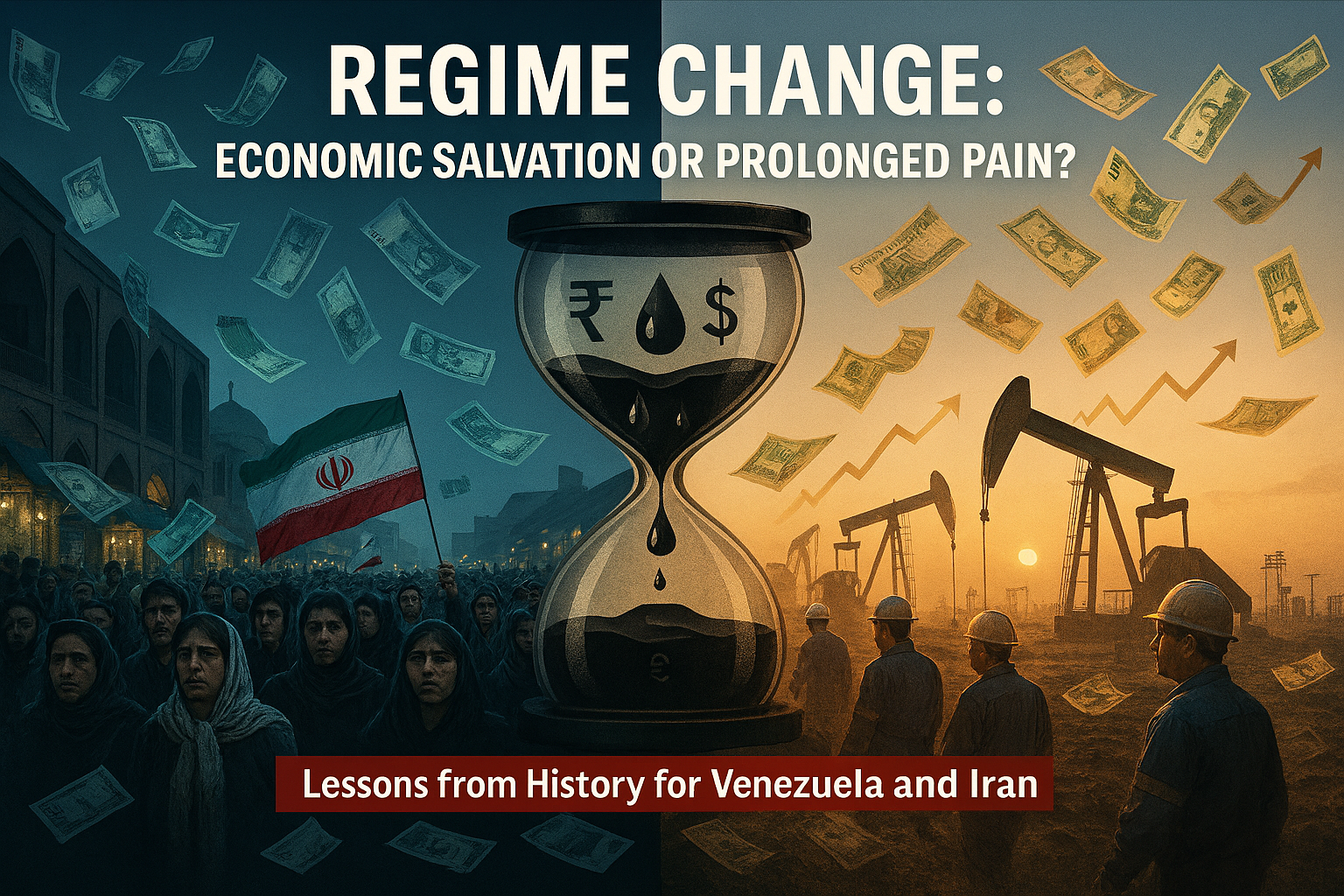
In the sweltering heat of Caracas this January, street vendors who once bartered eggs for devalued bolivars now speak cautiously of hope. Nicolás Maduro’s departure from Venezuela’s presidency—confirmed through a negotiated transition involving regional powers and domestic opposition—has unleashed a torrent of speculation about economic renewal. Opinion polls conducted in the capital’s barrios suggest more than 70% of Venezuelans expect their purchasing power to improve within two years, a striking reversal from the fatalism that pervaded the nation during its decade-long economic collapse.
Meanwhile, 2,500 kilometers northeast across the Atlantic, a different drama unfolds in Tehran’s ancient bazaars. Merchants shuttered their shops throughout late 2025 and early 2026, not in religious observance but in protest against a government whose economic mismanagement has rendered the rial nearly worthless and pushed inflation past 50%. What began as scattered demonstrations over bread prices has metastasized into the most serious challenge to Iran’s clerical establishment since the Green Movement.
These parallel crises illuminate one of political economy’s most consequential questions: does regime change deliver the economic renewal that catalyzes it, or does it merely exchange one form of hardship for another? The economics of regime change—the material consequences when one governing structure displaces another through revolution, coup, or negotiated transition—remains poorly understood despite its obvious importance. Citizens topple autocrats expecting prosperity; what they often receive is prolonged stagnation punctuated by false starts.
The scholarly consensus tilts pessimistic. Decades of research document how political upheaval disrupts investment, erodes property rights, and triggers capital flight that takes years to reverse. Iraq’s post-2003 descent into sectarian chaos, Libya’s fragmentation after Muammar Gaddafi’s fall, and Egypt’s economic stagnation following the Arab Spring all confirm this grim pattern. Yet outliers exist—South Korea’s democratic transition preceded its elevation to developed-nation status, Indonesia navigated Suharto’s 1998 ouster without prolonged collapse, and Poland’s post-communist shock therapy became a model others studied. Understanding what separates success from failure has never mattered more. Venezuela stands at a crossroads between rehabilitation and further decay, while Iran’s rulers calculate whether economic concessions might forestall the fate that befell their Venezuelan counterparts.
This analysis examines the economic impact of regime change through comparative historical analysis, extracting lessons for nations experiencing or approaching political rupture. It argues that while regime change creates necessary preconditions for reform, economic recovery depends crucially on institutional quality, external support, and the speed with which new governments establish credible commitments to property rights and macroeconomic stability. The contrast between post-regime change economic recovery in successful transitions and failures offers practical guidance for policymakers navigating Venezuela’s uncertain future and contemplating Iran’s potential transformation.
The Pessimistic Historical Consensus: Why Regime Change Usually Disappoints
The dominant finding in political economy research is unambiguous: regime change typically harms economic performance in the short to medium term. Alberto Alesina and Roberto Perotti’s landmark 1996 study demonstrated that political instability reduces investment rates by approximately 0.8 percentage points for each standard deviation increase in instability measures. This might seem modest until compounded over years. A nation experiencing severe upheaval—multiple coup attempts, revolutionary transitions, or prolonged civil conflict—can see investment collapse by 5-7% of GDP annually, directly translating into forgone growth.
The mechanisms are well-established. Political uncertainty raises discount rates as investors demand higher returns for increased risk. Property rights become ambiguous when governments change hands violently; the new regime may repudiate contracts signed by its predecessor, nationalize industries, or impose retroactive taxation. Capital flight accelerates as those with movable assets—financial wealth, human capital, portable businesses—relocate to more stable jurisdictions. World Bank research on political transitions shows unemployment typically rises 1-1.5 percentage points immediately following regime change, even in relatively peaceful transitions.
Iraq exemplifies these dynamics at their most destructive. The 2003 invasion removed Saddam Hussein’s Ba’athist regime but created a power vacuum that sectarian militias and insurgents rushed to fill. The decision to disband the Iraqi army and pursue aggressive de-Ba’athification destroyed institutional capacity overnight. GDP per capita, which stood at approximately $3,600 in 2002, plummeted to $2,100 by 2005, and Iraq burned through decades of developmental progress. Oil production—the economy’s backbone—collapsed from 2.5 million barrels daily pre-invasion to barely 1 million by late 2003. Even massive American reconstruction spending, exceeding $60 billion in the first five years, couldn’t prevent economic catastrophe when basic security and functioning institutions disappeared simultaneously.
Libya’s trajectory after 2011 followed a similar pattern, though NATO intervention prevented the scale of foreign occupation that characterized Iraq. Muammar Gaddafi’s overthrow unleashed regional militias that the weak central government in Tripoli could never fully control. Oil production, which reached 1.65 million barrels daily in 2010, fell to barely 200,000 barrels at its nadir during the civil conflict. The IMF documented that Libya’s GDP contracted by 62% in 2011 alone, a peacetime economic collapse matched only by the Great Depression in severity. A decade later, Libya remains partitioned between competing governments, its economic potential squandered by political fragmentation that regime change enabled.
Egypt’s experience proved that even relatively peaceful transitions disappoint economically. The 2011 uprising removed Hosni Mubarak with far less violence than Iraq or Libya experienced, and the military maintained basic order throughout. Yet economic performance remained dismal. Tourism—Egypt’s crucial foreign exchange earner—collapsed as visitors avoided perceived instability. Foreign direct investment dried up as businesses waited for political clarity that never fully arrived. GDP growth, which averaged 5-6% in the decade before 2011, barely exceeded 2% annually through 2013. Unemployment rose from 9% in 2010 to nearly 13% by 2013, particularly devastating for the educated youth who had led protests against Mubarak.
The pattern transcends individual cases. A comprehensive analysis by the Brookings Institution examining Arab Spring outcomes across Tunisia, Egypt, Libya, Yemen, and Syria found that citizens in all five nations reported worse economic conditions five years post-uprising than before. This wasn’t merely perception—real wages declined, unemployment rose, and fiscal positions deteriorated as new governments struggled with legitimacy crises and inherited debts. Historical regime change economic outcomes suggested a cruel irony: the economic grievances that motivated regime change often worsened precisely because the change occurred.
The economic impact of regime change operates through multiple channels simultaneously. Infrastructure deteriorates when governments focus on political survival rather than maintenance. Brain drain accelerates as skilled professionals emigrate. International sanctions often remain in place during transitional periods, as new governments struggle to establish credibility with global financial institutions. Domestic factions compete for control of state resources, prioritizing redistribution to supporters over efficiency. The combatants in Iraq’s sectarian militias sought control of government ministries not to deliver services but to channel patronage to their ethnic constituencies—a pattern that corroded institutional quality for years.
Moreover, economic reform typically requires unpopular measures that fragile post-transition governments lack the political capital to implement. Subsidy removal, currency devaluation, state-owned enterprise privatization, and civil service restructuring all create losers who can mobilize against governments already vulnerable to accusations of betraying revolutionary ideals. Research published in the Journal of Economic Growth demonstrates that democracies emerging from autocracy postpone necessary macroeconomic stabilization on average 2-3 years longer than established democracies facing similar crises, precisely because new governments fear the political consequences of austerity.
This pessimistic consensus, while empirically grounded, risks becoming self-fulfilling. International financial institutions and bilateral donors often withhold support from transitional governments, citing instability and uncertain reform trajectories. This caution paradoxically worsens the instability it purports to avoid by denying resources needed for early stabilization. Citizens lose faith when immediate improvements fail to materialize, creating political space for authoritarians promising order. The economics of regime change thus creates a negative feedback loop: economic deterioration following political transition undermines the new regime’s legitimacy, inviting further instability that deepens economic crisis.
Success Stories and Conditions for Recovery: When Political Upheaval Enables Growth
Yet the historical record contains enough counterexamples to prove that economic disaster following regime change isn’t inevitable. Several nations navigated political transitions without prolonged economic collapse, and some even accelerated development afterward. Understanding what distinguished these successes from failures offers crucial lessons for contemporary cases.
South Korea’s 1987 democratic transition stands as perhaps the most impressive example of political upheaval enabling rather than disrupting economic dynamism. The authoritarian developmental state constructed under Park Chung-hee and sustained by Chun Doo-hwan delivered rapid industrialization but at considerable cost to civil liberties. When massive street protests forced democratic reforms in 1987, many observers feared economic disruption. Foreign Affairs analysis from that era worried that labor militancy freed from authoritarian constraints would erode the export competitiveness that underpinned Korean growth.
Instead, South Korea’s GDP growth accelerated to over 10% annually in 1987-1988, driven partly by democratic legitimacy enhancing international economic relationships and partly by unleashed entrepreneurial energy no longer constrained by political favoritism. Real wages rose substantially as newly empowered unions bargained effectively, yet productivity gains kept pace, preventing competitiveness losses. The chaebol—Korea’s family-controlled conglomerates—adapted to greater political accountability without losing efficiency. By the mid-1990s, South Korea had joined the OECD, cementing its developed-nation status. The 1997 Asian Financial Crisis temporarily interrupted this trajectory, but Korea’s recovery proved more robust than authoritarian neighbors like Indonesia precisely because democratic accountability forced painful but necessary restructuring of the banking sector.
Indonesia itself provides another instructive case. Suharto’s 1998 resignation amid economic crisis and street protests created conditions for catastrophic state failure—ethnic tensions simmered across the archipelago, the military’s political role remained unclear, and GDP had already contracted 13% from the Asian Financial Crisis. Yet Indonesia navigated the transition with surprising resilience. The IMF’s program, though initially poorly designed, eventually stabilized the rupiah. Decentralization reforms transferred power from Jakarta to provinces and districts, relieving pressure on the central government while allowing local adaptation. Crucially, the military accepted a diminished political role without staging a coup, and elections in 1999 produced a legitimate government that could implement reforms.
Indonesia’s post-regime change economic recovery wasn’t immediate—GDP growth remained below 5% until 2000—but the trajectory was positive and sustained. By 2004, growth exceeded 5% annually and continued at that pace through the commodities boom of the 2000s. Democratic institutions deepened rather than collapsed under pressure. The contrast with Iraq and Libya is striking: Indonesia faced comparable challenges—ethnic fragmentation, uncertain democratic traditions, economic crisis—yet avoided their fate primarily through rapid establishment of credible institutions and inclusive political processes that gave diverse groups stakes in the new system.
Eastern Europe after 1989 offers perhaps the richest laboratory for understanding variation in post-regime change economic outcomes. Poland’s “shock therapy”—the rapid implementation of macroeconomic stabilization, price liberalization, and privatization beginning January 1990—remains controversial but broadly successful. Analysis by The Economist documented that Poland’s GDP per capita, which stood at barely 30% of Western European levels in 1990, reached 70% by 2019. The initial pain was severe: inflation hit 585% in 1990, industrial production fell 25%, unemployment rose from effectively zero to 16% by 1993. Yet credible commitments to property rights, rapid integration with Western European markets, and eventually EU accession created conditions for sustained growth averaging 4-5% annually over three decades.
Not all post-communist transitions succeeded similarly. Russia’s chaotic privatization enriched oligarchs while impoverishing ordinary citizens, creating a crisis of legitimacy that eventually enabled Vladimir Putin’s authoritarian restoration. Romania and Bulgaria lagged Poland economically throughout the 1990s, victims of slower reform and greater corruption. The variation illustrates that regime change creates opportunities but doesn’t guarantee outcomes—institutional quality and policy choices matter enormously.
Several factors distinguish successful from failed transitions. First, successful cases established credible property rights rapidly. Poland’s shock therapy, whatever its other faults, created clear legal frameworks for private ownership within months. South Korea’s democratic transition didn’t disrupt existing property arrangements, and Indonesia’s decentralization actually strengthened local property rights. In contrast, Iraq’s Coalition Provisional Authority made property rights ambiguous through poorly designed de-Ba’athification, while Libya never established functioning courts capable of adjudicating disputes.
Second, successful transitions typically involved significant external support—financial, technical, and political. Poland received debt relief and preferential access to European markets. South Korea benefited from existing American security guarantees and trade relationships. Indonesia obtained IMF financing that, despite program flaws, prevented complete currency collapse. The Marshall Plan’s role in Western Europe’s post-1945 reconstruction remains the template: external resources provide breathing room for painful reforms while demonstrating that the international community supports the transition.
Third, commodity-dependent economies face particular challenges requiring specific policy responses. Indonesia’s success partly reflected deliberate efforts to avoid “Dutch disease”—the phenomenon where resource booms appreciate currencies and hollow out manufacturing. Research from the World Bank demonstrates that resource-dependent nations experiencing regime change need especially strong institutions to manage commodity revenues transparently. Norway’s sovereign wealth fund model represents the gold standard, but even less sophisticated mechanisms like Indonesia’s revenue-sharing arrangements between central and local governments can prevent the worst outcomes.
Fourth, inclusive political settlements that give diverse factions stakes in the new system prevent the zero-sum competitions that plagued Iraq and Libya. Poland’s Roundtable Talks created negotiated transition rather than winner-take-all. Indonesia’s decentralization accommodated regional diversity. South Korea’s democratic institutions channeled labor-management conflict into bargaining rather than violence. Exclusionary transitions—where victors monopolize power—invite resistance that undermines economic recovery by forcing governments to prioritize security over development.
The conditions for post-regime change economic recovery thus extend beyond technocratic economic management to encompass political settlements, institutional design, and international support. Political upheaval and economic growth can coexist, but only when deliberate policy choices mitigate the inherent uncertainties that regime change creates.
Venezuela’s Post-Maduro Crossroads: Pathways to Recovery and Risks of Relapse
Venezuela’s January 2026 transition—negotiated through regional mediation involving Colombia, Brazil, and the United States, with Maduro accepting exile in exchange for immunity—creates the most significant opportunity for economic recovery in a generation. The optimism is palpable and, in many respects, justified. Oil production, which collapsed from 3.2 million barrels daily in 1998 to barely 400,000 by 2024, could theoretically return to 2 million barrels daily within three years if investment flows and technical expertise returns. The lifting of American and European sanctions removes a major barrier to financial normalization. Venezuela’s opposition coalition, fractious during resistance, now faces the sobering responsibility of governing a shattered economy.
Yet cautious observers note troubling parallels with previous failed transitions. The Venezuela economy after Maduro faces challenges that dwarf most historical cases. Hyperinflation—which peaked at an estimated 130,000% annually in 2018 before dollarization partially stabilized prices—destroyed domestic currency credibility and created habits of speculation over production. Capital stock deteriorated catastrophically during two decades of underinvestment and maintenance neglect; Petróleos de Venezuela (PDVSA), once Latin America’s premier oil company, resembles a hollow shell, its equipment corroded, its reservoirs damaged by poor extraction practices, its expertise scattered across continents as engineers fled. The Financial Times reported that restoring PDVSA to even 60% of previous capacity requires $150-200 billion in investment over a decade—capital that won’t materialize without credible political stability.
The new government’s early actions will determine whether Venezuela follows Poland’s recovery path or Libya’s fragmentation. Several policy priorities stand out. First, macroeconomic stabilization remains incomplete despite dollarization. The transitional government must establish a credible central bank, address public debt (estimated at $150 billion, much of it in default), and create budgetary discipline after years of fiscal chaos. Bringing the IMF into a monitoring role—politically sensitive given nationalist opposition—would signal commitment to orthodox management while unlocking multilateral financing.
Second, property rights require urgent clarification. Chavismo’s nationalizations and expropriations left ownership disputes affecting billions in assets. A credible arbitration mechanism that balances restitution for victims of expropriation against need for social stability could unlock frozen capital. Chile’s post-Pinochet model offers guidance: the democratic governments that followed military rule didn’t reverse privatizations entirely but created social safety nets that legitimized market economics among previously skeptical constituencies.
Third, oil sector restructuring must avoid both extremes of complete nationalization and wholesale privatization. The Norwegian model—maintaining state ownership while professionalizing management and creating transparent revenue distribution—suits Venezuela’s political culture better than selling PDVSA outright. Analysis from the Brookings Institution suggests mixed ownership, with international oil companies taking minority stakes in joint ventures while the state retains majority control, could attract necessary capital without triggering nationalist backlash. Critically, oil revenues must fund broader economic diversification rather than simply enriching new elites—the “resource curse” that plagued Venezuela under both Chavismo and its predecessors.
Fourth, institutional reconstruction must proceed rapidly. Venezuela’s judiciary, legislature, and bureaucracy suffered systematic politicization under Chavismo. Rebuilding credible institutions requires purging the most compromised officials while retaining enough continuity to maintain basic state functions—a delicate balance Iraq failed catastrophically. Technical assistance from Chile, Colombia, and Spain could accelerate this process while demonstrating regional commitment to Venezuela’s recovery.
The political economy challenges are equally daunting. Chavista remnants retain support among perhaps 20-30% of Venezuelans, concentrated in certain regions and sectors. Exclusionary policies that strip Chavistas of political voice invite resistance that could turn violent. Yet accountability for corruption and human rights abuses can’t be entirely sacrificed to reconciliation. Truth and reconciliation mechanisms—South Africa’s post-apartheid model—might thread this needle, though Venezuela’s polarization exceeds even South Africa’s during transition.
External support will prove crucial. The United States has indicated willingness to provide $5 billion in reconstruction assistance if Venezuela meets governance benchmarks. The European Union and multilateral development banks could contribute similar amounts. China, Venezuela’s largest creditor with perhaps $60 billion in outstanding loans, seeks repayment but might accept debt restructuring if Venezuela’s new government maintains oil shipments. Regional powers like Colombia and Brazil have strong interests in Venezuelan stability given migration pressures—over 7 million Venezuelans fled during the Maduro years, creating humanitarian and political challenges for neighbors.
Yet historical regime change economic outcomes suggest tempering optimism. Even under favorable scenarios, Venezuela’s recovery requires a decade of sustained effort. GDP growth might reach 5-7% annually if conditions align, but from such a depleted base that per-capita income won’t return to 2013 levels until the mid-2030s. Unemployment, currently estimated at 40% including underemployment, won’t normalize without years of investment in productive capacity. The professional class that fled—doctors, engineers, teachers, managers—won’t return immediately, creating human capital constraints that slow recovery.
The first 18-24 months prove critical for any transition. If Venezuela’s new government can stabilize prices, restore basic services, and demonstrate inclusive governance, a virtuous cycle becomes possible: returning confidence encourages investment, investment creates employment, employment reduces desperation that fuels extremism. Conversely, if early missteps—hyperinflation resurgence, political score-settling, corruption scandals—discredit reformers, cynicism and polarization deepen, inviting either chaos or authoritarian restoration. The economics of regime change places Venezuela at a crossroads where every policy choice resonates far beyond its immediate impact.
Iran’s Simmering Crisis and Regime Fragility: Economic Drivers and Uncertain Futures
While Venezuela navigates post-transition challenges, Iran’s regime confronts mounting pressures that could eventually produce similar upheaval. The Iran protests economic causes that erupted in late 2025 and accelerated into early 2026 reflect deep structural problems that episodic repression cannot resolve indefinitely. The rial, which traded at approximately 32,000 to the dollar in 2015, collapsed past 600,000 to the dollar by December 2025—a currency crisis that vaporized savings and made imported necessities unaffordable for ordinary Iranians. Inflation, officially reported at 52% annually but likely higher in practice, reflects both monetary mismanagement and economic sanctions that constrict trade.
Iran’s economic crisis stems from multiple failures compounding over decades. American sanctions reimposed in 2018 after Washington withdrew from the nuclear agreement devastated oil exports, Iran’s primary foreign exchange earner. Oil shipments, which exceeded 2.5 million barrels daily in 2017, fell to perhaps 500,000-800,000 daily by 2024, much of it sold surreptitiously to China at discounts. Analysis published in Foreign Affairs documented that sanctions reduced Iranian GDP by approximately 12% between 2017 and 2020, a peacetime economic contraction matched only by Venezuela’s collapse. Unemployment, particularly among educated youth, exceeds 25%, creating a frustrated demographic that fills protest movements.
Yet sanctions alone don’t explain Iran’s dysfunction. Systemic corruption, with the Islamic Revolutionary Guard Corps controlling perhaps 40% of the economy through opaque networks, stifles entrepreneurship and diverts resources from productive investment. Subsidies consuming nearly 15% of GDP prevent budgetary rationalization while enriching smugglers who exploit price differences. Water scarcity, exacerbated by misguided agricultural policies, threatens livelihoods across rural provinces. The regime’s response to economic crisis—alternating between brutal repression and tactical concessions that never address root causes—has exhausted its legitimacy among large segments of Iranian society.
The bazaar shutdowns that began in November 2025 carry particular significance. The Washington Post reported that merchants historically provided the regime with crucial social support, funding revolutionary causes in 1979 and tolerating economic difficulties in exchange for Islamic governance. Their defection signals crisis comparable to the Shah’s final years, when economic mismanagement and corruption alienated even conservative religious constituencies. When traditional supporters join opposition movements, regimes lose their social foundations.
What happens economically if Iran’s regime falls remains deeply uncertain. The optimistic scenario draws on Indonesia’s experience: a negotiated transition that preserves state continuity while opening political space for reform. Iran possesses considerable human capital—high literacy rates, substantial technical expertise, entrepreneurial traditions dating centuries. Sanctions relief following regime change could unleash pent-up economic potential, particularly if a new government credibly committed to property rights and market economics. Oil production could increase to 4 million barrels daily within two years if investment flowed freely. GDP growth might reach 8-10% annually in early recovery as capacity utilization normalized.
Yet pessimistic scenarios draw on Iraq and Libya. Iran’s ethnic diversity—Persians, Azeris, Kurds, Arabs, Baloch—creates centrifugal pressures that weakened central authority might not contain. The Revolutionary Guard commands substantial military force with interests in preserving its economic privileges regardless of civilian government preferences. Regional powers—Saudi Arabia, Israel, Turkey—have conflicting interests in Iranian stability that could manifest through proxy support for favored factions. American policymakers debate whether supporting regime change risks creating another failed state on a larger, more strategic scale than Libya.
The economic impact of regime change in Iran would likely dwarf Venezuela’s transition given Iran’s larger population (85 million versus 28 million) and more complex economy. Brain drain could accelerate dramatically—millions of educated Iranians already live abroad, and political chaos would trigger further exodus. Supply chains dependent on Revolutionary Guard networks might collapse without replacement mechanisms. Agriculture, already stressed by water scarcity, could fail without state intervention that new governments might lack capacity to provide.
International support structures for Iranian transition would differ significantly from Venezuela. The United States would likely provide assistance, but regional complications and domestic political constraints might limit scale. European nations have economic interests in Iran but limited budgets for reconstruction. China and Russia, traditional partners with the current regime, would approach any successor government cautiously. Unlike Venezuela, where regional consensus supports transition, Iranian regime change would occur amid great power competition that complicates economic recovery.
The most likely scenario involves neither smooth transition nor complete collapse but extended crisis—periodic protests met with repression, incremental reforms that prove insufficient, deepening economic dysfunction that radicalizes opposition while strengthening hardliners. This “muddling through” prevents both regime change and genuine economic reform, leaving Iranians trapped in declining living standards without clear pathways to improvement. Historical regime change economic outcomes suggest this intermediate state—stable enough to resist collapse, dysfunctional enough to prevent growth—might persist for years.
Conclusion: Necessary But Insufficient—The Political Economy of Transitions
The economics of regime change reveals a paradox that policymakers and citizens must confront honestly: political transformation is often necessary for economic revival in failing states, yet transformation alone guarantees nothing. Economic recovery requires deliberate choices that mitigate the inherent uncertainties political upheaval creates. The contrast between successful transitions—South Korea, Poland, Indonesia—and failures like Iraq and Libya illustrates that institutional quality, policy competence, external support, and inclusive political settlements determine whether regime change enables growth or prolongs suffering.
Venezuela’s transition and Iran’s potential upheaval pose distinct challenges that historical experience can inform but not determine. For Venezuela, the immediate priorities are macroeconomic stabilization, property rights clarification, oil sector reconstruction, and inclusive governance that prevents exclusionary impulses from triggering civil conflict. The resources for recovery exist—educated diaspora, oil reserves, regional support—but must be mobilized through credible institutions that inspire confidence. The first 24 months will establish trajectories that persist for decades.
For Iran, assuming regime change eventually occurs, the challenges multiply given greater complexity, regional complications, and ethnic fragmentation. International support—financial and technical—will prove crucial, yet geopolitical rivalries complicate coordination. The Indonesian model of inclusive transition preserving state continuity while opening political space offers the best template, but Iran’s Revolutionary Guard poses institutional obstacles Indonesia’s military never presented. Planning for potential transition now, rather than reacting to crisis, could mitigate worst outcomes.
Several policy prescriptions emerge from comparative analysis. First, international financial institutions should prepare contingency frameworks for transitions rather than waiting until crisis deepens. Early disbursement of reconstruction funds contingent on governance benchmarks—not delayed years while new governments prove themselves—can stabilize situations before they deteriorate irreversibly. The Marshall Plan succeeded partly through rapid deployment when credibility mattered most.
Second, technical assistance in institutional reconstruction deserves equal priority with financial support. Venezuela’s new government needs experienced bureaucrats, judges, and regulators to rebuild state capacity. International secondment programs, drawing on successful Latin American democracies like Chile and Uruguay, could transfer expertise rapidly. Similarly, Iran’s potential transition would require extensive technical assistance in areas from central banking to local governance.
Third, realistic timelines must temper public expectations. Post-regime change economic recovery unfolds over decades, not months. Public diplomacy that honestly acknowledges difficulties while maintaining commitment to long-term support can prevent premature disillusionment. Overselling transition prospects—as occurred in Iraq and Libya—creates backlash when immediate improvements fail to materialize.
Fourth, political settlements must prioritize inclusivity over efficiency. Excluding groups from political processes invites resistance that undermines economic stability regardless of policy competence. Venezuela’s treatment of residual Chavista constituencies and Iran’s hypothetical management of Revolutionary Guard elements will substantially determine whether transitions consolidate or fragment.
The economic impact of regime change ultimately depends less on the change itself than on what follows. Political upheaval and economic growth can coexist when governments establish credible institutions rapidly, implement painful reforms with social safety nets that maintain legitimacy, attract external support through demonstrated commitment to inclusion and accountability, and manage commodity revenues transparently when applicable. These conditions are demanding and rarely achieved completely, explaining why successful transitions remain exceptional rather than normal.
Yet the alternative—indefinite toleration of failed regimes—imposes its own costs that compound over time. Venezuela’s economic collapse under Maduro destroyed two decades of development and displaced millions. Iran’s dysfunction under clerical rule squanders the potential of 85 million people while fueling regional instability. Regime change, whatever its risks, creates possibilities for renewal that stagnant autocracy forecloses.
The citizens celebrating in Caracas and protesting in Tehran deserve honest assessments rather than false promises. Regime change is necessary but insufficient for prosperity. The economics adjust slowly, institutions reconstruct painfully, and recovery requires sustained effort that exhausts nations already depleted by years of misrule. Yet history demonstrates that success, while difficult, remains achievable when deliberate policy choices address the specific challenges political transition creates. The lessons from South Korea, Poland, and Indonesia offer roadmaps; whether Venezuela and potentially Iran follow them depends on choices being made now, as old orders collapse and uncertain futures unfold.


The phone calls from American buyers haven’t stopped. Neither have the shipments. For many Singapore-based companies with exposure to the United States, the Trump administration’s 10% baseline tariff — widely feared when it landed in April 2025 — has turned out to be, as more than one founder has privately put it, something they can live with. The margin hit is real. The commitment to the US market is, for now, intact.
This isn’t naivety. Singapore’s business class is too wired into global trade to mistake inconvenience for catastrophe. What the past twelve months have revealed, instead, is a calibrated judgement: that America’s consumer base, its legal predictability, and its sheer scale still make it the world’s most attractive destination, tariff or no tariff.
Why Singapore’s Export Sector Held Up Better Than Expected
When the White House announced its sweeping reciprocal tariffs on April 2, 2025 — quickly dubbed “Liberation Day” — Singapore found itself in an unusual position. The city-state was handed the lowest rate in Southeast Asia: a 10% baseline, compared with 19% to 40% for neighbours like Vietnam, Indonesia, and Cambodia. This was in spite of Singapore holding a free trade agreement with Washington that had been in force since January 2004 — and despite the US actually running a goods trade surplus with Singapore.
That anomaly still rankles in Singapore’s government corridors. According to the US Trade Representative, the US goods trade surplus with Singapore reached $3.6 billion in 2025, up from $1.9 billion in 2024 — a near-doubling that makes the tariff’s rationale increasingly hard to justify on balance-of-payments grounds. In March 2026, Singapore’s trade ministry went public with its dispute of American trade data, arguing the official US figures misrepresent the bilateral picture.
Yet even with the duty in place, Singapore’s companies did something that surprised economists who had modelled for a significant contraction: they adapted and, in many cases, pushed on. The Ministry of Trade and Industry upgraded Singapore’s 2025 GDP forecast to around 4% in November — well above the 1.5% to 2.5% initially pencilled in — citing stronger semiconductor exports driven by the AI boom and unexpected resilience among trading partners. Full-year growth came in at 4.8%.
The US remains Singapore’s second-largest export destination, absorbing roughly 11% of the Republic’s domestic exports in 2024. Companies have not abandoned that relationship. Many have leaned into it harder, viewing tariff disruption elsewhere in Asia as a relative advantage.
A Manageable Levy, But Not a Costless One
How are Singapore companies dealing with US tariffs? The short answer is: largely by absorbing part of the cost, passing some on, and restructuring faster than anyone expected.
A March 2025 survey by the American Chamber of Commerce in Singapore found that most respondents planned to pass tariff-related costs through to US customers, while simultaneously accelerating supply chain diversification. This dual-track response reflects a broader strategic logic: protect the American relationship in the near term while reducing single-market dependency over a longer horizon.
What that looks like on the ground varies by sector. Manufacturers in precision engineering — a bright spot identified by MTI in its August 2025 briefing — have continued ramping up capital investment in AI-related semiconductor production, insulated partly by the global demand surge from data centre buildouts. These firms aren’t debating whether to serve the US market. They’re debating how to remain irreplaceable within it.
The picture is more complicated for smaller companies working with thinner margins. Nomura analysts reported in September 2025 that Singapore exporters were absorbing more than 20% of US tariff costs directly — a real and sustained squeeze. Still, for a 10% levy applied to goods that clear US customs at high average selling prices, the maths often still work. A Singapore med-tech firm shipping precision instruments at $15,000 per unit absorbs a very different blow than, say, a Vietnamese garment exporter facing a 32% rate on $8 t-shirts.
The relevant comparison isn’t between tariff and no-tariff Singapore. It’s between Singapore at 10% and its regional competitors at 19% to 40%. On that basis, the commercial case for the US market hasn’t collapsed. It’s narrowed — which is why the companies still in the game are typically those with the product quality to justify the premium or the brand equity to pass costs through.
The Sectoral Flashpoints: Pharma and Chips
Singapore’s composure at the aggregate level masks genuine alarm in two sectors that define its high-value export identity: pharmaceuticals and semiconductors.
Singapore ships approximately S$4 billion (US$3.1 billion) worth of pharmaceutical products to the United States each year. These are mostly branded drugs — sophisticated, high-value formulations — which faced a threatened 100% tariff unless manufacturers established a physical US manufacturing presence. That threat, announced as part of Trump’s sectoral tariff push, is currently on hold pending negotiations and exemption applications. But it has not disappeared. Deputy Prime Minister and Trade Minister Gan Kim Yong acknowledged in September 2025 that negotiations with Washington over both pharma and semiconductors were ongoing, with an “arrangement to allow us to remain competitive in the US market” still the goal rather than the outcome.
Minister Gan Siow Huang confirmed in October 2025 that a significant number of Singapore-based pharmaceutical firms are pausing US expansion decisions pending tariff clarity — a rational hold on capital allocation, not a signal of retreat. The broader concern, articulated by Gan Kim Yong, is longer-range: that escalating tariffs globally could divert investment away from Singapore toward the United States, draining capital that might otherwise have flowed into the region.
In semiconductors, Singapore’s position is partially protected by the AI-driven global demand spike. The precision engineering cluster saw continued investment ramp-ups through 2025, with MTI noting the “sustained shift towards higher value-added” activity as a structural buffer. Yet Section 232 sectoral tariffs on chips — not yet imposed but actively discussed in Washington — remain a latent risk that keeps Singapore’s trade negotiators in near-permanent engagement with US counterparts.
The Case Against Optimism: What the Bears Are Right About
It would be a misreading of Singapore’s resilience to treat it as vindication of the tariff-and-carry-on school of thought. The firms that are pressing ahead in the US market are, almost uniformly, those with structural advantages that most companies don’t have: high average selling prices, proprietary technology, brand recognition, or an irreplaceable position within a US supply chain.
For smaller Singapore companies — the SMEs that account for roughly two-thirds of the city-state’s workforce — the calculus looks different. EnterpriseSG acknowledged in early 2026 that tariffs would “continue to be a looming concern for a long time,” with sectoral duties on semiconductors and pharmaceuticals a persistent threat and the risk of trade diversion from tariff-hit neighbours an additional drag.
What tariff rate does Singapore face from the United States?
Singapore faces a 10% baseline US tariff — the lowest in Southeast Asia — under the Trump administration’s reciprocal tariff framework, despite a free trade agreement in force since 2004 and a US goods trade surplus of $3.6 billion in 2025. A further increase to 15% under Section 122 was announced in February 2026.
Government support has materialised, but its scope has limits. The Business Adaptation Grant, launched in October 2025, offers up to S$100,000 per company with co-funding required — meaningful for a one-person fintech studio rethinking its US go-to-market, but insufficient to offset the structural cost pressures facing an electronics manufacturer running US$50 million in American revenue. SMEs receive a higher support quantum; the grant’s architects acknowledge it can’t reach every firm.
There is also a timing question. Singapore’s 2025 outperformance was partly a function of front-loading: companies rushed exports in the first half of the year ahead of anticipated tariff escalation, driving a 13% NODX rebound in June that flattered the headline numbers. Strip out front-loading, and the structural growth trajectory is more modest. MTI has already warned that 2026 growth — forecast in the 1% to 3% range — will feel meaningfully different from 2025’s AI-and-front-loading-driven surge.
What follows, however, is not necessarily contraction. It is normalisation under a genuinely higher-tariff world — a world Singapore’s companies are, by now, better equipped to navigate than they were fourteen months ago.
The Structural Bet: Singapore’s Long-Term US Positioning
Singapore’s most consequential strategic response to Trump’s tariff regime has not been lobbying Washington or diversifying away from the US. It’s been doubling down on what makes Singaporean goods hard to replace: quality, reliability, and an institutional environment that American buyers trust.
Prime Minister Lawrence Wong has been careful not to overstate the resolution of US-Singapore trade talks, noting as recently as late 2025 that negotiations were at “a very early stage” on pharmaceuticals. But the underlying posture of Singapore’s business community — captured in a UOB Business Outlook Study from May 2025 — is instructive: eight in ten Singapore companies planned overseas expansion within three years, with North America among the markets specifically flagged by consumer goods and industrial firms despite the tariff environment.
That appetite reflects something the macro data alone can’t show. Many Singapore companies with US exposure have been building American relationships for decades. They know their buyers personally. They’ve invested in US certifications, US-compatible regulatory frameworks, US distribution networks. Walking away from that at a 10% tariff rate would mean writing off infrastructure that cost more than 10% to build.
The more profound question is whether the next generation of Singapore companies — those deciding now where to build their first international footprint — will make the same American bet their predecessors did. The EnterpriseSG data on market diversification is notable: in 2025, the agency helped Singapore companies enter 76 new markets — the broadest footprint in five years. Angola. Fiji. Markets that would have been afterthoughts in 2019.
The US isn’t losing its primacy in Singapore’s commercial imagination. But it is, for the first time in a generation, being weighed against alternatives in a way that feels genuinely open. That shift is subtle. It may also be durable.
There is a version of this story where 10% is, in fact, nothing — where Singapore’s companies absorb a manageable cost, keep their American relationships intact, and emerge from the tariff era with their US market share preserved or even expanded as higher-levied competitors retreat. That version is not impossible. Several major firms are living it.
But the more honest reading of the past twelve months is that Singapore’s business community has proved something more modest and more instructive: not that tariffs don’t matter, but that they don’t automatically determine outcomes. What matters, still, is whether you have something the American market genuinely wants. For companies that do, the levy is a tax on success. For those that don’t, it’s an exit ramp. The US market is sorting Singapore’s exporters, quietly and efficiently, in exactly the way markets always have.
Analysis
OnlyFans’ $3bn Succession Gamble: A Valuation Discount, a Fintech Pivot, and the AI Spectre Haunting the Creator Economy

London. When Leonid Radvinsky, the reclusive, Ukrainian-born billionaire who quietly built one of the internet’s most improbable cash machines, died of cancer last month at 43, the fate of his empire—a digital bazaar of intimacy worth over $7 billion in annual transactions—was suddenly thrust into a glaringly uncertain light.
Now, we have the first chapter of what comes next. In a move that speaks less to a triumphant exit and more to a pragmatic posthumous recalibration, OnlyFans is finalizing a deal to sell a minority stake of less than 20% to San Francisco-based Architect Capital, valuing the British company at over $3 billion.
The narrative for casual observers is simple: a founder dies, and a lucrative stake sale ensues. But for the FT/Economist reader—those tracking the collision of high finance, the stigmatized economy, and the future of digital labor—the real story is far more nuanced. This is a story about valuation compression, the shifting sands of the $214 billion creator economy, and a strategic fintech gambit that could redefine what OnlyFans actually is.
The Radvinsky Calculus: Why the Price Tag Fell From $8bn to $3bn
Let’s be surgically precise: OnlyFans is not a normal business. It is a staggeringly profitable one. In 2024, with a skeletal staff of just 46 employees, Fenix International (OnlyFans’ parent) generated $1.4 billion in revenue and a pre-tax profit of $684 million—a net margin of roughly 37% that would make most Silicon Valley unicorns weep with envy. On paper, this is a valuation darling. Yet, as late as 2025, Radvinsky had been shopping a 60% majority stake with aspirations of an $8 billion valuation or a $5.5 billion enterprise value that included a hefty $2 billion debt package.
So why the markdown?
The answer is a textbook case of the “vice discount” (also known as the “stigma penalty”). OnlyFans remains, at its core, synonymous with adult content. This singular association creates a structural ceiling on its valuation. Traditional institutional investors—sovereign wealth funds, major pension managers, and blue-chip private equity—operate under strict Environmental, Social, and Governance (ESG) mandates and reputational constraints that make owning a pornography platform, no matter how profitable, a non-starter.
Moreover, the dependency on the Visa/Mastercard duopoly looms like the sword of Damocles. Both card networks classify adult platforms as “high-risk merchants,” a designation that imposes elevated fees and, more importantly, the constant threat of being de-platformed from the global financial rails with little notice.
Faced with these headwinds and the fresh uncertainty of the founder’s passing, the Radvinsky family trust—now led by his widow, Katie, who is overseeing the sale—has pivoted from a controlling exit to a minority liquidity event. This keeps control within the trust while injecting external capital and, critically, new expertise into the boardroom.
Architect Capital’s Fintech Gambit: Banking the Unbanked Creators
This is where the deal transcends a simple equity swap and becomes a corporate metamorphosis. Architect Capital is not just a financier; it is effectively a strategic partner with a specific mandate: fintech.
Reports indicate the deal is contingent on Architect working with OnlyFans to develop new financial services and products for its 4.6 million creators. This is not a gimmick; it is an economic necessity. A significant portion of OnlyFans’ top earners are sex workers who face widespread discrimination in the traditional banking sector. Accounts are frozen, loans are denied, and mortgages are unattainable, regardless of how high the tax-paid income is.
For Architect, a firm known for tackling businesses in regulatory gray zones, this is the alpha play. By building a fintech stack—perhaps offering creator-specific banking, debit cards with instant payout options, or even micro-loans against future earnings—OnlyFans can deepen its “take rate” beyond the 20% subscription cut and, crucially, lock in its top talent.
This pivot is also a deliberate move toward mainstreaming the platform. As reported by Expert.ru, OnlyFans’ long-term plan includes a potential IPO in 2028 and a concerted effort to shift its public image toward “wellness” verticals like fitness and nutrition. A robust, regulated financial services arm attached to a platform with millions of high-earning “solopreneurs” is a narrative that Goldman Sachs or Morgan Stanley could actually sell to the public markets.
The Elephant in the Server Room: The AI Threat and Fanvue’s 150% Growth
For all the talk of fintech and $3 billion valuations, there is an existential threat gnawing at the edges of the human intimacy economy: Artificial Intelligence.
While OnlyFans is navigating estate trusts and banking regulations, a competitor called Fanvue is growing at 150% year-over-year. Sacra estimates Fanvue hit $100 million in Annual Recurring Revenue (ARR) in 2025, driven in large part by its aggressive embrace of AI-generated creators. Unlike OnlyFans, which mandates that AI content must resemble a verified human creator, Fanvue has become the de facto home for fully synthetic personas. With a fresh $22 million Series A round in its pocket and a partnership with voice-cloning giant ElevenLabs, Fanvue is automating the parasocial relationships that OnlyFans monetizes.
The economic efficiency is terrifying for human creators. A single operator can now manage a portfolio of AI influencers, generating income without the logistical friction of real photoshoots or the emotional labor of engaging with fans. If Fanvue’s ARR hits $500 million by 2028 (well within its trajectory), the “human creator premium” that OnlyFans relies on may begin to erode, further compressing its future valuation multiples.
Coda: The Path to 2028
The $3 billion valuation for a 20% stake is not a failure; it is a foundation. It represents a 21.6x multiple on last year’s pre-tax profits—a figure that, while compressed by tech standards, is an astronomical premium for a “vice” asset in a jittery 2026 market.
The real test for the family trust and Architect Capital will be execution. Can they successfully navigate the regulatory minefield to become a credible neobank for creators? Can they pivot the brand sufficiently before an IPO to close the valuation gap? Or will the relentless, synthetic march of AI render the human touch—the very currency of OnlyFans—an overpriced luxury?
The market is betting $3 billion that for the next five years at least, the answer is “Yes.” The rest of us will be watching to see if they can outrun the algorithm.
Analysis
The Trump Coin and Lessons from the Ostrogoths: How a Gold Offering Reveals the Limits of Presidential Power Over America’s Money
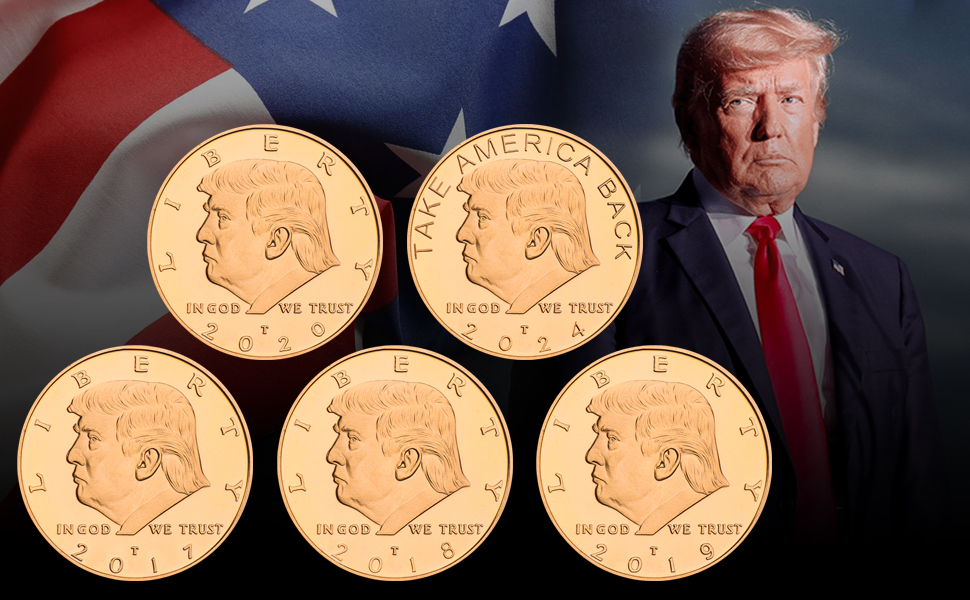
By the time the U.S. Mint strikes the first 24-karat gold Trump commemorative coin later this year, the great American tradition of keeping living politicians off the nation’s money will have been quietly, but spectacularly, circumvented.
Approved unanimously on March 19, 2026, by the Trump-appointed Commission of Fine Arts, the coin is ostensibly a celebration of the nation’s 250th anniversary. Yet, it serves a secondary, more visceral purpose for its chief architect: projecting executive dominance. The design is unapologetically aggressive. The obverse features President Donald Trump leaning intensely over the Resolute Desk, fists clenched, with the word “LIBERTY” arcing above his head and the dual dates “1776–2026” flanking him. The reverse bears a bald eagle, talons braced, ready to take flight.
Predictably, the political theater has been deafening. Critics have decried the coin as monarchic symbolism, pointing out that since the days of George Washington, the republic has fiercely guarded its currency against the vanity of living rulers. Defenders hail it as a masterstroke of patriotic fundraising and commemorative artistry.
But beneath the partisan noise lies a profound economic irony. In the grand sweep of monetary history, a leader plastering his face on ceremonial gold does not signal absolute control over a nation’s wealth. Quite the opposite. As we look back to the shifting empires of late antiquity, such numismatic pageantry usually reveals the exact opposite: a leader attempting to mask the uncomfortable reality of his limited sovereignty.
To understand the true weight of the 2026 Trump gold coin, one must look not to the halls of the Federal Reserve, but to the 6th-century courts of the Ostrogothic kings of Italy.
The Loophole of Vanity: 31 U.S.C. § 5112
To grasp the limits of the President’s monetary power, one must first look at the legal acrobatics required to mint the coin in the first place.
Federal law strictly forbids the portrait of a living person on circulating U.S. currency—a tradition born from the Founding Fathers’ revulsion for the coinage of King George III. To bypass this, the administration utilized the authorities granted under 31 U.S.C. § 5112, specifically the Treasury’s broad discretion to issue gold bullion and commemorative coins that do not enter general circulation.
While the coin bears a nominal face value of $1, it is a piece of bullion, not a medium of exchange. You cannot buy a coffee with it; it will not alter the M2 money supply; it will not shift the consumer price index.
Herein lies the central paradox of the Trump Semiquincentennial coin:
- The Facade of Power: It utilizes the highest-purity gold and the official imprimatur of the United States Mint to project executive authority.
- The Reality of Policy: The actual levers of the American economy—interest rates, quantitative easing, and the health of the fiat dollar—remain stubbornly out of the Oval Office’s direct control, residing instead with the independent Federal Reserve.
This dynamic—where a ruler uses localized, symbolic coinage to project a sovereignty he does not fully possess over the broader economic system—is not a modern invention. It is a historical hallmark of limited power.
Echoes from Ravenna: The Ostrogothic Parallel
When the Western Roman Empire collapsed in the late 5th century, Italy fell under the dominion of the Ostrogoths. The most famous of their rulers, Theodoric the Great, commanded the peninsula with formidable military might from his capital in Ravenna. He was, for all practical purposes, the king of Italy.
Yet, when you examine Ostrogothic coinage from this era, a fascinating picture of deference and limitation emerges.
Despite his military supremacy, Theodoric understood that the true center of global economic gravity lay to the east, in Constantinople. The Byzantine Emperor controlled the solidus—the gold standard of the Mediterranean world. If Theodoric wanted his kingdom to participate in international trade, he had to play by Byzantine monetary rules.
Consequently, the Ostrogoths minted gold and silver coins that were essentially counterfeits of Byzantine money. They bore the portrait of the reigning Eastern Emperor (such as Anastasius or Justinian), not the Ostrogothic king. Theodoric restricted his own branding to a modest monogram, and later kings, like Theodahad, only dared to place their full portraits on the bronze follis—the low-value base metal used for buying bread in local markets, entirely decoupled from international high finance.
The lesson from the Ostrogoths is clear, and widely recognized in peer-reviewed numismatic scholarship: controlling the territory is not the same as controlling the currency. The Ostrogoths used their local mints to project an image of continuity and authority to their immediate subjects, but they bowed to the monetary hegemony of the true empire.
The Byzantine Emperor of Modern Finance
Today, the “Constantinople” of the global economy is not a rival nation, but the institutional apparatus of the fiat dollar system—chiefly, the Federal Reserve and the global bond market.
President Trump has frequently chafed against this reality. Throughout his political career, he has sought to blur the lines of Fed independence, occasionally demanding lower interest rates or criticizing the Fed Chair with a ferocity normally reserved for political rivals. Yet, the institutional firewalls have largely held. The President cannot unilaterally dictate the cost of capital. He cannot force the world to buy U.S. Treasuries.
Thus, the 24-karat commemorative coin acts as his modern bronze follis.
It is a stunning piece of metal, but it is ultimately a domestic token. It satisfies a base of political supporters and projects an aura of monarchic permanence, just as Theodahad’s portrait did in the markets of Rome. But it does not challenge the underlying hegemony of the independent central banking system. The global markets, the sovereign wealth funds, and the algorithmic trading desks—the modern equivalents of the Byzantine merchants—will ignore the gold coin entirely. They will continue to trade in the invisible, digital fiat dollars over which the President exercises only indirect influence.
The Illusion of Monetary Sovereignty
What, then, does the “Trump coin” tell us about the current state of American executive power?
First, it highlights a growing preference for the aesthetics of power over the mechanics of governance. Minting a gold coin with one’s face on it is a frictionless exercise in executive privilege. Reining in a multi-trillion-dollar deficit, negotiating complex trade pacts, or carefully managing a soft economic landing are laborious, constrained, and often unrewarding tasks.
Second, it reveals the resilience of America’s financial architecture. That the President must resort to a commemorative loophole—utilizing a non-circulating bullion designation to bypass the strictures of circulating fiat—is a testament to the fact that the core of America’s money remains insulated from populist whim.
Consider the implications for dollar hegemony:
- Global Confidence: International investors rely on the U.S. dollar precisely because it is not subject to the immediate, emotional control of the executive branch.
- Institutional Friction: The outcry over the coin, while loud, proves that democratic norms regarding the separation of leader and state apparatus are still fiercely defended in the public square.
- The Paradox of Gold: By choosing gold—the traditional refuge of those who distrust government fiat—the administration inadvertently highlights its own lack of faith in the very paper currency it is sworn to manage.
Conclusion: The Weight of Empty Gold
The Roman historian Cassius Dio once observed that you can judge the health of a republic by the faces on its coins. When the republic falls, the faces of magistrates are replaced by the faces of autocrats.
But history is rarely that simple. The Ostrogothic kings of the 6th century put their faces on bronze because they lacked the power to control the gold. In March 2026, an American president has put his face on gold because he lacks the power to control the fiat.
The Semiquincentennial Trump coin is destined to be a remarkable collector’s item, a flashpoint in the culture wars, and a brilliant piece of political marketing. But when historians look back on the numismatics of the 2020s, they will not see a president who conquered the American monetary system. They will see a leader who, much like the kings of late antiquity, had to settle for a brilliant, golden simulacrum of power, while the true economic empire hummed along, indifferent and out of reach.
FAQ: Understanding the 2026 Commemorative Coin and U.S. Monetary Policy
Is it legal for a living U.S. President to be on a coin? Yes, but only under specific circumstances. By law (31 U.S.C. § 5112), living persons cannot be depicted on circulating currency (like standard pennies, quarters, or paper bills). However, the U.S. Mint has the authority to produce non-circulating bullion and commemorative coins. The 2026 Trump coin exploits this loophole as a non-circulating commemorative piece.
Does the U.S. President control the value of the dollar? No. While presidential policies (like tariffs, taxation, and government spending) affect the broader economy, the direct control of the U.S. money supply and interest rates rests with the Federal Reserve, an independent central bank. The President appoints the Fed Chair, but cannot legally dictate the bank’s day-to-day monetary policy.
What is the historical significance of the Ostrogothic coinage parallel? In the 6th century, Ostrogothic kings in Italy minted gold coins bearing the face of the Byzantine Emperor, while reserving their own portraits for lower-value bronze coins. This demonstrated that while they held local, symbolic power, true economic sovereignty belonged to the Byzantine Empire. The 2026 Trump coin operates similarly: it offers localized symbolic prestige, but the actual “engine” of the U.S. economy remains under the control of the independent Federal Reserve.
Can I spend the 24-karat Trump coin at a store? Technically, the coin has a legal face value of $1. However, because it is minted from 24-karat gold, its intrinsic metal value and numismatic collector value far exceed its $1 face value. It is meant to be collected and held as an asset or piece of memorabilia, not used in daily commercial transactions.

Singapore Firms Press Ahead in US Market Despite Trump Tariffs

The IMF’s High-Voltage Mandate: How Pakistan’s FY27 Power Subsidy Cut Will Rewire Its Economy

How US Debt, Gold Chaos, and a Stalled Middle East Are Rewriting the Rules of Investing

Top 15 Stocks for Investment in 2026 in PSX: Your Complete Guide to Pakistan’s Best Investment Opportunities
Top 15 Stocks for Investment in 2026 in PSX: Your Complete Guide to Pakistan’s Best Investment Opportunities

Debunking IMF Program Myths: Reconfiguring Engagement for True National Ownership in a Volatile World
-
 Markets & Finance4 months ago
Top 15 Stocks for Investment in 2026 in PSX: Your Complete Guide to Pakistan’s Best Investment Opportunities
-
Markets & Finance4 months ago
Top 15 Stocks for Investment in 2026 in PSX: Your Complete Guide to Pakistan’s Best Investment Opportunities
-
 Analysis3 months ago
Debunking IMF Program Myths: Reconfiguring Engagement for True National Ownership in a Volatile World
-

 Global Economy5 months ago
What the U.S. Attack on Venezuela Could Mean for Oil and Canadian Crude Exports: The Economic Impact
-

 Investment4 months ago
Top 10 Mutual Fund Managers in Pakistan for Investment in 2026: A Comprehensive Guide for Optimal Returns
-

 Asia5 months ago
China’s 50% Domestic Equipment Rule: The Semiconductor Mandate Reshaping Global Tech
-

 AI5 months ago
15 Most Lucrative Sectors for Investment in Pakistan: A 2025 Data-Driven Analysis
-

 Exports5 months ago
Pakistan’s Export Goldmine: 10 Game-Changing Markets Where Pakistani Businesses Are Winning Big in 2025