
Governance
Singapore’s Carbon Tax Surge: Leading Asia in a Fractured Global Pricing Landscape

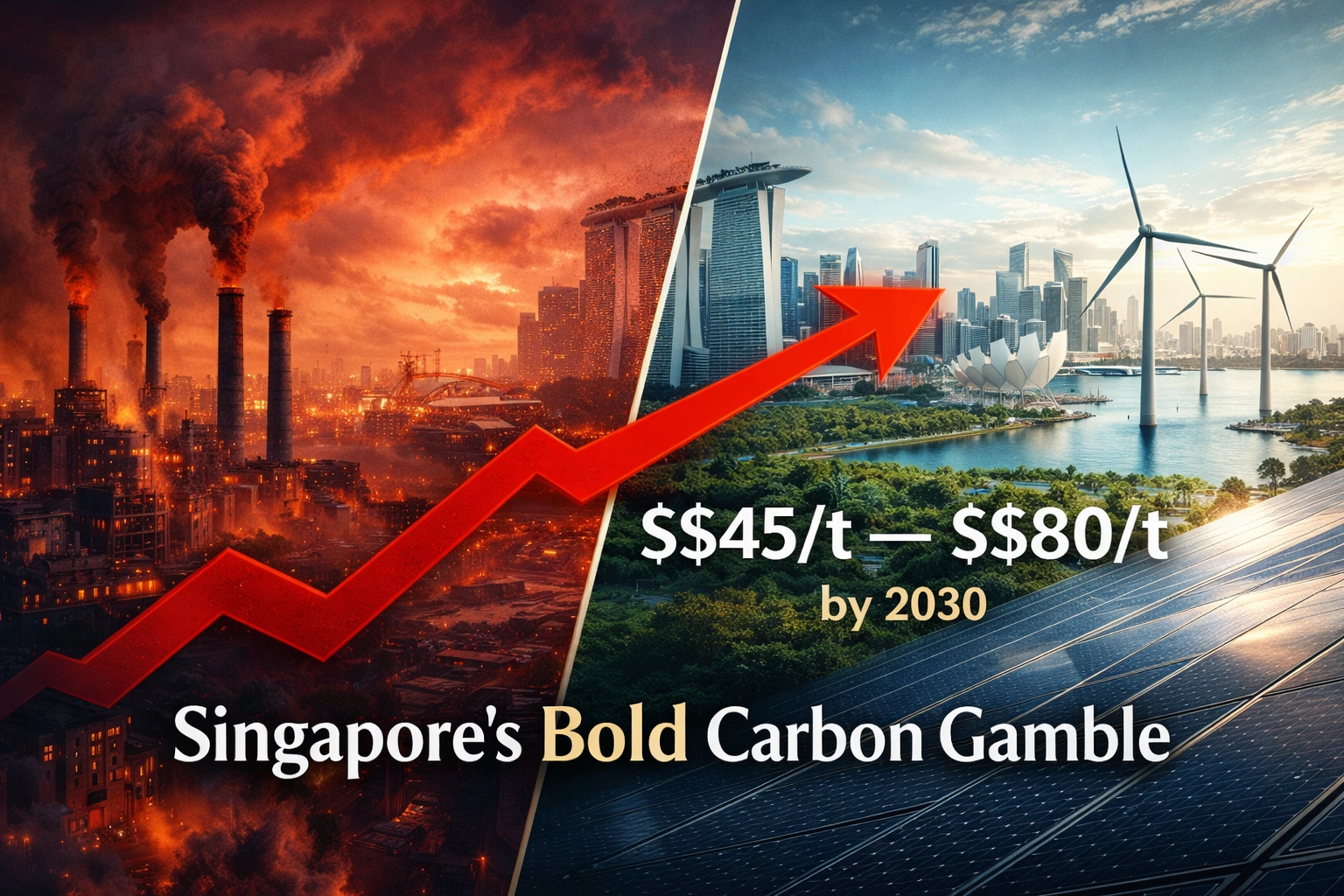
Singapore’s carbon tax jumps to S$45 in 2026, positioning it among Asia’s highest. Analysis of global pricing gaps, climate vulnerability, and what this means for regional leadership.
The elevator ride in Marina Bay’s glittering financial district just became more expensive—not because of rising real estate, but because Singapore is making an unequivocal bet on carbon pricing. As of January 2026, the city-state has nearly doubled its carbon levy to S$45 per tonne of CO₂ equivalent, a rate that would make even European policymakers take notice. For context, this translates to roughly US$33 per tonne—a figure that places this Southeast Asian financial hub alongside some of the world’s most aggressive climate jurisdictions, yet in a region where carbon pricing remains the exception rather than the rule.
This isn’t incrementalism. It’s a calculated escalation in a world where carbon prices span a chasm from under US$1 to over €80 per tonne, and where the policy architecture for pricing emissions looks less like coordinated global action and more like a fragmented patchwork of competing national strategies.
The Trajectory: From Symbolic to Substantive
Singapore’s carbon pricing journey began modestly in 2019 with a S$5 per tonne levy—Southeast Asia’s first carbon tax, but hardly more than a signal of intent. The tax remained static through 2023, providing what officials called a “transitional period” for the economy to adjust. Then came 2024, when the rate quintupled to S$25, and now in 2026, it stands at S$45 for both this year and 2027.
The government has been explicit about future intentions: S$50–80 per tonne by 2030, with the endpoint deliberately left as a range to maintain policy flexibility. These aren’t abstract figures. According to government estimates, the average four-room Housing & Development Board flat will see utility bills rise by approximately S$3 monthly in 2026, assuming stable market conditions—though authorities have cushioned the blow with enhanced U-Save rebates providing up to S$380 annually for eligible households.
Behind the numbers lies an uncomfortable reality: Singapore is acutely exposed to climate impacts. As a low-lying island nation where 70% of the land sits less than five meters above mean sea level, rising oceans aren’t a distant threat—they’re an existential one. Climate vulnerability has translated into climate policy urgency in ways that landlocked nations with higher elevations simply don’t experience.
The Global Pricing Divide: An Uneven Playing Field
To understand Singapore’s position, one must first grasp the extraordinary fragmentation of global carbon pricing. According to the World Bank’s State and Trends of Carbon Pricing 2025, there are now 80 carbon pricing instruments operating worldwide, covering approximately 28% of global emissions. Yet the average price across these instruments sits at just US$19 per tonne—barely a third of what Singapore now charges.
The variance is staggering. At the upper end, the EU Emissions Trading System (EU ETS) has seen prices fluctuate between €60–80 per tonne through 2025, with analysts projecting an average of €92 per tonne in 2026. The UK ETS, though operationally independent since Brexit, has tracked below EU levels, ranging between £40–60, with forecasts suggesting £57–76 per tonne in 2026.
Canada presents a more complex picture. While the federal consumer carbon tax was eliminated in early 2025 under Prime Minister Mark Carney’s administration, the industrial Output-Based Pricing System remains in place, with rates reaching CA$80 per tonne in 2024 and scheduled to climb toward CA$170 by 2030—though provincial fragmentation and a critical 2026 benchmark review introduce significant uncertainty.
| Jurisdiction | 2026 Carbon Price (USD equivalent) | Mechanism Type | Coverage |
|---|---|---|---|
| EU ETS | ~€80–92 (~$88–101) | Cap-and-trade | ~75% of emissions (ETS1 + ETS2) |
| UK ETS | ~£57–76 (~$73–97) | Cap-and-trade | ~37% of emissions |
| Singapore | S$45 (~$33) | Carbon tax | ~70% of emissions |
| Canada (Industrial) | CA$80 (~$59) | Hybrid OBPS | Large emitters only |
| South Korea K-ETS | ~$5–8 | Cap-and-trade | ~73% of emissions |
| China ETS | ~¥100 (~$13) | Cap-and-trade | ~60% of emissions |
| Australia Safeguard | Variable (ACCUs ~$40–80) | Baseline-and-credit | Large industrial facilities |
Sources: World Bank, ICAP, national government sources
Asia’s Pricing Gap: Singapore as an Outlier
Within Asia, Singapore’s S$45 rate stands in stark relief. China’s national ETS, the world’s largest by emissions coverage, saw prices averaging around ¥100 (approximately US$13) through 2024, with projections suggesting a gradual rise to ¥200 (US$25) by 2030. The system expanded beyond power generation in 2024 to include steel, cement, and aluminum, but its intensity-based cap and generous free allowances have kept prices suppressed—by design, critics argue, to protect industrial competitiveness.
South Korea’s K-ETS, operational since 2015 and covering nearly three-quarters of national emissions, has similarly struggled with oversupply issues that have kept prices in the single digits. A recent analysis from IEEFA noted that Asian ETS systems—with the notable exceptions of South Korea and Kazakhstan—lack the strict, gradually increasing reduction rates that have driven price discipline in Europe.
Australia’s reformed Safeguard Mechanism, which became operational in mid-2023, occupies a middle ground. Rather than setting explicit carbon prices, it mandates that facilities exceeding 100,000 tonnes of annual emissions must keep within declining baselines or purchase Australian Carbon Credit Units (ACCUs). Market analysis suggests ACCUs could reach $80 per tonne before 2035, positioning Australia closer to Western price levels—though the system’s production-adjusted framework and reliance on offsets introduce complexity.
Singapore’s decision to employ a straightforward carbon tax rather than a cap-and-trade system reflects both administrative efficiency and a recognition that, as a city-state without extensive heavy industry, the transaction costs of a trading system would outweigh its benefits. The approximately 50 facilities currently covered—spanning manufacturing, power generation, waste, and water treatment—account for 70% of national emissions, a concentration that makes monitoring and enforcement relatively straightforward.
Economic Calculus: Competitiveness Versus Climate Ambition
The tension between carbon pricing and industrial competitiveness has dominated policy debates globally. Singapore’s response has been pragmatic: a transition framework for emissions-intensive, trade-exposed (EITE) sectors that provides temporary relief through allowances, phasing down through 2030. Sectors like refining, petrochemicals, and semiconductors received transitional support that effectively reduced their 2024–2025 tax burden by up to 76% of the nominal rate.
These allowances will taper sharply as the S$45 rate takes hold. For multinationals with operations in Singapore, the math is becoming unavoidable: a facility emitting 500,000 tonnes annually now faces a tax bill of S$22.5 million ($16.5 million), up from S$12.5 million in 2024–2025. By 2030, at the midpoint of the S$50–80 range, that same facility could be looking at S$32.5 million ($24 million) annually—assuming no emissions reductions.
Yet Singapore’s bet is that higher carbon costs will accelerate rather than deter investment—specifically, investment in low-carbon solutions. The city-state has positioned itself as a regional hub for carbon services, launching the Climate Impact X marketplace and actively developing carbon market infrastructure aligned with Article 6 of the Paris Agreement. From 2024, facilities can use high-quality international carbon credits (ICCs) to offset up to 5% of taxable emissions, provided credits meet stringent eligibility criteria including host country authorization and corresponding adjustments to prevent double-counting.
This 5% limit is deliberate policy. As officials noted in public consultations, the goal is to prioritize domestic emissions reduction while providing flexibility for hard-to-abate sectors. It mirrors similar limits in South Korea and California, reflecting a global consensus that carbon credits should complement, not replace, direct abatement.
The 2026 Inflection: Why Now?
The timing of Singapore’s escalation is no accident. The European Union’s Carbon Border Adjustment Mechanism (CBAM) entered its transitional phase in 2023 and will begin imposing charges in 2026 on imports of carbon-intensive goods—initially cement, steel, aluminum, fertilizers, electricity, and hydrogen. For Asian exporters, CBAM creates a powerful incentive to demonstrate domestic carbon pricing, as jurisdictions with credible carbon costs may receive credit against CBAM charges.
Analysis from IEEFA suggests China’s recent ETS expansion was partly motivated by CBAM considerations—a tacit acknowledgment that carbon pricing is becoming a trade competitiveness issue, not merely an environmental one. Singapore, with its open economy and export orientation, cannot afford to be perceived as a carbon haven. Higher carbon taxes signal climate seriousness to trading partners while potentially generating leverage in future trade negotiations.
There’s also a fiscal dimension. The Singapore government has been transparent that carbon tax revenues fund decarbonization initiatives and support measures for businesses and households. With revenues exceeding S$1 billion annually at current rates, and set to grow substantially, the carbon tax has become a meaningful budget line—though officials insist the policy is revenue-neutral when accounting for support programs.
Forward Projections: The 2030 Question and Beyond
Forecasting carbon prices is notoriously difficult—markets respond to policy signals, technological breakthroughs, and economic shocks in ways that defy linear projection. Yet several modeling exercises suggest where Singapore’s trajectory might lead.
If the government opts for the lower end of its 2030 range (S$50), Singapore would still rank among Asia’s most expensive jurisdictions but would fall short of European and North American levels. At the upper end (S$80), the city-state would be pricing carbon at rates comparable to projected 2030 levels in Canada and approaching EU territory. Independent analysis suggests that factoring in economic growth and energy transition dynamics, effective carbon prices could reach US$57 by 2030 and potentially US$145 by 2050—though these figures assume continued policy tightening that remains politically uncertain.
The critical question is whether Singapore’s approach will catalyze regional convergence or remain an outlier. There are tentative signs of movement. Malaysia has indicated plans to introduce carbon pricing by 2026. Vietnam is piloting ETS concepts. Indonesia, whose emissions dwarf Singapore’s, has explored carbon tax mechanisms, though implementation remains uncertain. Yet these developments could equally fizzle—carbon pricing has a history of political reversal, as Canada’s recent consumer tax elimination demonstrates.
Criticisms and Constraints: The Limits of Unilateral Action
Not everyone applauds Singapore’s carbon ambition. Industry groups have argued that steep increases impose competitiveness burdens without commensurate climate benefit, noting that Singapore accounts for barely 0.1% of global emissions. The “polluter pays” principle, critics contend, becomes economically punitive when applied asymmetrically—local firms bear costs that international competitors avoid.
Environmental advocates, conversely, argue that even S$80 falls short of the social cost of carbon. The High-Level Commission on Carbon Prices in 2017 estimated that prices between US$40–80 per tonne were needed by 2020, rising to US$50–100 by 2030, to meet Paris Agreement targets. By this metric, Singapore’s 2026 rate reaches the lower threshold, but the 2030 ambiguity leaves open whether sufficient ambition will materialize.
There’s also concern about regressive impacts. Carbon taxes, by raising energy costs, disproportionately affect lower-income households. Singapore’s U-Save rebates attempt to address this, but the adequacy of support remains contested, particularly as utility bills compound with broader cost-of-living pressures.
Perhaps most fundamentally, unilateral carbon pricing faces inherent limits. Without coordinated global action, emissions simply migrate to jurisdictions with lower costs—the carbon leakage problem that bedevils every climate policy architect. Singapore’s EITE transition framework acknowledges this reality, but the framework itself is time-limited. What happens post-2030, when support phases out but regional price convergence remains elusive?
Implications: Singapore as Climate Policy Laboratory
For all its limitations, Singapore’s carbon tax surge offers a testing ground for several propositions central to global climate governance. Can explicit carbon pricing drive emissions reductions in small, trade-exposed economies without triggering capital flight? Will linking carbon taxation to international credit markets under Article 6 create viable flexibility mechanisms, or simply open avenues for greenwashing? And can early movers establish first-mover advantages in emerging green sectors that offset near-term competitiveness costs?
The answers won’t be evident for years, but the experiment matters beyond Singapore’s borders. As a financial hub with extensive regional networks, Singapore’s policy choices influence corporate decision-making across Southeast Asia. If carbon-intensive industries successfully adapt while maintaining competitiveness, it weakens the argument that climate ambition and economic growth are irreconcilable. If, conversely, the policy provokes relocations or undermines growth, it will embolden skeptics elsewhere.
What’s increasingly clear is that the global carbon pricing landscape entering 2026 remains deeply fractured. Europe leads on price and coverage. Asia lags, with pockets of ambition but systemic oversupply and low prices. North America vacillates between provincial experimentation and federal retreat. And emerging economies, despite producing the majority of emissions growth, largely abstain from pricing mechanisms altogether.
Into this fragmented terrain, Singapore has placed a substantial wager—that pricing carbon aggressively, even unilaterally, positions the city-state favorably for the inevitable transition to a decarbonized global economy. It’s a bet that acknowledges vulnerability: when you’re five meters above sea level and rising waters are undeniable, climate policy isn’t ideological—it’s existential. Whether that urgency translates into effective policy remains the question that S$45 per tonne is designed to answer.


The phone calls from American buyers haven’t stopped. Neither have the shipments. For many Singapore-based companies with exposure to the United States, the Trump administration’s 10% baseline tariff — widely feared when it landed in April 2025 — has turned out to be, as more than one founder has privately put it, something they can live with. The margin hit is real. The commitment to the US market is, for now, intact.
This isn’t naivety. Singapore’s business class is too wired into global trade to mistake inconvenience for catastrophe. What the past twelve months have revealed, instead, is a calibrated judgement: that America’s consumer base, its legal predictability, and its sheer scale still make it the world’s most attractive destination, tariff or no tariff.
Why Singapore’s Export Sector Held Up Better Than Expected
When the White House announced its sweeping reciprocal tariffs on April 2, 2025 — quickly dubbed “Liberation Day” — Singapore found itself in an unusual position. The city-state was handed the lowest rate in Southeast Asia: a 10% baseline, compared with 19% to 40% for neighbours like Vietnam, Indonesia, and Cambodia. This was in spite of Singapore holding a free trade agreement with Washington that had been in force since January 2004 — and despite the US actually running a goods trade surplus with Singapore.
That anomaly still rankles in Singapore’s government corridors. According to the US Trade Representative, the US goods trade surplus with Singapore reached $3.6 billion in 2025, up from $1.9 billion in 2024 — a near-doubling that makes the tariff’s rationale increasingly hard to justify on balance-of-payments grounds. In March 2026, Singapore’s trade ministry went public with its dispute of American trade data, arguing the official US figures misrepresent the bilateral picture.
Yet even with the duty in place, Singapore’s companies did something that surprised economists who had modelled for a significant contraction: they adapted and, in many cases, pushed on. The Ministry of Trade and Industry upgraded Singapore’s 2025 GDP forecast to around 4% in November — well above the 1.5% to 2.5% initially pencilled in — citing stronger semiconductor exports driven by the AI boom and unexpected resilience among trading partners. Full-year growth came in at 4.8%.
The US remains Singapore’s second-largest export destination, absorbing roughly 11% of the Republic’s domestic exports in 2024. Companies have not abandoned that relationship. Many have leaned into it harder, viewing tariff disruption elsewhere in Asia as a relative advantage.
A Manageable Levy, But Not a Costless One
How are Singapore companies dealing with US tariffs? The short answer is: largely by absorbing part of the cost, passing some on, and restructuring faster than anyone expected.
A March 2025 survey by the American Chamber of Commerce in Singapore found that most respondents planned to pass tariff-related costs through to US customers, while simultaneously accelerating supply chain diversification. This dual-track response reflects a broader strategic logic: protect the American relationship in the near term while reducing single-market dependency over a longer horizon.
What that looks like on the ground varies by sector. Manufacturers in precision engineering — a bright spot identified by MTI in its August 2025 briefing — have continued ramping up capital investment in AI-related semiconductor production, insulated partly by the global demand surge from data centre buildouts. These firms aren’t debating whether to serve the US market. They’re debating how to remain irreplaceable within it.
The picture is more complicated for smaller companies working with thinner margins. Nomura analysts reported in September 2025 that Singapore exporters were absorbing more than 20% of US tariff costs directly — a real and sustained squeeze. Still, for a 10% levy applied to goods that clear US customs at high average selling prices, the maths often still work. A Singapore med-tech firm shipping precision instruments at $15,000 per unit absorbs a very different blow than, say, a Vietnamese garment exporter facing a 32% rate on $8 t-shirts.
The relevant comparison isn’t between tariff and no-tariff Singapore. It’s between Singapore at 10% and its regional competitors at 19% to 40%. On that basis, the commercial case for the US market hasn’t collapsed. It’s narrowed — which is why the companies still in the game are typically those with the product quality to justify the premium or the brand equity to pass costs through.
The Sectoral Flashpoints: Pharma and Chips
Singapore’s composure at the aggregate level masks genuine alarm in two sectors that define its high-value export identity: pharmaceuticals and semiconductors.
Singapore ships approximately S$4 billion (US$3.1 billion) worth of pharmaceutical products to the United States each year. These are mostly branded drugs — sophisticated, high-value formulations — which faced a threatened 100% tariff unless manufacturers established a physical US manufacturing presence. That threat, announced as part of Trump’s sectoral tariff push, is currently on hold pending negotiations and exemption applications. But it has not disappeared. Deputy Prime Minister and Trade Minister Gan Kim Yong acknowledged in September 2025 that negotiations with Washington over both pharma and semiconductors were ongoing, with an “arrangement to allow us to remain competitive in the US market” still the goal rather than the outcome.
Minister Gan Siow Huang confirmed in October 2025 that a significant number of Singapore-based pharmaceutical firms are pausing US expansion decisions pending tariff clarity — a rational hold on capital allocation, not a signal of retreat. The broader concern, articulated by Gan Kim Yong, is longer-range: that escalating tariffs globally could divert investment away from Singapore toward the United States, draining capital that might otherwise have flowed into the region.
In semiconductors, Singapore’s position is partially protected by the AI-driven global demand spike. The precision engineering cluster saw continued investment ramp-ups through 2025, with MTI noting the “sustained shift towards higher value-added” activity as a structural buffer. Yet Section 232 sectoral tariffs on chips — not yet imposed but actively discussed in Washington — remain a latent risk that keeps Singapore’s trade negotiators in near-permanent engagement with US counterparts.
The Case Against Optimism: What the Bears Are Right About
It would be a misreading of Singapore’s resilience to treat it as vindication of the tariff-and-carry-on school of thought. The firms that are pressing ahead in the US market are, almost uniformly, those with structural advantages that most companies don’t have: high average selling prices, proprietary technology, brand recognition, or an irreplaceable position within a US supply chain.
For smaller Singapore companies — the SMEs that account for roughly two-thirds of the city-state’s workforce — the calculus looks different. EnterpriseSG acknowledged in early 2026 that tariffs would “continue to be a looming concern for a long time,” with sectoral duties on semiconductors and pharmaceuticals a persistent threat and the risk of trade diversion from tariff-hit neighbours an additional drag.
What tariff rate does Singapore face from the United States?
Singapore faces a 10% baseline US tariff — the lowest in Southeast Asia — under the Trump administration’s reciprocal tariff framework, despite a free trade agreement in force since 2004 and a US goods trade surplus of $3.6 billion in 2025. A further increase to 15% under Section 122 was announced in February 2026.
Government support has materialised, but its scope has limits. The Business Adaptation Grant, launched in October 2025, offers up to S$100,000 per company with co-funding required — meaningful for a one-person fintech studio rethinking its US go-to-market, but insufficient to offset the structural cost pressures facing an electronics manufacturer running US$50 million in American revenue. SMEs receive a higher support quantum; the grant’s architects acknowledge it can’t reach every firm.
There is also a timing question. Singapore’s 2025 outperformance was partly a function of front-loading: companies rushed exports in the first half of the year ahead of anticipated tariff escalation, driving a 13% NODX rebound in June that flattered the headline numbers. Strip out front-loading, and the structural growth trajectory is more modest. MTI has already warned that 2026 growth — forecast in the 1% to 3% range — will feel meaningfully different from 2025’s AI-and-front-loading-driven surge.
What follows, however, is not necessarily contraction. It is normalisation under a genuinely higher-tariff world — a world Singapore’s companies are, by now, better equipped to navigate than they were fourteen months ago.
The Structural Bet: Singapore’s Long-Term US Positioning
Singapore’s most consequential strategic response to Trump’s tariff regime has not been lobbying Washington or diversifying away from the US. It’s been doubling down on what makes Singaporean goods hard to replace: quality, reliability, and an institutional environment that American buyers trust.
Prime Minister Lawrence Wong has been careful not to overstate the resolution of US-Singapore trade talks, noting as recently as late 2025 that negotiations were at “a very early stage” on pharmaceuticals. But the underlying posture of Singapore’s business community — captured in a UOB Business Outlook Study from May 2025 — is instructive: eight in ten Singapore companies planned overseas expansion within three years, with North America among the markets specifically flagged by consumer goods and industrial firms despite the tariff environment.
That appetite reflects something the macro data alone can’t show. Many Singapore companies with US exposure have been building American relationships for decades. They know their buyers personally. They’ve invested in US certifications, US-compatible regulatory frameworks, US distribution networks. Walking away from that at a 10% tariff rate would mean writing off infrastructure that cost more than 10% to build.
The more profound question is whether the next generation of Singapore companies — those deciding now where to build their first international footprint — will make the same American bet their predecessors did. The EnterpriseSG data on market diversification is notable: in 2025, the agency helped Singapore companies enter 76 new markets — the broadest footprint in five years. Angola. Fiji. Markets that would have been afterthoughts in 2019.
The US isn’t losing its primacy in Singapore’s commercial imagination. But it is, for the first time in a generation, being weighed against alternatives in a way that feels genuinely open. That shift is subtle. It may also be durable.
There is a version of this story where 10% is, in fact, nothing — where Singapore’s companies absorb a manageable cost, keep their American relationships intact, and emerge from the tariff era with their US market share preserved or even expanded as higher-levied competitors retreat. That version is not impossible. Several major firms are living it.
But the more honest reading of the past twelve months is that Singapore’s business community has proved something more modest and more instructive: not that tariffs don’t matter, but that they don’t automatically determine outcomes. What matters, still, is whether you have something the American market genuinely wants. For companies that do, the levy is a tax on success. For those that don’t, it’s an exit ramp. The US market is sorting Singapore’s exporters, quietly and efficiently, in exactly the way markets always have.

Introduction: Why Budget Preparation Matters
In February 2026, fiscal debates are raging across capitals worldwide. Pakistan’s FY26 budget set a GDP growth target of 4.2% with a Rs17.57 trillion outlay while simultaneously slashing overall spending to rein in deficits. Meanwhile, the United States Congressional Budget Office warned of a projected $1.9 trillion deficit by year’s end. These headlines underscore a timeless truth: a national budget is not merely an accounting exercise — it is the most powerful economic tool a government wields, shaping growth, equity, and long-term stability in a single document.
Yet the mechanics of budget preparation remain poorly understood outside specialist circles. What distinguishes fiscal policymakers who succeed from those who don’t? What skills does the job demand, and which techniques have proven most effective across different economies? This article breaks down the budget preparation process, drawing on global best practices and contemporary examples to offer both a conceptual map and practical insights.
The Core Skills of Budget Preparation
Analytical Rigor
At its foundation, budget preparation is an exercise in applied economics. Officials must be able to interpret macroeconomic indicators — GDP growth rates, inflation trends, unemployment figures, and trade balances — and translate them into fiscal projections. They must evaluate the sustainability of public debt and assess whether proposed spending commitments are compatible with long-run solvency.
Pakistan’s FY26 budget offers a vivid illustration. Officials were forced to weigh the competing claims of defense, infrastructure, and social spending against the backdrop of IMF program conditionalities and a fragile external balance. That kind of trade-off analysis requires not just facility with numbers but genuine economic judgment — the ability to see what a figure means, not just what it says.
Forecasting and Scenario Planning
Revenue and expenditure projections are inherently uncertain, and skilled budget preparers know how to work with that uncertainty rather than paper over it. Econometric models can extrapolate historical trends, but they must be stress-tested against alternative scenarios: What happens to revenue if oil prices drop by 20%? How does debt service change if global interest rates rise? What if growth disappoints by a full percentage point?
The IMF’s guidance on Medium-Term Expenditure Frameworks (MTEFs) exists precisely because good forecasting requires extending the planning horizon beyond a single fiscal year. Short-term budgets are vulnerable to optimism bias and political gaming; multi-year frameworks force honest reckoning with future constraints.
Negotiation and Political Management
Budget preparation is never a purely technical process. It unfolds within a political environment where ministries compete for allocations, provinces push back against central ceilings, and opposition parties exploit public dissatisfaction for electoral advantage. The protests that accompanied Pakistan’s FY26 budget debate are a reminder that even technically sound fiscal plans can unravel if the political foundations are not carefully managed.
Skilled budget officials understand that negotiation is not a distraction from their work — it is part of the work. Building coalitions within government, managing expectations from external stakeholders, and communicating difficult trade-offs to a skeptical public are all essential competencies.
Communication and Transparency
A budget that cannot be explained cannot be trusted. The World Bank has consistently emphasized citizen engagement in budget processes as a driver of accountability; governments that present their fiscal plans in accessible, honest language are better positioned to maintain public confidence when hard decisions must be made.
This means more than publishing a summary document. It means presenting realistic assumptions, acknowledging uncertainty, and being candid about what programs will be cut or constrained. In an era of social media scrutiny and watchdog organizations, opacity is a liability governments can ill afford.
Key Techniques in National Budgeting
Top-Down and Bottom-Up Approaches
Budget systems generally operate on one of two logics, or a combination of both. In a top-down approach, the central authority — typically the finance ministry — sets aggregate spending ceilings based on macroeconomic targets, and line ministries are required to fit their proposals within those limits. In a bottom-up approach, ministries estimate their funding needs independently and submit them for consolidation at the national level.
Each model has its weaknesses. Pure top-down systems can become disconnected from operational realities on the ground; pure bottom-up systems tend to generate spending bids that exceed available resources and require painful across-the-board cuts to balance. Most effective budget systems are hybrids: top-down in setting the overall fiscal envelope, bottom-up in determining how resources are allocated within it.
Macroeconomic Anchoring
No budget can be prepared in a vacuum. The fiscal plan must be anchored in a credible macroeconomic framework that projects revenues, external conditions, and growth prospects. Pakistan’s National Economic Council, for example, approved a Rs4.2 trillion development plan explicitly tied to the country’s macroeconomic targets for FY26 — a deliberate attempt to ensure that the capital budget was consistent with overall economic strategy rather than a separate wish list.
When macroeconomic anchoring is weak or absent, budgets become aspirational documents rather than actionable plans. Revenue projections prove wildly optimistic, expenditure commitments cannot be honored, and credibility with markets and multilateral institutions erodes.
Performance-Based Budgeting
One of the most significant reforms in public financial management over the past three decades has been the shift from input-based to performance-based budgeting. Rather than allocating funds on the basis of historical spending patterns or institutional inertia, performance-based systems tie allocations to measurable outcomes: health coverage rates, infrastructure completion milestones, student achievement scores.
OECD countries have been at the forefront of this transition, with mixed but broadly positive results. The discipline of defining outputs and outcomes forces agencies to think carefully about what they are actually trying to achieve — and gives finance ministries a basis for holding them accountable when results fall short.
Medium-Term Expenditure Frameworks
Perhaps the most widely endorsed reform in international fiscal governance is the adoption of MTEFs — multi-year plans that extend budget commitments and projections across a three-to-five year horizon. By requiring governments to map the medium-term implications of current-year decisions, MTEFs help guard against the kind of short-termism that produces pre-election spending surges, structural deficits, and policy reversals.
Both the IMF and World Bank treat MTEFs as a cornerstone of sound fiscal management, and their track record in countries as diverse as South Africa, Tanzania, and Sweden suggests that the framework travels reasonably well across different institutional contexts — provided it is implemented with genuine political will rather than as a box-ticking exercise.
Persistent Challenges
Even the best-designed budget process faces structural obstacles. Political pressure to overspend in election years is nearly universal. Revenue forecasting is fundamentally difficult in commodity-dependent economies, where a single price shift can swing fiscal balances by several percentage points of GDP. Advanced economies increasingly face the challenge of chronic structural deficits — the United States’ projected $1.9 trillion shortfall reflects not a single poor decision but decades of accumulated commitments that no annual budget can easily unwind.
In lower-income countries, capacity constraints compound these challenges. Skilled fiscal economists are in short supply, data systems are often weak, and institutional memory is fragile in the face of high staff turnover. International technical assistance can help, but genuine improvement in budget quality ultimately requires sustained investment in domestic public financial management capacity.
The Direction of Travel: What’s Changing in Budgeting
Three trends are reshaping national budget preparation in meaningful ways. First, digital tools — including AI-assisted forecasting and blockchain-based expenditure tracking — are beginning to improve both the accuracy of projections and the real-time visibility of how money is being spent. Second, the integration of climate considerations into fiscal planning is moving from a niche concern to a mainstream expectation; green budgeting frameworks are now standard in many European contexts and gaining traction elsewhere. Third, participatory budgeting mechanisms — which give citizens a direct voice in at least some allocation decisions — are expanding the democratic legitimacy of fiscal processes, particularly at the subnational level.
None of these trends eliminates the fundamental difficulty of the task. But they do suggest that the practice of budget preparation is evolving rapidly, and that policymakers who fail to keep pace risk being left behind.
Conclusion
Preparing a national budget demands analytical precision, forecasting skill, political acumen, and a commitment to transparent communication. The techniques available to budget makers — macroeconomic anchoring, performance-based frameworks, medium-term planning — are well understood and well documented. The challenge is not a lack of knowledge about what good budgeting looks like; it is the sustained institutional will to do it.
As fiscal pressures intensify across both developed and developing economies in 2026, the quality of budget preparation has never mattered more. Governments that invest seriously in this capacity — building the skills, the systems, and the culture of honest fiscal planning — will be substantially better equipped to navigate whatever economic turbulence lies ahead.

A decade after the SDGs and Paris Agreement peaked, multilateralism confronts financing gaps, climate setbacks, and geopolitical fractures threatening global progress.
Introduction: The Promise of 2015
September 2015 felt like the culmination of humanity’s aspirational instincts. In New York, world leaders adopted the Sustainable Development Goals—17 ambitious targets to end poverty, protect the planet, and ensure prosperity for all by 2030. Weeks later in Paris, 196 parties forged the Paris Agreement, committing to hold global warming well below 2°C. The third pillar, the Addis Ababa Action Agenda on Financing for Development, promised to bankroll this grand vision.
That year represented multilateralism’s apex—a rare moment when geopolitical rivals set aside differences to tackle existential threats collectively. A decade later, that consensus feels like ancient history.
Today, the architecture of global cooperation shows deep fissures. Climate targets drift further from reach, development financing falls catastrophically short, and geopolitical fragmentation undermines collective action. The question isn’t whether multilateralism faces challenges—it’s whether the system can survive its current stress test.
The Golden Age That Wasn’t Built to Last
When Global Unity Seemed Inevitable
The mid-2010s carried an optimism bordering on naïveté. The United Nations SDGs framework promised “no one left behind,” addressing everything from quality education (Goal 4) to climate action (Goal 13). The Paris Agreement’s bottom-up approach—where nations set their own emission reduction targets—seemed politically genius, accommodating diverse economic realities while maintaining collective ambition.
World Bank projections suggested extreme poverty could be eliminated by 2030. Renewable energy costs were plummeting. China’s Belt and Road Initiative promised infrastructure investments across developing nations. The International Monetary Fund reported global growth rebounding from the 2008 financial crisis.
Yet this golden age rested on fragile foundations: stable geopolitics, sustained economic growth, and unwavering political will. Within years, each assumption would crumble.
The Unraveling: Three Crises Converge
1. The Financing Chasm
The numbers tell a brutal story. Developing nations require between $2.5 trillion and $4.5 trillion annually to achieve the SDGs, according to recent UN Conference on Trade and Development estimates. Current financing? A fraction of that figure.
The COVID-19 pandemic obliterated fiscal space across the Global South. Debt servicing now consumes resources meant for hospitals, schools, and climate adaptation. The World Bank reports that 60% of low-income countries face debt distress or high debt vulnerability—up from 30% in 2015.
Promised climate finance remains unfulfilled. Wealthy nations committed $100 billion annually by 2020; they’ve yet to consistently meet that modest target. Meanwhile, actual climate adaptation needs exceed $300 billion yearly by 2030, per Intergovernmental Panel on Climate Change assessments.
2. Climate Targets Slip Away
The Paris Agreement aimed to limit warming to 1.5°C above pre-industrial levels. Current nationally determined contributions place the world on track for approximately 2.8°C of warming by century’s end—a trajectory toward catastrophic climate impacts.
Extreme weather events have intensified: record-breaking heatwaves, devastating floods, and unprecedented wildfires strain national budgets and displace millions. Yet fossil fuel subsidies reached $7 trillion globally in 2022, according to IMF analysis—undermining climate pledges with one hand while making them with the other.
The credibility gap widens. Corporate net-zero commitments often lack interim targets or transparent accounting. Developing nations, contributing least to historical emissions, face adaptation costs spiraling beyond their means while wealthy polluters debate incremental carbon pricing.
3. Geopolitical Fragmentation
The rules-based international order has fractured. US-China strategic competition overshadows cooperative initiatives. Russia’s invasion of Ukraine shattered European security assumptions and redirected resources toward military buildups. Trade wars, technology decoupling, and supply chain nationalism replace the globalization consensus.
Multilateral institutions themselves face paralysis. The UN Security Council, hobbled by veto-wielding permanent members, struggles to address conflicts from Syria to Sudan. The World Trade Organization appellate body remains non-functional since 2019. Even the G20—once the crisis-response mechanism for global challenges—produces communiqués too diluted to drive meaningful action.
The Data Doesn’t Lie: SDGs Progress Report Card
Stark Realities Behind the Targets
A comprehensive UN SDGs progress assessment reveals troubling trends:
- Goal 1 (No Poverty): Progress reversed. Extreme poverty increased for the first time in a generation during the pandemic, affecting 70 million additional people.
- Goal 2 (Zero Hunger): Over 780 million people face chronic hunger—up from 613 million in 2019.
- Goal 13 (Climate Action): Only 15% of tracked targets are on course.
- Goal 17 (Partnerships): Official development assistance as a percentage of donor GNI remains below the 0.7% UN target for most wealthy nations.
The Economist Intelligence Unit projects that at current trajectories, fewer than 30% of SDG targets will be achieved by 2030. The world faces a “polycrisis”—overlapping emergencies that compound rather than offset each other.
Voices From the Fault Lines
What Policy Leaders Are Saying
UN Secretary-General António Guterres recently warned of a “Great Fracture,” where geopolitical rivals build separate technological, economic, and monetary systems. His call for an “SDG Stimulus” of $500 billion annually has gained rhetorical support but little concrete action.
Climate envoys from small island developing states speak bluntly: for nations like Tuvalu or the Maldives, the 1.5°C threshold isn’t symbolic—it’s existential. Rising seas threaten their very existence while multilateral forums offer platitudes.
Development economists point to structural inequities. As World Bank chief economist Indermit Gill notes, today’s international financial architecture reflects 1944’s Bretton Woods priorities, not 2025’s multipolar reality. Reforming institutions designed when many developing nations were still colonies proves politically impossible.
Is Multilateralism Beyond Repair?
Distinguishing Detour From Derailment
The current crisis doesn’t necessarily spell multilateralism’s demise—but it demands urgent reinvention.
Minilateralism offers one path forward: smaller coalitions of willing nations tackling specific challenges. The Beyond Oil and Gas Alliance coordinates fossil fuel phaseouts among committed nations. The International Solar Alliance mobilizes renewable energy deployment across tropical countries. These initiatives bypass the consensus requirements that paralyze larger forums.
Alternative financing mechanisms are emerging. Debt-for-climate swaps, blue bonds, and innovative taxation proposals (digital services, financial transactions, billionaire wealth taxes) could unlock resources without relying solely on traditional development assistance.
Technology transfers accelerate independently of diplomatic channels. Renewable energy deployment in India, electric vehicle adoption in Indonesia, and mobile money systems across Africa demonstrate that development needn’t await global summits.
Yet these piecemeal solutions can’t replace comprehensive cooperation. Climate change, pandemic preparedness, and nuclear proliferation require collective action at scale. The question is whether political leadership exists to rebuild multilateral consensus before crises force more painful adjustments.
The Path Not Yet Taken
What Renewal Requires
Resurrecting effective multilateralism demands acknowledging uncomfortable truths:
- Power has shifted. Institutions must reflect today’s economic and demographic realities, granting emerging economies commensurate voice and representation.
- Trust has eroded. Rebuilding credibility requires wealthy nations fulfilling existing commitments before proposing new ones. Climate finance delivery, debt relief, and vaccine equity matter more than aspirational declarations.
- Urgency has intensified. The 2030 SDG deadline approaches rapidly. Incremental progress won’t suffice—transformative action at wartime speed is necessary.
- Sovereignty concerns are valid. Effective multilateralism respects national circumstances while maintaining collective standards. The Paris Agreement’s bottom-up architecture offers a model; the challenge is enforcement without coercion.
The upcoming UN Summit of the Future and COP30 climate talks in Brazil present opportunities for course correction. Whether leaders seize them depends on domestic politics, economic conditions, and sheer political will.
Conclusion: Retreat or Regroup?
A decade after multilateralism’s zenith, the experiment faces its sternest examination. The SDGs limp toward 2030 with most targets unmet. The Paris Agreement’s 1.5°C ambition slips further from grasp. Financing gaps yawn wider while geopolitical rivalries consume attention and resources.
Yet declaring multilateralism’s death would be premature. The alternative—uncoordinated national responses to global challenges—promises worse outcomes. Climate physics doesn’t negotiate. Pandemics ignore borders. Financial contagion spreads regardless of political preferences.
The infrastructure of cooperation remains intact, however strained. What’s missing is the political imagination to adapt it for a more fractured, multipolar era. The architecture of 2015 won’t suffice for 2025’s challenges—but neither will abandoning the project altogether.
The world stands at a crossroads. One path leads toward fragmented, transactional arrangements where short-term interests trump collective welfare. The other requires reinventing multilateralism for an age of strategic competition, ensuring it delivers tangible benefits quickly enough to maintain legitimacy.
History suggests humans cooperate most effectively when facing existential threats. Climate change, nuclear risks, and pandemic potential certainly qualify. Whether today’s generation of leaders rises to that challenge will determine not just multilateralism’s future, but humanity’s trajectory for decades ahead.
The question isn’t whether we can afford to cooperate. It’s whether we can afford not to.
Sources & Further Reading:

Singapore Firms Press Ahead in US Market Despite Trump Tariffs

The IMF’s High-Voltage Mandate: How Pakistan’s FY27 Power Subsidy Cut Will Rewire Its Economy

How US Debt, Gold Chaos, and a Stalled Middle East Are Rewriting the Rules of Investing

Top 15 Stocks for Investment in 2026 in PSX: Your Complete Guide to Pakistan’s Best Investment Opportunities
Top 15 Stocks for Investment in 2026 in PSX: Your Complete Guide to Pakistan’s Best Investment Opportunities

Debunking IMF Program Myths: Reconfiguring Engagement for True National Ownership in a Volatile World
-
 Markets & Finance4 months ago
Top 15 Stocks for Investment in 2026 in PSX: Your Complete Guide to Pakistan’s Best Investment Opportunities
-
Markets & Finance4 months ago
Top 15 Stocks for Investment in 2026 in PSX: Your Complete Guide to Pakistan’s Best Investment Opportunities
-
 Analysis3 months ago
Debunking IMF Program Myths: Reconfiguring Engagement for True National Ownership in a Volatile World
-

 Global Economy5 months ago
What the U.S. Attack on Venezuela Could Mean for Oil and Canadian Crude Exports: The Economic Impact
-

 Investment4 months ago
Top 10 Mutual Fund Managers in Pakistan for Investment in 2026: A Comprehensive Guide for Optimal Returns
-

 Asia5 months ago
China’s 50% Domestic Equipment Rule: The Semiconductor Mandate Reshaping Global Tech
-

 AI5 months ago
15 Most Lucrative Sectors for Investment in Pakistan: A 2025 Data-Driven Analysis
-

 Exports5 months ago
Pakistan’s Export Goldmine: 10 Game-Changing Markets Where Pakistani Businesses Are Winning Big in 2025