
Investment
Pakistan Stock Surge: KSE-100 Hits Record 188,000+ on Rate Cut Bets

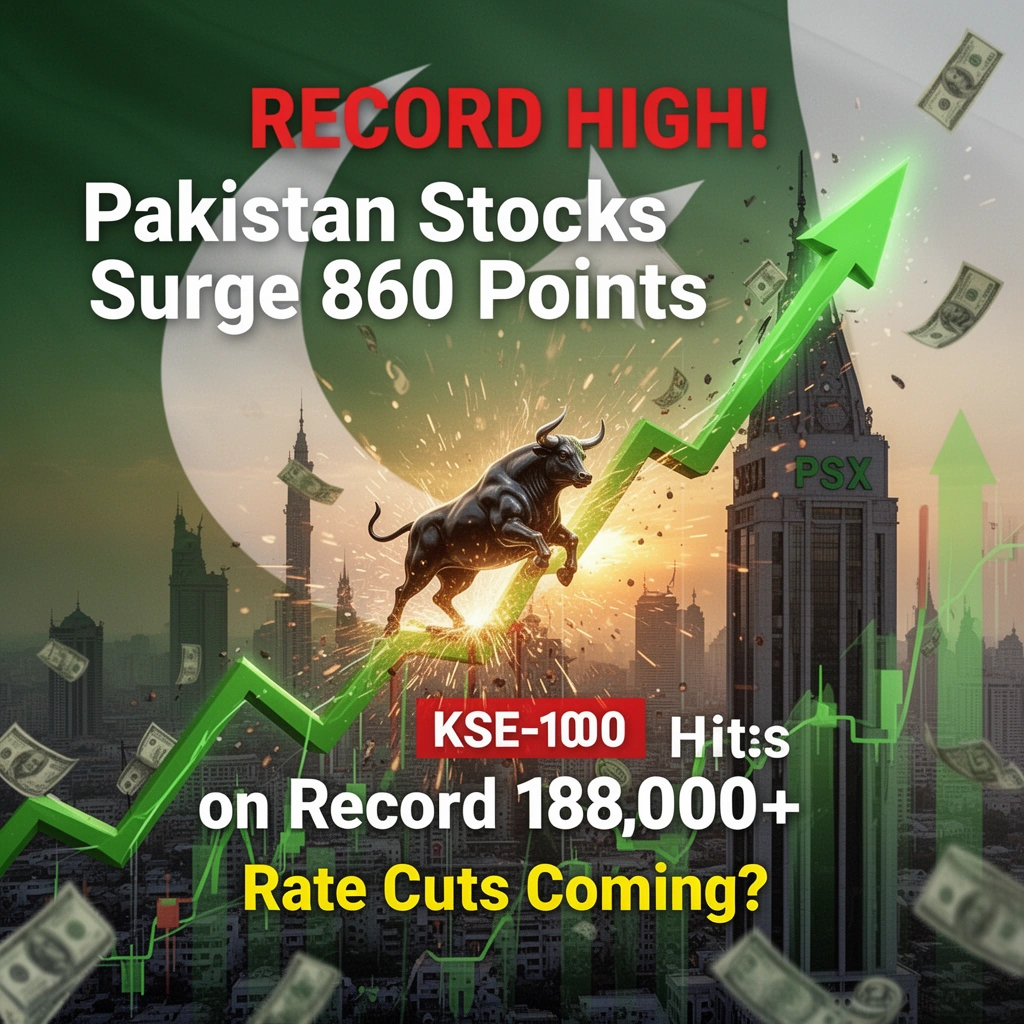
KSE-100 index soars past 188,621 points amid Pakistan stock market rally fueled by SBP rate cut expectations. Analysis of drivers, risks, and global emerging market context for January 2026.
A Frontier Market’s Unexpected Ascent
The trading floor at the Pakistan Stock Exchange opened Tuesday morning with the nervous energy that has become characteristic of frontier markets in early 2026. By midday, the benchmark KSE-100 index had tumbled to an intraday low of 187,192 points, triggering familiar anxieties among investors who remember Pakistan’s volatility all too well. Yet what followed was a dramatic reversal that encapsulates the peculiar momentum gripping this South Asian economy.
The KSE-100 surged 860 points to close at a record 188,621.78, marking not just another milestone but a continuation of what has become one of the most compelling—and confounding—bull runs in emerging markets. For investors watching from afar, Pakistan’s bourse suddenly looks less like a frontier gamble and more like an opportunity that demands serious consideration.
The rally extends a remarkable streak. Over the past month alone, the index has climbed 10.20 percent, and stands up 63.99 percent compared to the same period last year, according to data from Trading Economics. This isn’t the ephemeral bounce of speculative fervor; it’s a sustained ascent driven by fundamentals that are quietly reshaping Pakistan’s investment narrative.
The January 20 Session: Volatility Gives Way to Conviction
Tuesday’s trading session offered a microcosm of Pakistan’s current market dynamics. The index swung between an intraday high of 188,958.38 and its morning low of 187,192.02, a range reflecting both persistent uncertainty and growing confidence. The volatility wasn’t surprising—frontier markets rarely move in straight lines—but the decisive close above 188,600 points signaled something more substantial than mere momentum.

Volume remained robust, with market participants noting sustained buying interest across heavyweight sectors. According to analysis from KTrade Securities, all-share traded volumes rose 2.3 percent day-over-day to 1,226 million shares, suggesting broad participation rather than narrow speculation. The breadth of the rally—spanning energy, financials, and fertilizers—indicates institutional conviction rather than retail exuberance.
Heavy stocks drove the gains. Engro Holdings, Pakistan Petroleum, Sazgar Engineering, Oil and Gas Development Company, and Pakistan State Oil collectively added 661 points to the index, underscoring how Pakistan’s largest companies are benefiting from improving macroeconomic conditions and sector-specific tailwinds.
The Rate Cut Catalyst: Monetary Easing in Focus
At the heart of Tuesday’s rally—and indeed, much of the recent bullishness—lies a simple calculation: investors are betting heavily that the State Bank of Pakistan will announce a rate cut at its Monetary Policy Committee meeting scheduled for January 26. The conviction behind this bet is remarkably strong.
Survey data indicates that approximately 80 percent of market participants expect the SBP to reduce interest rates, with 56 percent predicting a 50 basis point cut and 15 percent foreseeing a full percentage point reduction. These aren’t idle expectations. They’re grounded in a macroeconomic reality that has shifted dramatically over the past several months.
The central bank surprised markets in December by cutting rates 50 basis points to 10.5 percent, even as many analysts had forecast rates would remain on hold. The move followed the IMF’s approval of a $1.2 billion disbursement, which bolstered foreign exchange reserves to over $15.8 billion, according to Trading Economics data. That cut signaled the SBP’s confidence that inflation was being durably tamed without requiring the punishingly high real interest rates that had characterized much of 2024 and early 2025.
Market pricing now reflects expectations of further easing. Looking ahead, nearly 49 percent of survey participants believe the policy rate will remain at 10 percent until June 2026, while 46 percent expect it to fall below 10 percent. If realized, such cuts would represent a remarkable pivot from the 22 percent peak reached during Pakistan’s acute inflation crisis.
The broader context matters enormously. Pakistan’s real interest rate—the policy rate minus inflation—currently stands at approximately 450 basis points, well above the historical average of 200-300 basis points for the country. This substantial buffer provides the SBP meaningful room to ease without risking inflation expectations becoming unanchored.
Inflation’s Cooling Trajectory
The foundation for monetary easing rests on Pakistan’s remarkable inflation performance. After experiencing devastating price pressures that saw annual inflation surge above 30 percent in 2023, the country has achieved a disinflation that would have seemed implausible just 18 months ago.
Pakistan’s annual inflation eased to 5.6 percent in December 2025 from 6.1 percent in November, marking the lowest reading since August. More critically, this deceleration appears broad-based rather than driven by volatile components. Food and non-alcoholic beverage inflation decelerated significantly to 3.2 percent from 5.5 percent in November, with perishable food prices declining 17.8 percent, according to Trading Economics.
For a country where food comprises a substantial portion of household consumption baskets, this moderation provides genuine relief to ordinary Pakistanis while simultaneously creating space for the central bank to support growth through lower rates. The combination of falling inflation and a still-elevated policy rate creates what economists term “real policy easing”—even if nominal rates are unchanged, declining inflation makes monetary conditions more accommodative.
The inflation trajectory looks sustainable. Core inflation, which strips out volatile food and energy prices, has also moderated, though it remains somewhat sticky. The central bank’s target range of 5-7 percent appears achievable for the foreseeable future, barring external shocks.
The IMF Anchor: Credibility Through Commitment
Pakistan’s relationship with the International Monetary Fund has been tumultuous over decades—a pattern of crisis lending, temporary stabilization, and eventual backsliding that eroded investor confidence. The current program, however, appears different in execution if not always in rhetoric.
The successful completion of recent IMF reviews and the subsequent $1.2 billion disbursement represents more than just liquidity provision. It signals external validation of Pakistan’s fiscal and monetary policy trajectory, providing a credibility anchor that domestic institutions often struggle to establish independently.
The Monetary Policy Committee noted that despite sizable ongoing debt repayments, SBP’s foreign exchange reserves continued to increase, reaching above $15.8 billion, according to the December policy statement. Moreover, with the realization of planned official inflows, SBP’s reserves are projected to strengthen to $17.8 billion by June 2026.
These aren’t trivial numbers for Pakistan. Reserve adequacy has historically been a vulnerability—periods when reserves dipped below three months of import cover triggered currency crises and capital flight. The current trajectory, if sustained, would represent the strongest reserve position in recent memory, providing a crucial buffer against external shocks.
The fiscal side shows improvement as well, though challenges persist. Led by sizable SBP profit transfer, the overall and primary fiscal balances recorded surpluses during the first quarter of fiscal year 2026. However, tax collection remains a persistent weakness, with revenue growth lagging targets and necessitating potentially painful adjustments in coming months.
Economic Activity: Green Shoots Amid Caution
Beyond monetary and fiscal metrics, Pakistan’s real economy is showing signs of life that contrast with the torpor of recent years. High-frequency indicators point to continued momentum in industry and agriculture, with large-scale manufacturing up 4.1 percent year-over-year in the first quarter of fiscal year 2026, according to central bank data.
This manufacturing recovery is particularly notable given the sector’s struggles during the acute phase of Pakistan’s economic crisis. Industries ranging from textiles to automobiles are benefiting from improved power supply reliability, moderating input costs, and gradually recovering domestic demand.
The remittance story remains crucial. Worker remittances rose 17 percent year-over-year to $3.6 billion in December 2025, taking cumulative inflows in the first half of fiscal year 2026 to $19.7 billion, up 11 percent year-over-year. For an economy chronically short of foreign exchange, these inflows provide vital breathing room, supporting both the balance of payments and domestic consumption through transfers to households.
Yet headwinds persist. The State Bank reported a current account deficit of $244 million in December 2025, compared with surpluses of $454 million in December 2024 and $98 million in November 2025. While the deficit remains manageable within the projected 0-1 percent of GDP range, its reemergence after months of surplus warrants monitoring.
Sector Leadership: Banks, Energy, and Discovery
The composition of Pakistan’s equity rally reveals where investors see the most compelling opportunities. Banking stocks have been consistent leaders, benefiting from the prospect of lower funding costs, improving asset quality as the economy stabilizes, and the potential for credit growth resumption after years of contraction.
The energy sector, particularly oil and gas exploration companies, received a boost from recent discoveries. Hydrocarbon reserves were discovered in the TAL block, with expected production of 1.37 million cubic feet per day of gas. While not transformative in scale, such discoveries provide psychological lift to a sector that has long underperformed due to pricing disputes and regulatory uncertainty.
Pakistan Petroleum (PPL), Oil and Gas Development Company (OGDC), and Pakistan State Oil (PSO) have all participated in the rally, though for differing reasons. Exploration companies benefit from discovery potential and improving cash flows, while marketing companies like PSO gain from normalizing economic activity and reduced circular debt accumulation.
The fertilizer sector represents another area of strength, supported by government efforts to support agricultural production and moderating input costs, particularly natural gas pricing. Given agriculture’s central role in Pakistan’s economy and food security, policy support for this sector tends to be bipartisan and sustained.
The Historical Context: Unprecedented Territory
To fully appreciate the current rally’s magnitude, consider the historical perspective. The KSE-100 has previously reached all-time highs, with the index touching 170,719 points in earlier sessions. The current level of 188,621 represents a substantial advance beyond those previous peaks, taking the index into genuinely unprecedented territory.
The year-to-date performance is particularly striking. From January 5 to 9, the KSE-100 surged from 179,035 to 184,410, adding 5,375 points in a single week, according to Arif Habib Limited analysis. Such concentrated gains reflect both improving fundamentals and technical factors, including short-covering and momentum-based buying.
What distinguishes this rally from previous episodes is its foundation. Past bull markets in Pakistan often rested on fragile bases—temporary commodity windfalls, unsustainable fiscal expansions, or purely speculative fervor. The current advance, while certainly benefiting from momentum, appears anchored in more durable improvements: disinflation, external sector stability, and the resumption of economic activity after a brutal contraction.
Global Comparison: Pakistan’s Place in the Emerging Market Constellation
Pakistan’s equity performance becomes even more remarkable when viewed against the broader emerging market landscape. The year 2025 has been exceptional for emerging markets generally, with the MSCI Emerging Markets Index posting strong gains and outperforming developed markets.
The MSCI Emerging Markets Index has surged around 30 percent since the beginning of the year, outperforming all three major Wall Street averages. Within this cohort, certain markets have excelled. Greece’s Athens Composite has surged nearly 44 percent over the year and will be upgraded to developed market status in September 2026, while Chile and the Czech Republic’s benchmark indexes are both up around 50.8 percent year-to-date.
Pakistan’s 64 percent annual gain positions it among the top performers globally, though its frontier market classification and smaller free float mean it attracts less attention than larger emerging markets like India or Vietnam.
India, the regional giant, presents an interesting comparison. After a multi-year period of outperformance, Indian equities diverged from broader emerging market trends in 2025, entering a phase of consolidation. The Indian market’s valuation premium to other emerging markets had become stretched, prompting profit-taking even as the economic fundamentals remained solid.
Vietnam tells a different story. FTSE Russell announced in October 2025 that Vietnam will be upgraded from Frontier to Secondary Emerging Market status from September 21, 2026. The VN-Index rose from 1,100 points in April 2025 to nearly 1,700 points by October 2025, a 50 percent jump and a 33 percent year-to-date gain, making Vietnam the best-performing market in Southeast Asia.
Pakistan’s challenge is securing a similar reclassification. While its market has performed admirably, concerns about liquidity, governance, and regulatory predictability continue to keep it in the frontier category. Progress on these structural issues could unlock substantial passive inflows should international index providers upgrade Pakistan’s status.
The Dollar Dynamic: Currency as Catalyst
A crucial but often overlooked driver of emerging market performance in 2025-2026 has been the weakening U.S. dollar. One of the key catalysts for the continued strengthening of emerging market currencies and assets—U.S. dollar weakness—appears set to persist into the new year, according to VIG Asset Management analysis.
For Pakistan specifically, the Pakistani rupee strengthened slightly against the U.S. dollar, closing at 280.02 per dollar, up 0.03 percent week-over-week. While the magnitude of appreciation has been modest compared to some peers, the stabilization itself represents progress after years of serial devaluations that eroded purchasing power and investor confidence.
Currency stability creates multiple benefits for equity investors. It reduces the hedging costs for foreign investors, improves the predictability of earnings for companies with dollar-denominated debt, and signals macroeconomic competence to international audiences. For a country that has experienced repeated balance-of-payments crises, even modest currency strength carries outsize psychological weight.
Risks on the Horizon: What Could Derail the Rally
Prudent analysis demands acknowledging risks, and Pakistan’s rally faces several potential headwinds. The most immediate concerns fiscal slippage. Federal Board of Revenue collection slowed considerably to 10.2 percent year-over-year during July-November fiscal year 2026, implying significant acceleration required to achieve the budgeted tax collection target in the remaining seven months.
Tax revenue shortfalls create a familiar dilemma for Pakistani policymakers: either slash expenditures, potentially derailing growth, or accept higher deficits that risk triggering IMF concerns and currency pressure. The government’s ability to square this circle will be tested in coming months.
Foreign direct investment tells a sobering story. Net FDI stood at $808 million in the first six months of fiscal year 2025-26, down 43 percent year-over-year compared to $1,425 million in the same period last year. The country’s net FDI in December 2025 reported outflows of $135 million, with the largest outflow from Norway of $376 million in the IT sector due to Telenor’s exit from Pakistan following the sale of its assets to PTCL.
The FDI weakness reflects deeper structural issues: regulatory uncertainty, governance concerns, and the exit of multinational corporations that have concluded Pakistan’s market doesn’t justify the operational complexity. While portfolio inflows into equities have been strong, the absence of greenfield FDI limits Pakistan’s long-term growth potential and technological upgrading.
Geopolitical risks remain ever-present. Regional tensions, domestic political instability, and the perennial risk of security incidents all pose threats to investor confidence. Pakistan’s location in a volatile neighborhood means external shocks—from conflict escalation to border closures—can materialize with little warning.
Global factors matter as well. The global environment remains challenging, particularly for exports, which may have some implications for the macroeconomic outlook, the SBP noted. A global slowdown, particularly in key markets like China and the Gulf countries that absorb Pakistani exports, could undermine the current account trajectory.
The Valuation Question: Expensive or Just Getting Started?
For equity investors, the perennial question becomes whether Pakistan’s rally has run ahead of fundamentals or represents genuine value recognition. The KSE-100 currently trades at a price-to-earnings ratio of 9.2 times and offers a dividend yield of approximately 5.4 percent, according to analyst estimates.
These multiples appear modest relative to regional peers and global emerging markets, particularly given the earnings growth prospects. Yet valuations alone don’t determine market direction—sentiment, liquidity, and momentum frequently dominate in the short term.
The composition of buyers matters. Buying from local mutual funds, as reflected in recent flow data, played a key role in supporting the market’s upward trend. Domestic institutional participation provides a more stable foundation than purely retail-driven rallies, though it also means foreign investor participation remains limited relative to Pakistan’s market size.
For international investors, Pakistan presents a classic frontier market trade-off: exceptional returns potential balanced against liquidity constraints, governance uncertainty, and episodic volatility. The country lacks the institutional infrastructure and market depth of larger emerging markets, meaning position sizing must remain modest and exit liquidity cannot be taken for granted.
Forward Outlook: Momentum Versus Mean Reversion
As the January 26 Monetary Policy Committee meeting approaches, market attention will focus intensely on the magnitude of any rate cut and the accompanying forward guidance. A 50 basis point reduction is largely priced in; anything less could trigger profit-taking, while a larger cut might fuel further gains.
Beyond the immediate catalyst, Pakistan’s market trajectory depends on execution across multiple dimensions. Can the government close its fiscal gap without derailing growth? Will the current account remain manageable as imports recover? Can political stability be maintained through an election cycle? These questions will determine whether 2026 proves to be a continuation of 2025’s success or a return to familiar volatility.
The international context provides some tailwinds. Emerging market equities are positioned for robust performance in 2026, boosted by lower local interest rates, higher earnings growth, attractive valuations, ongoing improvements in corporate governance, healthier fiscal balance sheets and resilient global growth, according to J.P. Morgan Global Research.
For Pakistan to capture its share of emerging market flows, however, it must continue demonstrating policy credibility. The IMF program provides a framework, but sustained implementation matters more than announced intentions. Investors have heard promising narratives from Pakistani policymakers before; what distinguishes this cycle is the actual delivery on inflation reduction, reserve accumulation, and fiscal discipline.
Implications for Investors and Policymakers
For portfolio managers evaluating Pakistan, the opportunity set has clearly improved relative to the acute crisis years. The risk-reward proposition, while still tilted toward higher risk than established emerging markets, no longer appears as asymmetrically unfavorable as it did when reserves were perilously low and inflation was raging.
Tactical traders will focus on near-term catalysts: the January 26 rate decision, upcoming corporate earnings, and technical chart levels. Strategic investors might view Pakistan as a potential multi-year recovery play, betting that continued policy discipline could unlock a re-rating toward regional peer valuations.
For policymakers, the market’s strength creates both opportunities and responsibilities. Strong equity markets improve sentiment, facilitate capital raising for corporations, and can support wealth effects that boost consumption. Yet they also risk complacency—allowing market euphoria to substitute for the hard structural reforms that Pakistan desperately needs.
The agenda remains daunting: tax base expansion, energy sector reform, privatization of loss-making state enterprises, governance improvements in institutions ranging from power distribution to ports. These challenges won’t be solved by monetary easing or IMF programs alone. They require sustained political will, technical capacity, and societal consensus that have often proven elusive.
Conclusion: A Rally Grounded in Reality, Shadowed by Risks
Pakistan’s stock market surge past 188,600 points represents more than statistical milestone. It reflects a fundamental shift in the country’s macroeconomic trajectory—from crisis management to tentative normalization. The confluence of moderating inflation, improving reserves, and the prospect of further monetary easing has created conditions for equity appreciation that would have seemed implausible during the darkest days of 2023-2024.
Yet as Tuesday’s intraday volatility demonstrated, this remains a market where conviction and anxiety coexist. The path from frontier gamble to reliable emerging market investment requires more than favorable momentum—it demands institutional development, governance improvements, and sustained policy credibility that take years to build.
For now, Pakistan’s bourse continues to defy skeptics, posting returns that place it among the world’s top-performing markets. Whether this represents a durable re-rating or an ephemeral rally will be determined by execution on the structural challenges that have constrained Pakistan’s potential for decades. The central bank’s January 26 decision will provide the next chapter in this unfolding story.
Sources :
- Pakistan Stock Exchange Market Summary – Official PSX data and statistics
- KSE-100 Index Bloomberg Quote – Real-time index tracking
- State Bank of Pakistan Official Site – Monetary policy statements and economic data
- Trading Economics Pakistan Indicators – Comprehensive economic metrics
- MSCI Emerging Markets Analysis – Global EM context and comparisons


Investing 101
Gaming Giant’s Bold Gamble: Why Investors are Devouring Risky EA Debt Amid Geopolitical Crosscurrents
Investors are aggressively snapping up debt for Electronic Arts’ historic $55bn take-private, signaling resilient credit markets despite geopolitical tensions and AI disruption. Explore the EA LBO’s financial engineering, cost savings, and the appetite for risky video game financing in 2026.
Introduction: The Unyielding Allure of High-Yield
The world of high finance rarely pauses for breath, even as geopolitical headwinds gather and technological disruption reshapes industries. Yet, the recent $55 billion take-private of video game titan Electronic Arts (EA) has delivered a masterclass in market resilience, demonstrating an almost insatiable investor appetite for leveraged debt—even when tied to a complex, globally-infused transaction. Led by Saudi Arabia’s Public Investment Fund (PIF), Silver Lake, and Affinity Partners, this landmark deal, poised to redefine the gaming M&A landscape, has seen its $18-20 billion debt package met with overwhelming demand, proving that the pursuit of yield often eclipses lingering doubts.
This isn’t merely another private equity mega-deal; it’s a bellwether for global credit markets in early 2026. JPMorgan-led bond deals, designed to finance one of the largest leveraged buyouts in history, have drawn over $25 billion in orders, far surpassing their target size. This aggressive investor embrace of what many consider risky debt, particularly given the backdrop of Middle East tensions and concerns over AI’s impact on software, underscores a fascinating dichotomy: a cautious macroeconomic outlook juxtaposed with an audacious hunt for returns in stable, cash-generative assets. The question isn’t just how this was financed, but why investors dove in with such conviction, and what it signals for the year ahead.
The Anatomy of a Mega-Buyout: EA’s Financial Engineering
At an enterprise value of approximately $55 billion, the Electronic Arts take-private deal stands as the largest leveraged buyout on record, eclipsing the 2007 TXU Energy privatization. The financing structure is a finely tuned orchestration of equity and debt, designed to maximize returns for the acquiring consortium while appealing to a broad spectrum of debt investors.
Equity & Debt Breakdown
The EA $55bn LBO is funded through a combination of substantial equity and a significant debt tranche:
- Equity Component: Approximately $36 billion, largely comprising cash contributions from the consortium partners, including the rollover of PIF’s existing 9.9% stake in EA. PIF is set to own a substantial majority, approximately 93.4%, with Silver Lake holding 5.5% and Affinity Partners 1.1%.
- Debt Package: A substantial $18-20 billion debt package, fully committed by a JPMorgan-led syndicate of banks. This makes it the largest LBO debt financing post-Global Financial Crisis.
Unpacking the Debt Tranches: Demand & Pricing
The sheer scale of demand for this EA acquisition financing has been striking. The initial $18 billion debt offering, which included both secured and unsecured tranches, quickly swelled to over $25 billion in investor orders. This oversubscription highlights a strong market appetite for gaming-backed paper.
Key components of the debt include:
- Leveraged Loans: A cross-border loan deal totaling $5.75 billion launched on March 16, 2026, comprising a $4 billion U.S. dollar loan and a €1.531 billion ($1.75 billion) euro tranche.
- Pricing: Term Loan Bs (TLBs) were guided at 350-375 basis points over SOFR/Euribor, with a 0% floor and a 98.5 Original Issue Discount (OID). This discounted pricing suggests lenders were baking in some risk, yet the demand remained robust.
- Secured & Unsecured Bonds: The financing also features an upsized $3.25 billion term loan A, an additional $6.5 billion of other dollar and euro secured debt, and $2.5 billion of unsecured debt. While specific high-yield bond pricing hasn’t been detailed, market intelligence suggests secured debt at approximately 6.25-7.25% and unsecured north of 8.75%, reflective of the leverage profile.
The Deleveraging Path: Justifying a 6x+ Debt/EBITDA
Moody’s projects that EA’s gross debt will increase twelve-fold from $1.5 billion, pushing pro forma leverage (total debt to EBITDA) to around eight times at closing. Such high leverage ratios typically raise red flags, but the consortium’s pitch centers on EA’s robust cash flows and significant projected cost savings.
Three Pillars Justifying the Leverage
- Stable Cash Flows from Core Franchises: EA boasts an enviable portfolio of consistently profitable franchises, including FIFA (now EA Sports FC), Madden NFL, Apex Legends, and The Sims. These titles generate predictable, recurring revenue streams, particularly through live service models and annual updates, which underpin the company’s financial stability—a critical factor for debt investors.
- Strategic Cost Savings & Operational Efficiencies: The new owners have outlined an aggressive plan for $700 million in projected annual cost savings. This includes:
- R&D Optimization: $263 million from reclassifying R&D expenses for major titles like Battlefield 6 and Skate as one-time costs, now that they are live and generating revenue.
- Portfolio Review: $100 million from a strategic review of the game portfolio.
- AI Tool Integration: $100 million from leveraging AI tools for development and operations.
- Organizational Streamlining: $170 million from broader organizational efficiencies.
- Public Company Cost Removal: $30 million saved by no longer incurring costs associated with being a public entity.
These add-backs significantly bolster adjusted EBITDA figures, making the debt package appear more manageable to prospective lenders. Moody’s expects leverage to decrease to five times by 2029.
- Untapped Growth Potential in Private Ownership: Freed from quarterly earnings pressure, EA’s management can pursue longer-term strategic initiatives and R&D without the immediate scrutiny of public markets. This is particularly appealing for a company operating in an industry prone to rapid innovation and large, multi-year development cycles. The consortium’s diverse networks across gaming, entertainment, and sports are expected to create opportunities to “blend physical and digital experiences, enhance fan engagement, and drive growth on a global stage”.
Geopolitical Currents and the Appetite for Risky Debt
The influx of capital into the Electronic Arts bond deals is particularly noteworthy given the complex geopolitical backdrop of early 2026. Global markets are navigating sustained tensions in the Middle East, the specter of trade tariffs, and the disruptive force of artificial intelligence. Yet, these factors have not deterred investors from snapping up debt to finance Electronic Arts’ $55bn take-private.
The Saudi PIF Factor: Geopolitical Implications
The prominent role of Saudi Arabia’s Public Investment Fund (PIF) as the lead equity investor introduces a significant geopolitical dimension. The PIF, managing over $925 billion in assets, views this acquisition as a strategic move to establish Saudi Arabia as a global hub for games and sports, aligning with its “Vision 2030” diversification efforts. PIF’s deep pockets and long-term investment horizon offer stability often attractive to private equity deals.
However, the involvement of a sovereign wealth fund, particularly one with ties to Jared Kushner’s Affinity Partners, has not been without scrutiny. Concerns about national security risks, foreign access to consumer data, and control over American technology (including AI) have been voiced by organizations like the Communications Workers of America (CWA), who urged federal regulators to scrutinize the deal. Despite these geopolitical and regulatory considerations, the debt market demonstrated a remarkable willingness to participate. This indicates that the perceived financial stability and growth prospects of EA outweighed concerns tied to the source of equity capital.
AI Disruption and Market Confidence
The gaming industry, like many sectors, faces potential disruption from AI. Yet, EA itself projects $100 million in cost savings from AI tools, signaling a strategic embrace rather than fear of the technology. This forward-looking approach to AI, coupled with the inherent stability of established gaming franchises, likely contributed to investor confidence. In a volatile environment, proven entertainment IP acts as a relatively safe harbor.
The successful placement of this jumbo financing also suggests that while some sectors (like software) have seen “broader risk-off sentiment” due to AI uncertainty, the market distinguishes between general software and robust, content-driven interactive entertainment.
Broader Implications for Gaming M&A and Private Equity
The EA LBO is more than an isolated transaction; it’s a powerful signal for the broader M&A landscape and the future of private equity.
A Return to Mega-LBOs?
After a period where massive leveraged buyouts fell out of favor post-Global Financial Crisis, the EA deal marks a definitive comeback. It “waves the green flag on sponsors resuming mega-deal transactions,” indicating that easing borrowing costs and renewed boardroom confidence are aligning to facilitate large-cap M&A. The success of this deal, especially the oversubscription of its debt tranches, could embolden other private equity firms to pursue similar-sized targets in industries with reliable cash flows. This is crucial for private-equity debt appetite in 2026.
Creative Independence Post-Delisting
While private ownership offers freedom from public market pressures, it also introduces questions about creative independence. Historically, private equity has been associated with aggressive cost-cutting and a focus on short-term profits. For a creative industry like gaming, this can be a double-edged sword. While the stated goal is to “accelerate innovation and growth”, some within EA have expressed concern about potential workforce reductions and increased monetization post-acquisition. The challenge for the new owners will be to balance financial optimization with the nurturing of creative talent and IP development crucial for long-term success.
What it Means for 2027: Scenarios and Ripple Effects
As the EA $55bn take-private moves towards its expected close in Q1 FY27 (June 2026), its ripple effects will be closely watched by analysts and investors alike.
- Post-Deal EA Strategy: Under private ownership, expect EA to double down on its most successful franchises and potentially explore new growth vectors less scrutinized by quarterly reports. Strategic investments in areas like mobile gaming, esports, and potentially new IP development could accelerate. The projected cost savings will likely be reinvested to fuel growth or rapidly deleverage.
- Valuation Multiples: The deal itself sets a new benchmark for valuations in the gaming sector, particularly for companies with strong IP and predictable revenue streams. This could influence future M&A activities involving peers like Activision Blizzard (though now part of Microsoft) or Take-Two Interactive, raising their perceived floor valuations.
- Credit Market Confidence: The overwhelming investor demand for EA’s debt signals a powerful confidence in the leveraged finance markets, particularly for well-understood, resilient businesses. If EA successfully executes its deleveraging and growth strategy post-buyout, it will further validate the market’s willingness to finance large, complex LBOs, even amidst global uncertainty. This could pave the way for more “risky debt” deals tied to stable, high-quality assets.
- Geopolitical Influence in Tech: The PIF’s leading role solidifies the trend of sovereign wealth funds actively participating in global technology and entertainment sectors. This influence will continue to shape discussions around regulatory oversight, national interests, and the evolving landscape of global capital flows.
The investors snapping up debt to finance Electronic Arts’ $55bn take-private aren’t just betting on a video game company; they’re wagering on the enduring power of stable cash flows, strategic cost management, and a robust credit market willing to absorb risk for attractive yields. In a world grappling with uncertainty, the virtual battlefields of EA’s franchises offer a surprisingly solid ground for real-world financial gains.
Analysis
Saba Capital’s Bold Tender Offer: Buying Blue Owl Funds at Steep Discounts Amid Private Credit Turmoil

When a hedge fund swoops in to buy distressed stakes at 20–35% below net asset value, it’s rarely a random act of generosity. It’s arbitrage—and it signals something deeper is fracturing in the private credit market.
In early February 2026, Boaz Weinstein’s Saba Capital Management, partnering with Cox Capital Partners, launched a tender offer to acquire shares in three Blue Owl Capital funds: Blue Owl Capital Corporation II (OBDC II), Blue Owl Technology Income Corp (OTIC), and Blue Owl Credit Income Corp (OCIC). The proposed prices ranged from 65 to 80 cents on the dollar relative to each fund’s stated net asset value—a brazen bet that retail investors, trapped by redemption gates and growing skepticism about private asset valuations, would take whatever exit they could get.
This is hedge fund opportunism in credit funds at its most calculated. And it may be one of the more revealing moments in a private credit story that has been quietly unraveling for months.
The Saba Blue Owl Tender Offer: What We Know
The mechanics of the Saba Capital–Blue Owl BDC discount trade are straightforward, even if the implications are anything but. Saba and Cox are offering retail and institutional investors in these non-traded business development companies (BDCs) a cash buyout of their stakes—at prices well below what Blue Owl’s own accounting says those assets are worth.
For OBDC II, OTIC, and OCIC, the discounts reportedly sit between 20% and 35% below NAV, depending on the vehicle. Saba’s thesis: the stated NAVs are optimistic—possibly significantly so—and liquidity pressure on investors will drive enough sellers to make the trade profitable even if some markdown in underlying valuations is warranted.
Blue Owl, for its part, has not been passive. The firm has moved to sell approximately $1.4 billion in assets and announced plans to return capital to investors. But it has also halted redemptions across certain funds, a move that, while legally permissible under fund structures, tends to send a loud signal to the market: liquidity is tighter than the pitch deck implied. Reuters reported a notable drop in OWL shares following news of the asset sales and debt fund restructurings, even as the broader stock recovered modestly on reports of Saba’s involvement—a curious market response that speaks volumes about investor sentiment.
Why Boaz Weinstein Is Betting Against Private Credit Valuations
Weinstein has built his reputation on identifying structural mispricing in complex credit instruments. He rose to prominence partly by recognizing—and profiting from—risks in synthetic credit markets that others had underwritten with excessive confidence. His move into the Blue Owl funds at steep discount follows a familiar playbook: find an illiquid market where reported values and transactable values have diverged sharply, then extract the spread.
The non-traded BDC redemption halt is the mechanism that creates his opportunity. When investors cannot sell their stakes on an exchange and the fund manager suspends the redemption window, those investors are effectively stranded. A tender offer—even at a painful discount—can look attractive to someone who needs liquidity or simply no longer trusts the NAV figure printed on their quarterly statement.
Saba’s position is essentially a structured bet that:
- Private credit valuations are inflated relative to what a secondary buyer would actually pay
- Redemption pressure will continue, keeping retail sellers motivated
- Blue Owl’s asset sales will either validate the markdown or, at minimum, prevent meaningful NAV appreciation
This is not merely opportunism for its own sake. It’s a price discovery mechanism in a corner of the market that has long lacked one.
The Broader Private Credit Liquidity Crisis
To understand why the Saba Capital–Blue Owl BDC discount trade matters beyond a single firm’s P&L, you need to zoom out to the $1.8 trillion private credit market.
Over the past five years, private credit exploded as institutional and retail capital flooded into non-bank lending. The pitch was compelling: higher yields, lower volatility (a feature, skeptics noted, of infrequent mark-to-market pricing rather than genuine stability), and access to growing companies bypassed by traditional banks. BDCs, including non-traded vehicles like those in Blue Owl’s lineup, became popular conduits for retail investors seeking yield in a low-rate world.
But several structural tensions have been building:
- Rising redemption requests as investors reassess the risk-return profile in a higher-rate environment where liquid credit alternatives have become more attractive.
- AI-driven disruption in software lending, which has raised questions about the credit quality of technology-focused portfolios—directly relevant to OTIC, Blue Owl’s tech-oriented income vehicle.
- NAV skepticism, as secondary market transactions and tender offers like Saba’s imply that the private assets underpinning these funds may be worth materially less than reported.
- Liquidity mismatches, baked into the non-traded structure itself—where quarterly redemption windows create an illusion of liquidity that evaporates precisely when investors want it most.
Bloomberg and the Financial Times have both noted that the impact of the Saba tender offer on the private credit market extends beyond Blue Owl, raising uncomfortable questions about how other non-traded BDCs and credit interval funds are being priced.
Blue Owl’s Response: Asset Sales and Capital Returns
Blue Owl’s decision to sell $1.4 billion in assets and accelerate capital returns is, on one reading, a responsible response to liquidity pressure. On another, it’s an implicit acknowledgment that the redemption halt was unsustainable and that some degree of NAV reset was necessary to restore credibility with investors.
The firm has been vocal in pushing back against what it characterizes as opportunistic and potentially misleading tender offers—a reasonable complaint given that Saba’s bid prices are not peer-reviewed appraisals of the underlying loan portfolios but rather negotiating anchors designed to attract distressed sellers. Blue Owl’s leadership has urged investors not to tender, pointing to ongoing asset management and anticipated distributions as the better path to value recovery.
Whether that argument lands will depend heavily on what the $1.4 billion in asset sales actually reveal about realized values. If dispositions close near stated NAV, Blue Owl’s credibility is substantially restored. If they close at significant markdowns, Saba’s thesis gains traction—and the ripple effects across the broader private credit fund universe could be considerable.
What This Means for Retail Investors
The retail investor risks in non-traded BDCs have been well-documented in regulatory filings, though often buried in dense prospectus language. Investors drawn in by above-market yield projections and the prestige of institutional-quality private credit exposure are now encountering the structural fine print: redemption queues, quarterly windows, and the absence of a liquid secondary market.
Saba’s tender offer creates a perverse but real choice. Accepting means crystallizing a 20–35% loss relative to stated NAV. Rejecting means trusting that Blue Owl’s reported values are accurate, that the asset sales will close cleanly, and that redemption capacity will normalize—none of which are guaranteed.
For financial advisors who placed clients into these structures, this is a moment of reckoning. The hedge fund opportunism in credit funds story is partly about Weinstein’s acuity. But it’s also about the mismatch between how non-traded private credit products were sold to retail investors and how they are actually performing under stress.
Forward-Looking: A Stress Test for Private Credit’s Retail Ambitions
The Saba Capital buys Blue Owl stakes at discount episode will likely serve as a case study for regulators, fund managers, and financial advisors for years. It arrives at a moment when the SEC has been scrutinizing the marketing of illiquid alternatives to retail investors, and when several major asset managers are pushing to expand access to private markets through evergreen fund structures.
If the tender offer attracts significant seller participation, it will validate the secondary discount as a real price—not a theoretical one—and pressure other non-traded BDC managers to either shore up liquidity mechanisms or face similar activist attention. If Blue Owl successfully defends its NAV through disciplined asset management and transparent dispositions, it may emerge as a model for how to navigate activist pressure in the private credit space.
Either way, the Blue Owl funds steep discount offer of 2026 has already accomplished something that quarterly NAV statements and manager commentary rarely do: it has forced a genuine conversation about what these assets are actually worth in a market that would prefer not to ask.

When silver prices cratered by a historic 27% on January 30, 2026—wiping out $150 billion in market value within hours—most traders scrambled to stanch the bleeding. Yet one firm turned catastrophe into windfall. Zhongcai Futures, the proprietary trading house controlled by reclusive Chinese entrepreneur Bian Ximing, banked over $500 million by betting against the very rally that entranced global speculators, according to reports from the Financial Times and market observers.
The profit haul marks another stunning victory for the 61-year-old plastics magnate turned commodities oracle, whose contrarian instincts have repeatedly outmaneuvered Wall Street’s conventional wisdom. After pocketing $1.5 billion from prescient gold futures trades between 2022 and 2024, Bian’s Shanghai-based brokerage executed short positions on silver just as the white metal approached its dizzying peak above $121 per ounce in late January—a record that would prove ephemeral.
The Silver Supercycle That Wasn’t
Silver’s ascent in late 2025 and early 2026 resembled nothing witnessed since the Hunt Brothers’ infamous squeeze four decades prior. Fueled by a confluence of factors—Chinese retail speculation, artificial intelligence’s voracious appetite for the metal’s thermal properties, and mounting concerns over currency debasement—prices rocketed from approximately $32 per ounce in early 2025 to an intraday high near $121 by late January 2026, representing a staggering 276% surge.
The narrative captivating markets was compelling: silver’s unrivaled electrical and thermal conductivity had become indispensable for next-generation AI chip manufacturing. Data center construction exploded as Large Language Models demanded increasingly sophisticated cooling systems, with silver-sintered thermal pastes emerging as the industry standard. Industrial demand appeared insatiable.
Yet beneath the euphoria lurked structural fragilities. As Bloomberg chronicled, speculative fever gripped Shanghai trading floors, where individual investors and equity funds venturing into commodities drove prices divorced from supply-demand fundamentals. Trend-following commodity trading advisers amplified the momentum, creating what analysts later termed a “speculative bubble” rather than a durable industrial squeeze.
By mid-January, the iShares Silver Trust (SLV) recorded unprecedented call option volumes exceeding those of the Nasdaq 100 ETF—a harbinger of the volatility to come. When silver futures surged past $110 per ounce, the CME Group implemented emergency measures, transitioning to percentage-based margin requirements that hiked maintenance margins to 15% for standard positions. The Shanghai Futures Exchange followed suit with multiple rounds of restrictions throughout January.
These administrative interventions would prove decisive. As reported across financial media, the margin hikes forced leveraged speculators who had controlled 5,000-ounce contracts with minimal collateral into a “margin trap,” triggering cascading liquidations that accelerated the selloff.
Zhongcai’s Contrarian Gambit
While retail investors queued for hours outside European bullion dealers and Chinese traders posted thousand-percent gains on social media, Bian Ximing’s team pursued a different calculus. Operating from Gibraltar—where Bian conducts business largely via video calls, maintaining his characteristic distance from Shanghai’s trading floors—Zhongcai Futures established short positions on the Shanghai Futures Exchange as silver approached its zenith.
The timing proved exquisite. On January 30, silver commenced its historic plunge around 10:30 AM Eastern Time, declining to $119 before President Trump’s announcement of Kevin Warsh as Federal Reserve chair nominee at 1:45 PM—a development widely cited as the crash catalyst, though the selloff had already eliminated 27% of silver’s value by that point. By session’s end, spot silver settled near $84 per ounce, representing a $37 per ounce drop in under 20 hours.
The mechanics behind Zhongcai’s profits illuminate Bian’s investment philosophy. Rather than chasing parabolic moves, he focuses on identifying structural imbalances and positioning for mean reversion. His sporadic blog posts—parsed religiously by Chinese traders seeking to emulate his hedge fund-style approach—emphasize “letting go of ego,” choosing targets based on trends, and maintaining discipline on costs. “Investment is essentially a game of survival capability,” Bian wrote in a January reflection, weeks before silver’s collapse.
Market observers note that Zhongcai’s short positions likely concentrated on Shanghai contracts rather than COMEX, providing natural hedges as Chinese markets remained closed during Lunar New Year holidays that shielded domestic traders from the worst intraday volatility when global prices briefly tumbled. The firm’s $500 million gain reflects not merely directional conviction but sophisticated execution across timing, venue selection, and risk management.
Anatomy of the Rout: Why Silver Crashed
The January 30 selloff represented multiple failures converging simultaneously. First, the paper silver market—ETFs and futures trading many multiples of physical metal volume—had disconnected dangerously from underlying supply. The 28% single-day drop in SLV, its worst session since inception, exposed how financialized commodity instruments can gap violently when speculation reaches fever pitch.
Second, exchange-mandated margin increases forced deleveraging precisely when positions were most extended. With silver at $120, a standard 5,000-ounce contract carried $600,000 in notional exposure; CME’s 15% maintenance requirement meant traders suddenly needed $90,000 versus previous minimums around $25,000. Those unable to meet calls faced automatic liquidation, creating self-reinforcing downward pressure.
Third, high-frequency trading dynamics amplified the cascade. Chinese authorities’ early-2026 moves to remove servers from exchange data centers and halt subscriptions in certain commodity fund products—including the UBS SDIC Silver Futures Fund—mechanically reduced marginal demand just as volatility peaked. When algorithms detected price deterioration, automated selling intensified the rout.
Current silver prices hovering around $90 per ounce as of February 4, 2026, reflect partial recovery from the lows but remain dramatically below late January peaks. The metal has stabilized approximately 176% above year-ago levels, though technical analysts identify the $75-$80 range as critical support—the consolidation zone before silver’s final parabolic surge.
Bian Ximing: The Invisible King of Futures
Born in 1963 in Zhuji, Zhejiang Province, during China’s tumultuous Cultural Revolution, Bian Ximing’s trajectory from vocational school graduate to billionaire commodities trader embodies calculated risk-taking married to macroeconomic foresight. After founding a high-end plastic tubes factory in 1995, he diversified into real estate, finance, and media, acquiring the brokerage that became Zhongcai Futures in 2003.
His reputation crystallized through his 2022-2024 gold play. Anticipating global efforts to reduce dollar reliance amid inflation fears, Bian established long positions at gold’s mid-2022 lows and scaled holdings through 2023, ultimately exiting near bullion’s 2024 peaks with an estimated $1.5 billion profit. The success earned him comparisons to Warren Buffett for his patient, fundamentals-driven approach—a rarity among China’s more speculative trading culture.
Yet Bian’s latest copper bet demonstrates his agility. As of May 2025 reports, Zhongcai held the largest net long copper position on the Shanghai Futures Exchange—nearly 90,000 tons worth approximately $1 billion—wagering on the metal’s centrality to electrification and China’s high-tech industrial transition. That position has generated roughly $200 million in profits to date, per Bloomberg calculations.
The silver short, however, marks a tactical pivot. While maintaining copper longs, Zhongcai recognized silver’s speculative excess and positioned accordingly—illustrating Bian’s capacity to hold seemingly contradictory views on related assets when fundamentals diverge. His lieutenants occasionally post “reflections” on the company site, offering glimpses into a trading operation that blends Western institutional discipline with shrewd navigation of China’s distinct market structure.
Market Implications: What Comes Next for Precious Metals
The silver crash holds sobering lessons for commodity markets increasingly dominated by momentum strategies and retail speculation. First, even genuine industrial demand stories—silver’s role in AI infrastructure is legitimate—can be overwhelmed by speculative excess. When paper markets far exceed physical volumes, financialization creates vulnerabilities to sharp corrections.
Second, regulatory interventions matter. Exchange margin adjustments, while prudent for systemic stability, can trigger violent moves when implemented amid extended positioning. Traders operating with maximum leverage learned painfully that exchanges prioritize clearinghouse solvency over individual P&L.
Third, the episode underscores China’s growing influence on global commodity prices. Chinese retail and institutional flows drove silver’s rally and contributed to its collapse, with domestic regulatory actions—HFT crackdowns, fund redemption halts—rippling across international markets. As geopolitical tensions persist, understanding China’s market structure becomes essential for commodity investors worldwide.
Looking ahead, analysts divide on silver’s trajectory. Citigroup analysts maintain $150 targets, citing structural supply deficits and AI-driven demand as justifying a new $65-$70 floor even after the correction. Bears counter that January’s crash revealed demand isn’t as inelastic as bulls assumed; at $100-plus per ounce, industrial substitution and demand destruction become economic imperatives.
Gold faces similar crosscurrents, having plunged 12% on January 30 to below $5,000 per ounce after touching $5,602 earlier that week. While central bank purchases and geopolitical risk support longer-term bullion strength, the correction demonstrates that even traditional safe havens aren’t immune to sentiment reversals when positioning grows extreme.
For copper, Bian’s continued conviction through recent trade-war volatility signals confidence in China’s economic resilience and secular electrification trends. Major players like Mercuria forecast $12,000-$13,000 per ton, well above current $9,500 levels, if supply constraints and infrastructure demand materialize as expected.
The Broader Lessons
Zhongcai’s silver windfall exemplifies timeless trading principles that transcend specific asset classes. Bian Ximing’s success stems from identifying crowded trades, maintaining discipline when markets grow euphoric, and executing with precision when others capitulate. His ability to profit from both gold’s rise (2022-2024) and silver’s fall (January 2026) reflects not market timing alone but understanding market structure, sentiment extremes, and the mechanics of leveraged speculation.
For institutional investors, the episode reinforces why derivatives exposure requires rigorous risk management. The 99% long liquidation rate during silver’s crash—$70.52 million wiped out in four hours according to data compiled by ChainCatcher News and HyperInsight—illustrates how one-directional positioning leaves little room for error when volatility strikes.
Retail traders, meanwhile, confront uncomfortable truths about information asymmetries. While Zhongcai operated with deep liquidity and sophisticated infrastructure, individual investors often lacked real-time data on margin adjustments and exchange positioning. The “invisible king of futures” capitalizes partly on seeing what others miss—or seeing it faster.
As markets digest January’s tumult, silver’s recovery to $90 per ounce suggests the correction hasn’t destroyed all investor appetite. Physical demand remains robust; Shanghai Gold Exchange premiums over London quotes exceeded $13 per ounce in early February, incentivizing new bullion imports. Mining supply constraints persist, with Fresnillo cutting 2026 guidance and Hecla projecting output below 2025 levels.
Yet the psychological scars will linger. January 2026 joins 1980’s Hunt Brothers collapse and 2011’s post-financial crisis peak as cautionary tales of silver’s volatility. Those betting on precious metals’ inflation-hedge properties must now contend with the reality that speculative fervor can override fundamentals for extended periods—in both directions.
Conclusion: Discipline Triumphs Over Euphoria
In an era when retail traders armed with Reddit forums and leveraged derivatives amplify market moves, Zhongcai’s $500 million silver profit stands as a reminder that disciplined capital allocation still matters. Bian Ximing’s reluctance to chase parabolic rallies, his focus on structural imbalances rather than momentum, and his willingness to position contrarily when consensus grows overwhelming—these attributes explain why his track record sparkles while so many speculators suffer.
As silver stabilizes and investors reassess precious metals allocations, the January crash offers a masterclass in market dynamics. Leverage cuts both ways. Exchange rules trump individual conviction. And occasionally, the trader watching from Gibraltar sees more clearly than the crowd queuing outside Budapest bullion shops.
For those navigating commodity markets in 2026 and beyond, Zhongcai’s success suggests a path forward: respect fundamentals, fear euphoria, and remember that in investing as in life, survival matters more than spectacular gains. The invisible king of futures has spoken—not through interviews or appearances, but through profits earned when others panicked or grew reckless. In that sense, Bian Ximing’s greatest lesson may be the one he’s lived rather than written: that true edge comes not from outsmarting the market, but from outlasting it.

KSE-100 Plunges Amid Geopolitical Firestorm — But Islamabad Holds the World’s Attention

The Trump Coin and Lessons from the Ostrogoths: How a Gold Offering Reveals the Limits of Presidential Power Over America’s Money

Gaming Giant’s Bold Gamble: Why Investors are Devouring Risky EA Debt Amid Geopolitical Crosscurrents

Top 15 Stocks for Investment in 2026 in PSX: Your Complete Guide to Pakistan’s Best Investment Opportunities
Top 15 Stocks for Investment in 2026 in PSX: Your Complete Guide to Pakistan’s Best Investment Opportunities

Debunking IMF Program Myths: Reconfiguring Engagement for True National Ownership in a Volatile World
-
 Markets & Finance3 months ago
Top 15 Stocks for Investment in 2026 in PSX: Your Complete Guide to Pakistan’s Best Investment Opportunities
-
Markets & Finance3 months ago
Top 15 Stocks for Investment in 2026 in PSX: Your Complete Guide to Pakistan’s Best Investment Opportunities
-
 Analysis2 months ago
Debunking IMF Program Myths: Reconfiguring Engagement for True National Ownership in a Volatile World
-

 Global Economy3 months ago
What the U.S. Attack on Venezuela Could Mean for Oil and Canadian Crude Exports: The Economic Impact
-

 Investment3 months ago
Top 10 Mutual Fund Managers in Pakistan for Investment in 2026: A Comprehensive Guide for Optimal Returns
-

 Asia3 months ago
China’s 50% Domestic Equipment Rule: The Semiconductor Mandate Reshaping Global Tech
-

 AI3 months ago
15 Most Lucrative Sectors for Investment in Pakistan: A 2025 Data-Driven Analysis
-

 Exports3 months ago
Pakistan’s Export Goldmine: 10 Game-Changing Markets Where Pakistani Businesses Are Winning Big in 2025