
Exclusive
Why Economists Are Raising the US Economic Outlook for 2026 Above 2% Despite Trumponomics

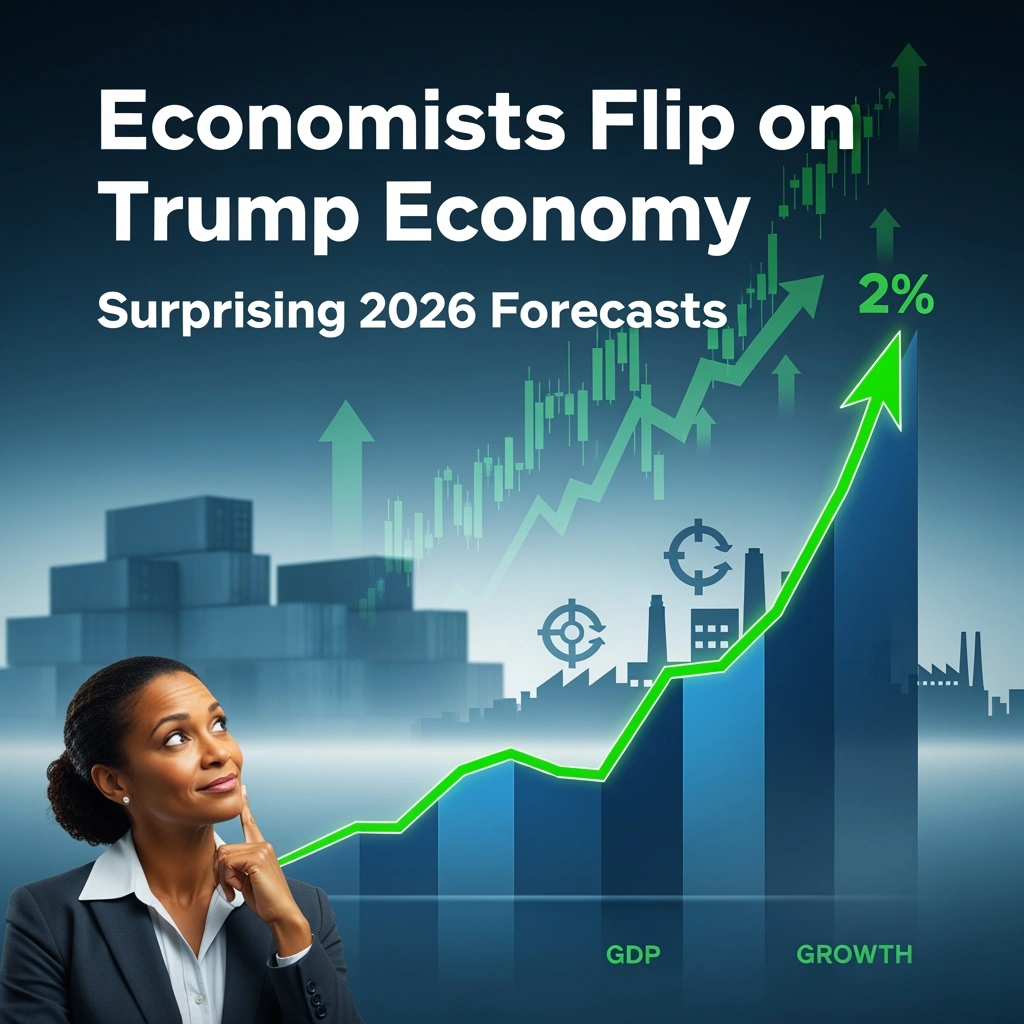
There’s a peculiar rhythm to economic forecasting in polarized times. Last year, as President Trump’s second term began with talk of sweeping tariffs and aggressive trade renegotiations, professional economists did what they’re trained to do: they downgraded their growth projections. The US economic outlook 2026 dimmed considerably, with consensus forecasts sliding from a comfortable 2.4% GDP growth to a more anemic 1.8% by mid-2025.
Now, barely six months later, those same economists are quietly walking back their pessimism. The latest Wall Street Journal survey of forecasters shows the 2026 GDP forecast rebounding to 2.2%—a meaningful revision that signals something important has shifted in how the professional class views Trumponomics impact on the American economy.
It’s a classic case of markets—and economists—hating uncertainty more than bad news. What we’re witnessing isn’t necessarily a vindication of Trump’s economic policies, nor is it a repudiation. Rather, it’s a sophisticated recalibration based on three critical insights: the policies are more predictable than feared, the underlying economy has proven remarkably resilient, and the full policy mix includes growth-positive elements that may offset the drag from protectionism.
This article examines why economic sentiment has reversed course, what the latest data reveals about US GDP growth 2026 forecast, and what this recalibration means for investors, policymakers, and everyday Americans navigating an economy caught between competing forces.
The Evolution of Forecasts: From Pre-Election Optimism to Tariff Fears and Back
To understand where we are, we need to trace where we’ve been. The forecast trajectory for 2026 reads like a volatility chart.
In late 2024, before the November election, economists were cautiously optimistic. The Federal Reserve had engineered what looked increasingly like a soft landing—inflation cooling from its 2022 peaks without triggering recession. The Blue Chip Economic Indicators survey showed consensus 2026 GDP forecast hovering around 2.3%, roughly in line with estimates of potential growth. The Conference Board projected similar numbers, while the IMF’s October 2024 World Economic Outlook pegged US growth at 2.2% for 2026.
Then came the election and its aftermath. President Trump’s victory brought promises of universal baseline tariffs, potential 60% levies on Chinese imports, and sweeping immigration restrictions. For economists schooled in the costs of protectionism, alarm bells rang. The Trump tariffs economic growth calculus looked decidedly negative.
By February 2025, the downgrades began in earnest. Goldman Sachs economists, who had been relatively optimistic, trimmed their 2026 forecast from 2.4% to 1.9%. The Wall Street Journal’s monthly survey saw its consensus plummet to 1.8% by March 2025—the lowest reading since the COVID recovery. The National Association for Business Economics (NABE) survey told a similar story, with members citing trade policy uncertainty as their top concern. Even typically sanguine forecasters like Vanguard’s economic team reduced their baseline scenario.
The concerns were well-founded in economic theory. Tariffs function as consumption taxes, raising prices for businesses and consumers. Immigration restrictions, in an economy near full employment, threatened to constrain labor supply and boost wage pressures. The Tax Foundation estimated that comprehensive tariff implementation could reduce GDP by 0.5-0.7 percentage points. Oxford Economics modeled potential scenarios showing growth dropping below 1.5% under aggressive trade action.
But here’s what economists didn’t fully anticipate: the gap between campaign rhetoric and implemented policy, the market’s growing comfort with Trump’s negotiating style, and the resilience of the underlying economic fundamentals.
What the Latest Surveys Reveal: A Quiet Consensus Emerges
Fast forward to January 2026, and the forecast landscape looks strikingly different. The latest Wall Street Journal survey, conducted in early January and released last week, shows the consensus US economic outlook 2026 rising to 2.2%—a 40-basis-point upgrade from the trough just months ago.
But the WSJ survey doesn’t stand alone. A convergence is happening across the forecasting community:
Major Forecast Revisions (2026 GDP Growth):
- Goldman Sachs: Now projecting 2.5%, up from 1.9% (June 2025 revision)
- Morgan Stanley: 2.3%, revised from 1.7%
- JP Morgan: 2.1%, up from 1.8%
- Deloitte Economic Outlook: 2.2% baseline scenario
- Blue Chip Economic Indicators: Consensus 2.2% (January 2026)
- IMF World Economic Outlook Update: 2.3% (January 2026 release)
- World Bank Global Economic Prospects: 2.1% (January 2026)
- Conference Board: 2.0% (December 2025 revision)
The pattern is unmistakable. Institutions that slashed forecasts in late 2024 and early 2025 are now rebuilding their growth expectations. Goldman Sachs economist Jan Hatzius, whose team produces some of Wall Street’s most closely watched forecasts, noted in a recent client note that “the policy uncertainty premium has declined meaningfully as the administration’s approach has become clearer and more selective than initially feared.”
The Federal Reserve’s own Summary of Economic Projections, released at the December 2025 FOMC meeting, shows Fed governors’ median 2026 GDP forecast at 2.0%—unchanged from September but notably not downgraded despite ongoing policy uncertainty. The Atlanta Fed’s GDPNow model, which provides real-time tracking, has been running consistently above 2% for Q1 2026.
Even international observers are upgrading. The OECD’s November 2025 Economic Outlook raised its US forecast to 2.2%, while private European forecasters like Capital Economics shifted from recession warnings to modest growth projections.
What explains this collective revision? The answer lies not in economists becoming Trump enthusiasts, but in three interconnected developments that have reduced tail risks and clarified the policy trajectory.
Why Concerns Have Receded: Pricing In Predictability
The first and perhaps most important factor: policy clarity has increased, and actual implementation has been more measured than feared.
While President Trump imposed selective tariffs—including 20% levies on certain steel and aluminum imports and targeted increases on Chinese electric vehicles and semiconductors—the promised universal baseline tariff never materialized. The threatened 60% across-the-board China tariffs were replaced by sector-specific measures and ongoing negotiations. The administration has clearly prioritized using tariff threats as negotiating leverage rather than as a comprehensive policy overhaul.
“We’ve essentially moved from pricing in worst-case scenarios to pricing in what’s actually happening,” explains Mark Zandi, chief economist at Moody’s Analytics, in a recent podcast. “The administration has proven more pragmatic than the campaign suggested.”
This matters enormously for economic modeling. A 10% universal tariff has very different effects than targeted 20-25% tariffs on specific sectors. The former would ripple through the entire price system; the latter creates manageable adjustments in affected industries while leaving broader consumption patterns largely intact.
The immigration policy follow-through has similarly been less disruptive than modeled. While border enforcement has tightened and deportations have increased, mass deportation scenarios haven’t materialized. The labor market, while showing some regional tightness in agriculture and construction, hasn’t experienced the supply shock that February 2025 forecasts assumed. Initial claims for unemployment insurance remain near historic lows, and workforce participation has actually edged up.
Second, the underlying economic fundamentals have proven remarkably robust, providing a buffer against policy headwinds.
Consumer spending, which accounts for roughly 70% of US GDP, has maintained momentum through the uncertainty. Retail sales grew 3.2% in Q4 2025 (year-over-year), supported by solid wage growth, accumulated pandemic savings still working through the system, and a strong labor market. The unemployment rate stood at 3.9% in December 2025—above the 3.5% lows of 2023 but still historically tight.
Corporate balance sheets remain healthy. S&P 500 companies entered 2026 with leverage ratios near two-decade lows and cash positions that can fund investment even if financing conditions tighten. Capital expenditure plans, particularly in technology and infrastructure, continue to show strength. The Deloitte CFO Signals survey indicates that 64% of chief financial officers plan to increase capital spending in 2026—a vote of confidence in medium-term growth prospects.
The financial system is stable. Banks are well-capitalized, credit spreads remain reasonable, and there are no obvious bubbles threatening systemic stability. The Fed’s financial stability report, released in November 2025, identified no major vulnerabilities requiring immediate policy action. This stands in sharp contrast to the fragile conditions that preceded the 2008 financial crisis or even the regional banking stress of early 2023.
Third, economists have recalibrated their models to account for growth-positive policy elements that were underweighted in initial assessments.
The extension and expansion of the 2017 Tax Cuts and Jobs Act provisions—which were set to expire in 2025—provides meaningful fiscal stimulus. The Tax Foundation estimates that making these cuts permanent and adding new provisions (including expanded bonus depreciation and R&D expensing) could add 0.3-0.5 percentage points to GDP growth over a two-year horizon.
Deregulation across energy, finance, and technology sectors has proceeded faster than anticipated. While the economic effects of regulatory relief are notoriously difficult to quantify, surveys of business sentiment show meaningful improvement in perceived operating freedom. The National Federation of Independent Business (NFIB) optimism index rose 8 points between mid-2025 and January 2026, with “government regulations” dropping from the top concern to fourth place.
Energy policy has tilted decisively toward production maximization. Permits for drilling on federal lands have accelerated, and the administration has fast-tracked LNG export facilities. While this carries environmental costs, the economic modeling clearly shows near-term GDP benefits from increased domestic energy production and exports. The Energy Information Administration projects US crude oil production reaching 13.5 million barrels per day in 2026—a record that supports both GDP growth and the trade balance.
Potential Upside Drivers: Tax Cuts, Productivity, and the AI Wildcard
Beyond the recession of specific fears, there are genuine positive scenarios that some economists now see as plausible upside risks to the 2.2% consensus.
The most significant involves productivity growth. After decades of disappointing productivity performance—the so-called “productivity slowdown” that puzzled economists since the early 2000s—there are tantalizing hints of acceleration. Labor productivity grew at a 2.3% annual rate in Q3 2025, following 2.5% in Q2. These numbers, if sustained, would represent a meaningful break from the 1.3% average of the 2010-2019 period.
The driver? Artificial intelligence and related technologies may finally be showing up in the productivity statistics. Goldman Sachs research suggests that generative AI could boost productivity growth by 0.3-0.5 percentage points annually over the next decade as adoption spreads beyond early-adopting tech firms into traditional sectors. While productivity is notoriously hard to forecast, the possibility of sustained acceleration represents the most consequential upside scenario for long-term growth.
“If we’re entering a genuine productivity boom driven by AI diffusion, then 2.5-3% growth becomes achievable without triggering inflation,” notes Northwestern University economist Diane Swonk. “That would be the best-case scenario—and it’s not impossible.”
Tax policy provides another potential accelerant. Beyond simply extending existing cuts, there’s discussion of further corporate tax reduction and expanded investment incentives. While the fiscal sustainability of such measures is questionable, the growth effects in the near term could be meaningful. The Penn Wharton Budget Model estimates that comprehensive tax reform along the lines being discussed could add 0.2-0.4 percentage points to 2026 growth, though at the cost of significantly larger deficits.
Infrastructure spending, ironically, could provide bipartisan stimulus. Despite political dysfunction, there’s surprising consensus on the need for infrastructure investment, particularly in broadband, the electrical grid (to support AI data centers and EV charging), and water systems. The Infrastructure Investment and Jobs Act passed in 2021 continues to ramp up spending, and there are indications of potential additional packages. These have multiplier effects that many mainstream models may be underestimating.
Consumer balance sheets also carry upside potential. Household debt service ratios remain well below pre-2008 levels, suggesting capacity for increased borrowing if consumers choose to leverage themselves. The median FICO score has risen to 717—the highest in decades—indicating broad creditworthiness. If confidence continues improving and consumers decide to spend rather than save, consumption growth could exceed the modest projections embedded in current forecasts.
Lingering Risks: Inflation Persistence, Trade Escalation, and Fiscal Limits
Yet for all the upgraded optimism, significant downside risks remain—and prudent analysts are quick to enumerate them.
Inflation hasn’t fully surrendered. Core PCE inflation stood at 2.8% in December 2025, still uncomfortably above the Fed’s 2% target. The disinflationary progress that characterized 2023-2024 has stalled. If tariffs broaden or immigration restrictions tighten further, price pressures could reaccelerate. The Cleveland Fed’s inflation nowcast suggests core inflation may tick up to 3.0% by mid-2026 under current policy trajectories.
The Fed faces an uncomfortable dilemma. With inflation above target but growth forecasts modest, the central bank has limited room for error. The market currently prices in one 25-basis-point rate cut in 2026—far fewer than the four cuts anticipated a year ago. If inflation proves stickier than expected, the Fed may need to maintain restrictive policy longer, or even hike again, which would pressure growth. Goldman Sachs assigns a 25% probability to a “no-landing” scenario where persistent inflation forces renewed tightening.
Trade policy remains a wildcard. While the administration has been more selective than feared, the tariff toolkit remains on the table. Negotiations with China remain contentious, and there are indications of potential new actions on autos and pharmaceuticals. Each escalation carries ripple effects through supply chains that are difficult to model. The Peterson Institute for International Economics maintains that comprehensive tariff implementation could still reduce GDP by 0.5-1.0 percentage points if deployed broadly.
Global retaliation poses additional risks. The EU has already implemented measured counter-tariffs on $6 billion in US goods. China has responded with restrictions on rare earth exports and agricultural purchases. If tit-for-tat escalation accelerates, US exporters—particularly in agriculture, aerospace, and professional services—could face significant headwinds. The National Association of Manufacturers warns that export-dependent sectors remain vulnerable to policy shifts.
Fiscal sustainability concerns are mounting. The Congressional Budget Office projects the federal deficit reaching $2.0 trillion in fiscal 2026—roughly 7% of GDP during a period of relative prosperity. If tax cuts expand without offsetting spending reductions, these deficits could swell further. While markets have thus far absorbed Treasury issuance without difficulty, there are limits to fiscal tolerance.
Higher deficits push up long-term interest rates, crowd out private investment, and create vulnerability to future crises. The 10-year Treasury yield has climbed from 3.8% in mid-2025 to 4.4% currently—not yet problematic, but moving in a concerning direction. If foreign buyers (particularly China and Japan) reduce Treasury holdings or if inflation fears intensify, financing costs could jump, creating a drag on growth that swamps policy stimulus.
Political dysfunction in Washington adds uncertainty. With narrow margins in Congress, legislative gridlock on fiscal and regulatory matters could prevent coherent policy implementation. The debt ceiling fight looms again in mid-2026, carrying the risk of another damaging standoff. These political economy factors don’t appear directly in GDP models but affect business confidence and planning horizons.
Global Ripple Effects and Comparative Outlooks
The US economic trajectory doesn’t unfold in isolation. How America performs relative to other major economies shapes capital flows, currency movements, and global growth dynamics.
The latest forecasts show US GDP growth 2026 forecast outpacing most developed economies. The Eurozone faces persistent structural challenges—aging demographics, energy dependence, and fiscal fragmentation—that constrain growth to around 1.3%. Germany, Europe’s largest economy, may barely reach 1.0% as manufacturing weakness persists. The UK, still managing post-Brexit adjustments and political uncertainty, is projected at 1.5%.
Japan presents an interesting case. After decades of stagnation, modest reforms and inflation returning to positive territory have created cautious optimism. The IMF projects 1.1% growth for Japan in 2026—underwhelming in absolute terms but representing relative improvement. The yen’s weakness has boosted export competitiveness, though at the cost of eroding real purchasing power for Japanese consumers.
China’s trajectory remains the great uncertainty in global forecasting. Official targets suggest 4.5-5.0% growth, but private analysts are increasingly skeptical. The property sector downturn continues to metastasize, local government debt pressures mount, and demographic headwinds intensify. Consensus among Western forecasters has settled around 4.2% for 2026—still high by developed economy standards but representing continued deceleration for the world’s second-largest economy.
This comparative context matters because US outperformance attracts capital. The dollar has strengthened against most major currencies, reflecting both higher relative growth and more attractive yields. This creates a virtuous cycle for US assets but potentially complicates the Fed’s inflation fight, as a strong dollar pressures commodity prices upward and tightens financial conditions globally.
Emerging markets face squeeze from multiple directions. Higher US yields pull capital away from riskier markets. A strong dollar increases debt servicing costs for the many countries that borrowed in dollars. Trade policy uncertainty disrupts supply chains that many emerging economies depend upon. The Institute of International Finance notes that emerging market growth forecasts have been revised down by 0.3 percentage points on average for 2026, partly reflecting spillovers from US policy uncertainty.
Yet there are winners in the new configuration. Mexico benefits from nearshoring trends and USMCA trade advantages, with forecasts around 2.7%. India continues to attract investment as a China alternative, with projections near 6.5%. Vietnam, Indonesia, and Poland have emerged as beneficiaries of supply chain diversification.
The global picture, then, shows the US growing faster than most developed economies but slower than major emerging markets—a middle ground that reflects both American strengths (dynamism, innovation, deep capital markets) and constraints (high debt levels, political polarization, demographic pressures).
What This Means for Investors, Policymakers, and Everyday Americans
So economists are upgrading forecasts. What does that actually mean beyond wonky spreadsheets and academic debates?
For investors, the message is nuanced. A 2.2% growth environment is neither boom nor bust—it’s a Goldilocks scenario where corporate earnings can expand modestly without triggering inflation that forces aggressive Fed tightening. Equity market valuations currently reflect considerable optimism, with the S&P 500 trading near 21x forward earnings. That’s sustainable if earnings grow 8-10%, which is plausible in a 2.2% GDP environment with healthy margins.
Fixed income becomes more interesting. If the Fed cuts once in 2026 as markets expect, the yield curve should steepen, benefiting longer-duration bonds. But inflation risks argue for caution on long-duration exposure. The classic 60/40 portfolio may finally find firmer footing after years of challenges, though with returns likely in the high single digits rather than the double-digit bonanza of recent years.
Real assets deserve attention. If inflation proves persistent in the 2.5-3.0% range, commodities, real estate, and infrastructure investments provide natural hedges. Gold has already rallied to near-record levels, reflecting both inflation hedging and geopolitical risk premiums. Energy equities could benefit from both production-friendly policy and constrained global supply.
For policymakers, the upgraded outlook creates breathing room but not comfort. The Fed can likely hold rates steady rather than hiking again, but cuts depend on inflation cooperating. Fiscal authorities face the awkward reality that deficits remain high despite solid growth—a structural problem that will require painful adjustments eventually.
Trade negotiators operate in a window where economic resilience allows aggressive bargaining without immediate crisis, but the patience of affected industries has limits. The agricultural sector, for example, has absorbed significant export losses from retaliatory tariffs; continued pain could force policy adjustments.
Regulatory agencies implementing deregulation must balance growth objectives with prudential oversight. The 2008 financial crisis demonstrated the costs of regulatory capture and inadequate supervision. Finding the right equilibrium—enough oversight to prevent systemic risk, enough freedom to enable innovation—remains deeply challenging.
For everyday Americans, a 2.2% growth economy means the labor market should remain relatively healthy. Unemployment may drift up toward 4.2-4.5% but not spike toward recessionary levels. Wage growth should continue modestly above inflation, supporting real income gains. That said, the gains will be uneven—knowledge workers in tech hubs fare better than manufacturing workers in legacy industries.
Housing affordability remains challenged. With mortgage rates likely staying in the 6-7% range and home prices elevated, homeownership hurdles persist for younger households. Renters face similar pressures as construction hasn’t kept pace with household formation.
The wealth gap continues widening. Asset price appreciation disproportionately benefits the already-wealthy, while those dependent on wages face stagnant or modestly improving living standards. This dynamic, while not new, carries political implications that feed back into economic policy debates.
Perhaps most importantly, everyday Americans should recognize that consensus forecasts have error bars. A 2.2% forecast could easily become 1.5% if trade escalation accelerates or 3.0% if productivity surges. The range of outcomes remains wide, and individual circumstances vary enormously based on industry, geography, and skill level.
Looking Ahead: Confidence Tempered by Uncertainty
The story of economists Trump policies 2026 assessment is ultimately one of professionals adjusting their models to reality. The downgrade cycle of late 2024 and early 2025 reflected genuine concerns about policy direction; the upgrade cycle now underway reflects recognition that implementation has been more measured and the economy more resilient than feared.
But let’s be clear: raising forecasts from 1.8% to 2.2% doesn’t mean all is well. It means the probability of near-term recession has diminished while the likelihood of moderate, unspectacular growth has increased. It’s the economic equivalent of revising a student’s grade from a C-minus to a C-plus—better, but hardly honor roll material.
The US economic outlook 2026 remains clouded by uncertainty that no model fully captures. Geopolitical tensions from Ukraine to the Middle East to Taiwan carry tail risks. Technological disruption could accelerate or disappoint. Political polarization could intensify or ease. Climate events grow more frequent and severe, creating economic costs not fully reflected in GDP forecasts.
What economists have learned—or relearned—through this cycle is humility. The confident downgrades of early 2025 now look premature, just as the comfortable 2.4% forecasts of late 2024 proved naïve. Economic forecasting remains more art than science, particularly in an era where policy whiplash and structural change make historical relationships less reliable.
The honest assessment is this: The US economy appears positioned for moderate growth in 2026, supported by resilient fundamentals and more predictable policy than initially feared. Inflation pressures remain elevated but not runaway. The labor market continues near full employment. Financial stability looks sound. Productivity may be inflecting upward.
Yet meaningful risks persist across multiple dimensions—inflation, trade, fiscal sustainability, political dysfunction, and global spillovers. The margin for error remains thin. Policy mistakes could tip the economy toward stagnation; external shocks could disrupt even the most carefully constructed forecasts.
For those watching from outside the economics profession, the takeaway should be measured optimism tempered by realism. The worst-case scenarios of early 2025 have receded. The best-case scenarios remain plausible but not assured. What’s most likely is muddle-through growth—enough to keep recession at bay, not enough to solve structural challenges.
And perhaps that’s fitting. In an era of extraordinary change and genuine uncertainty, muddling through with modest growth and manageable risks might be the best outcome we can reasonably expect. Economists have upgraded their forecasts because that’s what the data suggests. Whether those forecasts prove accurate will depend on countless decisions—by policymakers, business leaders, consumers, and global actors—that haven’t yet been made.
The one certainty? Six months from now, economists will be revising their forecasts again. And the cycle will continue.


There is a moment in every genuine geopolitical crisis when financial markets stop pretending they are merely reacting to data and begin reckoning with something more elemental: fear. That moment arrived on the morning of Saturday, February 28, 2026, when the United States and Israel launched coordinated strikes on Iran—killing Supreme Leader Ayatollah Ali Khamenei and igniting the most consequential military conflict in the Middle East in a generation. By Monday morning in New York, the world’s trading floors were measuring the aftershocks in barrels, basis points, and bullion.
What began as a targeted military operation has rapidly evolved into a multi-front conflict with cascading implications for energy markets, global supply chains, and the architecture of international finance. For investors, policymakers, and ordinary citizens watching the price of petrol rise at the pump, the central question is no longer whether markets will feel the US-Iran conflict market impact—they already are. The real question is how deep, how prolonged, and who ultimately bears the cost.
Immediate Market Reactions: Risk-Off in Real Time
The financial system’s first verdict was swift and largely predictable in its direction if not its magnitude. Stocks fell and the dollar climbed as military strikes intensified across the Middle East, sending oil to its biggest surge in four years while stoking concern that inflation will accelerate. Gold briefly topped $5,400. The S&P 500 dropped 1.1%, following losses in Europe and Asia. Airlines and cruise operators sank while energy and defense shares jumped. Bloomberg
By Monday’s open, the damage had spread more broadly. The Dow Jones Industrial Average dropped 282 points, or 0.6%. The S&P 500 lost 0.5%, and the Nasdaq Composite declined 0.4%—though the three major averages rallied off session lows as gains in technology stocks helped trim losses. At their nadir, the Dow was down about 600 points, or 1.2%. CNBC The CBOE Volatility Index—Wall Street’s so-called “fear gauge”—jumped to its highest level of 2026.
The bond market offered a counterintuitive signal. The 10-year Treasury yield was little changed Monday at 3.97%, regaining some ground after falling to an 11-month low of 3.926% on Friday. CNBC That modest move suggested bond traders are torn between two forces: a flight-to-safety impulse pulling yields lower, and an inflation anxiety—driven by soaring oil—pushing them back up. As an analyst, I’ve observed this precise tension before in conflict-driven crises: the bond market’s internal debate often telegraphs how long-lasting the disruption will prove to be.
The Strait of Hormuz: The World’s Most Expensive Bottleneck
No single geographic feature looms larger over the geopolitical risks oil prices calculation than the Strait of Hormuz. This narrow waterway between Iran and Oman is, in the words of one analyst, not a “production story” but a “chokepoint story”—and chokepoints, when threatened, carry systemic implications that dwarf any single country’s output.
More than 14 million barrels per day flowed through the Strait in 2025, or roughly a third of the world’s total seaborne crude exports. About three-quarters of those barrels went to China, India, Japan and South Korea. China, the world’s second-largest economy, receives half of its crude imports through the Strait. CNBC Iran has threatened to close this waterway entirely.
About 13 million barrels per day of crude oil transited the Strait of Hormuz in 2025, accounting for roughly 31% of global seaborne crude flows, according to market intelligence firm Kpler. CNBC Container shipping giants have already responded: Maersk announced it would suspend all vessel crossings in the Strait of Hormuz until further notice, warning that services calling ports in the Arabian Gulf may experience delays. CNBC
Amrita Sen, founder of Energy Aspects, told CNBC that oil markets are likely to hold around $80 a barrel for now after an initial spike, noting stabilization, but warned that “what the U.S. will not be able to do is control these one-off attacks on tankers.” CNBC The insurance industry is already pricing in the risk: marine hull insurance in the Gulf could rise by 25 to 50 percent in the near term, according to Dylan Mortimer, marine hull UK war leader at insurance broker Marsh. CNBC Those premiums ultimately flow through to the cost of every barrel, and every barrel’s cost flows through to every economy on earth.
Sector-Specific Impacts: Winners, Losers, and the Middle Ground
The Iran tensions global economy shock has not distributed its pain—or its windfalls—evenly across sectors. The divergence is stark.
Energy and Defense: The Reluctant Beneficiaries
Several oil stocks surged following the strikes on fears the conflict could disrupt global crude production and transport. Exxon Mobil and Chevron shares gained about 4%, while ConocoPhillips was also up more than 5%. Brent crude prices hit a new 52-week high of more than $78 on Monday. CNBC Defense contractors followed suit: Lockheed Martin shares gained 6%, while Northrop Grumman was up 5%, and drone maker AeroVironment jumped more than 10%. CNBC
Travel and Hospitality: The Immediate Casualties
Travel-related stocks dropped sharply. United Airlines, most exposed to international travel of the US carriers, tumbled more than 6%. American and Delta each fell more than 5%. Marriott International slid nearly 5%, while Airbnb sank more than 3%. Online reservation platforms Expedia and Booking Holdings slid more than 4% and 3% respectively. CNBC
The human toll on aviation has been immediate. Airlines canceled thousands of flights for the week in the Middle East, with 1,560 flights scrubbed on Monday alone, or 41.28% of those scheduled for arrival in Middle East countries, according to aviation data firm Cirium. Hundreds of thousands of passengers remain stranded. CNBC
Safe-Haven Assets: Gold’s Gravity-Defying Run
Gold’s ascent has been the defining market narrative of this crisis. Gold rallied above $5,300 per ounce, hitting record highs as investors moved into safe-haven assets. JP Morgan has raised its gold price target to $6,300 per ounce by December 2026, reflecting analyst confidence that this isn’t just a temporary spike. INDmoney Precious metals and the US dollar are now functioning as the twin shock absorbers of the global financial system.
Long-Term Risks: Inflation, Fragmentation, and the Asian Dimension
Beyond the immediate volatility lies a more structurally dangerous set of pressures. Elevated oil prices, if sustained, function as a regressive global tax—hitting emerging markets, commodity-importing nations, and lower-income households hardest.
Standard Chartered’s Global Head of Research Eric Robertsen noted that investors had already been underpricing geopolitical risk, with commodity-linked currencies outperforming, suggesting markets are paying for exposure to scarce resources and terms-of-trade winners. CNBC
The implications for Asia—the region most dependent on Hormuz-transiting oil—are severe and underappreciated by Western financial commentary. China, Japan, South Korea, and India collectively import the vast majority of their crude through this corridor. Any sustained disruption would accelerate inflationary pressures across Asian manufacturing economies, potentially stalling the global export recovery that policymakers have counted on.
There is also the geopolitical fracture dimension. China and Russia have condemned the US-Israeli strikes. In a phone call with his Russian counterpart, Chinese Foreign Minister Wang Yi said it was “unacceptable for the US and Israel to launch attacks against Iran.” CNBC This fracture carries long-term implications for dollar-denominated trade systems, multilateral institutions, and the cohesion of any post-conflict reconstruction framework.
The scenario analysis from Wells Fargo is instructive. Their strategists mapped out scenarios ranging from quick de-escalation to a worst-case prolonged Hormuz closure: in their worst-case scenario, the S&P 500 could drop to 6,000 from current levels around 6,850, but their base case still targets 7,500 by year-end. INDmoney The range of that spread—nearly 25%—is itself a measure of how genuinely uncertain the endgame remains.
The Diplomatic Paradox: War Launched During Talks
Perhaps the most jarring dimension of this crisis is the diplomatic context in which it erupted. The UN Secretary-General noted that the joint military operation by Israel and the United States occurred following indirect talks between the US and Iran mediated by Oman, “squandering an opportunity for diplomacy.” UN News
Although the last round of talks ended Thursday with Iran agreeing to “never” stockpile enriched uranium, that was not enough to avert US military action. CNN Markets loathe uncertainty, but they despise diplomatic incoherence even more—because it removes the scaffolding of predictable resolution. The absence of a clear off-ramp is precisely what is keeping risk premiums elevated across asset classes.
President Trump has suggested the conflict could last four weeks, and separately told The Atlantic that Iran’s new leadership wants to resume negotiations. Trump said Iran’s new leadership wanted to resume negotiations and that he has agreed to talk to them, saying “They want to talk, and I have agreed to talk.” CNBC Markets will be parsing every diplomatic signal for evidence of de-escalation—any credible ceasefire announcement would likely trigger a sharp oil selloff and equity recovery.
Investor Implications and Strategic Considerations
For portfolio managers navigating Middle East conflict investment strategies, several principles apply in this environment.
Overweight energy and defense selectively. The oil price tailwind for integrated majors and defense contractors is real, but entry points matter. Much of the initial upside is already priced in.
Reduce exposure to aviation, hospitality, and emerging-market importers. Nations like India, South Korea, and Japan face disproportionate energy import cost pressures, which will compress corporate margins and strain current accounts.
Monitor the Strait obsessively. David Roche of Quantum Strategy framed the market impact in terms of duration and whether Iran would attempt to close the Strait of Hormuz—if the conflict is short and contained, the risk-off move and oil spike could be brief; if it turns into a three-to-five-week regime change endeavor, markets would react “rather badly.” CNBC
Gold remains the structural hedge. With JP Morgan targeting $6,300 by year-end and central bank demand for bullion already at historical highs entering 2026, gold’s role as the geopolitical insurance policy of last resort appears set to deepen.
Conclusion: A Conflict That Will Rewrite Risk Premiums
The US-Iran conflict of February-March 2026 is not merely another geopolitical flare-up to be absorbed and forgotten within a trading week. The assassination of Khamenei, the direct involvement of US military forces, the threatened closure of the world’s most critical energy chokepoint, and the fissure it has opened between Western and non-Western powers collectively represent a structural inflection point for global markets.
In the short term, monitor Brent crude and the CBOE VIX daily as the conflict’s most sensitive barometers. In the medium term, watch whether Iran’s successor leadership follows through on negotiation signals or opts for prolonged asymmetric warfare against Gulf infrastructure. In the long term, consider how this crisis accelerates the already-underway energy transition: every $10 increase in sustainable oil prices makes renewable alternatives marginally more competitive, nudging capital allocation toward green infrastructure.
Conflict is never an opportunity to celebrate. But history teaches that periods of maximum geopolitical uncertainty are also when the contours of the next financial order begin to take shape—quietly, beneath the noise of war. The investors and institutions who read those contours correctly today will be better positioned for the world that emerges when the smoke clears over Tehran.
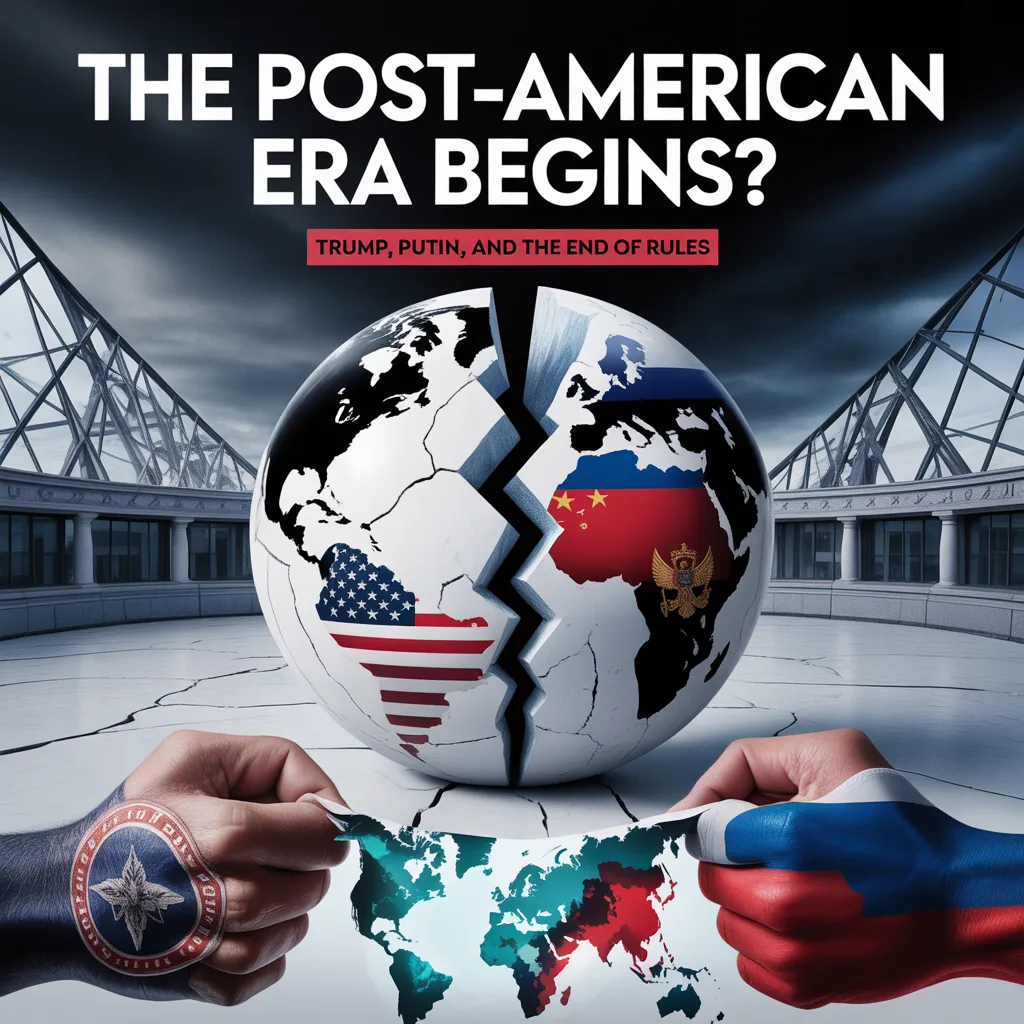
On a crisp January morning in Davos, as global elites gathered for their annual ritual of discussing “collaboration” and “shared prosperity,” Canadian Prime Minister Mark Carney delivered a speech that felt less like diplomacy and more like a eulogy. “We are in the midst of a rupture, not a transition,” he declared, warning that great powers now wield economic integration as weapons and tariffs as leverage. What made Carney’s address so striking wasn’t merely its candor about the death of the rules-based international order—it was the unspoken target of his critique. Though he never mentioned Donald Trump by name, everyone understood: the gravedigger of the post-1945 system isn’t primarily Beijing or Moscow. It’s Washington.
The irony is as sharp as it is unsettling. For eight decades, the United States positioned itself as the architect and guarantor of a liberal international order predicated on sovereignty, multilateral cooperation, and the peaceful resolution of disputes. Today, under Trump’s second administration, America is accelerating that order’s collapse with a ferocity that makes Russia’s revisionism look almost modest by comparison. The evidence is mounting: Trump Greenland national security threats that echo Putin’s Ukraine rationale, withdrawal from 66 international organizations, and an explicit rejection of international law itself. The world’s erstwhile hegemon isn’t pivoting—it’s demolishing its own creation.
Trump Greenland National Security: A Familiar Playbook
In late January 2026, President Trump declared that acquiring Greenland was “imperative for national and world security,” repeatedly refusing to rule out military force to seize the Danish autonomous territory. The White House press secretary confirmed that “utilizing the U.S. Military is always an option” in pursuing what Trump frames as a vital strategic objective. His justification? Greenland’s Arctic position makes it essential to defend against Russian and Chinese encroachment. Never mind that the United States already maintains a significant military presence at Pituffik Space Base under a 1951 agreement with Denmark, or that Denmark is a NATO ally bound by mutual defense commitments. Trump’s push for Greenland represents a territorial ambition dressed in the language of security—a rationale that should sound disturbingly familiar.
When Vladimir Putin ordered Russian forces into Ukraine in February 2022, he invoked strikingly similar logic. He framed the invasion as a preventive war necessitated by NATO expansion and Ukraine’s growing military cooperation with the West, which he characterized as an existential threat to Russian security. Putin claimed he was conducting a “special military operation to protect the people in the Donbas,” portraying Russia’s aggression as defensive action against Western provocations. The parallels to Trump’s Greenland rhetoric are unmistakable: both leaders invoke national security imperatives to justify territorial expansion, both dismiss the sovereignty of smaller nations as subordinate to great-power interests, and both signal willingness to use military force if diplomacy fails to deliver the desired result.

The structural similarity goes deeper than rhetoric. As scholars analyzing Putin’s preventive war logic have noted, Moscow genuinely feared that Ukraine’s westward drift would shift the balance of power irreversibly against Russia. Trump’s national security advisor reportedly framed Greenland in precisely these terms: critical minerals vital for emerging technologies and national security applications, combined with strategic positioning against peer competitors. Both cases reveal how great powers invoke security to legitimize what earlier eras would have simply called conquest. The Trump administration’s approach differs from Putin’s primarily in degree and presentation—Trump at Davos eventually backed away from tariff threats and pledged not to use force, though his broader posture suggests these were tactical retreats rather than strategic shifts.
Post-American Era: Economic Weaponization and the New Reality
Mark Carney’s Davos speech articulated what allies have whispered privately for years: the post-American era has arrived, and it arrived with American complicity. Drawing on Václav Havel’s essay on life under Soviet totalitarianism, Carney argued that middle powers had long placed metaphorical signs in their windows—participating in the rituals of the rules-based order while politely ignoring the gap between American rhetoric and reality. That bargain no longer works because great powers have begun using economic integration as weapons, tariffs as leverage, financial infrastructure as coercion, and supply chains as vulnerabilities to be exploited.
The economic weaponization Carney describes isn’t hypothetical. Trump has threatened 25% tariffs on European goods unless Denmark cedes Greenland, withdrawn from dozens of international organizations, and explicitly stated in a New York Times interview: “I don’t need international law.” These actions represent a systematic dismantling of the institutional architecture that Washington itself constructed after 1945. When the United States freezes all foreign assistance, blocks judges at the International Criminal Court with sanctions, and contemplates military seizure of allied territory, it’s not reforming the liberal international order—it’s demolishing it.
What distinguishes American norm erosion from Chinese or Russian revisionism is its devastating effect on the order’s legitimacy. Beijing and Moscow have long been external challengers, states that never fully bought into liberal principles and therefore were always viewed with suspicion by the system’s defenders. But when the United States—the order’s founding architect, military guarantor, and self-proclaimed exemplar—abandons multilateralism for transactionalism and sovereignty for spheres of influence, it removes the keystone from the entire edifice. As observers at Chatham House note, Trump’s assertion that he personally determines when the United States should comply with rules that bind others represents a fundamental repudiation of the reciprocity on which international law depends.
Trump Greenland Putin Ukraine Parallels: Great Powers Unchained
The parallels between Trump’s Greenland ambitions and Putin’s Ukraine invasion illuminate a broader pattern: the return of great-power politics unmoored from international legal constraints. Both leaders frame territorial expansion as defensive necessity, both invoke the language of security to mask strategic opportunism, and both signal contempt for the sovereignty of smaller neighbors. Yet the comparison also reveals asymmetries that make the American case more corrosive to global order.
Putin’s Russia, while destabilizing and aggressive, operates largely as expected from a revanchist power still nursing post-Cold War grievances. Moscow’s invasion of Ukraine, though catastrophic, surprised few serious analysts of Russian strategic culture. The Kremlin has consistently prioritized spheres of influence over sovereign equality, and its use of force, while illegal and brutal, aligns with historical patterns of Russian imperial behavior. International reaction to the Ukraine invasion—sanctions, isolation, unified NATO response—demonstrated that the international community still recognizes and punishes brazen violations of territorial integrity, even when committed by a nuclear-armed permanent Security Council member.
Trump’s America, by contrast, represents something more dangerous: the defection of the system’s hegemon. When the United States threatens military action against Greenland while simultaneously positioning itself as a defender of peace, when it withdraws from multilateral frameworks while demanding allies shoulder greater security burdens, it doesn’t just violate norms—it delegitimizes them. The hypocrisy is the point. By demonstrating that rules apply selectively based on power rather than principle, Washington validates every revisionist power’s cynicism about the liberal international order. Why should China respect freedom of navigation in the South China Sea when America threatens to seize Arctic territory from a NATO ally? Why should Russia accept Ukraine’s sovereignty when the United States disregards Greenland’s self-determination?
Three critical distinctions separate Trump’s approach from Putin’s and make it more systemically corrosive:
Institutional destruction vs. institutional evasion. Russia works around or against international institutions; America is actively dismantling them from within. Moscow violated the UN Charter by invading Ukraine, but it didn’t withdraw from the United Nations or sanction the International Court of Justice. Trump has done both equivalents, leaving a trail of abandoned treaties and defunded organizations.
Alliance betrayal vs. alliance expansion. Putin’s aggression strengthened NATO cohesion and prompted Finland and Sweden to join the alliance. Trump’s threats against Greenland have fractured transatlantic unity and raised existential questions about Article 5 guarantees. When a Democratic Senator observes that NATO countries might need to defend Greenland “against the U.S. if necessary,” the alliance’s foundational logic has collapsed.
Normative leadership vs. normative destruction. Russia never claimed to champion a rules-based order; its revisionism involves no ideological betrayal. America’s abandonment of principles it once preached—sovereignty, peaceful resolution of disputes, multilateral cooperation—represents a betrayal that undermines those principles’ global legitimacy. As analysis from the Carnegie Endowment notes, Trump’s policies signal a shift from American leadership of a liberal order to America operating as just one great power in a post-Western world.
US Undermining World Order: The Venezuela Test Case
If Trump’s Greenland threats represented rhetorical escalation, the January 2026 military operation in Venezuela provided brutal proof of concept. U.S. forces abducted Venezuelan President Nicolás Maduro and his wife in a large-scale raid on Caracas, with Trump declaring the United States would “run” Venezuela and was “not afraid of boots on the ground.” The operation violated every principle of sovereignty, non-intervention, and peaceful dispute resolution enshrined in the UN Charter—principles the United States spent decades promoting as universal norms.
The Venezuela intervention accelerated Trump’s Greenland campaign precisely because it demonstrated that consequences for American lawlessness remain minimal. International condemnation came, predictably, from South America and the Global South. But the muted response from European allies—whose own security depends on American credibility—revealed how thoroughly Trump has inverted the traditional logic of alliances. Rather than America’s allies constraining its behavior through institutional commitments and shared values, Trump has weaponized alliance dependence to extract concessions and silence criticism. When Denmark responded to Greenland threats by deploying elite troops to the territory, Trump threatened tariffs. When those tariffs materialized, European unity fractured.
This is economic coercion masquerading as alliance management, and it represents a profound departure from postwar American statecraft. Previous administrations occasionally pressured allies on defense spending or trade disputes, but they operated within an accepted framework of reciprocal obligations and institutional constraints. Trump has discarded that framework entirely, replacing it with a transactional model where America’s overwhelming power—military, economic, financial—becomes a cudgel for extracting unilateral advantage. The rules-based order assumed that power would be self-limiting, channeled through institutions and constrained by enlightened self-interest. Trump’s foreign policy demonstrates that assumption was always fragile.
Decline of Liberal International Order: Middle Powers and Adaptation
Carney’s speech represented more than elegant critique—it outlined a survival strategy for what he termed “middle powers” navigating the wreckage of American-led order. His prescription: stop invoking the “rules-based international order” as though it still functions as advertised, acknowledge that great powers now pursue unhindered power and interests, and build coalitions among less powerful states to create “a third path with impact.”
This vision of middle-power resilience through collective action offers both hope and warning. Hope, because it suggests the complete collapse into great-power spheres of influence isn’t inevitable—that states between the giants retain agency if they coordinate effectively. Warning, because it implicitly concedes that the universal rules-based order is dead, replaced by a more fragmented, regionalized system where justice and security depend on coalition strength rather than law.
Canada’s response under Carney illustrates this adaptation in practice. Within months of taking office, he signed trade and security agreements across four continents, doubled defense spending, and positioned Canada as a champion of the multilateral system that Washington is abandoning. Other middle powers are following similar playbooks. European nations are accelerating integration and boosting military capacity, recognizing they can no longer outsource security to an increasingly unreliable America. ASEAN states are diversifying partnerships, hedging between Washington and Beijing rather than betting exclusively on either. Even traditional American allies like South Korea and Japan are exploring greater strategic autonomy.
Yet this proliferation of hedging strategies and defensive regionalisms carries its own risks. A world organized around competing regional blocs and ad hoc coalitions may prove more stable than unconstrained great-power rivalry, but it represents a significant step backward from the aspirations of 1945. The postwar order, for all its flaws and hypocrisies, at least established the principle that international law should constrain power—that might shouldn’t automatically make right. When middle powers abandon appeals to universal norms in favor of balance-of-power politics, they validate the very great-power cynicism that necessitated their adaptation.
Rules-Based Order Collapse: The Path Forward
The uncomfortable truth that Carney articulated and Trump embodies is that nostalgia offers no strategy. The liberal international order that emerged from World War II—multilateral institutions, free trade, collective security, democratic solidarity—was always more aspiration than reality, particularly for those outside the Western security community. Its genuine achievements, from unprecedented economic growth to the avoidance of great-power war, coexisted with profound inequalities, selective application of rules, and a persistent gap between universalist rhetoric and particularist practice.
What made the system workable wasn’t perfection but American willingness to embed its hegemony within institutional constraints that at least gestured toward reciprocity and legitimacy. When Washington championed the WTO even when rulings went against it, when it built coalitions rather than dictating terms, when it defended smaller allies’ sovereignty even at cost to short-term interests, it sustained the fiction that rules could constrain power. Trump has shattered that fiction with remarkable efficiency.
The consequences extend far beyond Greenland or Venezuela. Every authoritarian regime now possesses a ready-made justification for territorial ambitions: “If America can threaten to seize allied territory for national security reasons, why can’t we?” Every middle power calculating its security posture must now account for the possibility that American protection is conditional, transactional, and reversible. Every international institution confronts an existential question: what purpose do rules serve when the most powerful player explicitly rejects their authority?
Three scenarios appear plausible for the international system’s evolution:
Fragmented regionalism: The current trajectory, where overlapping regional orders—European integration, Asian hedging, Western Hemisphere proximity to American power—replace the aspiration of universal rules. This is Carney’s “third path,” potentially more stable than pure great-power rivalry but far less protective of smaller states’ sovereignty and far less conducive to addressing global challenges like climate change or pandemic response.
Spheres of influence: Trump’s apparent preference, where great powers divide the world into exclusive zones and police their peripheries without interference. This arrangement might reduce great-power conflict through mutual recognition, but it would formalize the subordination of smaller states and legitimize territorial expansion for security reasons—essentially returning to 19th-century concert politics with 21st-century technology.
System collapse into conflict: The nightmare scenario, where the erosion of institutional restraints and proliferation of territorial grievances creates cascading crises that overwhelm great powers’ capacity for management. This is the path that led from the Congress of Vienna’s breakdown to World War I, and while nuclear weapons change the calculus, they don’t eliminate the risk of miscalculation and escalation.
None of these futures resembles the liberal international order’s promise. None offers the combination of sovereignty protection, economic openness, and collective security that defined postwar aspirations. And crucially, the United States isn’t drifting into these scenarios through inattention or incompetence—it’s actively accelerating toward them through deliberate policy choices that prioritize short-term advantage over long-term stability.
The Greengrocer’s Sign: Legitimacy and the Future
Carney’s invocation of Havel’s greengrocer serves as this moment’s most potent metaphor. For decades, allies participated in rituals celebrating the rules-based order even as they privately recognized its imperfections and hypocrisies. They placed the sign in the window—”Workers of the world, unite” or “Sovereignty matters” or “International law binds us all”—not out of conviction but to avoid trouble, signal compliance, and preserve the system’s veneer of legitimacy.
Trump has removed America’s sign. By explicitly stating “I don’t need international law,” by threatening force against allies, by withdrawing from institutions and agreements, he’s acknowledged what cynics always suspected: that American support for the liberal order was conditional on American advantage, and when that calculus shifted, the principles would be abandoned.
The question now is whether other powers will follow America’s example and remove their own signs, embracing naked interest and power politics, or whether they’ll attempt to sustain some version of rules-based order without American leadership. Early evidence suggests a mixture: some states, particularly in the Global South, are invoking international law more vigorously now that Washington has abandoned it, seeing an opportunity to constrain great powers through collective legal action. Others are pursuing the hedging strategies Carney advocates, building resilience through diversification rather than relying on rules.
What seems increasingly unlikely is a return to the comfortable fiction of the past seven decades—that a benign American hegemon would voluntarily constrain its power through institutional commitments and provide global public goods while asking relatively little in return. That fiction required American buy-in, and Trump has made clear that at least one major faction of American politics views it as a sucker’s bargain. Even if a future administration attempts to restore elements of liberal internationalism, allies will remember 2025-2026 and hedge accordingly.
The great tragedy of Trump’s Greenland obsession and broader assault on international order isn’t that it reveals American hypocrisy—serious observers always knew the gap between principle and practice. The tragedy is that it destroys whatever practical value that hypocrisy once served. When America claimed to support sovereignty while occasionally violating it, at least smaller states could appeal to those stated principles as leverage. When America framed alliances as partnerships rather than protection rackets, at least allies could assume some baseline of reliable commitments. Trump has stripped away the hypocrisy and left only the power politics beneath.
In doing so, he hasn’t made America weaker—the United States remains overwhelmingly powerful militarily and economically. But he has made the world more dangerous, more fragmented, and less capable of addressing collective challenges. And he has ensured that when historians write the story of the liberal international order’s collapse, they will identify not Beijing or Moscow as the primary accelerant, but Washington. The United States, having led the West in building an international order after 1945, now leads it in tearing that order down.
Carney’s warning deserves the final word: “The old order is not coming back. We should not mourn it. Nostalgia is not a strategy. But from the fracture, we can build something better, stronger and more just.” Whether middle powers can actually construct that better order while great powers pursue unhindered ambitions remains the decade’s defining question. But one thing is certain: they’ll be building it without the United States—or more precisely, despite the United States.
On a crisp January morning in Davos, as global elites gathered for their annual ritual of discussing “collaboration” and “shared prosperity,” Canadian Prime Minister Mark Carney delivered a speech that felt less like diplomacy and more like a eulogy. “We are in the midst of a rupture, not a transition,” he declared, warning that great powers now wield economic integration as weapons and tariffs as leverage. What made Carney’s address so striking wasn’t merely its candor about the death of the rules-based international order—it was the unspoken target of his critique. Though he never mentioned Donald Trump by name, everyone understood: the gravedigger of the post-1945 system isn’t primarily Beijing or Moscow. It’s Washington.
The irony is as sharp as it is unsettling. For eight decades, the United States positioned itself as the architect and guarantor of a liberal international order predicated on sovereignty, multilateral cooperation, and the peaceful resolution of disputes. Today, under Trump’s second administration, America is accelerating that order’s collapse with a ferocity that makes Russia’s revisionism look almost modest by comparison. The evidence is mounting: Trump Greenland national security threats that echo Putin’s Ukraine rationale, withdrawal from 66 international organizations, and an explicit rejection of international law itself. The world’s erstwhile hegemon isn’t pivoting—it’s demolishing its own creation.
Trump Greenland National Security: A Familiar Playbook
In late January 2026, President Trump declared that acquiring Greenland was “imperative for national and world security,” repeatedly refusing to rule out military force to seize the Danish autonomous territory. The White House press secretary confirmed that “utilizing the U.S. Military is always an option” in pursuing what Trump frames as a vital strategic objective. His justification? Greenland’s Arctic position makes it essential to defend against Russian and Chinese encroachment. Never mind that the United States already maintains a significant military presence at Pituffik Space Base under a 1951 agreement with Denmark, or that Denmark is a NATO ally bound by mutual defense commitments. Trump’s push for Greenland represents a territorial ambition dressed in the language of security—a rationale that should sound disturbingly familiar.
When Vladimir Putin ordered Russian forces into Ukraine in February 2022, he invoked strikingly similar logic. He framed the invasion as a preventive war necessitated by NATO expansion and Ukraine’s growing military cooperation with the West, which he characterized as an existential threat to Russian security. Putin claimed he was conducting a “special military operation to protect the people in the Donbas,” portraying Russia’s aggression as defensive action against Western provocations. The parallels to Trump’s Greenland rhetoric are unmistakable: both leaders invoke national security imperatives to justify territorial expansion, both dismiss the sovereignty of smaller nations as subordinate to great-power interests, and both signal willingness to use military force if diplomacy fails to deliver the desired result.
The structural similarity goes deeper than rhetoric. As scholars analyzing Putin’s preventive war logic have noted, Moscow genuinely feared that Ukraine’s westward drift would shift the balance of power irreversibly against Russia. Trump’s national security advisor reportedly framed Greenland in precisely these terms: critical minerals vital for emerging technologies and national security applications, combined with strategic positioning against peer competitors. Both cases reveal how great powers invoke security to legitimize what earlier eras would have simply called conquest. The Trump administration’s approach differs from Putin’s primarily in degree and presentation—Trump at Davos eventually backed away from tariff threats and pledged not to use force, though his broader posture suggests these were tactical retreats rather than strategic shifts.
Post-American Era: Economic Weaponization and the New Reality
Mark Carney’s Davos speech articulated what allies have whispered privately for years: the post-American era has arrived, and it arrived with American complicity. Drawing on Václav Havel’s essay on life under Soviet totalitarianism, Carney argued that middle powers had long placed metaphorical signs in their windows—participating in the rituals of the rules-based order while politely ignoring the gap between American rhetoric and reality. That bargain no longer works because great powers have begun using economic integration as weapons, tariffs as leverage, financial infrastructure as coercion, and supply chains as vulnerabilities to be exploited.
The economic weaponization Carney describes isn’t hypothetical. Trump has threatened 25% tariffs on European goods unless Denmark cedes Greenland, withdrawn from dozens of international organizations, and explicitly stated in a New York Times interview: “I don’t need international law.” These actions represent a systematic dismantling of the institutional architecture that Washington itself constructed after 1945. When the United States freezes all foreign assistance, blocks judges at the International Criminal Court with sanctions, and contemplates military seizure of allied territory, it’s not reforming the liberal international order—it’s demolishing it.
What distinguishes American norm erosion from Chinese or Russian revisionism is its devastating effect on the order’s legitimacy. Beijing and Moscow have long been external challengers, states that never fully bought into liberal principles and therefore were always viewed with suspicion by the system’s defenders. But when the United States—the order’s founding architect, military guarantor, and self-proclaimed exemplar—abandons multilateralism for transactionalism and sovereignty for spheres of influence, it removes the keystone from the entire edifice. As observers at Chatham House note, Trump’s assertion that he personally determines when the United States should comply with rules that bind others represents a fundamental repudiation of the reciprocity on which international law depends.
Trump Greenland Putin Ukraine Parallels: Great Powers Unchained
The parallels between Trump’s Greenland ambitions and Putin’s Ukraine invasion illuminate a broader pattern: the return of great-power politics unmoored from international legal constraints. Both leaders frame territorial expansion as defensive necessity, both invoke the language of security to mask strategic opportunism, and both signal contempt for the sovereignty of smaller neighbors. Yet the comparison also reveals asymmetries that make the American case more corrosive to global order.
Putin’s Russia, while destabilizing and aggressive, operates largely as expected from a revanchist power still nursing post-Cold War grievances. Moscow’s invasion of Ukraine, though catastrophic, surprised few serious analysts of Russian strategic culture. The Kremlin has consistently prioritized spheres of influence over sovereign equality, and its use of force, while illegal and brutal, aligns with historical patterns of Russian imperial behavior. International reaction to the Ukraine invasion—sanctions, isolation, unified NATO response—demonstrated that the international community still recognizes and punishes brazen violations of territorial integrity, even when committed by a nuclear-armed permanent Security Council member.
Trump’s America, by contrast, represents something more dangerous: the defection of the system’s hegemon. When the United States threatens military action against Greenland while simultaneously positioning itself as a defender of peace, when it withdraws from multilateral frameworks while demanding allies shoulder greater security burdens, it doesn’t just violate norms—it delegitimizes them. The hypocrisy is the point. By demonstrating that rules apply selectively based on power rather than principle, Washington validates every revisionist power’s cynicism about the liberal international order. Why should China respect freedom of navigation in the South China Sea when America threatens to seize Arctic territory from a NATO ally? Why should Russia accept Ukraine’s sovereignty when the United States disregards Greenland’s self-determination?
Three critical distinctions separate Trump’s approach from Putin’s and make it more systemically corrosive:
Institutional destruction vs. institutional evasion. Russia works around or against international institutions; America is actively dismantling them from within. Moscow violated the UN Charter by invading Ukraine, but it didn’t withdraw from the United Nations or sanction the International Court of Justice. Trump has done both equivalents, leaving a trail of abandoned treaties and defunded organizations.
Alliance betrayal vs. alliance expansion. Putin’s aggression strengthened NATO cohesion and prompted Finland and Sweden to join the alliance. Trump’s threats against Greenland have fractured transatlantic unity and raised existential questions about Article 5 guarantees. When a Democratic Senator observes that NATO countries might need to defend Greenland “against the U.S. if necessary,” the alliance’s foundational logic has collapsed.
Normative leadership vs. normative destruction. Russia never claimed to champion a rules-based order; its revisionism involves no ideological betrayal. America’s abandonment of principles it once preached—sovereignty, peaceful resolution of disputes, multilateral cooperation—represents a betrayal that undermines those principles’ global legitimacy. As analysis from the Carnegie Endowment notes, Trump’s policies signal a shift from American leadership of a liberal order to America operating as just one great power in a post-Western world.
US Undermining World Order: The Venezuela Test Case
If Trump’s Greenland threats represented rhetorical escalation, the January 2026 military operation in Venezuela provided brutal proof of concept. U.S. forces abducted Venezuelan President Nicolás Maduro and his wife in a large-scale raid on Caracas, with Trump declaring the United States would “run” Venezuela and was “not afraid of boots on the ground.” The operation violated every principle of sovereignty, non-intervention, and peaceful dispute resolution enshrined in the UN Charter—principles the United States spent decades promoting as universal norms.
The Venezuela intervention accelerated Trump’s Greenland campaign precisely because it demonstrated that consequences for American lawlessness remain minimal. International condemnation came, predictably, from South America and the Global South. But the muted response from European allies—whose own security depends on American credibility—revealed how thoroughly Trump has inverted the traditional logic of alliances. Rather than America’s allies constraining its behavior through institutional commitments and shared values, Trump has weaponized alliance dependence to extract concessions and silence criticism. When Denmark responded to Greenland threats by deploying elite troops to the territory, Trump threatened tariffs. When those tariffs materialized, European unity fractured.
This is economic coercion masquerading as alliance management, and it represents a profound departure from postwar American statecraft. Previous administrations occasionally pressured allies on defense spending or trade disputes, but they operated within an accepted framework of reciprocal obligations and institutional constraints. Trump has discarded that framework entirely, replacing it with a transactional model where America’s overwhelming power—military, economic, financial—becomes a cudgel for extracting unilateral advantage. The rules-based order assumed that power would be self-limiting, channeled through institutions and constrained by enlightened self-interest. Trump’s foreign policy demonstrates that assumption was always fragile.
Decline of Liberal International Order: Middle Powers and Adaptation
Carney’s speech represented more than elegant critique—it outlined a survival strategy for what he termed “middle powers” navigating the wreckage of American-led order. His prescription: stop invoking the “rules-based international order” as though it still functions as advertised, acknowledge that great powers now pursue unhindered power and interests, and build coalitions among less powerful states to create “a third path with impact.”
This vision of middle-power resilience through collective action offers both hope and warning. Hope, because it suggests the complete collapse into great-power spheres of influence isn’t inevitable—that states between the giants retain agency if they coordinate effectively. Warning, because it implicitly concedes that the universal rules-based order is dead, replaced by a more fragmented, regionalized system where justice and security depend on coalition strength rather than law.
Canada’s response under Carney illustrates this adaptation in practice. Within months of taking office, he signed trade and security agreements across four continents, doubled defense spending, and positioned Canada as a champion of the multilateral system that Washington is abandoning. Other middle powers are following similar playbooks. European nations are accelerating integration and boosting military capacity, recognizing they can no longer outsource security to an increasingly unreliable America. ASEAN states are diversifying partnerships, hedging between Washington and Beijing rather than betting exclusively on either. Even traditional American allies like South Korea and Japan are exploring greater strategic autonomy.
Yet this proliferation of hedging strategies and defensive regionalisms carries its own risks. A world organized around competing regional blocs and ad hoc coalitions may prove more stable than unconstrained great-power rivalry, but it represents a significant step backward from the aspirations of 1945. The postwar order, for all its flaws and hypocrisies, at least established the principle that international law should constrain power—that might shouldn’t automatically make right. When middle powers abandon appeals to universal norms in favor of balance-of-power politics, they validate the very great-power cynicism that necessitated their adaptation.
Rules-Based Order Collapse: The Path Forward
The uncomfortable truth that Carney articulated and Trump embodies is that nostalgia offers no strategy. The liberal international order that emerged from World War II—multilateral institutions, free trade, collective security, democratic solidarity—was always more aspiration than reality, particularly for those outside the Western security community. Its genuine achievements, from unprecedented economic growth to the avoidance of great-power war, coexisted with profound inequalities, selective application of rules, and a persistent gap between universalist rhetoric and particularist practice.
What made the system workable wasn’t perfection but American willingness to embed its hegemony within institutional constraints that at least gestured toward reciprocity and legitimacy. When Washington championed the WTO even when rulings went against it, when it built coalitions rather than dictating terms, when it defended smaller allies’ sovereignty even at cost to short-term interests, it sustained the fiction that rules could constrain power. Trump has shattered that fiction with remarkable efficiency.
The consequences extend far beyond Greenland or Venezuela. Every authoritarian regime now possesses a ready-made justification for territorial ambitions: “If America can threaten to seize allied territory for national security reasons, why can’t we?” Every middle power calculating its security posture must now account for the possibility that American protection is conditional, transactional, and reversible. Every international institution confronts an existential question: what purpose do rules serve when the most powerful player explicitly rejects their authority?
Three scenarios appear plausible for the international system’s evolution:
Fragmented regionalism: The current trajectory, where overlapping regional orders—European integration, Asian hedging, Western Hemisphere proximity to American power—replace the aspiration of universal rules. This is Carney’s “third path,” potentially more stable than pure great-power rivalry but far less protective of smaller states’ sovereignty and far less conducive to addressing global challenges like climate change or pandemic response.
Spheres of influence: Trump’s apparent preference, where great powers divide the world into exclusive zones and police their peripheries without interference. This arrangement might reduce great-power conflict through mutual recognition, but it would formalize the subordination of smaller states and legitimize territorial expansion for security reasons—essentially returning to 19th-century concert politics with 21st-century technology.
System collapse into conflict: The nightmare scenario, where the erosion of institutional restraints and proliferation of territorial grievances creates cascading crises that overwhelm great powers’ capacity for management. This is the path that led from the Congress of Vienna’s breakdown to World War I, and while nuclear weapons change the calculus, they don’t eliminate the risk of miscalculation and escalation.
None of these futures resembles the liberal international order’s promise. None offers the combination of sovereignty protection, economic openness, and collective security that defined postwar aspirations. And crucially, the United States isn’t drifting into these scenarios through inattention or incompetence—it’s actively accelerating toward them through deliberate policy choices that prioritize short-term advantage over long-term stability.
The Greengrocer’s Sign: Legitimacy and the Future
Carney’s invocation of Havel’s greengrocer serves as this moment’s most potent metaphor. For decades, allies participated in rituals celebrating the rules-based order even as they privately recognized its imperfections and hypocrisies. They placed the sign in the window—”Workers of the world, unite” or “Sovereignty matters” or “International law binds us all”—not out of conviction but to avoid trouble, signal compliance, and preserve the system’s veneer of legitimacy.
Trump has removed America’s sign. By explicitly stating “I don’t need international law,” by threatening force against allies, by withdrawing from institutions and agreements, he’s acknowledged what cynics always suspected: that American support for the liberal order was conditional on American advantage, and when that calculus shifted, the principles would be abandoned.
The question now is whether other powers will follow America’s example and remove their own signs, embracing naked interest and power politics, or whether they’ll attempt to sustain some version of rules-based order without American leadership. Early evidence suggests a mixture: some states, particularly in the Global South, are invoking international law more vigorously now that Washington has abandoned it, seeing an opportunity to constrain great powers through collective legal action. Others are pursuing the hedging strategies Carney advocates, building resilience through diversification rather than relying on rules.
What seems increasingly unlikely is a return to the comfortable fiction of the past seven decades—that a benign American hegemon would voluntarily constrain its power through institutional commitments and provide global public goods while asking relatively little in return. That fiction required American buy-in, and Trump has made clear that at least one major faction of American politics views it as a sucker’s bargain. Even if a future administration attempts to restore elements of liberal internationalism, allies will remember 2025-2026 and hedge accordingly.
The great tragedy of Trump’s Greenland obsession and broader assault on international order isn’t that it reveals American hypocrisy—serious observers always knew the gap between principle and practice. The tragedy is that it destroys whatever practical value that hypocrisy once served. When America claimed to support sovereignty while occasionally violating it, at least smaller states could appeal to those stated principles as leverage. When America framed alliances as partnerships rather than protection rackets, at least allies could assume some baseline of reliable commitments. Trump has stripped away the hypocrisy and left only the power politics beneath.
In doing so, he hasn’t made America weaker—the United States remains overwhelmingly powerful militarily and economically. But he has made the world more dangerous, more fragmented, and less capable of addressing collective challenges. And he has ensured that when historians write the story of the liberal international order’s collapse, they will identify not Beijing or Moscow as the primary accelerant, but Washington. The United States, having led the West in building an international order after 1945, now leads it in tearing that order down.
Carney’s warning deserves the final word: “The old order is not coming back. We should not mourn it. Nostalgia is not a strategy. But from the fracture, we can build something better, stronger and more just.” Whether middle powers can actually construct that better order while great powers pursue unhindered ambitions remains the decade’s defining question. But one thing is certain: they’ll be building it without the United States—or more precisely, despite the United States.

KSE-100 Plunges Amid Geopolitical Firestorm — But Islamabad Holds the World’s Attention

The Trump Coin and Lessons from the Ostrogoths: How a Gold Offering Reveals the Limits of Presidential Power Over America’s Money

Gaming Giant’s Bold Gamble: Why Investors are Devouring Risky EA Debt Amid Geopolitical Crosscurrents

Top 15 Stocks for Investment in 2026 in PSX: Your Complete Guide to Pakistan’s Best Investment Opportunities
Top 15 Stocks for Investment in 2026 in PSX: Your Complete Guide to Pakistan’s Best Investment Opportunities

Debunking IMF Program Myths: Reconfiguring Engagement for True National Ownership in a Volatile World
-
 Markets & Finance3 months ago
Top 15 Stocks for Investment in 2026 in PSX: Your Complete Guide to Pakistan’s Best Investment Opportunities
-
Markets & Finance3 months ago
Top 15 Stocks for Investment in 2026 in PSX: Your Complete Guide to Pakistan’s Best Investment Opportunities
-
 Analysis2 months ago
Debunking IMF Program Myths: Reconfiguring Engagement for True National Ownership in a Volatile World
-

 Global Economy3 months ago
What the U.S. Attack on Venezuela Could Mean for Oil and Canadian Crude Exports: The Economic Impact
-

 Investment3 months ago
Top 10 Mutual Fund Managers in Pakistan for Investment in 2026: A Comprehensive Guide for Optimal Returns
-

 Asia3 months ago
China’s 50% Domestic Equipment Rule: The Semiconductor Mandate Reshaping Global Tech
-

 AI3 months ago
15 Most Lucrative Sectors for Investment in Pakistan: A 2025 Data-Driven Analysis
-

 Exports3 months ago
Pakistan’s Export Goldmine: 10 Game-Changing Markets Where Pakistani Businesses Are Winning Big in 2025