
Banks
Singapore’s Banking Paradox: Why Fee Income and Loan Recovery Can’t Fully Save Margins in 2026

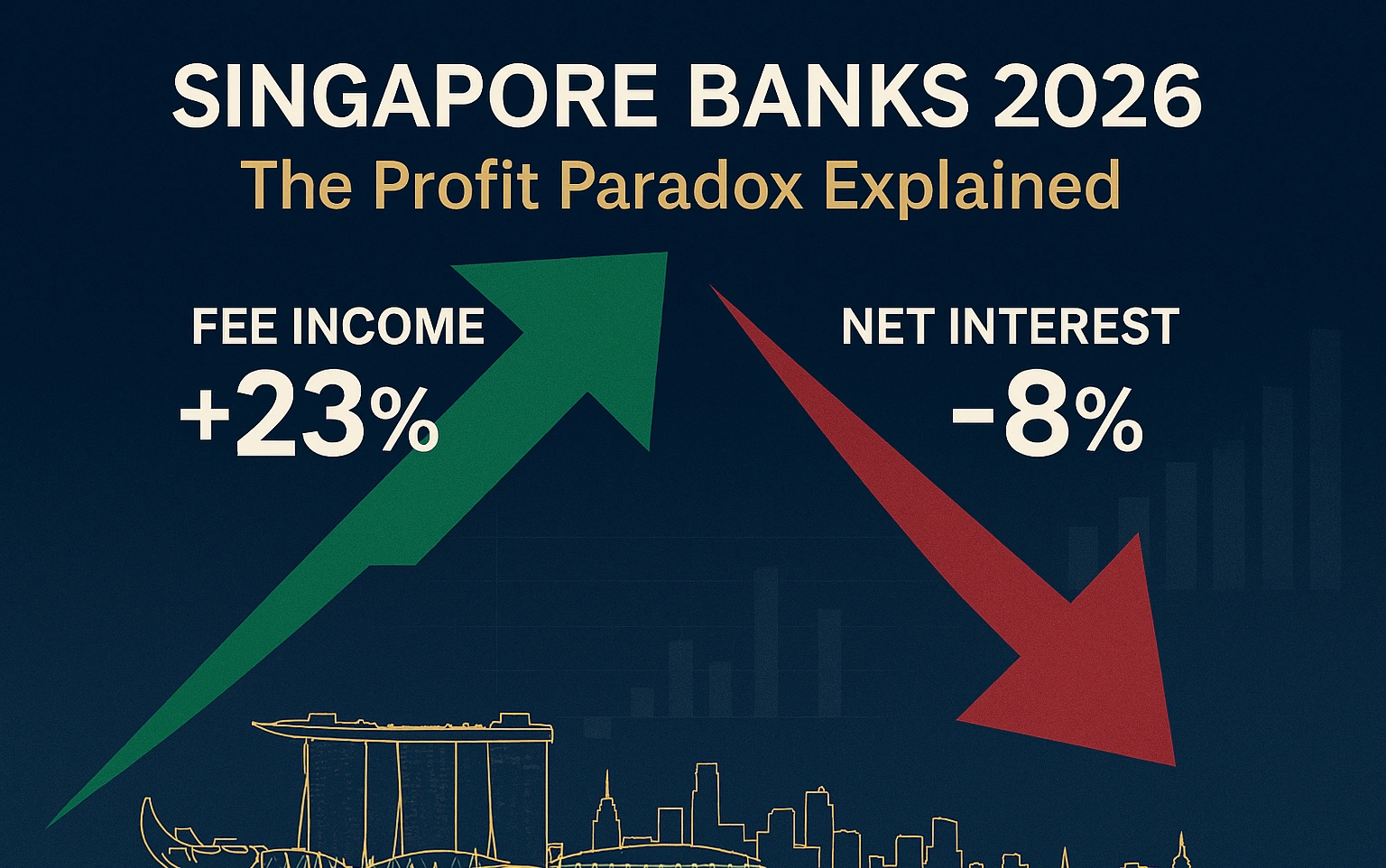
The city-state’s banking giants are rewriting their revenue playbook as traditional profit engines sputter—here’s what investors need to know
When DBS CEO announced Q3 2025 results with wealth management fees surging 20% year-over-year, the stock dropped 4%. Welcome to the new reality for Singapore banking: spectacular growth in one revenue stream can’t quite compensate for what’s eroding in another.
As 2026 unfolds, Singapore’s Big Three banks—DBS Group Holdings, OCBC Bank, and United Overseas Bank—find themselves navigating a fundamental recalibration. Analysts foresee a 2% growth in earnings per share for DBS in 2026, driven mainly through fee income, while net interest margins are anticipated to soften further, with UOB guiding for 1.75%-1.80%, down from 1.85%-1.90% in 2025.
This isn’t a crisis. It’s a transformation—one that reveals which banks have successfully diversified their revenue engines and which remain dangerously dependent on interest spreads that peaked in 2024 and won’t return anytime soon.
The Great Margin Squeeze: Why Singapore Banks Face Their Toughest Earnings Test in Years
The golden age of Singapore banking profitability, fueled by the 2022-2024 interest rate surge, is definitively over. Net interest margin declined to 1.84% for OCBC in Q3 2025 from 1.92% in Q2, while DBS reported the highest net interest margin at 1.96%, compared to 1.84% for OCBC and 1.82% for UOB.
These numbers tell a stark story. Between Q2 2024 and Q3 2025, Singapore’s banks watched their core profit engine—the spread between what they charge on loans and what they pay on deposits—compress by 15 to 28 basis points. For context, every 10 basis point decline in net interest margin reduces group profit by approximately 2-3%, according to bank management guidance.
Key Takeaways for Investors
- Net interest margins will compress further in 2026, with UOB guiding 1.75-1.80% versus 1.85-1.90% in 2025
- Wealth management AUM surged 18% year-over-year for DBS and OCBC, 8% for UOB in Q3 2025
- Dividend yields forecast at 6.1% for DBS, 5.4% for OCBC and UOB in FY2026
- Loan growth expected at low-to-mid single digits (2-5%), driven by corporate lending and regional expansion
- All three banks maintain CET1 ratios above 15%, providing capital buffers for dividends and buybacks
The culprit? A perfect storm of declining benchmark rates and aggressive deposit repricing. Flagship current accounts and SGD fixed deposits have been repriced by -120 basis points to -175 basis points from Q3 2024 to Q3 2025, with UOB making a further 60 basis point cut to its flagship current account in December 2025.
Here’s what makes this particularly challenging: while rates fell sharply, banks couldn’t immediately reduce deposit rates without risking customer flight. This asymmetry—loans repricing downward quickly while deposits adjust slowly—creates a painful compression period that Singapore banks are navigating right now.
The regional comparison is equally sobering. UOB’s net interest margin narrowed to 1.82% from 2.05%, representing a 23 basis point decline that exceeds what many regional peers experienced. Hong Kong banks, facing similar rate dynamics, have generally maintained margins in the 1.6%-1.9% range, suggesting Singapore banks entered this downturn from a higher baseline—meaning they had further to fall.
Yet there’s a crucial silver lining buried in the data. DBS economists expect 3-month Singapore Overnight Rate Average (SORA) to rebound from lows of 1.13% in early December 2025 to hold at approximately 1.25% through 2026. This stabilization suggests the worst of the margin compression may be behind us, even if margins don’t recover to 2024 peaks.

Fee Income Revolution: The S$4.8 Billion Question Reshaping Singapore Banking
While net interest income declines, an extraordinary wealth management boom is reshaping Singapore’s banking landscape—and the numbers are staggering.
DBS’s wealth management assets under management rose 12% year-on-year in the first half of 2025, while wealth income grew 8% year-on-year. Meanwhile, OCBC recorded an 11% year-on-year increase in wealth management AUM, with wealth income up 4% year-on-year. Even UOB, dealing with integration challenges from its Citibank acquisition, posted respectable gains.
By Q3 2025, the momentum accelerated dramatically. Assets under management grew 18% year-over-year for both DBS and OCBC, while UOB recorded an 8% increase. To put these figures in perspective: DBS alone added approximately S$21 billion in net new money in 2024, lifting total AUM to S$426 billion.
What’s driving this wealth influx? Singapore’s transformation into Asia’s premier wealth management hub isn’t accidental—it’s structural. The city-state now hosts 1,650 single-family offices as of 2025, nearly double the count from two years earlier. Each of these family offices represents not just wealthy individuals parking capital, but sophisticated financial entities requiring comprehensive banking services: treasury management, foreign exchange hedging, multi-currency accounts, and bespoke lending arrangements.
The fee composition tells an even more interesting story. Wealth management income isn’t just investment management fees—it encompasses a sophisticated menu of services. DBS, for instance, generates wealth fees from discretionary portfolio management (where the bank makes investment decisions on behalf of clients), advisory services, custody fees, transaction commissions on securities trades, foreign exchange markups, and insurance product distribution through its bancassurance partnerships.
Fee income showed strong 20% year-over-year growth to S$1.58 billion for DBS in Q3 2025, driven primarily by wealth management fee income. OCBC’s performance was equally impressive, with 15% year-over-year growth in non-interest income to S$1.57 billion, driven particularly by net fees and commissions in wealth management.
The mathematics of fee income versus net interest income deserves scrutiny. While fee income is growing at double-digit rates, it starts from a much smaller base than net interest income. For DBS, total fee income of approximately S$6 billion annually still represents roughly one-third of total net interest income. This means even a 20% surge in fees can only partially offset a 5-8% decline in NII.
But here’s what makes the fee story genuinely transformational: quality of earnings. Net interest income is inherently cyclical, tied to central bank policies and economic cycles beyond any individual bank’s control. Fee income, particularly from wealth management, is stickier. Once a bank captures a wealthy family’s business—establishing trust, demonstrating competence, and embedding itself in the family’s financial infrastructure—that relationship tends to persist across interest rate cycles.
The sustainability question looms large, however. Can wealth inflows continue at this pace? Two factors suggest yes. First, geopolitical instability in Hong Kong continues to drive capital southward. Second, ESG-related investments in Singapore have surged to SGD 45 billion by 2025, doubling in just two years, creating entirely new fee pools as banks develop and distribute sustainable investment products.
Loan Growth: The Comeback That Almost Wasn’t
For most of 2023 and early 2024, loan growth was Singapore banks’ Achilles heel. High interest rates discouraged borrowing, corporate treasurers prioritized paying down debt, and property market cooling measures kept mortgage growth subdued.
The turnaround, while modest, is real. Overall loans to non-bank customers grew by 4.7% year-over-year as of August 2025, compared to 3.8% in Q2, driven by higher corporate loans to residents and increased lending to the Americas.
Breaking down the loan book reveals where growth is materializing. Singapore bank loans increased to SGD 853.3 billion in June 2025 from SGD 844.6 billion in May 2025, driven by higher loans to businesses. Within the business sector, particularly strong growth appeared in building and construction (up to SGD 178.8 billion), general commerce (SGD 88 billion), and financial and insurance activities.
Consumer lending tells a more nuanced story. Housing and bridging loans increased to SGD 237.2 billion in June 2025 from SGD 235.7 billion in May, representing growth but at a glacial pace given Singapore’s perpetually hot property market. This reflects the ongoing impact of property cooling measures—higher stamp duties, tighter loan-to-value ratios, and total debt servicing ratio frameworks that limit how much Singaporeans can borrow relative to their income.
The 2026 outlook for loan growth requires parsing bank-specific guidance and macroeconomic realities. UOB expects low single-digit loan growth, which translates to roughly 2-3% expansion. OCBC projects mid-single-digit loan growth (approximately 4-5%), while DBS, despite its optimistic tone, faces mathematical challenges in maintaining growth from the largest loan book base among the three.
Corporate lending opportunities exist but come with important caveats. Singapore’s GDP growth is projected at 1-3% for 2026, significantly below the 4.4% achieved in 2024. This slower growth naturally constrains business expansion and, by extension, credit demand. However, credit demand should stay healthy in the immediate term as business sentiment improves amid some reduction in uncertainty.
Trade finance represents another bright spot. Singapore’s position as ASEAN’s financial hub means it captures a disproportionate share of regional trade financing. As ASEAN economies continue their 5-6% growth trajectories—faster than developed markets—Singapore banks benefit from financing intra-regional commerce, even when Singapore’s own domestic economy grows more slowly.
The property market deserves special attention because it represents such a large portion of consumer loan books. While mortgage rates are likely to continue easing, potentially offering some relief to homeowners or those looking to enter the property market, banks are simultaneously becoming more cautious. Banks will be scrutinizing loan applications more carefully, particularly for investment properties or in sectors they perceive as higher risk.
This creates an interesting dynamic: borrowing costs are falling, which should stimulate demand, but credit standards are tightening, which constrains supply. The net effect will likely be modest loan growth—positive but underwhelming—that contributes to but doesn’t transform the earnings picture.
The Analyst Verdict: Flattish Profits, Spectacular Dividends
Wall Street and regional investment banks have coalesced around a remarkably consistent view of Singapore banks’ 2026 prospects: profits will plateau or decline slightly, but shareholder returns remain compelling.
DBS is forecast to post a dividend yield of 6.1% in FY2026, while OCBC and UOB are each expected to offer yields of about 5.4%. These yields sit well above Singapore’s 10-year government bond yield (approximately 2.8%) and comfortably exceed fixed deposit rates offered by the same banks (ranging from 2.5-3.2% for 12-month placements).
The earnings forecasts themselves paint a picture of stability rather than excitement. DBS, the sector bellwether, faces expectations of approximately 2% earnings growth—essentially flat in real terms after accounting for inflation. The net profit may ease slightly from 2025 peaks, while total income stays stable.
What underpins these dividend forecasts isn’t just current profitability but capital strength. All three banks maintain Common Equity Tier 1 (CET1) ratios exceeding 15%, which sits comfortably 5 percentage points above Monetary Authority of Singapore requirements. This excess capital provides multiple strategic options: higher dividends, share buybacks, or capital-return programs.
Dividend yields of up to 6% and excess capital continue to be strong tailwinds for the sector, with potential for general provisions writeback and excess capital on the cards (exempting UOB). The mention of general provisions writeback is significant. During 2020-2021, banks dramatically increased loan loss provisions anticipating COVID-related defaults that ultimately materialized less severely than feared. As these precautionary provisions prove unnecessary, banks can release them back into earnings, providing a one-time boost to reported profits.
The investment case increasingly hinges on total shareholder return (capital appreciation plus dividends) rather than earnings growth alone. At current valuations, DBS trades at the highest price-to-earnings and price-to-book ratios among the three banks, with the lowest dividend yield, reflecting its premium positioning and superior return on equity of 17.1%.
Regional comparisons provide useful context. Hong Kong banks trade at similar valuation multiples but face greater uncertainty from China’s property market struggles and geopolitical tensions. Australian banks offer comparable dividend yields but operate in a more mature, slower-growth market. Singapore banks occupy a sweet spot: developed-market stability with emerging-market wealth accumulation dynamics.
One crucial risk factor that analysts flag consistently is asset quality, particularly concerning exposure to Greater China property markets. UOB faced sharply higher allowances for credit and other losses, working through refinancing stress in parts of its real estate exposure. While systemic risk appears contained—Singapore banks’ direct exposure to distressed Chinese developers remains limited—any deterioration would quickly undermine the benign credit cost assumptions underpinning 2026 forecasts.
Strategic Crossroads: How Banks Are Adapting Beyond 2026
The banks’ strategic responses to margin pressure reveal dramatically different philosophies about the future of banking in Asia.
DBS has doubled down on digital transformation and regional expansion. The bank’s wealth management success stems partly from technology investments that allow relationship managers to serve more clients more efficiently. Its digital platforms process over $1 billion in daily transaction volumes, generating fee income from every foreign exchange conversion, cross-border payment, and securities trade.
OCBC’s strategy centers on insurance integration and what it calls the “multi-pillar” approach. OCBC Bank’s performance highlights the critical role of diversification in insulating total income, allowing net profit to remain virtually unchanged year-over-year. Through Great Eastern, its insurance subsidiary, OCBC cross-sells life insurance and investment-linked products to banking customers, generating commissions that appear in non-interest income but originate from the banking relationship.
UOB faces the most complex strategic challenge: integrating the Citibank consumer businesses it acquired across Thailand, Malaysia, Vietnam, and Indonesia. The synergy extraction phase from the integration of Citi Malaysia, Thailand, Indonesia, and Vietnam is proving more challenging than initially anticipated. However, UOB aims to accelerate Southeast Asia expansion, targeting 30% of revenue from the region in 2026, while keeping Singapore’s revenue share at 50%.
The technology arms race deserves particular attention. All three banks are investing heavily in artificial intelligence for credit underwriting, fraud detection, and customer service. DBS processes loan applications that once took three days in under 30 minutes using machine learning models that assess creditworthiness across hundreds of data points. These efficiency gains directly impact the cost-to-income ratio—a critical metric as revenue growth slows.
Regulatory environment shifts could also reshape the competitive landscape. The Monetary Authority of Singapore continues refining frameworks around digital banks, cryptocurrency, and family office regulation. Any tightening of wealth management regulations could slow the very fee income growth that banks are counting on to offset margin compression.
The 2026 Investment Case: Income Over Growth
For investors weighing Singapore bank stocks as 2026 approaches, the thesis has fundamentally shifted from a growth story to an income story.
The bull case rests on three pillars. First, Singapore equity valuations remain attractive, with the yield gap against T-bills tracking above historical averages. Second, dividend sustainability looks rock-solid given excess capital buffers. Third, the worst of net interest margin compression has likely passed, meaning earnings should stabilize rather than continue deteriorating.
The bear case centers on limited upside. With analysts forecasting essentially flat earnings growth, capital appreciation depends on multiple expansion—investors paying more for the same earnings—which seems unlikely in a higher-interest-rate world where bonds offer decent yields. Additionally, any negative surprises on asset quality, particularly from China exposure or Singapore property market weakening, could quickly undermine the defensive narrative.
For income-focused investors, particularly retirees or those building dividend portfolios, Singapore banks offer rare combination of yield, quality, and liquidity. The 5.4-6.1% dividend yields exceed what most developed-market banks offer, while Singapore’s regulatory framework and banks’ capital strength provide safety that emerging market banks cannot match.
The technical picture matters too. The sector is expected to see continued fund inflows, supported by a second round of Equity Market Development Programme fund deployment extending into early 2026. This government-driven initiative channels sovereign wealth into Singapore equities, providing steady bid support that can dampen volatility and support valuations.
Conclusion: Excellence Amid Moderation
Singapore’s banking sector enters 2026 not in crisis but in transition. The extraordinary profitability of 2023-2024, driven by interest rate tailwinds that won’t repeat, is giving way to a more nuanced revenue model where fee income and modest loan growth must compensate for narrowing margins.
Analysts foresee wealth management momentum continuing, creating compensatory fees in place of declines in net interest income. Whether this compensation proves complete or partial will determine whether 2026 earnings merely flatline or actually contract.
For DBS, OCBC, and UOB, the test isn’t survival—their balance sheets and market positions ensure that—but rather whether they can demonstrate the strategic agility to thrive in a lower-margin environment. Early evidence suggests they can, but the journey from record profits to sustainable, diversified excellence requires execution discipline that few banks globally have consistently demonstrated.
Investors should approach Singapore banks with realistic expectations: high dividend yields and defensive characteristics, but limited capital appreciation until either interest rates rise again or fee income growth accelerates beyond current trajectories. That’s not a condemnation—it’s simply the reality of mature, well-capitalized banks operating in a moderating economic environment.
The Singapore banking story for 2026 isn’t about explosive growth. It’s about quality income, prudent capital management, and the slow transformation of business models to match a changing economic reality. For investors seeking stable returns in uncertain times, that might be exactly what they need.
What’s your take on Singapore banks’ strategic pivot? Can fee income models sustainably replace net interest income dominance, or are we witnessing temporary compensation for cyclical margin pressure? Share your perspective in the comments below.


Analysis
The Trump Coin and Lessons from the Ostrogoths: How a Gold Offering Reveals the Limits of Presidential Power Over America’s Money
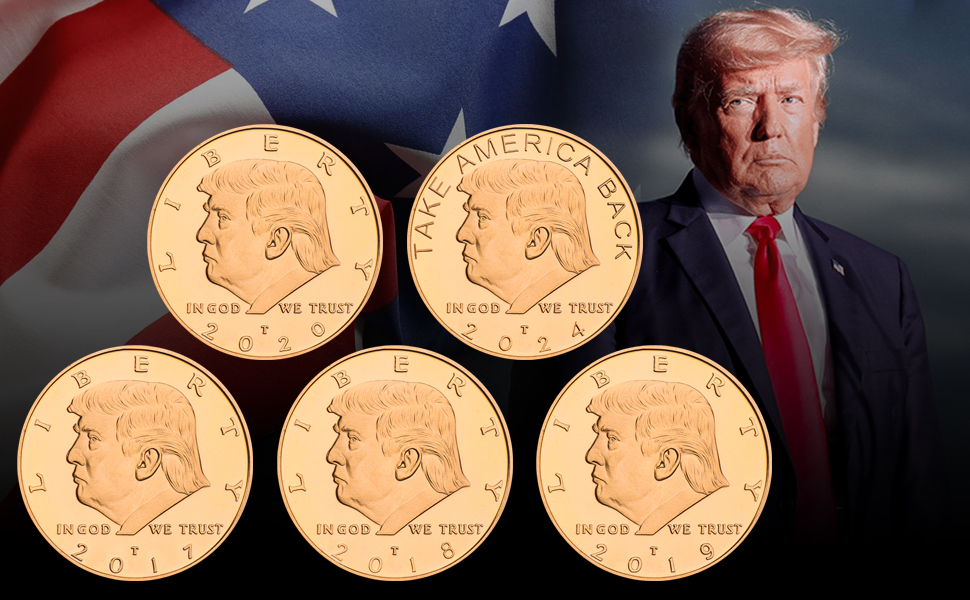
By the time the U.S. Mint strikes the first 24-karat gold Trump commemorative coin later this year, the great American tradition of keeping living politicians off the nation’s money will have been quietly, but spectacularly, circumvented.
Approved unanimously on March 19, 2026, by the Trump-appointed Commission of Fine Arts, the coin is ostensibly a celebration of the nation’s 250th anniversary. Yet, it serves a secondary, more visceral purpose for its chief architect: projecting executive dominance. The design is unapologetically aggressive. The obverse features President Donald Trump leaning intensely over the Resolute Desk, fists clenched, with the word “LIBERTY” arcing above his head and the dual dates “1776–2026” flanking him. The reverse bears a bald eagle, talons braced, ready to take flight.
Predictably, the political theater has been deafening. Critics have decried the coin as monarchic symbolism, pointing out that since the days of George Washington, the republic has fiercely guarded its currency against the vanity of living rulers. Defenders hail it as a masterstroke of patriotic fundraising and commemorative artistry.
But beneath the partisan noise lies a profound economic irony. In the grand sweep of monetary history, a leader plastering his face on ceremonial gold does not signal absolute control over a nation’s wealth. Quite the opposite. As we look back to the shifting empires of late antiquity, such numismatic pageantry usually reveals the exact opposite: a leader attempting to mask the uncomfortable reality of his limited sovereignty.
To understand the true weight of the 2026 Trump gold coin, one must look not to the halls of the Federal Reserve, but to the 6th-century courts of the Ostrogothic kings of Italy.
The Loophole of Vanity: 31 U.S.C. § 5112
To grasp the limits of the President’s monetary power, one must first look at the legal acrobatics required to mint the coin in the first place.
Federal law strictly forbids the portrait of a living person on circulating U.S. currency—a tradition born from the Founding Fathers’ revulsion for the coinage of King George III. To bypass this, the administration utilized the authorities granted under 31 U.S.C. § 5112, specifically the Treasury’s broad discretion to issue gold bullion and commemorative coins that do not enter general circulation.
While the coin bears a nominal face value of $1, it is a piece of bullion, not a medium of exchange. You cannot buy a coffee with it; it will not alter the M2 money supply; it will not shift the consumer price index.
Herein lies the central paradox of the Trump Semiquincentennial coin:
- The Facade of Power: It utilizes the highest-purity gold and the official imprimatur of the United States Mint to project executive authority.
- The Reality of Policy: The actual levers of the American economy—interest rates, quantitative easing, and the health of the fiat dollar—remain stubbornly out of the Oval Office’s direct control, residing instead with the independent Federal Reserve.
This dynamic—where a ruler uses localized, symbolic coinage to project a sovereignty he does not fully possess over the broader economic system—is not a modern invention. It is a historical hallmark of limited power.
Echoes from Ravenna: The Ostrogothic Parallel
When the Western Roman Empire collapsed in the late 5th century, Italy fell under the dominion of the Ostrogoths. The most famous of their rulers, Theodoric the Great, commanded the peninsula with formidable military might from his capital in Ravenna. He was, for all practical purposes, the king of Italy.
Yet, when you examine Ostrogothic coinage from this era, a fascinating picture of deference and limitation emerges.
Despite his military supremacy, Theodoric understood that the true center of global economic gravity lay to the east, in Constantinople. The Byzantine Emperor controlled the solidus—the gold standard of the Mediterranean world. If Theodoric wanted his kingdom to participate in international trade, he had to play by Byzantine monetary rules.
Consequently, the Ostrogoths minted gold and silver coins that were essentially counterfeits of Byzantine money. They bore the portrait of the reigning Eastern Emperor (such as Anastasius or Justinian), not the Ostrogothic king. Theodoric restricted his own branding to a modest monogram, and later kings, like Theodahad, only dared to place their full portraits on the bronze follis—the low-value base metal used for buying bread in local markets, entirely decoupled from international high finance.
The lesson from the Ostrogoths is clear, and widely recognized in peer-reviewed numismatic scholarship: controlling the territory is not the same as controlling the currency. The Ostrogoths used their local mints to project an image of continuity and authority to their immediate subjects, but they bowed to the monetary hegemony of the true empire.
The Byzantine Emperor of Modern Finance
Today, the “Constantinople” of the global economy is not a rival nation, but the institutional apparatus of the fiat dollar system—chiefly, the Federal Reserve and the global bond market.
President Trump has frequently chafed against this reality. Throughout his political career, he has sought to blur the lines of Fed independence, occasionally demanding lower interest rates or criticizing the Fed Chair with a ferocity normally reserved for political rivals. Yet, the institutional firewalls have largely held. The President cannot unilaterally dictate the cost of capital. He cannot force the world to buy U.S. Treasuries.
Thus, the 24-karat commemorative coin acts as his modern bronze follis.
It is a stunning piece of metal, but it is ultimately a domestic token. It satisfies a base of political supporters and projects an aura of monarchic permanence, just as Theodahad’s portrait did in the markets of Rome. But it does not challenge the underlying hegemony of the independent central banking system. The global markets, the sovereign wealth funds, and the algorithmic trading desks—the modern equivalents of the Byzantine merchants—will ignore the gold coin entirely. They will continue to trade in the invisible, digital fiat dollars over which the President exercises only indirect influence.
The Illusion of Monetary Sovereignty
What, then, does the “Trump coin” tell us about the current state of American executive power?
First, it highlights a growing preference for the aesthetics of power over the mechanics of governance. Minting a gold coin with one’s face on it is a frictionless exercise in executive privilege. Reining in a multi-trillion-dollar deficit, negotiating complex trade pacts, or carefully managing a soft economic landing are laborious, constrained, and often unrewarding tasks.
Second, it reveals the resilience of America’s financial architecture. That the President must resort to a commemorative loophole—utilizing a non-circulating bullion designation to bypass the strictures of circulating fiat—is a testament to the fact that the core of America’s money remains insulated from populist whim.
Consider the implications for dollar hegemony:
- Global Confidence: International investors rely on the U.S. dollar precisely because it is not subject to the immediate, emotional control of the executive branch.
- Institutional Friction: The outcry over the coin, while loud, proves that democratic norms regarding the separation of leader and state apparatus are still fiercely defended in the public square.
- The Paradox of Gold: By choosing gold—the traditional refuge of those who distrust government fiat—the administration inadvertently highlights its own lack of faith in the very paper currency it is sworn to manage.
Conclusion: The Weight of Empty Gold
The Roman historian Cassius Dio once observed that you can judge the health of a republic by the faces on its coins. When the republic falls, the faces of magistrates are replaced by the faces of autocrats.
But history is rarely that simple. The Ostrogothic kings of the 6th century put their faces on bronze because they lacked the power to control the gold. In March 2026, an American president has put his face on gold because he lacks the power to control the fiat.
The Semiquincentennial Trump coin is destined to be a remarkable collector’s item, a flashpoint in the culture wars, and a brilliant piece of political marketing. But when historians look back on the numismatics of the 2020s, they will not see a president who conquered the American monetary system. They will see a leader who, much like the kings of late antiquity, had to settle for a brilliant, golden simulacrum of power, while the true economic empire hummed along, indifferent and out of reach.
FAQ: Understanding the 2026 Commemorative Coin and U.S. Monetary Policy
Is it legal for a living U.S. President to be on a coin? Yes, but only under specific circumstances. By law (31 U.S.C. § 5112), living persons cannot be depicted on circulating currency (like standard pennies, quarters, or paper bills). However, the U.S. Mint has the authority to produce non-circulating bullion and commemorative coins. The 2026 Trump coin exploits this loophole as a non-circulating commemorative piece.
Does the U.S. President control the value of the dollar? No. While presidential policies (like tariffs, taxation, and government spending) affect the broader economy, the direct control of the U.S. money supply and interest rates rests with the Federal Reserve, an independent central bank. The President appoints the Fed Chair, but cannot legally dictate the bank’s day-to-day monetary policy.
What is the historical significance of the Ostrogothic coinage parallel? In the 6th century, Ostrogothic kings in Italy minted gold coins bearing the face of the Byzantine Emperor, while reserving their own portraits for lower-value bronze coins. This demonstrated that while they held local, symbolic power, true economic sovereignty belonged to the Byzantine Empire. The 2026 Trump coin operates similarly: it offers localized symbolic prestige, but the actual “engine” of the U.S. economy remains under the control of the independent Federal Reserve.
Can I spend the 24-karat Trump coin at a store? Technically, the coin has a legal face value of $1. However, because it is minted from 24-karat gold, its intrinsic metal value and numismatic collector value far exceed its $1 face value. It is meant to be collected and held as an asset or piece of memorabilia, not used in daily commercial transactions.
Acquisitions
The Saigol Pivot: Inside Maple Leaf Cement’s Strategic Incursion into Pakistan’s Banking Sector

It is a move that initially appears as a study in industrial asymmetry: a northern cement giant, whose fortunes are tied to construction gypsum and clinker, systematically acquiring a stake in one of the country’s mid-tier Islamic banks. But beneath the surface of the Competition Commission of Pakistan’s (CCP) recent authorization lies a narrative far more sophisticated than a simple portfolio shuffle. This is the Saigol family’s Kohinoor Maple Leaf Group (KMLG) executing a deliberate financial pivot, threading the needle between regulatory scrutiny and the volatile realities of the 2026 Pakistan Stock Exchange (PSX) .
The CCP’s green light for Maple Leaf Cement Factory Limited (MLCF) to acquire shares in Faysal Bank Limited (FABL)—including a rare ex post facto approval for purchases made during 2025—offers a window into the evolving strategy of Pakistan’s old industrial guard .
The “Grey Area”: A Regulatory Slap on the Wrist?
In the sterile language of antitrust law, the transaction raised no red flags. The CCP’s Phase I assessment correctly noted the “entirely distinct” nature of cement manufacturing and commercial banking, concluding there was no horizontal or vertical overlap that could stifle competition .
However, the procedural backstory is where the texture lies. The Commission acknowledged reviewing a batch of open-market transactions on the PSX that were “already completed prior to obtaining the Commission’s approval” .
While the CCP granted ex-post facto authorization under Section 31(1)(d)(i) of the Competition Act 2010, it simultaneously issued a pointed directive: MLCF must ensure strict compliance with pre-merger approval requirements for any future transactions . It is a reminder that in Pakistan’s current financial climate, where liquidity is king and speed is of the essence, even blue-chip conglomerates can find themselves navigating the grey areas between investment opportunity and regulatory process. The directive serves as a subtle but firm warning to the market that the CCP is watching the methods of stake-building as closely as the ultimate concentration of ownership .
Strategic Rationale: Beyond Horizontal Logic
To understand the “why,” one must look beyond the cement kilns of Daudkhel and toward the balance sheets of the group. The Kohinoor Maple Leaf Group, born from the trifurcation of the Saigol empire, has long been a bastion of textiles and cement . But 2026 presents a different economic calculus.
Conglomerate diversification is the name of the game. With the PSX experiencing the volatile convulsions of a pre-election year—oscillating between geopolitical panic and IMF-induced stability—banking stocks have emerged as a high-yield, defensive hedge . Unlike the cyclical nature of cement, which is hostage to construction schedules and government infrastructure spending, the banking sector offers exposure to interest rate spreads and consumer financing.
For MLCF, a stake in Faysal Bank is not about vertical integration; it is about earnings stability. Faysal Bank, with its significant presence in Islamic finance (a sector rapidly gaining traction in Pakistan), offers a counter-cyclical buffer to the group’s industrial holdings. As one analyst put it, “They are swapping kiln dust for deposit multiplier.”
The Real-Time Context: PSX Volatility and the Hunt for Yield (March 2026)
The timing of the final authorization is critical. March 2026 finds the Pakistani equity market in a state of calculated anxiety. The KSE-100 has recently weathered a 16.9% correction from its January peaks, triggered by Middle East tensions and fears over the Strait of Hormuz . While energy stocks swing wildly with every oil price fluctuation, banking giants like Faysal Bank offer a rare port in the storm.
According to Arif Habib Limited’s latest strategy notes, the banking sector is currently trading at a price-to-book discount, with institutions like National Bank of Pakistan offering dividend yields as high as 13.3% . While Faysal Bank’s yields are more modest than NBP’s, its shareholding structure—dominated by Bahrain’s Ithmaar Holding (66.78%)—makes it an attractive target for local industrial groups seeking influence without the burden of outright control .
By accumulating shares incrementally through the PSX, KMLG is effectively renting exposure to the financialization of the Pakistani economy. It is a low-profile, high-liquidity entry into a sector that the State Bank of Pakistan projects will remain resilient despite import pressures and currency fluctuations .

Faysal Bank: The Prize Within
Why Faysal Bank specifically? The lender has carved a niche in the Islamic banking corridor, an area the government is keen to expand. With total institutional investors holding over 72% of the bank’s shares, it represents a tightly held, professionally managed asset .
Maple Leaf’s creeping acquisition suggests a desire to secure a seat at the table of Pakistan’s financial future. While the CCP authorization allows for an increased shareholding, it stops short of a full-blown merger. For now, this remains an “incursion”—a strategic toehold in the world of high finance, managed by the same family stewardship that Tariq Saigol has applied to transforming KMLG’s manufacturing base through sustainability and innovation .
The Verdict
The Maple Leaf Cement–Faysal Bank transaction is a harbinger of things to come in the 2026 Pakistani market. As the lines between industrial capital and financial capital blur, we will likely see more of these “conglomerate” acquisitions.
The CCP’s involvement, complete with its ex-post facto review and compliance directive, has set a precedent. It tells the market that while the commission is willing to facilitate investments that support “capital formation,” it will not tolerate a laissez-faire approach to merger control .
For the Saigol family, this is not just an investment; it is a hedge against the future. In an economy where cement demand can cool overnight but banking remains the lifeblood of commerce, owning a piece of the pipeline is the ultimate strategic pivot.
Analysis
Saba Capital’s Bold Tender Offer: Buying Blue Owl Funds at Steep Discounts Amid Private Credit Turmoil

When a hedge fund swoops in to buy distressed stakes at 20–35% below net asset value, it’s rarely a random act of generosity. It’s arbitrage—and it signals something deeper is fracturing in the private credit market.
In early February 2026, Boaz Weinstein’s Saba Capital Management, partnering with Cox Capital Partners, launched a tender offer to acquire shares in three Blue Owl Capital funds: Blue Owl Capital Corporation II (OBDC II), Blue Owl Technology Income Corp (OTIC), and Blue Owl Credit Income Corp (OCIC). The proposed prices ranged from 65 to 80 cents on the dollar relative to each fund’s stated net asset value—a brazen bet that retail investors, trapped by redemption gates and growing skepticism about private asset valuations, would take whatever exit they could get.
This is hedge fund opportunism in credit funds at its most calculated. And it may be one of the more revealing moments in a private credit story that has been quietly unraveling for months.
The Saba Blue Owl Tender Offer: What We Know
The mechanics of the Saba Capital–Blue Owl BDC discount trade are straightforward, even if the implications are anything but. Saba and Cox are offering retail and institutional investors in these non-traded business development companies (BDCs) a cash buyout of their stakes—at prices well below what Blue Owl’s own accounting says those assets are worth.
For OBDC II, OTIC, and OCIC, the discounts reportedly sit between 20% and 35% below NAV, depending on the vehicle. Saba’s thesis: the stated NAVs are optimistic—possibly significantly so—and liquidity pressure on investors will drive enough sellers to make the trade profitable even if some markdown in underlying valuations is warranted.
Blue Owl, for its part, has not been passive. The firm has moved to sell approximately $1.4 billion in assets and announced plans to return capital to investors. But it has also halted redemptions across certain funds, a move that, while legally permissible under fund structures, tends to send a loud signal to the market: liquidity is tighter than the pitch deck implied. Reuters reported a notable drop in OWL shares following news of the asset sales and debt fund restructurings, even as the broader stock recovered modestly on reports of Saba’s involvement—a curious market response that speaks volumes about investor sentiment.
Why Boaz Weinstein Is Betting Against Private Credit Valuations
Weinstein has built his reputation on identifying structural mispricing in complex credit instruments. He rose to prominence partly by recognizing—and profiting from—risks in synthetic credit markets that others had underwritten with excessive confidence. His move into the Blue Owl funds at steep discount follows a familiar playbook: find an illiquid market where reported values and transactable values have diverged sharply, then extract the spread.
The non-traded BDC redemption halt is the mechanism that creates his opportunity. When investors cannot sell their stakes on an exchange and the fund manager suspends the redemption window, those investors are effectively stranded. A tender offer—even at a painful discount—can look attractive to someone who needs liquidity or simply no longer trusts the NAV figure printed on their quarterly statement.
Saba’s position is essentially a structured bet that:
- Private credit valuations are inflated relative to what a secondary buyer would actually pay
- Redemption pressure will continue, keeping retail sellers motivated
- Blue Owl’s asset sales will either validate the markdown or, at minimum, prevent meaningful NAV appreciation
This is not merely opportunism for its own sake. It’s a price discovery mechanism in a corner of the market that has long lacked one.
The Broader Private Credit Liquidity Crisis
To understand why the Saba Capital–Blue Owl BDC discount trade matters beyond a single firm’s P&L, you need to zoom out to the $1.8 trillion private credit market.
Over the past five years, private credit exploded as institutional and retail capital flooded into non-bank lending. The pitch was compelling: higher yields, lower volatility (a feature, skeptics noted, of infrequent mark-to-market pricing rather than genuine stability), and access to growing companies bypassed by traditional banks. BDCs, including non-traded vehicles like those in Blue Owl’s lineup, became popular conduits for retail investors seeking yield in a low-rate world.
But several structural tensions have been building:
- Rising redemption requests as investors reassess the risk-return profile in a higher-rate environment where liquid credit alternatives have become more attractive.
- AI-driven disruption in software lending, which has raised questions about the credit quality of technology-focused portfolios—directly relevant to OTIC, Blue Owl’s tech-oriented income vehicle.
- NAV skepticism, as secondary market transactions and tender offers like Saba’s imply that the private assets underpinning these funds may be worth materially less than reported.
- Liquidity mismatches, baked into the non-traded structure itself—where quarterly redemption windows create an illusion of liquidity that evaporates precisely when investors want it most.
Bloomberg and the Financial Times have both noted that the impact of the Saba tender offer on the private credit market extends beyond Blue Owl, raising uncomfortable questions about how other non-traded BDCs and credit interval funds are being priced.
Blue Owl’s Response: Asset Sales and Capital Returns
Blue Owl’s decision to sell $1.4 billion in assets and accelerate capital returns is, on one reading, a responsible response to liquidity pressure. On another, it’s an implicit acknowledgment that the redemption halt was unsustainable and that some degree of NAV reset was necessary to restore credibility with investors.
The firm has been vocal in pushing back against what it characterizes as opportunistic and potentially misleading tender offers—a reasonable complaint given that Saba’s bid prices are not peer-reviewed appraisals of the underlying loan portfolios but rather negotiating anchors designed to attract distressed sellers. Blue Owl’s leadership has urged investors not to tender, pointing to ongoing asset management and anticipated distributions as the better path to value recovery.
Whether that argument lands will depend heavily on what the $1.4 billion in asset sales actually reveal about realized values. If dispositions close near stated NAV, Blue Owl’s credibility is substantially restored. If they close at significant markdowns, Saba’s thesis gains traction—and the ripple effects across the broader private credit fund universe could be considerable.
What This Means for Retail Investors
The retail investor risks in non-traded BDCs have been well-documented in regulatory filings, though often buried in dense prospectus language. Investors drawn in by above-market yield projections and the prestige of institutional-quality private credit exposure are now encountering the structural fine print: redemption queues, quarterly windows, and the absence of a liquid secondary market.
Saba’s tender offer creates a perverse but real choice. Accepting means crystallizing a 20–35% loss relative to stated NAV. Rejecting means trusting that Blue Owl’s reported values are accurate, that the asset sales will close cleanly, and that redemption capacity will normalize—none of which are guaranteed.
For financial advisors who placed clients into these structures, this is a moment of reckoning. The hedge fund opportunism in credit funds story is partly about Weinstein’s acuity. But it’s also about the mismatch between how non-traded private credit products were sold to retail investors and how they are actually performing under stress.
Forward-Looking: A Stress Test for Private Credit’s Retail Ambitions
The Saba Capital buys Blue Owl stakes at discount episode will likely serve as a case study for regulators, fund managers, and financial advisors for years. It arrives at a moment when the SEC has been scrutinizing the marketing of illiquid alternatives to retail investors, and when several major asset managers are pushing to expand access to private markets through evergreen fund structures.
If the tender offer attracts significant seller participation, it will validate the secondary discount as a real price—not a theoretical one—and pressure other non-traded BDC managers to either shore up liquidity mechanisms or face similar activist attention. If Blue Owl successfully defends its NAV through disciplined asset management and transparent dispositions, it may emerge as a model for how to navigate activist pressure in the private credit space.
Either way, the Blue Owl funds steep discount offer of 2026 has already accomplished something that quarterly NAV statements and manager commentary rarely do: it has forced a genuine conversation about what these assets are actually worth in a market that would prefer not to ask.

KSE-100 Plunges Amid Geopolitical Firestorm — But Islamabad Holds the World’s Attention

The Trump Coin and Lessons from the Ostrogoths: How a Gold Offering Reveals the Limits of Presidential Power Over America’s Money

Gaming Giant’s Bold Gamble: Why Investors are Devouring Risky EA Debt Amid Geopolitical Crosscurrents

Top 15 Stocks for Investment in 2026 in PSX: Your Complete Guide to Pakistan’s Best Investment Opportunities
Top 15 Stocks for Investment in 2026 in PSX: Your Complete Guide to Pakistan’s Best Investment Opportunities

Debunking IMF Program Myths: Reconfiguring Engagement for True National Ownership in a Volatile World
-
 Markets & Finance3 months ago
Top 15 Stocks for Investment in 2026 in PSX: Your Complete Guide to Pakistan’s Best Investment Opportunities
-
Markets & Finance3 months ago
Top 15 Stocks for Investment in 2026 in PSX: Your Complete Guide to Pakistan’s Best Investment Opportunities
-
 Analysis2 months ago
Debunking IMF Program Myths: Reconfiguring Engagement for True National Ownership in a Volatile World
-

 Global Economy3 months ago
What the U.S. Attack on Venezuela Could Mean for Oil and Canadian Crude Exports: The Economic Impact
-

 Investment3 months ago
Top 10 Mutual Fund Managers in Pakistan for Investment in 2026: A Comprehensive Guide for Optimal Returns
-

 Asia3 months ago
China’s 50% Domestic Equipment Rule: The Semiconductor Mandate Reshaping Global Tech
-

 AI3 months ago
15 Most Lucrative Sectors for Investment in Pakistan: A 2025 Data-Driven Analysis
-

 Exports3 months ago
Pakistan’s Export Goldmine: 10 Game-Changing Markets Where Pakistani Businesses Are Winning Big in 2025