
Exclusive
What Trump Said About the U.S. Economy at Davos — and What the Data Reveals

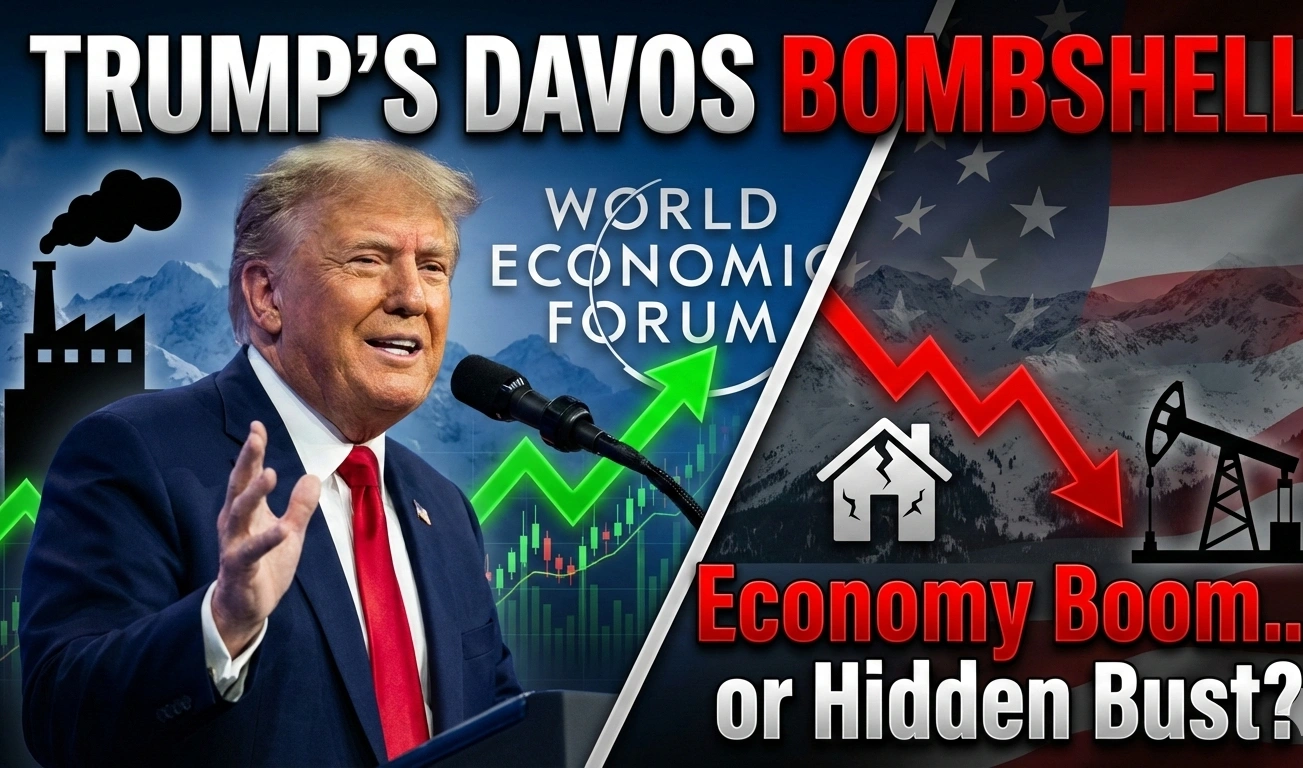
The alpine air in Davos was brisk on January 23, 2026, but the atmosphere inside the Congress Centre was even icier. President Donald Trump, addressing the World Economic Forum via video link for the second time in his current term, delivered a characteristically bold assessment of the American economy—one that painted a portrait of roaring industrial revival, plummeting energy costs, and imminent housing affordability.
His tone was triumphant, his claims sweeping. Yet in the ornate hall where global elites gathered, the reaction was notably muted. Polite applause punctuated pauses, but skeptical glances were exchanged among finance ministers and CEOs who’ve been parsing the actual trajectory of U.S. economic indicators since Trump’s so-called “Liberation Day” tariffs took effect last April.
Trump’s Davos economy speech in 2026 was vintage political theater—part victory lap, part sales pitch to international investors. He touted a manufacturing renaissance driven by his tariff regime, pledged to make America a “nation of owners, not renters,” and criticized European energy policy while boasting of American dominance at the pump. These proclamations resonated with his domestic base watching from home, but they landed awkwardly among an audience acutely aware of contradictory data emerging from U.S. federal agencies, independent research institutions, and global markets.
This disconnect between rhetoric and reality isn’t merely academic. As the world’s largest economy navigates an era of protectionist trade policy, elevated interest rates, and geopolitical volatility, understanding what Trump actually said at Davos—and how it compares to verifiable economic data—matters profoundly for investors, policymakers, and citizens alike. What follows is a rigorous examination of the president’s key claims, measured against the latest available evidence from the Bureau of Labor Statistics, Federal Reserve databases, energy markets, and housing sector analytics.
Key Highlights From Trump’s Davos 2026 Address
President Trump’s virtual address touched on several core economic themes that have defined his second term. Here are the most significant quotes and policy assertions from his speech:
- On tariffs and manufacturing: “We’ve unleashed the greatest factory boom in American history. Companies are pouring back into our country because they know tariffs mean business stays home. The Liberation Day tariffs are working exactly as planned.”
- On housing affordability: “We’re going to make America a nation of owners again, not renters. Homeownership is the American Dream, and my administration is cutting through red tape and bringing down costs so every family can achieve it.”
- On energy dominance: “American energy is the cheapest in the world. While Europe pays through the nose for inefficient green policies, Americans are filling up their tanks for less than they have in years. We’re producing more oil and gas than ever before.”
- On trade negotiations: “Countries that have ripped us off for decades are finally coming to the table with fair deals. We’re not backing down. America First means America wins.”
- On global competitiveness: “Investment is flooding into the United States. The world knows we’re the safest, strongest economy on the planet, and that’s not changing under my watch.”
These talking points were delivered with Trump’s characteristic confidence, designed to project strength and economic competence to both domestic and international audiences. But each claim invites scrutiny against measurable outcomes.

Tariffs and Trade Policy: Manufacturing Boom or Industrial Backfire?
Perhaps no aspect of Trump’s economic agenda has been more contentious than his aggressive use of tariffs. The “Liberation Day” tariffs announced on April 2, 2025, imposed sweeping levies on imports from China, the European Union, and other major trading partners—ostensibly to protect American manufacturing and force better trade terms. At Davos, Trump framed this policy as an unqualified success, claiming it sparked a “factory boom” that’s bringing industrial jobs flooding back to American shores.
The data tells a markedly different story. According to the Bureau of Labor Statistics, U.S. manufacturing employment has declined in seven of the nine months following the April 2025 tariff implementation. The sector shed approximately 43,000 jobs between April and December 2025, with particularly steep losses in auto parts manufacturing, electronics assembly, and metals fabrication—industries heavily dependent on integrated global supply chains that tariffs disrupted.
More revealing still is the trajectory of factory construction spending, a leading indicator of long-term industrial investment confidence. Federal Reserve Economic Data (FRED) from the St. Louis Fed tracks this metric closely through its TLMFGCONS series, which measures total manufacturing construction spending in millions of dollars. This data shows factory construction spending peaked in mid-2024 at approximately $225 billion annually, then began a steady decline through October 2025 (the most recent data available), falling to roughly $198 billion—a drop of about 12% that coincides almost precisely with the tariff rollout and subsequent supply chain reconfiguration costs.
The disconnect between Trump’s triumphalist rhetoric and these government statistics isn’t easily explained away. Economists at the Peterson Institute for International Economics have noted that while some reshoring announcements made headlines in 2025, many represented planned investments predating the tariffs, while others were subsequently canceled or scaled back as companies confronted the reality of higher input costs and retaliatory measures from trading partners.
The European Union’s counter-tariffs on American agricultural exports, for instance, have devastated Midwest soybean farmers—a politically sensitive constituency that Trump carried heavily in 2024. China’s pivot toward Brazilian and Argentine suppliers for industrial commodities has cost U.S. producers an estimated $18 billion in lost export revenue since mid-2025, according to the U.S. Department of Agriculture.
What Trump didn’t mention at Davos were these unintended consequences: rising input costs for American manufacturers who depend on imported components, retaliatory tariffs hammering export-oriented sectors, and investment hesitation as companies await clarity on whether tariff rates represent permanent policy or negotiating theater. The National Association of Manufacturers—hardly a liberal advocacy group—issued a cautious statement in December 2025 noting that while some tariff protections benefited specific industries, the overall impact had been “mixed at best” with supply chain disruptions offsetting gains.
Financial markets have reflected this ambiguity. The S&P Manufacturing PMI has hovered around the 50-point threshold separating expansion from contraction for most of late 2025, suggesting an industrial sector treading water rather than surging forward. For context, the manufacturing PMI averaged 52.8 in 2023 and 51.6 in 2024—both higher than the current reading, despite those years preceding Trump’s “factory boom” tariffs.
Housing Affordability: Bold Promises Meet Stubborn Market Realities
Trump’s pledge to transform America into “a nation of owners, not renters” resonated emotionally at Davos, tapping into a deep anxiety about housing affordability that transcends partisan divisions. The president pointed to regulatory rollbacks his administration has pursued, including attempts to streamline federal environmental reviews for residential development and pressure on local zoning boards to permit higher-density construction.
Yet housing affordability in January 2026 remains stubbornly elusive for most American households. The median existing home price stands at approximately $412,000 according to the National Association of Realtors—up 4.8% from January 2025 and nearly 47% higher than pre-pandemic levels in early 2020. Meanwhile, mortgage rates, while down slightly from their 2023 peaks, remain elevated at around 6.7% for a 30-year fixed-rate loan as of mid-January 2026, according to Freddie Mac’s Primary Mortgage Market Survey.
This combination—high prices plus high borrowing costs—has crushed affordability for first-time buyers. The monthly payment on that median-priced home with a standard 20% down payment now exceeds $2,200, compared to roughly $1,400 in early 2020. Real wage growth, while positive in some sectors, hasn’t kept pace. The result: homeownership rates have actually ticked downward slightly since Trump took office in January 2025, from 65.7% to 65.4% as of Q4 2025, per Census Bureau data.
The core challenge Trump’s rhetoric glosses over is supply. The United States has underbuilt housing for more than a decade relative to household formation, creating a structural deficit economists estimate at 3-4 million units. Regulatory streamlining—while potentially helpful at the margins—cannot quickly overcome labor shortages in construction (a sector that lost workers during the pandemic and hasn’t fully recovered), elevated materials costs (partly driven by tariffs on imported lumber and steel), and local political resistance to density that federal policy struggles to override.
Trump’s housing proposals have focused heavily on demand-side interventions—tax credits for first-time buyers, pressure on the Federal Reserve to lower interest rates—while offering less concrete action on supply constraints. The Federal Reserve, notably, has maintained its benchmark interest rate in the 4.25-4.50% range through early 2026, citing persistent inflation concerns partly related to tariff-driven price increases, effectively limiting how much mortgage rates can fall in the near term.
At Davos, Trump criticized rental markets and institutional investors purchasing single-family homes, rhetoric that polls well but doesn’t address why those investors find the market attractive in the first place: insufficient supply creates pricing power. Without a credible, large-scale plan to accelerate homebuilding—particularly affordable starter homes—the homeownership dream Trump invoked remains out of reach for millions.
Energy Dominance: Low Pump Prices and the European Contrast
On energy, Trump’s Davos messaging was characteristically combative. He contrasted what he described as America’s energy abundance and low consumer prices with Europe’s expensive, unreliable renewable transition—a critique designed to validate his administration’s “drill, baby, drill” philosophy and continued support for fossil fuel production.
Here, Trump’s claims align more closely with observable reality—though not quite as cleanly as his speech suggested. The average price of regular gasoline in the United States in mid-January 2026 sits at approximately $3.18 per gallon, according to AAA data. This represents a meaningful decline from the $3.85 average a year prior and is well below the peak of nearly $5.00 reached in summer 2022. American consumers are indeed paying less at the pump than most European counterparts, where taxes and carbon pricing keep fuel costs significantly higher.
U.S. crude oil production has remained robust, averaging about 13.2 million barrels per day in late 2025—near record levels—according to the Energy Information Administration. Natural gas production similarly continues at historic highs, supporting both domestic consumption and liquefied natural gas (LNG) exports that have made the United States a major global supplier, particularly to Europe following the disruption of Russian pipeline gas.
However, Trump’s portrayal omits crucial context. First, much of America’s oil and gas production boom predates his current term, accelerating during the 2010s shale revolution under both Obama and first-term Trump policies. Current production levels largely reflect long-cycle investments made years ago, plus market dynamics (higher global prices incentivizing drilling) rather than specific Trump administration actions since January 2025.
Second, while pump prices have fallen, this owes considerably to global crude oil market conditions—including OPEC+ production discipline weakening, demand growth in China slowing, and mild winter weather in the Northern Hemisphere reducing heating fuel consumption. The president’s energy policies, which primarily involve expanding federal leasing for drilling and rolling back emissions regulations, contribute at the margins but don’t singularly determine prices set in global markets.
Third, Trump’s critique of European energy policy ignores the rationale driving it: long-term energy security and climate mitigation. European leaders at Davos—while diplomatically refraining from direct rebuttals—have argued consistently that initial transition costs will yield strategic independence from volatile fossil fuel suppliers and position Europe competitively in clean technology manufacturing. Whether that bet pays off remains uncertain, but dismissing it as mere inefficiency oversimplifies a complex strategic calculation.
The energy picture Trump painted is thus partially accurate—Americans benefit from abundant domestic resources and relatively low prices—but his framing omits market complexities and overstates his administration’s causal role in outcomes substantially shaped by factors beyond presidential control.
Broader Implications for the U.S. and Global Economy in 2026
Stepping back from individual claims, Trump’s Davos appearance reflected a fundamental tension in his economic approach: confidence-building narratives aimed at sustaining business and consumer sentiment versus tangible policy outcomes that frequently disappoint the rhetoric’s promises.
From a global investor perspective, the United States retains substantial advantages—deep capital markets, technological leadership in AI and biotech, rule of law, and demographic dynamism relative to aging competitors like Japan and much of Europe. These structural strengths mean capital continues flowing into dollar-denominated assets despite policy uncertainties. U.S. equity markets have performed reasonably well through early 2026, with the S&P 500 up modestly year-to-date, suggesting investors see growth continuing even if not at the torrid pace Trump advertises.
Yet risks are accumulating. The tariff regime has introduced unpredictability into supply chains and raised costs that companies are increasingly passing to consumers, contributing to inflation persistence that constrains Federal Reserve flexibility. Manufacturing weakness, if sustained, could ripple into broader labor markets. Housing unaffordability threatens to become a generational crisis, with implications for wealth accumulation and social mobility. Trade partners are diversifying away from dollar dependence and U.S. supply chains where possible—a slow-moving but significant shift.
Economists surveyed by the Financial Times in early January projected U.S. GDP growth of 2.1% for 2026—solid but unspectacular, and down from 2.5% in 2025. Inflation is expected to remain around 2.8-3.0%, above the Fed’s 2% target, partly due to tariff effects. Unemployment, currently at 4.1%, is forecast to edge up slightly as labor demand softens. This is hardly a crisis scenario, but neither is it the “greatest economy ever” Trump routinely invokes.
The Davos audience—sophisticated actors who allocate capital based on probabilities, not slogans—likely digested Trump’s speech with professional detachment. They understand political leaders must project optimism. But they also track hard data, and that data suggests an economy of contradictions: resilient fundamentals shadowed by self-inflicted policy wounds, rhetorical confidence masking sectoral stress, and a president whose economic promises consistently outpace deliverable results.
Conclusion: Parsing Rhetoric From Reality in an Election Season
Trump’s Davos economy speech in 2026 was quintessential political communication—designed to shape perception, rally supporters, and project American strength to global elites. For those inclined to support the president, it offered reassurance that his policies are working. For skeptics, it provided fresh evidence of a widening gap between political messaging and economic fundamentals.
The reality, as data demonstrates, is more nuanced than either Trump’s boosters or critics typically acknowledge. Manufacturing isn’t booming, but neither has it collapsed. Housing affordability remains a serious challenge, yet homeownership rates haven’t cratered. Energy production is strong, though not uniquely attributable to current policies. Tariffs have created winners and losers, with aggregate effects tilting negative but not catastrophic.
What matters most for Americans trying to navigate this landscape—whether as workers, investors, or voters—is maintaining clear-eyed assessment grounded in verifiable information. Presidential speeches at global forums like Davos will always blend aspiration with salesmanship. The antidote is rigorous engagement with data from non-partisan sources: the Bureau of Labor Statistics for employment, the Federal Reserve for construction and monetary policy, the Census Bureau for housing, and the Energy Information Administration for production and prices.
As 2026 unfolds and another election cycle looms, these numbers—not political rhetoric—will determine whether Trump’s economic legacy is ultimately judged as successful stewardship or overpromised underdelivery. The Davos speech offered a preview of the narrative he’ll run on. The data provides the standard against which that narrative must be measured.


There is a moment in every genuine geopolitical crisis when financial markets stop pretending they are merely reacting to data and begin reckoning with something more elemental: fear. That moment arrived on the morning of Saturday, February 28, 2026, when the United States and Israel launched coordinated strikes on Iran—killing Supreme Leader Ayatollah Ali Khamenei and igniting the most consequential military conflict in the Middle East in a generation. By Monday morning in New York, the world’s trading floors were measuring the aftershocks in barrels, basis points, and bullion.
What began as a targeted military operation has rapidly evolved into a multi-front conflict with cascading implications for energy markets, global supply chains, and the architecture of international finance. For investors, policymakers, and ordinary citizens watching the price of petrol rise at the pump, the central question is no longer whether markets will feel the US-Iran conflict market impact—they already are. The real question is how deep, how prolonged, and who ultimately bears the cost.
Immediate Market Reactions: Risk-Off in Real Time
The financial system’s first verdict was swift and largely predictable in its direction if not its magnitude. Stocks fell and the dollar climbed as military strikes intensified across the Middle East, sending oil to its biggest surge in four years while stoking concern that inflation will accelerate. Gold briefly topped $5,400. The S&P 500 dropped 1.1%, following losses in Europe and Asia. Airlines and cruise operators sank while energy and defense shares jumped. Bloomberg
By Monday’s open, the damage had spread more broadly. The Dow Jones Industrial Average dropped 282 points, or 0.6%. The S&P 500 lost 0.5%, and the Nasdaq Composite declined 0.4%—though the three major averages rallied off session lows as gains in technology stocks helped trim losses. At their nadir, the Dow was down about 600 points, or 1.2%. CNBC The CBOE Volatility Index—Wall Street’s so-called “fear gauge”—jumped to its highest level of 2026.
The bond market offered a counterintuitive signal. The 10-year Treasury yield was little changed Monday at 3.97%, regaining some ground after falling to an 11-month low of 3.926% on Friday. CNBC That modest move suggested bond traders are torn between two forces: a flight-to-safety impulse pulling yields lower, and an inflation anxiety—driven by soaring oil—pushing them back up. As an analyst, I’ve observed this precise tension before in conflict-driven crises: the bond market’s internal debate often telegraphs how long-lasting the disruption will prove to be.
The Strait of Hormuz: The World’s Most Expensive Bottleneck
No single geographic feature looms larger over the geopolitical risks oil prices calculation than the Strait of Hormuz. This narrow waterway between Iran and Oman is, in the words of one analyst, not a “production story” but a “chokepoint story”—and chokepoints, when threatened, carry systemic implications that dwarf any single country’s output.
More than 14 million barrels per day flowed through the Strait in 2025, or roughly a third of the world’s total seaborne crude exports. About three-quarters of those barrels went to China, India, Japan and South Korea. China, the world’s second-largest economy, receives half of its crude imports through the Strait. CNBC Iran has threatened to close this waterway entirely.
About 13 million barrels per day of crude oil transited the Strait of Hormuz in 2025, accounting for roughly 31% of global seaborne crude flows, according to market intelligence firm Kpler. CNBC Container shipping giants have already responded: Maersk announced it would suspend all vessel crossings in the Strait of Hormuz until further notice, warning that services calling ports in the Arabian Gulf may experience delays. CNBC
Amrita Sen, founder of Energy Aspects, told CNBC that oil markets are likely to hold around $80 a barrel for now after an initial spike, noting stabilization, but warned that “what the U.S. will not be able to do is control these one-off attacks on tankers.” CNBC The insurance industry is already pricing in the risk: marine hull insurance in the Gulf could rise by 25 to 50 percent in the near term, according to Dylan Mortimer, marine hull UK war leader at insurance broker Marsh. CNBC Those premiums ultimately flow through to the cost of every barrel, and every barrel’s cost flows through to every economy on earth.
Sector-Specific Impacts: Winners, Losers, and the Middle Ground
The Iran tensions global economy shock has not distributed its pain—or its windfalls—evenly across sectors. The divergence is stark.
Energy and Defense: The Reluctant Beneficiaries
Several oil stocks surged following the strikes on fears the conflict could disrupt global crude production and transport. Exxon Mobil and Chevron shares gained about 4%, while ConocoPhillips was also up more than 5%. Brent crude prices hit a new 52-week high of more than $78 on Monday. CNBC Defense contractors followed suit: Lockheed Martin shares gained 6%, while Northrop Grumman was up 5%, and drone maker AeroVironment jumped more than 10%. CNBC
Travel and Hospitality: The Immediate Casualties
Travel-related stocks dropped sharply. United Airlines, most exposed to international travel of the US carriers, tumbled more than 6%. American and Delta each fell more than 5%. Marriott International slid nearly 5%, while Airbnb sank more than 3%. Online reservation platforms Expedia and Booking Holdings slid more than 4% and 3% respectively. CNBC
The human toll on aviation has been immediate. Airlines canceled thousands of flights for the week in the Middle East, with 1,560 flights scrubbed on Monday alone, or 41.28% of those scheduled for arrival in Middle East countries, according to aviation data firm Cirium. Hundreds of thousands of passengers remain stranded. CNBC
Safe-Haven Assets: Gold’s Gravity-Defying Run
Gold’s ascent has been the defining market narrative of this crisis. Gold rallied above $5,300 per ounce, hitting record highs as investors moved into safe-haven assets. JP Morgan has raised its gold price target to $6,300 per ounce by December 2026, reflecting analyst confidence that this isn’t just a temporary spike. INDmoney Precious metals and the US dollar are now functioning as the twin shock absorbers of the global financial system.
Long-Term Risks: Inflation, Fragmentation, and the Asian Dimension
Beyond the immediate volatility lies a more structurally dangerous set of pressures. Elevated oil prices, if sustained, function as a regressive global tax—hitting emerging markets, commodity-importing nations, and lower-income households hardest.
Standard Chartered’s Global Head of Research Eric Robertsen noted that investors had already been underpricing geopolitical risk, with commodity-linked currencies outperforming, suggesting markets are paying for exposure to scarce resources and terms-of-trade winners. CNBC
The implications for Asia—the region most dependent on Hormuz-transiting oil—are severe and underappreciated by Western financial commentary. China, Japan, South Korea, and India collectively import the vast majority of their crude through this corridor. Any sustained disruption would accelerate inflationary pressures across Asian manufacturing economies, potentially stalling the global export recovery that policymakers have counted on.
There is also the geopolitical fracture dimension. China and Russia have condemned the US-Israeli strikes. In a phone call with his Russian counterpart, Chinese Foreign Minister Wang Yi said it was “unacceptable for the US and Israel to launch attacks against Iran.” CNBC This fracture carries long-term implications for dollar-denominated trade systems, multilateral institutions, and the cohesion of any post-conflict reconstruction framework.
The scenario analysis from Wells Fargo is instructive. Their strategists mapped out scenarios ranging from quick de-escalation to a worst-case prolonged Hormuz closure: in their worst-case scenario, the S&P 500 could drop to 6,000 from current levels around 6,850, but their base case still targets 7,500 by year-end. INDmoney The range of that spread—nearly 25%—is itself a measure of how genuinely uncertain the endgame remains.
The Diplomatic Paradox: War Launched During Talks
Perhaps the most jarring dimension of this crisis is the diplomatic context in which it erupted. The UN Secretary-General noted that the joint military operation by Israel and the United States occurred following indirect talks between the US and Iran mediated by Oman, “squandering an opportunity for diplomacy.” UN News
Although the last round of talks ended Thursday with Iran agreeing to “never” stockpile enriched uranium, that was not enough to avert US military action. CNN Markets loathe uncertainty, but they despise diplomatic incoherence even more—because it removes the scaffolding of predictable resolution. The absence of a clear off-ramp is precisely what is keeping risk premiums elevated across asset classes.
President Trump has suggested the conflict could last four weeks, and separately told The Atlantic that Iran’s new leadership wants to resume negotiations. Trump said Iran’s new leadership wanted to resume negotiations and that he has agreed to talk to them, saying “They want to talk, and I have agreed to talk.” CNBC Markets will be parsing every diplomatic signal for evidence of de-escalation—any credible ceasefire announcement would likely trigger a sharp oil selloff and equity recovery.
Investor Implications and Strategic Considerations
For portfolio managers navigating Middle East conflict investment strategies, several principles apply in this environment.
Overweight energy and defense selectively. The oil price tailwind for integrated majors and defense contractors is real, but entry points matter. Much of the initial upside is already priced in.
Reduce exposure to aviation, hospitality, and emerging-market importers. Nations like India, South Korea, and Japan face disproportionate energy import cost pressures, which will compress corporate margins and strain current accounts.
Monitor the Strait obsessively. David Roche of Quantum Strategy framed the market impact in terms of duration and whether Iran would attempt to close the Strait of Hormuz—if the conflict is short and contained, the risk-off move and oil spike could be brief; if it turns into a three-to-five-week regime change endeavor, markets would react “rather badly.” CNBC
Gold remains the structural hedge. With JP Morgan targeting $6,300 by year-end and central bank demand for bullion already at historical highs entering 2026, gold’s role as the geopolitical insurance policy of last resort appears set to deepen.
Conclusion: A Conflict That Will Rewrite Risk Premiums
The US-Iran conflict of February-March 2026 is not merely another geopolitical flare-up to be absorbed and forgotten within a trading week. The assassination of Khamenei, the direct involvement of US military forces, the threatened closure of the world’s most critical energy chokepoint, and the fissure it has opened between Western and non-Western powers collectively represent a structural inflection point for global markets.
In the short term, monitor Brent crude and the CBOE VIX daily as the conflict’s most sensitive barometers. In the medium term, watch whether Iran’s successor leadership follows through on negotiation signals or opts for prolonged asymmetric warfare against Gulf infrastructure. In the long term, consider how this crisis accelerates the already-underway energy transition: every $10 increase in sustainable oil prices makes renewable alternatives marginally more competitive, nudging capital allocation toward green infrastructure.
Conflict is never an opportunity to celebrate. But history teaches that periods of maximum geopolitical uncertainty are also when the contours of the next financial order begin to take shape—quietly, beneath the noise of war. The investors and institutions who read those contours correctly today will be better positioned for the world that emerges when the smoke clears over Tehran.
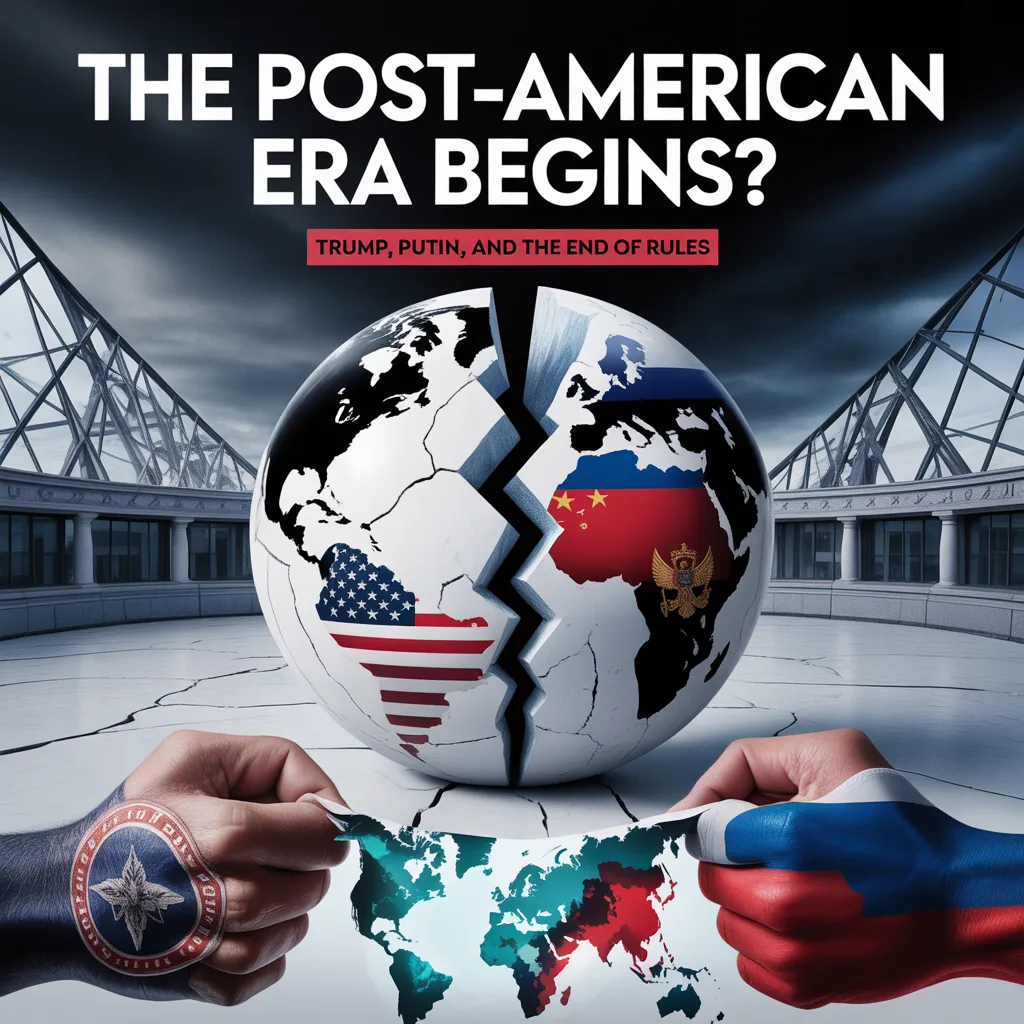
On a crisp January morning in Davos, as global elites gathered for their annual ritual of discussing “collaboration” and “shared prosperity,” Canadian Prime Minister Mark Carney delivered a speech that felt less like diplomacy and more like a eulogy. “We are in the midst of a rupture, not a transition,” he declared, warning that great powers now wield economic integration as weapons and tariffs as leverage. What made Carney’s address so striking wasn’t merely its candor about the death of the rules-based international order—it was the unspoken target of his critique. Though he never mentioned Donald Trump by name, everyone understood: the gravedigger of the post-1945 system isn’t primarily Beijing or Moscow. It’s Washington.
The irony is as sharp as it is unsettling. For eight decades, the United States positioned itself as the architect and guarantor of a liberal international order predicated on sovereignty, multilateral cooperation, and the peaceful resolution of disputes. Today, under Trump’s second administration, America is accelerating that order’s collapse with a ferocity that makes Russia’s revisionism look almost modest by comparison. The evidence is mounting: Trump Greenland national security threats that echo Putin’s Ukraine rationale, withdrawal from 66 international organizations, and an explicit rejection of international law itself. The world’s erstwhile hegemon isn’t pivoting—it’s demolishing its own creation.
Trump Greenland National Security: A Familiar Playbook
In late January 2026, President Trump declared that acquiring Greenland was “imperative for national and world security,” repeatedly refusing to rule out military force to seize the Danish autonomous territory. The White House press secretary confirmed that “utilizing the U.S. Military is always an option” in pursuing what Trump frames as a vital strategic objective. His justification? Greenland’s Arctic position makes it essential to defend against Russian and Chinese encroachment. Never mind that the United States already maintains a significant military presence at Pituffik Space Base under a 1951 agreement with Denmark, or that Denmark is a NATO ally bound by mutual defense commitments. Trump’s push for Greenland represents a territorial ambition dressed in the language of security—a rationale that should sound disturbingly familiar.
When Vladimir Putin ordered Russian forces into Ukraine in February 2022, he invoked strikingly similar logic. He framed the invasion as a preventive war necessitated by NATO expansion and Ukraine’s growing military cooperation with the West, which he characterized as an existential threat to Russian security. Putin claimed he was conducting a “special military operation to protect the people in the Donbas,” portraying Russia’s aggression as defensive action against Western provocations. The parallels to Trump’s Greenland rhetoric are unmistakable: both leaders invoke national security imperatives to justify territorial expansion, both dismiss the sovereignty of smaller nations as subordinate to great-power interests, and both signal willingness to use military force if diplomacy fails to deliver the desired result.

The structural similarity goes deeper than rhetoric. As scholars analyzing Putin’s preventive war logic have noted, Moscow genuinely feared that Ukraine’s westward drift would shift the balance of power irreversibly against Russia. Trump’s national security advisor reportedly framed Greenland in precisely these terms: critical minerals vital for emerging technologies and national security applications, combined with strategic positioning against peer competitors. Both cases reveal how great powers invoke security to legitimize what earlier eras would have simply called conquest. The Trump administration’s approach differs from Putin’s primarily in degree and presentation—Trump at Davos eventually backed away from tariff threats and pledged not to use force, though his broader posture suggests these were tactical retreats rather than strategic shifts.
Post-American Era: Economic Weaponization and the New Reality
Mark Carney’s Davos speech articulated what allies have whispered privately for years: the post-American era has arrived, and it arrived with American complicity. Drawing on Václav Havel’s essay on life under Soviet totalitarianism, Carney argued that middle powers had long placed metaphorical signs in their windows—participating in the rituals of the rules-based order while politely ignoring the gap between American rhetoric and reality. That bargain no longer works because great powers have begun using economic integration as weapons, tariffs as leverage, financial infrastructure as coercion, and supply chains as vulnerabilities to be exploited.
The economic weaponization Carney describes isn’t hypothetical. Trump has threatened 25% tariffs on European goods unless Denmark cedes Greenland, withdrawn from dozens of international organizations, and explicitly stated in a New York Times interview: “I don’t need international law.” These actions represent a systematic dismantling of the institutional architecture that Washington itself constructed after 1945. When the United States freezes all foreign assistance, blocks judges at the International Criminal Court with sanctions, and contemplates military seizure of allied territory, it’s not reforming the liberal international order—it’s demolishing it.
What distinguishes American norm erosion from Chinese or Russian revisionism is its devastating effect on the order’s legitimacy. Beijing and Moscow have long been external challengers, states that never fully bought into liberal principles and therefore were always viewed with suspicion by the system’s defenders. But when the United States—the order’s founding architect, military guarantor, and self-proclaimed exemplar—abandons multilateralism for transactionalism and sovereignty for spheres of influence, it removes the keystone from the entire edifice. As observers at Chatham House note, Trump’s assertion that he personally determines when the United States should comply with rules that bind others represents a fundamental repudiation of the reciprocity on which international law depends.
Trump Greenland Putin Ukraine Parallels: Great Powers Unchained
The parallels between Trump’s Greenland ambitions and Putin’s Ukraine invasion illuminate a broader pattern: the return of great-power politics unmoored from international legal constraints. Both leaders frame territorial expansion as defensive necessity, both invoke the language of security to mask strategic opportunism, and both signal contempt for the sovereignty of smaller neighbors. Yet the comparison also reveals asymmetries that make the American case more corrosive to global order.
Putin’s Russia, while destabilizing and aggressive, operates largely as expected from a revanchist power still nursing post-Cold War grievances. Moscow’s invasion of Ukraine, though catastrophic, surprised few serious analysts of Russian strategic culture. The Kremlin has consistently prioritized spheres of influence over sovereign equality, and its use of force, while illegal and brutal, aligns with historical patterns of Russian imperial behavior. International reaction to the Ukraine invasion—sanctions, isolation, unified NATO response—demonstrated that the international community still recognizes and punishes brazen violations of territorial integrity, even when committed by a nuclear-armed permanent Security Council member.
Trump’s America, by contrast, represents something more dangerous: the defection of the system’s hegemon. When the United States threatens military action against Greenland while simultaneously positioning itself as a defender of peace, when it withdraws from multilateral frameworks while demanding allies shoulder greater security burdens, it doesn’t just violate norms—it delegitimizes them. The hypocrisy is the point. By demonstrating that rules apply selectively based on power rather than principle, Washington validates every revisionist power’s cynicism about the liberal international order. Why should China respect freedom of navigation in the South China Sea when America threatens to seize Arctic territory from a NATO ally? Why should Russia accept Ukraine’s sovereignty when the United States disregards Greenland’s self-determination?
Three critical distinctions separate Trump’s approach from Putin’s and make it more systemically corrosive:
Institutional destruction vs. institutional evasion. Russia works around or against international institutions; America is actively dismantling them from within. Moscow violated the UN Charter by invading Ukraine, but it didn’t withdraw from the United Nations or sanction the International Court of Justice. Trump has done both equivalents, leaving a trail of abandoned treaties and defunded organizations.
Alliance betrayal vs. alliance expansion. Putin’s aggression strengthened NATO cohesion and prompted Finland and Sweden to join the alliance. Trump’s threats against Greenland have fractured transatlantic unity and raised existential questions about Article 5 guarantees. When a Democratic Senator observes that NATO countries might need to defend Greenland “against the U.S. if necessary,” the alliance’s foundational logic has collapsed.
Normative leadership vs. normative destruction. Russia never claimed to champion a rules-based order; its revisionism involves no ideological betrayal. America’s abandonment of principles it once preached—sovereignty, peaceful resolution of disputes, multilateral cooperation—represents a betrayal that undermines those principles’ global legitimacy. As analysis from the Carnegie Endowment notes, Trump’s policies signal a shift from American leadership of a liberal order to America operating as just one great power in a post-Western world.
US Undermining World Order: The Venezuela Test Case
If Trump’s Greenland threats represented rhetorical escalation, the January 2026 military operation in Venezuela provided brutal proof of concept. U.S. forces abducted Venezuelan President Nicolás Maduro and his wife in a large-scale raid on Caracas, with Trump declaring the United States would “run” Venezuela and was “not afraid of boots on the ground.” The operation violated every principle of sovereignty, non-intervention, and peaceful dispute resolution enshrined in the UN Charter—principles the United States spent decades promoting as universal norms.
The Venezuela intervention accelerated Trump’s Greenland campaign precisely because it demonstrated that consequences for American lawlessness remain minimal. International condemnation came, predictably, from South America and the Global South. But the muted response from European allies—whose own security depends on American credibility—revealed how thoroughly Trump has inverted the traditional logic of alliances. Rather than America’s allies constraining its behavior through institutional commitments and shared values, Trump has weaponized alliance dependence to extract concessions and silence criticism. When Denmark responded to Greenland threats by deploying elite troops to the territory, Trump threatened tariffs. When those tariffs materialized, European unity fractured.
This is economic coercion masquerading as alliance management, and it represents a profound departure from postwar American statecraft. Previous administrations occasionally pressured allies on defense spending or trade disputes, but they operated within an accepted framework of reciprocal obligations and institutional constraints. Trump has discarded that framework entirely, replacing it with a transactional model where America’s overwhelming power—military, economic, financial—becomes a cudgel for extracting unilateral advantage. The rules-based order assumed that power would be self-limiting, channeled through institutions and constrained by enlightened self-interest. Trump’s foreign policy demonstrates that assumption was always fragile.
Decline of Liberal International Order: Middle Powers and Adaptation
Carney’s speech represented more than elegant critique—it outlined a survival strategy for what he termed “middle powers” navigating the wreckage of American-led order. His prescription: stop invoking the “rules-based international order” as though it still functions as advertised, acknowledge that great powers now pursue unhindered power and interests, and build coalitions among less powerful states to create “a third path with impact.”
This vision of middle-power resilience through collective action offers both hope and warning. Hope, because it suggests the complete collapse into great-power spheres of influence isn’t inevitable—that states between the giants retain agency if they coordinate effectively. Warning, because it implicitly concedes that the universal rules-based order is dead, replaced by a more fragmented, regionalized system where justice and security depend on coalition strength rather than law.
Canada’s response under Carney illustrates this adaptation in practice. Within months of taking office, he signed trade and security agreements across four continents, doubled defense spending, and positioned Canada as a champion of the multilateral system that Washington is abandoning. Other middle powers are following similar playbooks. European nations are accelerating integration and boosting military capacity, recognizing they can no longer outsource security to an increasingly unreliable America. ASEAN states are diversifying partnerships, hedging between Washington and Beijing rather than betting exclusively on either. Even traditional American allies like South Korea and Japan are exploring greater strategic autonomy.
Yet this proliferation of hedging strategies and defensive regionalisms carries its own risks. A world organized around competing regional blocs and ad hoc coalitions may prove more stable than unconstrained great-power rivalry, but it represents a significant step backward from the aspirations of 1945. The postwar order, for all its flaws and hypocrisies, at least established the principle that international law should constrain power—that might shouldn’t automatically make right. When middle powers abandon appeals to universal norms in favor of balance-of-power politics, they validate the very great-power cynicism that necessitated their adaptation.
Rules-Based Order Collapse: The Path Forward
The uncomfortable truth that Carney articulated and Trump embodies is that nostalgia offers no strategy. The liberal international order that emerged from World War II—multilateral institutions, free trade, collective security, democratic solidarity—was always more aspiration than reality, particularly for those outside the Western security community. Its genuine achievements, from unprecedented economic growth to the avoidance of great-power war, coexisted with profound inequalities, selective application of rules, and a persistent gap between universalist rhetoric and particularist practice.
What made the system workable wasn’t perfection but American willingness to embed its hegemony within institutional constraints that at least gestured toward reciprocity and legitimacy. When Washington championed the WTO even when rulings went against it, when it built coalitions rather than dictating terms, when it defended smaller allies’ sovereignty even at cost to short-term interests, it sustained the fiction that rules could constrain power. Trump has shattered that fiction with remarkable efficiency.
The consequences extend far beyond Greenland or Venezuela. Every authoritarian regime now possesses a ready-made justification for territorial ambitions: “If America can threaten to seize allied territory for national security reasons, why can’t we?” Every middle power calculating its security posture must now account for the possibility that American protection is conditional, transactional, and reversible. Every international institution confronts an existential question: what purpose do rules serve when the most powerful player explicitly rejects their authority?
Three scenarios appear plausible for the international system’s evolution:
Fragmented regionalism: The current trajectory, where overlapping regional orders—European integration, Asian hedging, Western Hemisphere proximity to American power—replace the aspiration of universal rules. This is Carney’s “third path,” potentially more stable than pure great-power rivalry but far less protective of smaller states’ sovereignty and far less conducive to addressing global challenges like climate change or pandemic response.
Spheres of influence: Trump’s apparent preference, where great powers divide the world into exclusive zones and police their peripheries without interference. This arrangement might reduce great-power conflict through mutual recognition, but it would formalize the subordination of smaller states and legitimize territorial expansion for security reasons—essentially returning to 19th-century concert politics with 21st-century technology.
System collapse into conflict: The nightmare scenario, where the erosion of institutional restraints and proliferation of territorial grievances creates cascading crises that overwhelm great powers’ capacity for management. This is the path that led from the Congress of Vienna’s breakdown to World War I, and while nuclear weapons change the calculus, they don’t eliminate the risk of miscalculation and escalation.
None of these futures resembles the liberal international order’s promise. None offers the combination of sovereignty protection, economic openness, and collective security that defined postwar aspirations. And crucially, the United States isn’t drifting into these scenarios through inattention or incompetence—it’s actively accelerating toward them through deliberate policy choices that prioritize short-term advantage over long-term stability.
The Greengrocer’s Sign: Legitimacy and the Future
Carney’s invocation of Havel’s greengrocer serves as this moment’s most potent metaphor. For decades, allies participated in rituals celebrating the rules-based order even as they privately recognized its imperfections and hypocrisies. They placed the sign in the window—”Workers of the world, unite” or “Sovereignty matters” or “International law binds us all”—not out of conviction but to avoid trouble, signal compliance, and preserve the system’s veneer of legitimacy.
Trump has removed America’s sign. By explicitly stating “I don’t need international law,” by threatening force against allies, by withdrawing from institutions and agreements, he’s acknowledged what cynics always suspected: that American support for the liberal order was conditional on American advantage, and when that calculus shifted, the principles would be abandoned.
The question now is whether other powers will follow America’s example and remove their own signs, embracing naked interest and power politics, or whether they’ll attempt to sustain some version of rules-based order without American leadership. Early evidence suggests a mixture: some states, particularly in the Global South, are invoking international law more vigorously now that Washington has abandoned it, seeing an opportunity to constrain great powers through collective legal action. Others are pursuing the hedging strategies Carney advocates, building resilience through diversification rather than relying on rules.
What seems increasingly unlikely is a return to the comfortable fiction of the past seven decades—that a benign American hegemon would voluntarily constrain its power through institutional commitments and provide global public goods while asking relatively little in return. That fiction required American buy-in, and Trump has made clear that at least one major faction of American politics views it as a sucker’s bargain. Even if a future administration attempts to restore elements of liberal internationalism, allies will remember 2025-2026 and hedge accordingly.
The great tragedy of Trump’s Greenland obsession and broader assault on international order isn’t that it reveals American hypocrisy—serious observers always knew the gap between principle and practice. The tragedy is that it destroys whatever practical value that hypocrisy once served. When America claimed to support sovereignty while occasionally violating it, at least smaller states could appeal to those stated principles as leverage. When America framed alliances as partnerships rather than protection rackets, at least allies could assume some baseline of reliable commitments. Trump has stripped away the hypocrisy and left only the power politics beneath.
In doing so, he hasn’t made America weaker—the United States remains overwhelmingly powerful militarily and economically. But he has made the world more dangerous, more fragmented, and less capable of addressing collective challenges. And he has ensured that when historians write the story of the liberal international order’s collapse, they will identify not Beijing or Moscow as the primary accelerant, but Washington. The United States, having led the West in building an international order after 1945, now leads it in tearing that order down.
Carney’s warning deserves the final word: “The old order is not coming back. We should not mourn it. Nostalgia is not a strategy. But from the fracture, we can build something better, stronger and more just.” Whether middle powers can actually construct that better order while great powers pursue unhindered ambitions remains the decade’s defining question. But one thing is certain: they’ll be building it without the United States—or more precisely, despite the United States.
On a crisp January morning in Davos, as global elites gathered for their annual ritual of discussing “collaboration” and “shared prosperity,” Canadian Prime Minister Mark Carney delivered a speech that felt less like diplomacy and more like a eulogy. “We are in the midst of a rupture, not a transition,” he declared, warning that great powers now wield economic integration as weapons and tariffs as leverage. What made Carney’s address so striking wasn’t merely its candor about the death of the rules-based international order—it was the unspoken target of his critique. Though he never mentioned Donald Trump by name, everyone understood: the gravedigger of the post-1945 system isn’t primarily Beijing or Moscow. It’s Washington.
The irony is as sharp as it is unsettling. For eight decades, the United States positioned itself as the architect and guarantor of a liberal international order predicated on sovereignty, multilateral cooperation, and the peaceful resolution of disputes. Today, under Trump’s second administration, America is accelerating that order’s collapse with a ferocity that makes Russia’s revisionism look almost modest by comparison. The evidence is mounting: Trump Greenland national security threats that echo Putin’s Ukraine rationale, withdrawal from 66 international organizations, and an explicit rejection of international law itself. The world’s erstwhile hegemon isn’t pivoting—it’s demolishing its own creation.
Trump Greenland National Security: A Familiar Playbook
In late January 2026, President Trump declared that acquiring Greenland was “imperative for national and world security,” repeatedly refusing to rule out military force to seize the Danish autonomous territory. The White House press secretary confirmed that “utilizing the U.S. Military is always an option” in pursuing what Trump frames as a vital strategic objective. His justification? Greenland’s Arctic position makes it essential to defend against Russian and Chinese encroachment. Never mind that the United States already maintains a significant military presence at Pituffik Space Base under a 1951 agreement with Denmark, or that Denmark is a NATO ally bound by mutual defense commitments. Trump’s push for Greenland represents a territorial ambition dressed in the language of security—a rationale that should sound disturbingly familiar.
When Vladimir Putin ordered Russian forces into Ukraine in February 2022, he invoked strikingly similar logic. He framed the invasion as a preventive war necessitated by NATO expansion and Ukraine’s growing military cooperation with the West, which he characterized as an existential threat to Russian security. Putin claimed he was conducting a “special military operation to protect the people in the Donbas,” portraying Russia’s aggression as defensive action against Western provocations. The parallels to Trump’s Greenland rhetoric are unmistakable: both leaders invoke national security imperatives to justify territorial expansion, both dismiss the sovereignty of smaller nations as subordinate to great-power interests, and both signal willingness to use military force if diplomacy fails to deliver the desired result.
The structural similarity goes deeper than rhetoric. As scholars analyzing Putin’s preventive war logic have noted, Moscow genuinely feared that Ukraine’s westward drift would shift the balance of power irreversibly against Russia. Trump’s national security advisor reportedly framed Greenland in precisely these terms: critical minerals vital for emerging technologies and national security applications, combined with strategic positioning against peer competitors. Both cases reveal how great powers invoke security to legitimize what earlier eras would have simply called conquest. The Trump administration’s approach differs from Putin’s primarily in degree and presentation—Trump at Davos eventually backed away from tariff threats and pledged not to use force, though his broader posture suggests these were tactical retreats rather than strategic shifts.
Post-American Era: Economic Weaponization and the New Reality
Mark Carney’s Davos speech articulated what allies have whispered privately for years: the post-American era has arrived, and it arrived with American complicity. Drawing on Václav Havel’s essay on life under Soviet totalitarianism, Carney argued that middle powers had long placed metaphorical signs in their windows—participating in the rituals of the rules-based order while politely ignoring the gap between American rhetoric and reality. That bargain no longer works because great powers have begun using economic integration as weapons, tariffs as leverage, financial infrastructure as coercion, and supply chains as vulnerabilities to be exploited.
The economic weaponization Carney describes isn’t hypothetical. Trump has threatened 25% tariffs on European goods unless Denmark cedes Greenland, withdrawn from dozens of international organizations, and explicitly stated in a New York Times interview: “I don’t need international law.” These actions represent a systematic dismantling of the institutional architecture that Washington itself constructed after 1945. When the United States freezes all foreign assistance, blocks judges at the International Criminal Court with sanctions, and contemplates military seizure of allied territory, it’s not reforming the liberal international order—it’s demolishing it.
What distinguishes American norm erosion from Chinese or Russian revisionism is its devastating effect on the order’s legitimacy. Beijing and Moscow have long been external challengers, states that never fully bought into liberal principles and therefore were always viewed with suspicion by the system’s defenders. But when the United States—the order’s founding architect, military guarantor, and self-proclaimed exemplar—abandons multilateralism for transactionalism and sovereignty for spheres of influence, it removes the keystone from the entire edifice. As observers at Chatham House note, Trump’s assertion that he personally determines when the United States should comply with rules that bind others represents a fundamental repudiation of the reciprocity on which international law depends.
Trump Greenland Putin Ukraine Parallels: Great Powers Unchained
The parallels between Trump’s Greenland ambitions and Putin’s Ukraine invasion illuminate a broader pattern: the return of great-power politics unmoored from international legal constraints. Both leaders frame territorial expansion as defensive necessity, both invoke the language of security to mask strategic opportunism, and both signal contempt for the sovereignty of smaller neighbors. Yet the comparison also reveals asymmetries that make the American case more corrosive to global order.
Putin’s Russia, while destabilizing and aggressive, operates largely as expected from a revanchist power still nursing post-Cold War grievances. Moscow’s invasion of Ukraine, though catastrophic, surprised few serious analysts of Russian strategic culture. The Kremlin has consistently prioritized spheres of influence over sovereign equality, and its use of force, while illegal and brutal, aligns with historical patterns of Russian imperial behavior. International reaction to the Ukraine invasion—sanctions, isolation, unified NATO response—demonstrated that the international community still recognizes and punishes brazen violations of territorial integrity, even when committed by a nuclear-armed permanent Security Council member.
Trump’s America, by contrast, represents something more dangerous: the defection of the system’s hegemon. When the United States threatens military action against Greenland while simultaneously positioning itself as a defender of peace, when it withdraws from multilateral frameworks while demanding allies shoulder greater security burdens, it doesn’t just violate norms—it delegitimizes them. The hypocrisy is the point. By demonstrating that rules apply selectively based on power rather than principle, Washington validates every revisionist power’s cynicism about the liberal international order. Why should China respect freedom of navigation in the South China Sea when America threatens to seize Arctic territory from a NATO ally? Why should Russia accept Ukraine’s sovereignty when the United States disregards Greenland’s self-determination?
Three critical distinctions separate Trump’s approach from Putin’s and make it more systemically corrosive:
Institutional destruction vs. institutional evasion. Russia works around or against international institutions; America is actively dismantling them from within. Moscow violated the UN Charter by invading Ukraine, but it didn’t withdraw from the United Nations or sanction the International Court of Justice. Trump has done both equivalents, leaving a trail of abandoned treaties and defunded organizations.
Alliance betrayal vs. alliance expansion. Putin’s aggression strengthened NATO cohesion and prompted Finland and Sweden to join the alliance. Trump’s threats against Greenland have fractured transatlantic unity and raised existential questions about Article 5 guarantees. When a Democratic Senator observes that NATO countries might need to defend Greenland “against the U.S. if necessary,” the alliance’s foundational logic has collapsed.
Normative leadership vs. normative destruction. Russia never claimed to champion a rules-based order; its revisionism involves no ideological betrayal. America’s abandonment of principles it once preached—sovereignty, peaceful resolution of disputes, multilateral cooperation—represents a betrayal that undermines those principles’ global legitimacy. As analysis from the Carnegie Endowment notes, Trump’s policies signal a shift from American leadership of a liberal order to America operating as just one great power in a post-Western world.
US Undermining World Order: The Venezuela Test Case
If Trump’s Greenland threats represented rhetorical escalation, the January 2026 military operation in Venezuela provided brutal proof of concept. U.S. forces abducted Venezuelan President Nicolás Maduro and his wife in a large-scale raid on Caracas, with Trump declaring the United States would “run” Venezuela and was “not afraid of boots on the ground.” The operation violated every principle of sovereignty, non-intervention, and peaceful dispute resolution enshrined in the UN Charter—principles the United States spent decades promoting as universal norms.
The Venezuela intervention accelerated Trump’s Greenland campaign precisely because it demonstrated that consequences for American lawlessness remain minimal. International condemnation came, predictably, from South America and the Global South. But the muted response from European allies—whose own security depends on American credibility—revealed how thoroughly Trump has inverted the traditional logic of alliances. Rather than America’s allies constraining its behavior through institutional commitments and shared values, Trump has weaponized alliance dependence to extract concessions and silence criticism. When Denmark responded to Greenland threats by deploying elite troops to the territory, Trump threatened tariffs. When those tariffs materialized, European unity fractured.
This is economic coercion masquerading as alliance management, and it represents a profound departure from postwar American statecraft. Previous administrations occasionally pressured allies on defense spending or trade disputes, but they operated within an accepted framework of reciprocal obligations and institutional constraints. Trump has discarded that framework entirely, replacing it with a transactional model where America’s overwhelming power—military, economic, financial—becomes a cudgel for extracting unilateral advantage. The rules-based order assumed that power would be self-limiting, channeled through institutions and constrained by enlightened self-interest. Trump’s foreign policy demonstrates that assumption was always fragile.
Decline of Liberal International Order: Middle Powers and Adaptation
Carney’s speech represented more than elegant critique—it outlined a survival strategy for what he termed “middle powers” navigating the wreckage of American-led order. His prescription: stop invoking the “rules-based international order” as though it still functions as advertised, acknowledge that great powers now pursue unhindered power and interests, and build coalitions among less powerful states to create “a third path with impact.”
This vision of middle-power resilience through collective action offers both hope and warning. Hope, because it suggests the complete collapse into great-power spheres of influence isn’t inevitable—that states between the giants retain agency if they coordinate effectively. Warning, because it implicitly concedes that the universal rules-based order is dead, replaced by a more fragmented, regionalized system where justice and security depend on coalition strength rather than law.
Canada’s response under Carney illustrates this adaptation in practice. Within months of taking office, he signed trade and security agreements across four continents, doubled defense spending, and positioned Canada as a champion of the multilateral system that Washington is abandoning. Other middle powers are following similar playbooks. European nations are accelerating integration and boosting military capacity, recognizing they can no longer outsource security to an increasingly unreliable America. ASEAN states are diversifying partnerships, hedging between Washington and Beijing rather than betting exclusively on either. Even traditional American allies like South Korea and Japan are exploring greater strategic autonomy.
Yet this proliferation of hedging strategies and defensive regionalisms carries its own risks. A world organized around competing regional blocs and ad hoc coalitions may prove more stable than unconstrained great-power rivalry, but it represents a significant step backward from the aspirations of 1945. The postwar order, for all its flaws and hypocrisies, at least established the principle that international law should constrain power—that might shouldn’t automatically make right. When middle powers abandon appeals to universal norms in favor of balance-of-power politics, they validate the very great-power cynicism that necessitated their adaptation.
Rules-Based Order Collapse: The Path Forward
The uncomfortable truth that Carney articulated and Trump embodies is that nostalgia offers no strategy. The liberal international order that emerged from World War II—multilateral institutions, free trade, collective security, democratic solidarity—was always more aspiration than reality, particularly for those outside the Western security community. Its genuine achievements, from unprecedented economic growth to the avoidance of great-power war, coexisted with profound inequalities, selective application of rules, and a persistent gap between universalist rhetoric and particularist practice.
What made the system workable wasn’t perfection but American willingness to embed its hegemony within institutional constraints that at least gestured toward reciprocity and legitimacy. When Washington championed the WTO even when rulings went against it, when it built coalitions rather than dictating terms, when it defended smaller allies’ sovereignty even at cost to short-term interests, it sustained the fiction that rules could constrain power. Trump has shattered that fiction with remarkable efficiency.
The consequences extend far beyond Greenland or Venezuela. Every authoritarian regime now possesses a ready-made justification for territorial ambitions: “If America can threaten to seize allied territory for national security reasons, why can’t we?” Every middle power calculating its security posture must now account for the possibility that American protection is conditional, transactional, and reversible. Every international institution confronts an existential question: what purpose do rules serve when the most powerful player explicitly rejects their authority?
Three scenarios appear plausible for the international system’s evolution:
Fragmented regionalism: The current trajectory, where overlapping regional orders—European integration, Asian hedging, Western Hemisphere proximity to American power—replace the aspiration of universal rules. This is Carney’s “third path,” potentially more stable than pure great-power rivalry but far less protective of smaller states’ sovereignty and far less conducive to addressing global challenges like climate change or pandemic response.
Spheres of influence: Trump’s apparent preference, where great powers divide the world into exclusive zones and police their peripheries without interference. This arrangement might reduce great-power conflict through mutual recognition, but it would formalize the subordination of smaller states and legitimize territorial expansion for security reasons—essentially returning to 19th-century concert politics with 21st-century technology.
System collapse into conflict: The nightmare scenario, where the erosion of institutional restraints and proliferation of territorial grievances creates cascading crises that overwhelm great powers’ capacity for management. This is the path that led from the Congress of Vienna’s breakdown to World War I, and while nuclear weapons change the calculus, they don’t eliminate the risk of miscalculation and escalation.
None of these futures resembles the liberal international order’s promise. None offers the combination of sovereignty protection, economic openness, and collective security that defined postwar aspirations. And crucially, the United States isn’t drifting into these scenarios through inattention or incompetence—it’s actively accelerating toward them through deliberate policy choices that prioritize short-term advantage over long-term stability.
The Greengrocer’s Sign: Legitimacy and the Future
Carney’s invocation of Havel’s greengrocer serves as this moment’s most potent metaphor. For decades, allies participated in rituals celebrating the rules-based order even as they privately recognized its imperfections and hypocrisies. They placed the sign in the window—”Workers of the world, unite” or “Sovereignty matters” or “International law binds us all”—not out of conviction but to avoid trouble, signal compliance, and preserve the system’s veneer of legitimacy.
Trump has removed America’s sign. By explicitly stating “I don’t need international law,” by threatening force against allies, by withdrawing from institutions and agreements, he’s acknowledged what cynics always suspected: that American support for the liberal order was conditional on American advantage, and when that calculus shifted, the principles would be abandoned.
The question now is whether other powers will follow America’s example and remove their own signs, embracing naked interest and power politics, or whether they’ll attempt to sustain some version of rules-based order without American leadership. Early evidence suggests a mixture: some states, particularly in the Global South, are invoking international law more vigorously now that Washington has abandoned it, seeing an opportunity to constrain great powers through collective legal action. Others are pursuing the hedging strategies Carney advocates, building resilience through diversification rather than relying on rules.
What seems increasingly unlikely is a return to the comfortable fiction of the past seven decades—that a benign American hegemon would voluntarily constrain its power through institutional commitments and provide global public goods while asking relatively little in return. That fiction required American buy-in, and Trump has made clear that at least one major faction of American politics views it as a sucker’s bargain. Even if a future administration attempts to restore elements of liberal internationalism, allies will remember 2025-2026 and hedge accordingly.
The great tragedy of Trump’s Greenland obsession and broader assault on international order isn’t that it reveals American hypocrisy—serious observers always knew the gap between principle and practice. The tragedy is that it destroys whatever practical value that hypocrisy once served. When America claimed to support sovereignty while occasionally violating it, at least smaller states could appeal to those stated principles as leverage. When America framed alliances as partnerships rather than protection rackets, at least allies could assume some baseline of reliable commitments. Trump has stripped away the hypocrisy and left only the power politics beneath.
In doing so, he hasn’t made America weaker—the United States remains overwhelmingly powerful militarily and economically. But he has made the world more dangerous, more fragmented, and less capable of addressing collective challenges. And he has ensured that when historians write the story of the liberal international order’s collapse, they will identify not Beijing or Moscow as the primary accelerant, but Washington. The United States, having led the West in building an international order after 1945, now leads it in tearing that order down.
Carney’s warning deserves the final word: “The old order is not coming back. We should not mourn it. Nostalgia is not a strategy. But from the fracture, we can build something better, stronger and more just.” Whether middle powers can actually construct that better order while great powers pursue unhindered ambitions remains the decade’s defining question. But one thing is certain: they’ll be building it without the United States—or more precisely, despite the United States.

KSE-100 Plunges Amid Geopolitical Firestorm — But Islamabad Holds the World’s Attention

The Trump Coin and Lessons from the Ostrogoths: How a Gold Offering Reveals the Limits of Presidential Power Over America’s Money

Gaming Giant’s Bold Gamble: Why Investors are Devouring Risky EA Debt Amid Geopolitical Crosscurrents

Top 15 Stocks for Investment in 2026 in PSX: Your Complete Guide to Pakistan’s Best Investment Opportunities
Top 15 Stocks for Investment in 2026 in PSX: Your Complete Guide to Pakistan’s Best Investment Opportunities

Debunking IMF Program Myths: Reconfiguring Engagement for True National Ownership in a Volatile World
-
 Markets & Finance3 months ago
Top 15 Stocks for Investment in 2026 in PSX: Your Complete Guide to Pakistan’s Best Investment Opportunities
-
Markets & Finance3 months ago
Top 15 Stocks for Investment in 2026 in PSX: Your Complete Guide to Pakistan’s Best Investment Opportunities
-
 Analysis2 months ago
Debunking IMF Program Myths: Reconfiguring Engagement for True National Ownership in a Volatile World
-

 Global Economy3 months ago
What the U.S. Attack on Venezuela Could Mean for Oil and Canadian Crude Exports: The Economic Impact
-

 Investment3 months ago
Top 10 Mutual Fund Managers in Pakistan for Investment in 2026: A Comprehensive Guide for Optimal Returns
-

 Asia3 months ago
China’s 50% Domestic Equipment Rule: The Semiconductor Mandate Reshaping Global Tech
-

 AI3 months ago
15 Most Lucrative Sectors for Investment in Pakistan: A 2025 Data-Driven Analysis
-

 Exports3 months ago
Pakistan’s Export Goldmine: 10 Game-Changing Markets Where Pakistani Businesses Are Winning Big in 2025